
Custom web design: Security, AI, and local SEO wins
Florida business owners face a pivotal choice when building or rebuilding their website. The decision between a generic template and a custom-designed site directly affects your security posture, how well you rank in local search results, and whether you can integrate the AI tools that modern customers expect. This article breaks down exactly why custom web design matters for small and medium-sized businesses in Florida, covering the security risks you might not see coming, the AI capabilities that give your competitors an edge, and the local SEO strategies that put your business on the map where it counts most.
Table of Contents
- Enhanced security tailored for your needs
- AI-powered features: The edge over your competitors
- Local SEO dominance: Be found first in Florida
- Technical performance and growth: Built for speed and scalability
- When to choose custom versus template: A business-driven decision
- Why Florida businesses should rethink ‘just good enough’ web design
- Get expert custom web design and AI solutions for your Florida business
- Frequently asked questions
Key Takeaways
| Point | Details |
|---|---|
| Custom secures your site | Unique security features block breaches that templates can’t stop. |
| Unlock AI engagement | Custom design makes advanced AI chatbots and personalized content possible. |
| Win local SEO in Florida | Local optimization is easier and more effective with custom-built sites. |
| Built to scale | Custom sites handle growth and stay fast as your business expands. |
| Match your business goals | Decide when custom is worth it—balance investment with your need for security, AI, and SEO. |
Enhanced security tailored for your needs
Most Florida business owners think of web design as a visual exercise. Pick a template, drop in your logo, write some copy, and you’re done. That mindset works until a cyberattack exposes your customer data or Google flags your site as unsafe, and suddenly you’re rebuilding trust from scratch.
Template-based websites are built for mass use. That’s both their strength and their most serious weakness. Because thousands of businesses run the same underlying code, attackers can exploit a single vulnerability across all of them simultaneously. WordPress themes, Shopify templates, and Wix structures all carry shared code bases, which means a flaw discovered in one installation can be weaponized against every site using that same template. Custom-built websites don’t carry that baggage. Your code is unique to your business, so there’s no shared attack surface for hackers to exploit.
Data breaches rose 18% year-over-year, and Gartner projects that 80% of websites will require AI-enhanced personalization and security features by 2026. Florida businesses handling customer information, healthcare records, or payment data simply cannot afford to rely on the default protection that template platforms offer.
With a custom-built site, your developer can implement:
- SSL certificates configured specifically for your domain and subdomain structure, not just a blanket installation
- Custom firewalls that filter traffic patterns specific to your industry and geographic location
- Encrypted data storage with access controls tailored to your team’s roles and responsibilities
- Intrusion detection that monitors for anomalies in user behavior, flagging suspicious activity before it becomes a breach
- Automated security patching on a schedule that fits your business operations, not the template vendor’s timeline
“Security isn’t a feature you add later. For Florida businesses handling client data, it’s the foundation every other element must rest on.” This is the standard we hold every custom project to, because patching a breach costs far more in lost trust than building it right the first time.
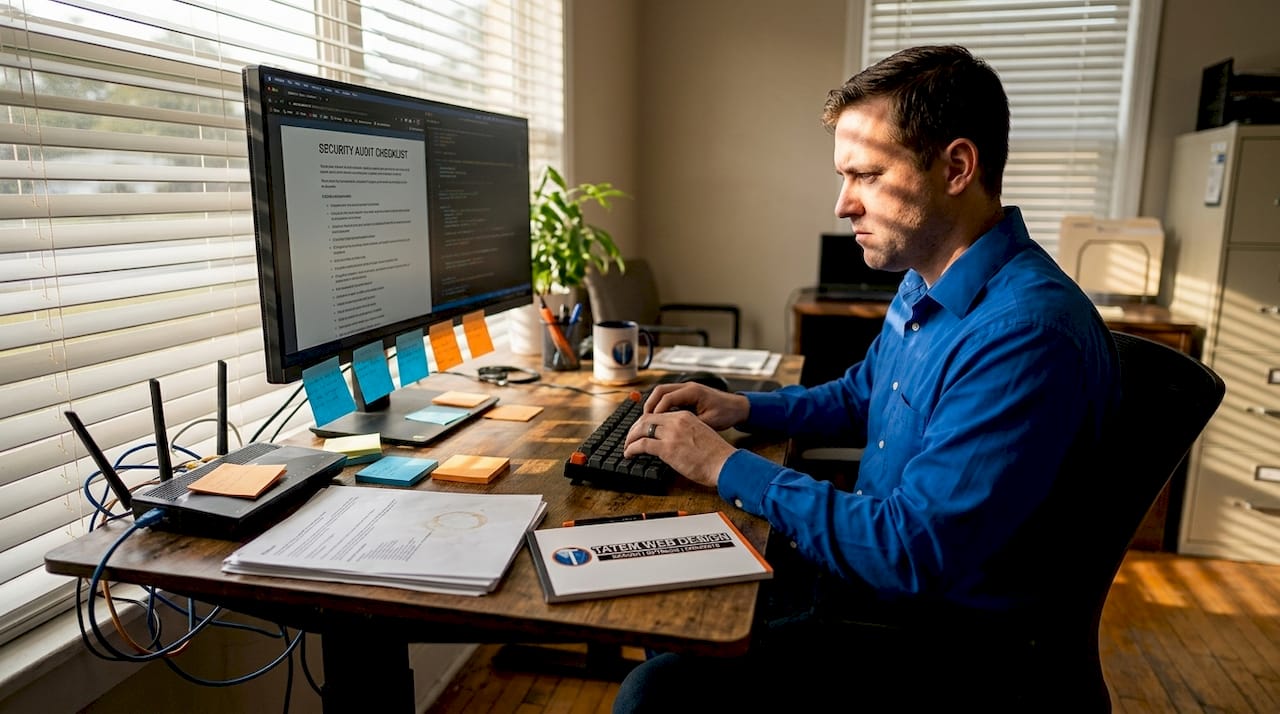
Pro Tip: Ask your web developer for a security audit checklist before any project kicks off. If they can’t provide one, that’s a signal to look elsewhere. Any serious custom development partner should conduct vulnerability assessments, test for SQL injection risks, and verify HTTPS configurations before your site goes live.
You can review specific website technical improvements that address these security requirements directly for Florida-based businesses.
With security covered, Florida businesses are also looking to stay competitive. For many, that means leveraging AI-driven customer engagement.
AI-powered features: The edge over your competitors
The phrase “AI-powered website” gets used loosely, but what it means in practical terms is a site that works for your business around the clock, learns from user behavior, and delivers a more relevant experience to every visitor. Template websites can’t do that. They’re static by nature, and even the most advanced templates offer only surface-level integrations that don’t adapt to your specific business context.
Custom web design allows you to build AI functionality into the core of your site, not bolt it on as an afterthought. Gartner projects AI personalization will define 80% of online experiences by 2026, which means businesses still running static template sites will fall measurably behind in customer engagement.
Here’s what that looks like for a Florida business in practical terms:
- AI chatbots for 24/7 intelligent support: A dental practice in Stuart, Florida, can use an AI chatbot to answer patient questions about procedures, office hours, and insurance at 2 a.m., capturing appointments that would otherwise be lost.
- Personalized content delivery: An e-commerce store selling marine equipment to Treasure Coast boat owners can show different product recommendations based on whether a visitor came from a fishing forum or a yacht club newsletter.
- RAG chatbots (Retrieval-Augmented Generation): These go beyond simple scripted responses. RAG chatbots pull from your actual business content, FAQs, service descriptions, and product catalogs to deliver accurate, contextual answers. They’re essentially a trained customer service representative available every hour of every day.
- AI lead capture tools: Instead of a simple contact form, a custom site can use AI to qualify leads in real time, asking follow-up questions based on what a visitor clicked on and routing high-priority inquiries directly to your sales team.
Custom AI website features vs. template limitations
| Feature | Custom AI website | Generic template |
|---|---|---|
| 24/7 intelligent chatbot | Full integration | Limited or unavailable |
| Personalized user experience | Behavior-based | Static for all users |
| RAG chatbot for FAQs | Yes, trained on your content | No |
| AI lead scoring | Integrated | Not available |
| Custom AI workflow automation | Tailored to your business | Not possible |
| Integration with AI agents | Yes (OpenClaw, NemoClaw, etc.) | No |
These aren’t features reserved for enterprise companies with massive technology budgets. With the right development partner, Florida SMBs can access the same caliber of AI website features that larger brands use to dominate their markets.
Pro Tip: Start with a single AI tool, whether that’s a chatbot, an AI lead capture form, or a personalized content feed, and measure its impact over 90 days before expanding. Incremental AI integration gives you data to justify each next step and avoids overwhelming your team with too many new systems at once.
With security and AI addressed, the next critical area is visibility. Specifically, outranking local competitors in Florida’s search results.
Local SEO dominance: Be found first in Florida
A beautifully designed website with strong AI features still fails if no one finds it. For Florida SMBs, local SEO is the mechanism that turns your website into a lead-generation engine. Template websites treat SEO as a checklist: add a meta description, use a keyword, done. Custom websites treat SEO as architecture, building it into every layer of the site from the ground up.
Custom websites allow precise local SEO optimization in ways that template platforms simply cannot match. Here’s what that precision looks like in practice.
A real estate agency in Stuart, Florida, doesn’t just need to rank for “real estate.” They need to rank for “waterfront homes for sale in Martin County,” “Jensen Beach real estate agent,” and “Hutchinson Island condos.” A custom site can be structured with dedicated landing pages, URL hierarchies, and schema markup (structured data that helps Google understand your content) targeting each of those specific searches. A template site forces you to work within the platform’s preset URL and page structure, limiting how granular you can get.
Here are the core local SEO steps that custom web design makes possible:
- Build location-specific landing pages for each city or neighborhood you serve, with unique content, local imagery, and customer reviews from that area.
- Implement schema markup for local business, including your name, address, phone number, and service area, helping Google display rich results like maps and star ratings.
- Integrate Google My Business data directly into your site so your hours, reviews, and contact information stay consistent across every platform.
- Optimize Core Web Vitals, the performance metrics Google uses to rank pages, including loading speed, interactivity, and visual stability.
- Build an internal linking structure that guides users and search engines through your service pages logically, signaling authority on your key topics.
- Use AI-enhanced SEO tools to identify emerging local search trends and automatically update content to reflect what Florida customers are actively searching for.
Local SEO performance comparison
| SEO factor | Custom website | Template website |
|---|---|---|
| City-specific landing pages | Unlimited, fully custom | Limited by platform |
| Schema markup control | Full | Partial or plugin-dependent |
| Core Web Vitals optimization | Built-in from the start | Constrained by template code |
| Google My Business integration | Seamless | Manual or third-party plugin |
| AI-driven content updates | Automated | Not available |
Pro Tip: Your NAP (Name, Address, Phone number) must be identical everywhere it appears, whether on your website, Google My Business, Yelp, or local Florida directories. Even a slight variation like “St.” versus “Street” can confuse search engines and hurt your local ranking. Review every listing at least once per quarter.
For Florida businesses ready to build on this foundation, our local SEO tips for Stuart, Florida businesses walk through specific strategies for the Treasure Coast market. If you’re evaluating broader local SEO services across the state, or want to understand how AI SEO optimization for Florida businesses is changing the competitive landscape in 2025 and beyond, those resources offer practical next steps.
After discussing reach, let’s highlight how technical performance and future-proofing set custom sites apart.
Technical performance and growth: Built for speed and scalability
Speed isn’t just a user experience concern. It’s a ranking factor, a conversion driver, and a signal of professionalism. A site that loads in under two seconds converts significantly better than one that takes four, and Google’s Core Web Vitals algorithm actively penalizes slow sites in search rankings. Template websites, packed with third-party plugins, bloated theme files, and generic code, struggle to meet these benchmarks without significant custom optimization work anyway.
Custom websites are built lean. Every element serves a purpose, and nothing runs in the background that your site doesn’t actually need. This results in faster load times, better Core Web Vitals scores, and a smoother experience on mobile devices where most Florida customers are browsing.
Agile development with sprints, discovery phases, wireframes, and QA testing controls scope creep and keeps custom projects on track. A headless CMS (Content Management System) architecture also allows your site to scale as your business grows without requiring a full redesign. In simple terms, a headless CMS separates your content from your site’s display layer, making it easy to add new features, sections, or even entirely new digital experiences without rebuilding from scratch.
Here’s why this matters for your Florida business over time:
- Lower long-term costs: You’re not paying for plugin licenses, premium theme upgrades, or costly emergency fixes when a template’s core code breaks.
- Faster feature launches: Adding a new service page, booking system, or product category takes hours instead of weeks because the architecture already supports it.
- Multi-channel flexibility: A headless CMS lets your content appear on your website, mobile app, and digital kiosk from a single source of truth.
- No forced migrations: Template platforms routinely sunset versions, forcing expensive emergency upgrades. Custom sites evolve on your schedule.
Performance comparison: Custom vs. template
| Performance factor | Custom website | Template website |
|---|---|---|
| Core Web Vitals compliance | Built-in | Often requires plugins |
| Mobile optimization | Tailored | Responsive but generic |
| Load time control | Full | Limited by theme code |
| Scalability | Headless CMS-ready | Platform-constrained |
| Feature addition speed | Fast | Dependent on plugin availability |
Pro Tip: Plan for scalability during the discovery phase of your custom web project, before a single line of code is written. Decisions about database architecture, CMS selection, and third-party API integrations are far cheaper to make on a whiteboard than after launch. Businesses that skip this step often face costly migrations within two to three years.
You can explore specific professional website services that incorporate these performance principles into every project we take on for Florida businesses.
All these technical and strategic advantages lead to a final question: Is custom web design always worth it, or are there cases where the investment isn’t justified?
When to choose custom versus template: A business-driven decision
Honesty matters here. Not every Florida business needs a fully custom website right now. A solo accountant with a five-page site, no e-commerce functionality, and a stable client base may get acceptable results from a well-configured template in the short term. Templates are faster to launch, lower in upfront cost, and manageable without a development team.
But the moment your business needs to grow online, accept payments, integrate AI tools, or compete in a market where other businesses are investing seriously in their digital presence, the template ceiling becomes very visible very quickly.
Custom websites enable precise UX optimization and Core Web Vitals compliance, but they’re most essential for businesses with growth goals, AI integration needs, or competitive local markets. That description fits the vast majority of Florida SMBs in healthcare, legal services, real estate, marine industries, and professional services.
Custom vs. template: Full comparison
| Consideration | Custom website | Template website |
|---|---|---|
| Upfront cost | Higher | Lower |
| Long-term cost | Lower with scalability | Higher (plugins, migrations) |
| Security | Tailored and robust | Shared vulnerability risk |
| AI integration | Full capability | Limited or unavailable |
| Local SEO control | Precise and unlimited | Platform-constrained |
| Scalability | Built for growth | Limited by platform |
| Launch timeline | 6 to 16 weeks | Days to 2 weeks |
| Unique user experience | Fully tailored | Generic without heavy customization |
When templates may be adequate:
- You have a static informational site with no interactive features
- You’re testing a new business idea with minimal initial investment
- You serve a very narrow niche with little local competition
- You have no plans to add e-commerce, booking systems, or AI tools
When custom is the clear choice:
- You serve clients who expect a professional, high-trust digital experience (healthcare, legal, financial)
- You’re competing in a dense Florida market where local SEO ranking directly impacts revenue
- You need AI chatbots, lead capture tools, or personalized content to engage visitors
- Your business is growing and your site needs to grow with it
“For any Florida business serious about digital growth, a custom website isn’t a luxury. It’s the infrastructure that makes every other marketing investment perform better.”
For a closer look at how Hutchinson Island web design can serve businesses along Florida’s Treasure Coast with a custom approach, that page offers region-specific context worth reviewing.
Why Florida businesses should rethink ‘just good enough’ web design
After more than 26 years working with Florida businesses across real estate, healthcare, legal services, marine industries, and professional services, we’ve seen the same pattern repeat itself. A business owner chooses a template to save money and time. The site looks acceptable at launch. Then, six months in, the cracks appear: a security incident, poor search rankings, a competitor’s AI chatbot capturing leads they should have won, or a site that breaks under traffic when a seasonal marketing campaign goes live.
The uncomfortable truth is that most “save money now” template decisions end up costing more in the long run. Not just in emergency IT bills or developer fees to patch template limitations, but in lost customers who landed on a competitor’s faster, more trustworthy, more responsive custom site and never came back. You can’t recover those missed engagements on a spreadsheet.
Here’s what we see most often overlooked. Florida SMBs underestimate how much a site’s perceived trustworthiness affects conversion rates. Customers in healthcare and legal services in particular make split-second judgments about credibility based on site design, load speed, and whether the experience feels polished. A template that looks like a hundred other sites signals “generic,” and generic doesn’t win high-value clients.
The businesses that thrive digitally in Florida’s competitive markets treat their website as their most important sales asset, not an administrative task to complete and forget. That means investing in AI-driven web design that keeps working after launch through personalization, automated lead capture, and AI-enhanced SEO, rather than a static page that needs a full redesign every three years just to stay current.
The businesses that tried to cut corners early are the same ones calling us later for emergency rebuilds, often at two to three times the cost of doing it right the first time. Build with intention, plan for growth, and choose a web partner who treats security, performance, and AI integration as foundations, not optional add-ons.
Get expert custom web design and AI solutions for your Florida business
If the insights in this article resonated with where your business is right now, or where you want it to be, the next step is a conversation with a team that has built custom sites for Florida businesses across every major industry.
At Tatem Web Design, we specialize in AI website design services that go far beyond aesthetics. From intelligent chatbots and AI lead capture to full-scale e-commerce and compliance-ready architectures, we build sites that work as hard as you do. Our AI security enhancements protect your business and your customers’ data from day one. And our end-to-end comprehensive website services cover everything from strategy and design through launch and ongoing optimization. Call us directly at 772-224-8118 to schedule your custom consultation and find out exactly what a purpose-built website can do for your Florida business.
Frequently asked questions
How long does a custom web design project usually take for Florida businesses?
A custom web design project typically takes 6 to 16 weeks, depending on scope, complexity, and the number of integrations like AI tools, e-commerce, or booking systems involved.
Can custom web design really improve my business’s security?
Yes. Custom web design avoids template vulnerabilities by building unique code structures with tailored firewalls, encrypted data handling, and role-based access controls that shared templates can’t provide.
Why is local SEO integration better with custom websites?
Custom websites enable precise optimization for Florida-specific search terms, Google My Business integration, and city-level landing pages that generic templates can’t replicate without major workarounds.
Are AI-powered features only available in custom web design?
Advanced AI features like RAG chatbots and user personalization are most effectively implemented in custom websites because they require deep integration with your business data, workflows, and content, something generic templates aren’t built to support.
Recommended
Tatem Web Design
26+ YearsWeb Design & SEO Specialist · Tatem Web Design
Matt Tatem has been designing websites professionally since 1999, making Tatem Web Design one of Florida's longest-running web agencies. Based in Stuart, FL, he specializes in WordPress, local SEO, Shopify e-commerce, and cybersecurity consulting for small businesses.
What a CMMC Level 2 Assessment Requires and How to Prepare
Prepare for your CMMC Level 2 assessment by understanding requirements, assessment paths, and mapping your Controlled Unclassified Information.
A Data Retention Policy Is Your Rulebook for Keeping and Deleting Data
Establishing a clear data retention policy helps manage data risk, ensuring compliance and effective data management for your organization.
Law Firm Local SEO: A Practical Playbook for More Local Clients
Unlock more local clients for your law firm with effective local SEO strategies. Optimize your Google Business Profile and boost your visibility!