
E-Commerce Optimization: A Profit-First Guide for Managers
E-commerce optimization is the continuous, data-driven process of improving every part of an online store to maximize true profit and customer engagement across acquisition, conversion, and retention. Most store owners focus on sales volume and miss the bigger picture. Real optimization means making better decisions at every stage of the customer journey, from the first Google search to the fifth repeat purchase. Mobile devices account for over 50% of total online shopping traffic, which means your store’s performance on a phone screen is no longer optional. The industry term for this practice is conversion rate optimization, or CRO, though true e-commerce optimization extends well beyond CRO into pricing, inventory, SEO, and customer retention.
What is e-commerce optimization and why does it matter?
E-commerce optimization is defined as the systematic use of data, testing, and operations research to improve an online store’s performance across four interconnected layers: acquisition, intent, conversion, and retention. Each layer represents a distinct stage in the customer lifecycle. Treating them as separate projects is one of the most expensive mistakes a store owner can make.
Acquisition covers how customers find your store through organic search, paid ads, social media, and referrals. Intent covers what happens when they arrive: do your product pages, navigation, and content match what they were looking for? Conversion is the moment a visitor becomes a buyer. Retention is everything that brings them back.

The goal is not to maximize gross merchandise value, or GMV. Optimizing for true profit rather than raw sales volume is the correct objective, because modern e-commerce costs including platform fees, ad spend, and fulfillment costs mean more sales do not automatically mean more profit. A store selling 1,000 units at a 2% margin after fees may be less profitable than one selling 600 units at a 12% margin.
For e-commerce managers and small business owners, this distinction changes every decision you make about pricing, ad budgets, and product mix.
What are the key layers and techniques in e-commerce optimization?
Each of the four layers has its own goals, metrics, and methods. The table below maps them clearly.
| Layer | Primary Goal | Core Techniques |
|---|---|---|
| Acquisition | Drive qualified traffic | SEO, paid search, content marketing, social ads |
| Intent | Match visitor expectations | UX design, product page clarity, site search |
| Conversion | Turn visitors into buyers | CRO, checkout optimization, social proof |
| Retention | Increase repeat purchases | Email marketing, loyalty programs, personalization |
The acquisition layer depends heavily on SEO. SEO in e-commerce involves keyword targeting, site structure, product descriptions, and metadata to improve organic visibility without paying for every click. Strong product page SEO is one of the highest-return investments a small store can make.
The intent layer is where most stores quietly lose money. A visitor who lands on a confusing product page or a slow-loading category page leaves without buying. Slow-loading sites lose customers before a purchase even enters their mind. Speed and clarity at this stage directly protect your ad spend.
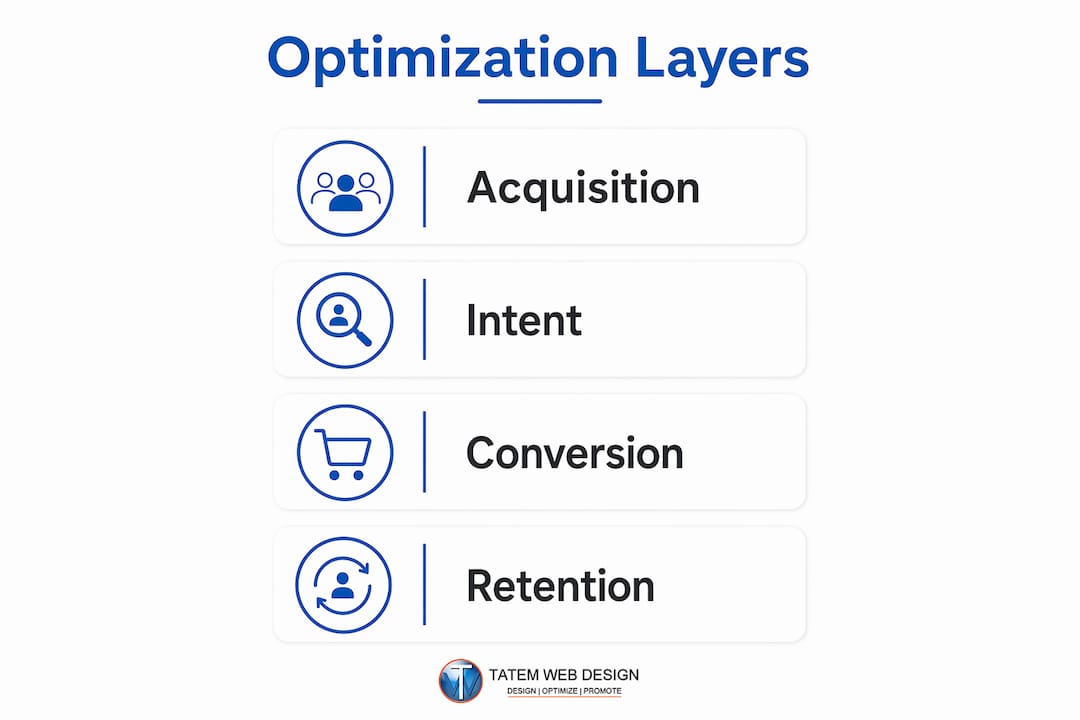
The conversion layer is where CRO techniques like A/B testing, strong calls to action, and social proof do their work. Customer reviews and testimonials reduce purchase anxiety and directly increase the likelihood of a completed order. The retention layer closes the loop. Loyal customers cost less to re-engage than new customers cost to acquire, making retention the highest-margin layer of the four.
Pro Tip: Treat your four optimization layers as a single system. A fix in acquisition that drives unqualified traffic will hurt your conversion rate, even if your product pages are excellent.
A unified commerce strategy connects all business systems so that optimization decisions apply consistently across your website, mobile app, and any physical retail presence. This is the direction serious e-commerce operations are moving, and it is worth building toward from the start.
How does operations research apply to e-commerce profit maximization?
Operations research, or OR, is the mathematical discipline behind true e-commerce optimization. It applies data models and algorithms to select the best possible decision under real constraints like budgets, inventory limits, and competitive pricing. E-commerce optimization is fundamentally an operations research discipline that uses these models to maximize profit rather than surface metrics.
This matters in practice because every store faces constraints. Your ad budget is finite. Your warehouse has limits. Your pricing affects both demand and margin simultaneously. OR models help you find the combination of decisions that produces the best outcome given all of those constraints at once, rather than optimizing each variable in isolation.
Here is what OR-informed thinking changes for e-commerce managers:
- Pricing decisions: Setting prices to maximize margin per unit, not just to win the most sales.
- Inventory planning: Stocking the right products in the right quantities to avoid both stockouts and overstock costs.
- Ad spend allocation: Distributing budget across channels based on true return on ad spend, not just click volume.
- Product mix: Prioritizing products with the best contribution margin, not just the highest revenue.
“Managers should optimize for true profit, not simply sales volume, given complex cost structures including fees and ad spend.” — DataGlass Labs
The practical implication is that you need clean data before you can apply any of these models. If you do not know your actual cost per acquisition, your platform fees, and your fulfillment cost per order, you are making pricing and budget decisions without the information needed to make them correctly. Start by building a simple profit and loss view at the product level. That single step separates stores that grow profitably from those that grow themselves into cash flow problems.
What practical techniques can small businesses implement right now?
Practical e-commerce optimization does not require a data science team. The techniques below are ordered by impact and accessibility for store owners working with limited resources.
-
Fix your mobile experience first. Mobile devices drive more than half of all online shopping traffic. Responsive design best practices cover touch-friendly navigation, readable font sizes, and fast load times on cellular connections. If your store is hard to use on a phone, you are losing the majority of your potential customers before they reach your product pages.
-
Cut friction from your checkout. Cart abandonment rates exceed 70% across e-commerce broadly. That means for every 10 shoppers who add something to their cart, 7 leave without buying. Reducing form fields, offering guest checkout, and displaying trust signals at the payment step are the fastest ways to recover that lost revenue.
-
Optimize your product pages for search. Use specific, long-tail keywords in product titles and descriptions. Write descriptions that answer the questions a buyer would actually ask. Add structured data markup so search engines can display your products in rich results. This is the foundation of organic traffic growth.
-
Run A/B tests on your highest-traffic pages. A/B testing lets you compare two versions of a page element, such as a call-to-action button color, headline, or image, to see which one produces more conversions. Start with your homepage and your top product pages. Even small improvements compound over time.
-
Add social proof at the point of decision. Place customer reviews, star ratings, and user-generated photos directly on product pages, not just on a separate reviews tab. Buyers make faster decisions when they see evidence that others have bought and been satisfied.
-
Use email to drive repeat purchases. A post-purchase email sequence that delivers order confirmation, shipping updates, and a follow-up with related products costs almost nothing to set up and consistently outperforms paid acquisition in return on investment.
-
Monitor your site speed monthly. Page load time affects both your search ranking and your bounce rate. Tools like Google PageSpeed Insights give you a free audit with specific fixes. A one-second improvement in load time can produce a measurable lift in conversions.
Pro Tip: Do not try to fix everything at once. Pick the one layer where you are losing the most customers, fix it completely, measure the result, and then move to the next. Scattered effort produces scattered results.
How do you measure the benefits of e-commerce optimization?
Measurement is what separates optimization from guessing. The e-commerce conversion rate is the percentage of site visitors who complete a purchase. It is the single most watched metric in CRO, and for good reason. A conversion rate improvement of even half a percentage point on a store with meaningful traffic translates directly into more revenue without spending more on ads.
The table below shows the KPIs that matter most and what each one tells you.
| KPI | What It Measures | Why It Matters |
|---|---|---|
| Conversion rate | Buyers divided by total visitors | Measures overall store effectiveness |
| True profit per order | Revenue minus all costs per transaction | Reveals actual business health |
| Cart abandonment rate | Carts created but not completed | Identifies checkout friction |
| Repeat purchase rate | Customers who buy more than once | Measures retention effectiveness |
| Customer acquisition cost | Total ad spend divided by new customers | Shows efficiency of acquisition layer |
Beyond the table, the most useful habit is building a weekly reporting view that shows these metrics together. When conversion rate drops while traffic holds steady, the problem is on-site. When traffic drops while conversion rate holds, the problem is in acquisition. Seeing the metrics side by side makes the diagnosis faster.
Avoid the common trap of reporting only on revenue. Revenue growth that comes with rising acquisition costs and falling margins is not a success. Improving online sales performance means growing profit, not just the top line. Build your reporting around true profit per order and you will make better decisions every week.
Key Takeaways
E-commerce optimization produces lasting profit growth only when it targets all four layers, acquisition, intent, conversion, and retention, using data-driven decisions rather than isolated fixes.
| Point | Details |
|---|---|
| Optimize for true profit | Maximizing sales volume without tracking costs leads to unprofitable growth. |
| Four layers work together | Fixing one layer in isolation without the others produces limited and often misleading results. |
| Mobile experience is non-negotiable | Over 50% of shopping traffic is mobile; a poor phone experience kills conversions before they start. |
| Cart abandonment exceeds 70% | Checkout friction is the single largest recoverable revenue loss for most stores. |
| Measure conversion rate and profit together | Conversion rate alone does not show business health; pair it with true profit per order. |
What I have learned from watching stores optimize the wrong things
After years of working with e-commerce businesses of all sizes, the pattern I see most often is this: store owners invest heavily in acquisition and almost nothing in the other three layers. They spend thousands on Google Ads, drive traffic to a slow, confusing product page, watch 70% of interested buyers abandon their carts, and then conclude that ads do not work. The ads worked fine. The store did not.
The second most common mistake is treating optimization as a project rather than a process. A store will hire someone to redesign the checkout, see a lift in conversions, and then stop testing. Six months later, a competitor has iterated past them. The stores that grow consistently are the ones running A/B tests every month, reviewing their KPIs every week, and treating every data point as a question worth answering.
The insight that changes everything for most managers is the shift from GMV thinking to true profit thinking. When you start measuring profit per order instead of revenue, your entire decision-making framework changes. You stop chasing volume and start chasing margin. You cut products that look good on a revenue report but drain your cash. You allocate ad spend to the channels that produce profitable customers, not just cheap clicks.
The businesses I have seen grow most reliably are the ones that combine OR-informed decision-making with genuine attention to user experience. The math tells you where to focus. The UX work makes the fix actually work for real customers. Neither one alone is enough.
— Matt
How Tatemweb builds e-commerce stores designed to convert
If you are ready to put these principles into practice on a store built to perform from day one, Tatemweb’s AI-powered e-commerce design service is built for exactly that. Tatemweb has over 26 years of experience designing and building online stores for Florida businesses across retail, healthcare, legal, and professional services.
Every store Tatemweb builds includes mobile-first responsive design, fast-loading architecture, SEO-ready product page structure, and optimized checkout flows. The team also integrates AI chatbots and lead capture tools to keep visitors engaged and moving toward purchase. Call Tatemweb directly at 772-224-8118 to schedule a consultation and find out what a properly optimized store can do for your bottom line.
FAQ
What is e-commerce optimization in simple terms?
E-commerce optimization is the ongoing process of improving your online store to increase profit and customer engagement through data-driven changes to design, content, pricing, and checkout.
What is the most important e-commerce optimization technique?
Checkout optimization delivers the fastest measurable return because cart abandonment rates exceed 70%, meaning most stores have significant recoverable revenue sitting in incomplete orders.
How do I calculate my e-commerce conversion rate?
Divide the number of completed purchases by the total number of site sessions, then multiply by 100. A result of 2% means 2 out of every 100 visitors complete a purchase.
Why should I optimize for profit instead of sales volume?
Platform fees, ad spend, and fulfillment costs mean that more sales do not guarantee more profit. Optimizing for true profit per order gives you an accurate picture of business health.
How does mobile design affect e-commerce performance?
Mobile devices account for over 50% of online shopping traffic. A store that loads slowly or is hard to navigate on a phone loses the majority of potential buyers before they reach the product page.
Recommended
Tatem Web Design
26+ YearsWeb Design & SEO Specialist · Tatem Web Design
Matt Tatem has been designing websites professionally since 1999, making Tatem Web Design one of Florida's longest-running web agencies. Based in Stuart, FL, he specializes in WordPress, local SEO, Shopify e-commerce, and cybersecurity consulting for small businesses.

Rank in ChatGPT in 90 Days With a Practitioner Led Checklist
Follow a practitioner led 90 day plan to get cited by ChatGPT: allow OAI-SearchBot, publish short answer capsules with schema, and track Bing AI Performance.

AI SEO Content Playbook: 16 GEO Signals for Agencies & Teams
A practical playbook mapping the GEO-16 signals to hands-on editorial workflows, review controls, and metrics. For agencies and in-house teams scaling AI...

Copy Ready Local Schema Markup for SMBs + Google Validation
Copy ready JSON-LD examples and Google validation steps for SMBs' local schema markup. Audit, implement, and verify each location page with confidence.