
Why Florida Data Privacy Law’s $1B Rule Still Risks Small Firms
The Florida Digital Bill of Rights (FDBR), enacted as SB 262 and codified at Fla. Stat. §§ 501.701 to 501.722, took effect on July 1, 2024. It mainly binds large “controllers”: for-profit companies doing business in Florida that make over $1 billion in global gross revenue and meet one of three business-model tests. Consumers get rights to access, correct, delete, and port their data, plus targeted opt-outs, while the Florida Department of Legal Affairs can levy civil penalties up to $50,000 per violation, tripled in certain cases.
TL;DR:
- Companies must meet multiple criteria, including being a for-profit, having over $1 billion revenue, and targeting Florida residents, to fall under the controller definition; small businesses sharing sensitive data are still subject to certain obligations.
- Consumers can exercise rights to access, correct, delete, and port their data within 45 days, with verification procedures requiring reasonable identity checks and limits on the number of free requests.
- Controllers must provide detailed privacy notices, implement data minimization, conduct regular data protection assessments, and establish secure, accessible methods for handling consumer requests.
- Sharing biometric, geolocation, race, health, or biometric data with third parties triggers additional disclosure and opt-out requirements for all organizations, regardless of size.
- Enforcement by the Florida Department of Legal Affairs involves fines up to $50,000 per violation, tripled in cases involving children or continued non-compliance, with most actions occurring within the first six months of law enforcement.
Table of Contents
- What Is Florida’s Data Privacy Law and Who Does It Cover?
- What Rights Do Florida Consumers Have Under the FDBR?
- What Do Controllers Have to Do to Comply With Florida Privacy Regulations?
- How Does the FDBR Interact With HIPAA, FIPA, and Rules for Minors?
- Who Enforces Florida’s Privacy Law and What Are the Penalties?
- Building a Florida Data Privacy Compliance Checklist
- How to Submit a Data Privacy Request in Florida
- Why Tatem Web Design Understands Florida’s Compliance Pressure
- Where to Read Florida’s Digital Bill of Rights Directly
- The Real Compliance Priority Most Businesses Get Backwards
- Sources
- FAQ
What Is Florida’s Data Privacy Law and Who Does It Cover?
Most Florida business owners hear “new privacy law” and brace for another compliance headache on the scale of the EU’s GDPR. The reality is narrower, and that distinction matters for anyone trying to figure out where to spend their compliance budget.
The FDBR’s controller test, spelled out in Fla. Stat. § 501.702, applies only to a for-profit entity that:
- Conducts business in Florida or produces products/services targeted to Florida residents.
- Collects personal data about consumers, either alone or with others.
- Determines the purpose and means of processing that data.
- Makes more than $1 billion in global gross annual revenue.
- Satisfies at least one of three business-model prongs.
Those three prongs are specific by design. That combination of revenue and business model was written to capture major ad-tech platforms, voice assistant providers, and app marketplaces, not the corner accounting firm or regional medical practice.
The statute also folds in affiliates. If a parent company controls a subsidiary, meaning it holds majority ownership or the power to direct the subsidiary’s management, the subsidiary’s data practices can be pulled into the same controller analysis. This prevents a billion-dollar tech company from spinning off a smaller entity purely to dodge the revenue threshold.
Here is the part most Florida SMBs miss: falling outside the core controller definition doesn’t mean the FDBR ignores you entirely. Separate provisions in the statute apply more broadly to any for-profit entity that sells sensitive personal data of Florida residents, regardless of revenue. A dental practice, a real estate brokerage, or a marine services company that shares biometric or precise geolocation data with a third party for money faces disclosure and consent obligations even without hitting the $1 billion threshold. Understanding which bucket your organization falls into is the first real compliance decision, and it shapes everything that follows.
What Rights Do Florida Consumers Have Under the FDBR?
Florida consumers can now exercise five core rights against controllers, plus two opt-outs unique to the state’s approach. Understanding the mechanics behind each one matters more than memorizing the list, because the deadlines and authentication rules are where businesses actually get tripped up.
- Right to confirm and access. Consumers can ask whether a controller is processing their personal data and get access to that data.
- Right to correct. Consumers can request correction of inaccuracies in their personal data.
- Right to delete. Consumers can request deletion of personal data provided by or obtained about them.
- Right to data portability. Consumers can obtain a copy of their data in a portable, readily usable format for transfer elsewhere.
- Right to opt out. Consumers can decline targeted advertising, the sale of personal data, and certain profiling used in decisions with legal or similarly significant effects.
Florida adds two opt-outs that go beyond what several other state privacy laws require, according to the FDBR’s statutory rights described in the bill text. Consumers can opt out of the collection of sensitive data, a category that includes precise geolocation, and they can separately opt out of data collected through voice or facial recognition features. Sensitive data under the statute also covers information about race, religion, health diagnoses, sexual orientation, citizenship status, and genetic or biometric data used for identification.
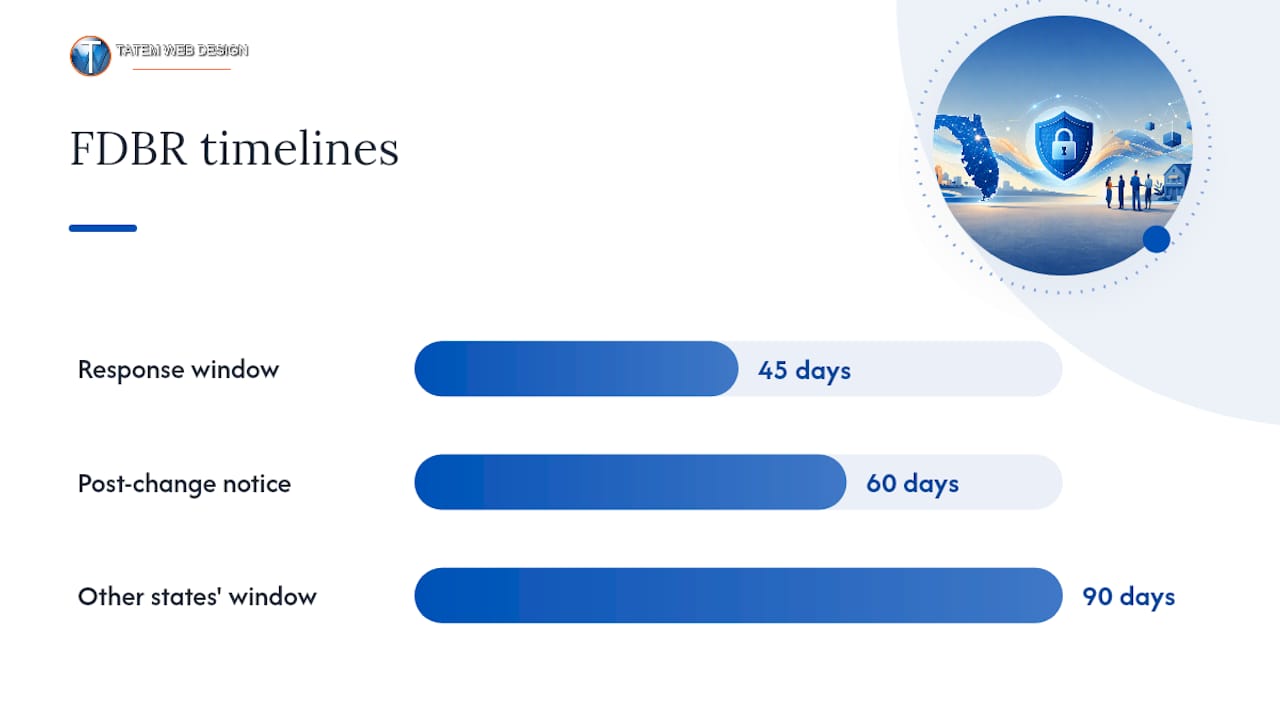
Controllers have up to around a month and a half to respond to a verified consumer request, with a shorter extension possible when reasonably necessary and the consumer is notified of the delay. If a controller declines to act, it must notify the consumer within the same window and explain why, and the consumer can appeal that denial. Once a controller changes a practice to comply, it has 60 days to provide notice to affected consumers.
Authentication matters here. Controllers can’t just hand over data to anyone who emails asking for it. They’re expected to use commercially reasonable methods to verify identity before fulfilling access or deletion requests, and the 45 day window is notably shorter than the 90-day period some other state privacy laws allow, which means request-handling workflows need to move faster than teams accustomed to other states might expect. Consumers get two free requests per 12-month period; beyond that, or for requests that are manifestly unfounded or excessive, controllers may charge a reasonable fee or decline to act.
What Do Controllers Have to Do to Comply With Florida Privacy Regulations?
Rights on paper mean nothing without operational duties on the controller side, and this is where the FDBR gets specific about documentation. Every covered controller needs a privacy notice that goes further than a generic “we value your privacy” paragraph.
The notice must disclose the categories of personal data collected, the purposes for processing, whether data is sold or shared with third parties, and, critically, separate disclosures when sensitive or biometric data is sold. A Florida statute amendment tied to SB 262 also explicitly pushed privacy notice requirements to cover the sale of sensitive personal data, so a generic disclosure buried in paragraph twelve of a privacy policy won’t satisfy the requirement.
Beyond notices, controllers face four operational duties:
- Data minimization. Collect only what’s reasonably necessary for the disclosed purpose, not everything the business could conceivably use someday.
- Data protection assessments. Conduct and document a DPIA before engaging in targeted advertising, profiling with legal effects, selling sensitive data, or other processing that presents heightened risk to consumers.
- Reasonable security practices. Maintain administrative, technical, and physical safeguards appropriate to the volume and sensitivity of data held.
- Consumer request mechanisms. Offer at least two methods for consumers to submit requests, and if the controller operates a website, one method must be through that site.
Pro Tip: Treat your DPIA process as a living document, not a one-time compliance exercise. Update it whenever you add a new ad tech vendor, launch a new data-sharing partnership, or change how your website collects geolocation data. Auditors and the DLA both look for evidence of ongoing diligence, not a single dusty PDF from 2024.
Vendor contracts deserve their own line item. Controllers that share data with processors need contractual language requiring those processors to assist with deletion and portability requests, maintain confidentiality, and delete or return data once the relationship ends. A vendor onboarding checklist built around compliance-first principles is a useful starting point for building that contract language into new vendor relationships rather than retrofitting it later.
How Does the FDBR Interact With HIPAA, FIPA, and Rules for Minors?
The FDBR doesn’t operate in a vacuum, and the statute carves out several categories of data and business already governed by other frameworks.
- HIPAA and protected health information. Entities covered by HIPAA, along with the protected health information they handle, are exempt from most FDBR obligations, since a separate federal framework already governs that data.
- Florida Information Protection Act (FIPA) updates. SB 262 amended FIPA to add biometric data and geolocation to the definition of personal information for breach notification purposes, meaning a breach involving fingerprint data or precise location history now triggers the same notification duties as a breach of Social Security numbers.
- Minors and known children. The statute distinguishes between children under 13, teens under 18, and adults. Controllers that have actual knowledge a consumer is a minor face tighter restrictions on selling or using their data for targeted advertising, and parents or legal guardians can exercise rights on a known child’s behalf.
- COPPA overlap. Where the federal Children’s Online Privacy Protection Act already governs data collection from children under 13, that federal framework continues to apply alongside, not instead of, Florida’s rules.
Businesses juggling HIPAA-covered patient data alongside general consumer data, like a dental practice running both a HIPAA-compliant patient portal and a separate marketing website, need to track which data lives under which framework rather than assuming one compliance program covers everything.
Who Enforces Florida’s Privacy Law and What Are the Penalties?
The Florida Department of Legal Affairs, operating through the Attorney General’s office, holds exclusive enforcement authority under the FDBR. There is no private right of action, meaning individual consumers cannot sue a business directly for a violation. That authority sits solely with the state.
Civil penalties can reach $50,000 per violation under Fla. Stat. § 501.72, and that figure triples under specific aggravating circumstances: when the violation involves a known child, when a controller fails to delete or correct data after a verified request, or when a controller continues selling personal data after a consumer has opted out. Those tripling triggers are worth memorizing, because they target exactly the failure modes most likely to draw complaints in the first place.
The DLA has discretion, not an obligation, to grant a 45-day cure period before pursuing penalties, and it can decline that grace period entirely for repeat violations or cases involving known children. Businesses that document good-faith remediation efforts put themselves in a far better position if the DLA ever does open an inquiry.
Early Enforcement Signal: In the first six months after the law took effect, the DLA received 787 consumer inquiries and opened 24 initial inquiries into potential controllers. That volume shows Floridians are actively using the law, and it gives the DLA a real dataset to prioritize future enforcement targets.
Because FDBR violations are treated as unfair and deceptive trade practices, the public record of DLA actions functions as a preview of what draws scrutiny. Reviewing those enforcement patterns is a smarter use of a compliance team’s time than guessing.
Building a Florida Data Privacy Compliance Checklist
Compliance work gets done in phases, not all at once, and trying to tackle everything simultaneously usually means nothing gets finished properly. Here’s a sequence that works for most Florida organizations, whether you’re a likely controller or a smaller business dealing with the universal sensitive-data rules.
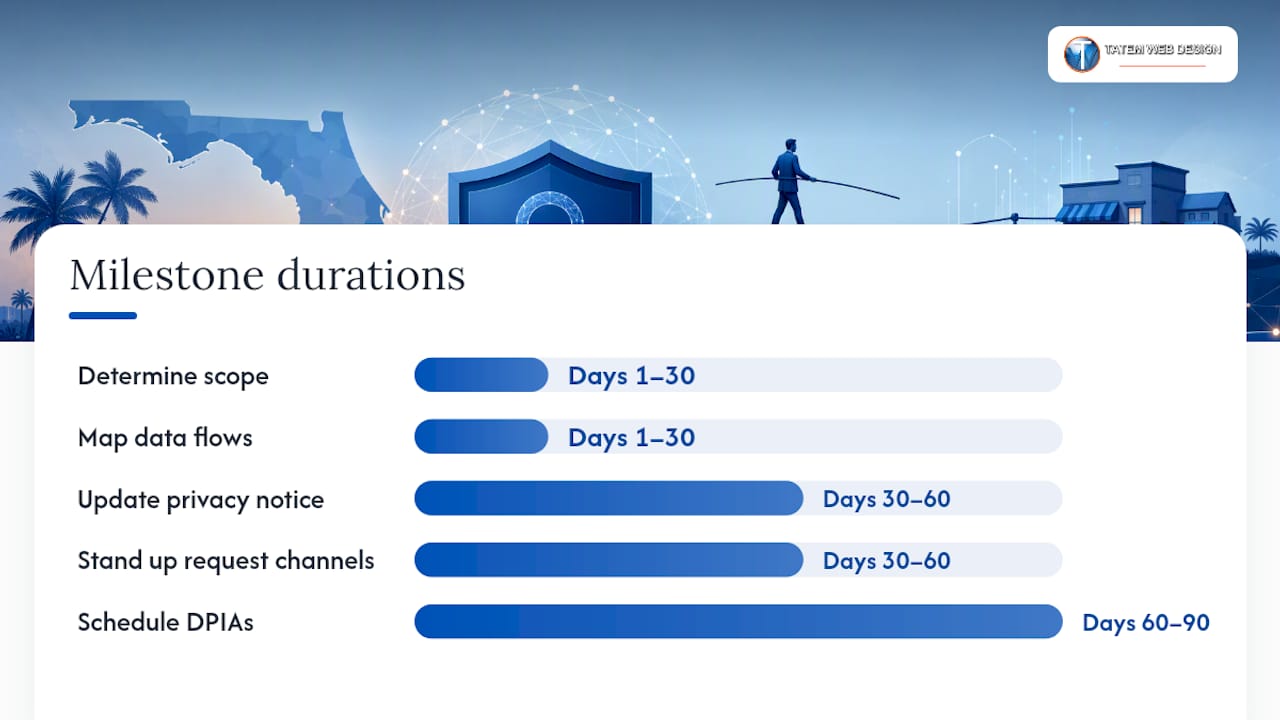
- Determine your scope (Days 1 to 30). Run the controller test against your actual revenue and business model. Separately, audit whether you sell sensitive or biometric data to any third party, since that triggers obligations regardless of size. Legal counsel should sign off on this determination in writing.
- Map your data flows (Days 1 to 30). Inventory every category of personal data you collect, where it’s stored, who it’s shared with, and why. This mapping exercise becomes the backbone of your privacy notice and your DPIA process.
- Update your privacy notice (Days 30 to 60). Rewrite disclosures to cover data categories, processing purposes, and separate sale disclosures for sensitive or biometric data. A clear, plainly written privacy notice is a useful model for the kind of readable disclosure language consumers actually understand, rather than dense legal boilerplate nobody reads.
- Stand up consumer-request channels (Days 30 to 60). Build at least two intake methods, including a website mechanism, and define your internal authentication and response workflow to fit inside the 45-day window.
- Schedule DPIAs for high-risk processing (Days 60 to 90). Document assessments for targeted advertising, profiling, and any sensitive-data sale before those activities continue, not after.
- Harden security controls (Days 60 to 90). Review administrative, technical, and physical safeguards against the volume and sensitivity of data you hold. This is where IT teams and outside consultants typically get involved.
- Update vendor contracts (Days 90 to 180). Require processors to support deletion, correction, and portability requests contractually, and confirm they’ll delete or return data at the end of the relationship.
- Train staff (Days 90 to 180). Anyone handling customer data, from sales to support to marketing, needs to understand the request process and the penalties for mishandling opt-outs.
- Update breach-notification procedures (Days 90 to 180). Since FIPA now includes biometric and geolocation data in its breach definitions, your incident response plan needs to reflect that broader scope.
Pro Tip: Assign a single owner to each milestone, not a committee. Compliance projects with a named accountable person move faster and produce cleaner documentation than initiatives spread across “the team.” When the DLA asks who’s responsible for a given control, you want a name, not a shrug.
Legal counsel should drive scope determination and contract language, compliance leads should own the DPIA schedule and training program, and IT should handle security controls, request-channel infrastructure, and breach-notification tooling. Smaller businesses without a dedicated compliance function often lean on an outside consultant to run steps one through six, then bring the work in-house once the framework is built.
How to Submit a Data Privacy Request in Florida
Exercising your rights under Florida’s consumer data rights framework doesn’t require a lawyer. Most requests can go through a company’s website or a listed privacy email address, and a short, specific message moves faster than a long one.
- Include identifying details. Give your full name, the email or account associated with the business, and a clear statement of which right you’re exercising, such as “I am requesting deletion of my personal data under the Florida Digital Bill of Rights.”
- Keep it brief. A one or two sentence request is easier to process than a lengthy narrative, and it reduces the chance a company flags it as unclear or excessive.
- Note the date. Track when you submitted the request, since the business has 45 days to respond, with one possible 15-day extension.
- Save everything. Keep copies of your request, any confirmation email, and the company’s eventual response in case you need to escalate.
If a business misses the deadline or denies your request without a clear explanation, you can appeal directly to the controller first. If that appeal fails, you can file a complaint with the Florida Department of Legal Affairs, since enforcement authority rests exclusively with that office rather than through a private lawsuit.
Why Tatem Web Design Understands Florida’s Compliance Pressure
A digital agency with extensive experience in Florida has provided compliance consulting work for HIPAA, CMMC Level 2, PII, and PCI requirements. That background matters here, because the operational steps the FDBR demands, privacy notice rewrites, data mapping, DPIA documentation, and security control hardening, are the exact same categories Tatem Web Design already builds for healthcare practices, legal offices, and government-adjacent organizations across Florida.
For a Florida business trying to translate statutory language into an actual website update, a working request-intake form, and a documented security posture, hands-on build experience can help close the gap between reading the law and actually complying with it. Businesses juggling HIPAA-covered patient data alongside general FDBR obligations often benefit from having both frameworks addressed in a coordinated manner rather than by disconnected vendors.
Where to Read Florida’s Digital Bill of Rights Directly
Reading the primary sources is worth the twenty minutes it takes. The CS/CS/SB 262 bill text on the Florida Senate’s website is the authoritative starting point, followed by Chapter 501, Section 72 of the Florida Statutes for the enforcement and penalty language specifically. The Department of Legal Affairs’ Digital Bill of Rights annual report offers the clearest picture of how enforcement is actually unfolding, and a broader compliance overview is available through PrivacyLawMap’s Florida guide for context on how the law compares to other states.
The Real Compliance Priority Most Businesses Get Backwards
Most coverage of the FDBR spends its energy on the $1 billion controller threshold, and that focus is understandable but a little misplaced for the audience actually reading articles like this one. If your Florida business clears a billion dollars in global revenue, you already have a legal team tracking this. The businesses that need to pay closer attention are the ones assuming the high revenue floor lets them ignore the law entirely.
It doesn’t. The universal sensitive-data sale rules and the FIPA breach-notification changes reach far smaller organizations, and that’s where the real exposure sits for a typical Florida small business. A marketing agency selling location data to an ad network, a wellness practice sharing biometric data with a third-party app, or a property manager passing geolocation data to a vendor can trigger obligations with zero regard for company size.
Prioritize your data-sharing agreements before you worry about DPIA templates. Know exactly what data leaves your organization and who receives it. That single audit will tell you more about your actual FDBR exposure than any generic checklist, including the one above.
— Matt
This article is general information, not a substitute for advice from a qualified lawyer. Consult a qualified legal professional about your own circumstances before acting on anything here.
Sources
- CS/CS/SB 262 bill text (HTML) — Florida Senate
- Florida Department of Legal Affairs — Digital Bill of Rights annual report (2025)
FAQ
What Are the Key Data Privacy Laws in Florida?
The primary law is the Florida Digital Bill of Rights (SB 262), effective July 1, 2024, alongside the older Florida Information Protection Act (FIPA), which SB 262 amended to add biometric and geolocation data to its breach-notification definitions.
Can Someone Record Me Without My Consent in Florida?
Florida is a two-party consent state for recording private conversations, meaning all parties generally must agree to an audio recording, though this recording-consent rule is a separate area of Florida law from the FDBR’s data privacy provisions.
Which US States Have Data Privacy Laws?
Florida joined a growing group of states with comprehensive consumer privacy statutes, and its FDBR is distinct from laws like California’s CCPA/CPRA due to its higher $1 billion revenue threshold and narrower controller test.
Can I Refuse to Show My ID in Florida?
Identification requirements depend on the specific situation, such as a traffic stop versus a general public encounter, and that question falls under Florida criminal and traffic law rather than the Digital Bill of Rights, which governs consumer data rights, not identification during law enforcement encounters.
Recommended
Tatem Web Design
26+ YearsWeb Design & SEO Specialist · Tatem Web Design
Matt Tatem has been designing websites professionally since 1999, making Tatem Web Design one of Florida's longest-running web agencies. Based in Stuart, FL, he specializes in WordPress, local SEO, Shopify e-commerce, and cybersecurity consulting for small businesses.

Rank in ChatGPT in 90 Days With a Practitioner Led Checklist
Follow a practitioner led 90 day plan to get cited by ChatGPT: allow OAI-SearchBot, publish short answer capsules with schema, and track Bing AI Performance.

AI SEO Content Playbook: 16 GEO Signals for Agencies & Teams
A practical playbook mapping the GEO-16 signals to hands-on editorial workflows, review controls, and metrics. For agencies and in-house teams scaling AI...

Copy Ready Local Schema Markup for SMBs + Google Validation
Copy ready JSON-LD examples and Google validation steps for SMBs' local schema markup. Audit, implement, and verify each location page with confidence.