
Real estate web design: Your AI-driven success guide
You built a website, paid someone to design it, and then waited for the leads to roll in. Months later, your phone is quiet, your contact form is empty, and competitors seem to be everywhere online while you’re invisible. This is the reality for too many Florida real estate agents, and the culprit is almost always the same: a generic, template-driven website that search engines ignore and buyers abandon. AI-driven solutions like property-specific chatbots, personalization engines, and AI Engine Optimization are rapidly changing what a high-performing real estate website looks like, and this guide will show you exactly how to get there.
Table of Contents
- What is real estate web design?
- The essential elements of a high-converting real estate website
- How AI is revolutionizing real estate web design in Florida
- Steps to create an AI-optimized real estate website
- Why most agents still get web design wrong—and how to break the cycle
- Ready to transform your real estate presence with AI?
- Frequently asked questions
Key Takeaways
| Point | Details |
|---|---|
| AI transforms real estate sites | Modern sites use AI chatbots and personalization for higher lead conversions. |
| Florida-specific web strategies | Effective design considers local market needs, mobile users, and organic SEO. |
| Core web features matter | IDX integration, lead capture, and security are essential for brokers and agents. |
| AI SEO boosts discovery | AI Engine Optimization drives organic traffic and rankings in competitive regions. |
| Proven steps to launch | Assess, choose an AI solution, integrate smart tools, and keep optimizing. |
What is real estate web design?
Real estate web design is not simply putting your headshot and a contact number on a webpage. It is a specialized discipline that combines property search technology, lead capture systems, local SEO, and now AI-powered tools into a single, cohesive digital experience built specifically to convert visitors into buyers, sellers, and renters.
Standard web design focuses on brand presentation and general user experience. Real estate web design goes further. It must handle live property data, respond to hyperlocal search queries, operate flawlessly on smartphones, and move a motivated visitor toward a scheduled showing or a contact form submission before they click away to your competitor’s site. The stakes are higher and the technical requirements are more demanding.
For Florida agents and brokers, those demands are even more intense. Florida’s property market spans wildly different buyer profiles, from international investors in Miami to retirees in Sarasota to vacation-home buyers along the Emerald Coast. Your website must speak directly to the right audience in the right market, with content and functionality tailored to how those buyers actually search.
Here is what separates a purpose-built real estate website from a generic one:
- IDX/MLS integration that pulls in live listings directly from your local Multiple Listing Service so buyers see real, up-to-date property data
- AI chatbots configured to answer property-specific questions, qualify leads, and book appointments without you lifting a finger
- Hyper-local landing pages targeting specific neighborhoods, zip codes, or communities in Florida
- Smart lead capture forms that adjust the questions they ask based on what the visitor has already viewed
- Mobile-first architecture because the majority of property searches now happen on phones, especially in tourist-heavy Florida markets
- ADA compliance to ensure accessibility and reduce legal risk
- Fast page load speeds because buyers searching from the beach on a mobile connection will not wait three seconds for your homepage to appear
“In competitive Florida markets like 30A, SEO and AI for organic lead generation are no longer optional features. They are the baseline requirement for any site that expects to rank and convert.”
When you work with an agency that understands Florida real estate web design, you get a partner who knows the difference between building a pretty website and building a lead-generating machine calibrated for your specific market.
The essential elements of a high-converting real estate website
Once you understand what real estate web design means, it’s time to see which features truly drive client action in Florida. Not every feature carries equal weight, and knowing where to invest your attention and budget makes all the difference between a site that earns its keep and one that quietly drains resources.
Speed, mobile experience, and accessibility
Site speed is not a luxury. Google’s Core Web Vitals algorithm directly ties page load performance to your search rankings, meaning a slow site punishes you twice: visitors leave before they see your listings, and Google ranks you lower so fewer visitors arrive in the first place. Your site must load in under two seconds on mobile, compress images without losing quality, and serve pages from a fast, reliable hosting environment.
ADA compliance (meeting Web Content Accessibility Guidelines) is equally important. Florida has seen a notable increase in web accessibility lawsuits, and non-compliant real estate sites are frequent targets. Beyond legal risk, accessible design actually improves usability for every visitor.
IDX and MLS search integration
IDX stands for Internet Data Exchange. It is the mechanism that allows your website to legally display active listings from your local MLS database in real time. Without IDX, your website is a brochure. With it, your site becomes a destination where buyers can search, filter, save favorites, and receive automated alerts when new listings match their criteria.

A properly configured IDX system does more than display listings. It captures behavioral data: which properties a visitor viewed, how many times they returned, what price ranges they filtered. That data feeds directly into your CRM and allows you to follow up with pinpoint precision rather than blasting generic emails.
AI chatbots and smart lead forms
This is where the gap between modern and outdated sites becomes most visible. AI chatbots for real estate are not the clunky pop-up boxes you remember from 2015. Today’s AI-driven chatbots are property-aware: they know what listings are on your site, can answer specific questions about square footage or HOA fees, and guide a buyer through the inquiry process at 2 AM when you are asleep.
AI website design benefits extend into lead forms as well. Smart forms use conditional logic powered by AI to ask different follow-up questions based on what the visitor selects. A buyer who says they want a waterfront condo in Fort Lauderdale gets asked different qualifying questions than a commercial investor in Tampa. This personalization feels natural to the visitor and gives you richer lead data from the first interaction.
The following table illustrates how AI-powered features compare to traditional real estate website features:
| Feature | Traditional website | AI-powered website |
|---|---|---|
| Lead capture | Static contact form | Dynamic, personalized smart forms |
| Chatbot | None or basic FAQ bot | Property-specific AI chatbot |
| SEO | Manual keyword pages | AI-generated, continuously optimized content |
| Personalization | Same content for all visitors | Custom content based on user behavior |
| Follow-up | Manual email blast | Automated, behavior-triggered sequences |
| Listing search | Basic IDX filter | AI-ranked, preference-based search results |
Pro Tip: When evaluating chatbot tools, look specifically for real estate-trained AI models that can handle listing-specific queries. A generic chatbot that cannot answer “does this property allow short-term rentals?” will frustrate buyers and cost you leads.
A numbered approach to building site trust
Trust signals are as important as functionality. Here is how to layer them effectively:
- Professional photography and video for every listing, including drone footage for waterfront and luxury properties
- Client testimonials placed on high-traffic pages, not buried in a separate reviews tab
- SSL certificate and visible security badges so buyers feel safe entering contact information
- Clear licensing and credentials displayed prominently, especially for Florida-licensed brokers
- Privacy policy and data handling disclosures that reflect current Florida and federal regulations
How AI is revolutionizing real estate web design in Florida
With the key elements in mind, let’s dive deeper into how AI is transforming real estate web design across Florida’s most competitive markets.
Understanding AEO and why it matters right now
Most agents have heard of SEO, but AEO, which stands for AI Engine Optimization, is the newer discipline that determines how well your content performs inside AI-driven search tools like Google’s AI Overviews, ChatGPT search, and Perplexity. When a buyer types “best waterfront condos under $500,000 in Sarasota” into an AI-powered search tool, AEO determines whether your listings and content appear in that answer.
AEO requires structuring your content so AI engines can extract and cite it confidently. That means using clear question-and-answer formats, providing factual data points like average price per square foot by neighborhood, and creating location-specific content that AI tools recognize as authoritative and locally relevant. Agents who optimize for AEO today will capture organic visibility from a growing segment of buyers who never use traditional search results at all.
The 9% conversion case: Why property-specific AI chatbots perform
One of the most compelling data points in real estate technology right now is the 9% conversion rate achieved by AI chatbots that are trained specifically on property data rather than generic customer service scripts. To put that in context, the average real estate website converts between 1% and 2% of visitors. A property-specific chatbot that triples or quadruples that rate is not a marginal improvement: it fundamentally changes your cost per lead.
The reason for this performance gap is straightforward. When a buyer asks “does this listing have a pool?” and the chatbot instantly answers “Yes, it has a heated pool with a screened enclosure, and the HOA covers pool maintenance,” the buyer feels understood and informed. That builds trust and moves them toward scheduling a showing. A generic chatbot that redirects to “please contact our agent for details” does the opposite.
Local personalization vs. generic templates
Florida’s property market is not one market. It is dozens of distinct markets layered on top of each other. What works for a luxury broker targeting international buyers in Miami does nothing for an agent farming suburban family homes in Ocala. AI SEO for Florida real estate works precisely because AI tools can generate, test, and optimize hyper-local content at a scale and speed that no human content team can match.
| Florida market | Primary buyer profile | Key AI personalization focus |
|---|---|---|
| Miami / Brickell | International investors, luxury buyers | Multilingual content, investment return data |
| 30A / Destin | Vacation home buyers, short-term rental investors | Rental yield data, proximity to attractions |
| Orlando suburbs | Families, Disney-area investors | School district data, community amenities |
| Sarasota / Naples | Retirees, snowbirds | 55+ communities, healthcare proximity |
| Stuart / Treasure Coast | Local buyers, boaters | Waterfront access, marina proximity |
Leveraging AI tools for web design means you are not just publishing a website. You are deploying a system that continuously learns which content resonates with which buyer, adjusts the experience accordingly, and feeds that intelligence back into your marketing strategy.
Steps to create an AI-optimized real estate website
Now that you see what’s possible with AI, here’s exactly how to start building a future-proofed Florida real estate site. The process is clear and sequential, and each step builds on the one before it.
-
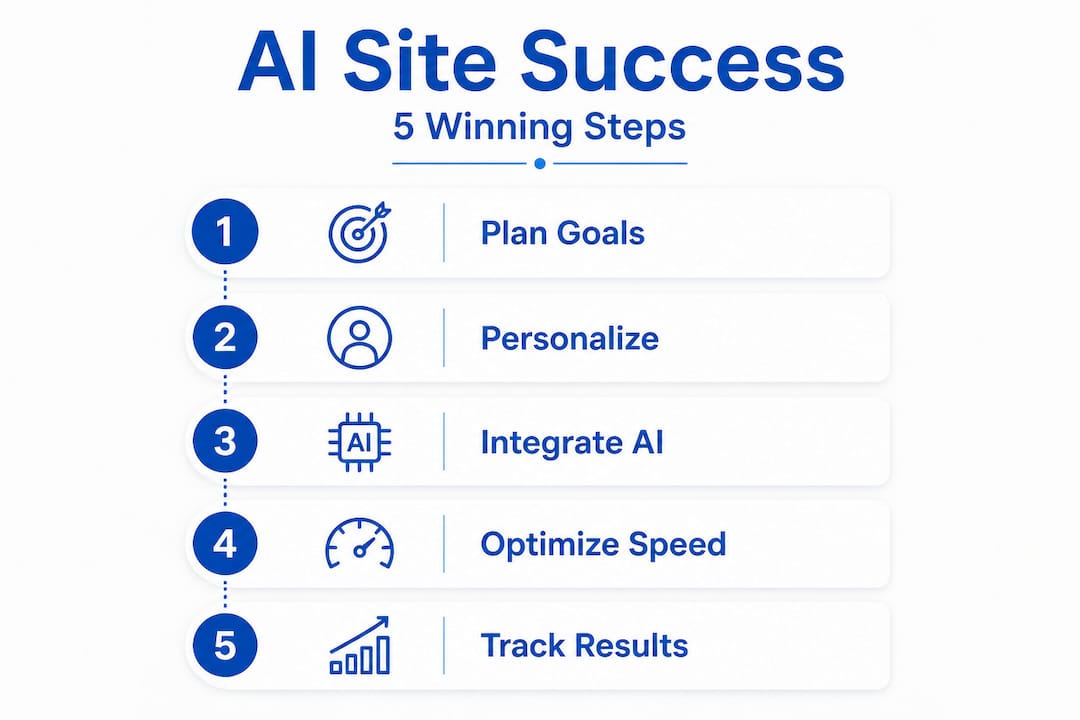
Audit your current digital presence. Before you design anything, benchmark where you stand. Run your existing site through Google PageSpeed Insights, check your local search rankings for key terms like “[your city] homes for sale,” and identify which competitors outrank you and why. This audit gives you a concrete baseline and reveals which gaps to prioritize first.
-
Define your niche and target buyer persona. The clearest mistake Florida agents make is trying to appeal to every buyer at once. Choose your niche: luxury waterfront, first-time buyers in a specific county, commercial investment properties, or vacation rentals. Your AI-optimized site will perform dramatically better when every element is calibrated to one well-defined audience rather than diluted across a dozen.
-
Choose a specialized platform or agency with AI capability. Not all web development agencies understand real estate. You need a partner who can configure IDX properly, implement property-specific AI chatbots, and build an SEO architecture based on how Florida buyers actually search. Choosing a custom site design with AI approach ensures you are not locked into a rigid template that cannot adapt as market conditions and technology evolve.
-
Integrate IDX, chatbot, and personalization systems. These three systems must communicate with each other. Your IDX feed should inform your chatbot so it can answer questions about live listings. Your chatbot should push lead data into your CRM automatically. Your personalization engine should surface different featured listings to different visitors based on their browsing behavior. Integration is where most template-based sites fail completely: the tools exist as disconnected plugins rather than a unified system.
-
Implement AI-powered SEO and AEO best practices. Work with your agency to build location-specific landing pages for every community you serve, optimized for both traditional Google search and AI-driven search tools. AI-powered SEO integration includes structured data markup (called schema), which signals to both Google and AI engines exactly what type of content each page contains: a listing, a neighborhood guide, an agent bio, or a market report.
-
Commit to ongoing testing and iteration. An AI-optimized site is not a one-time project. AI tools continuously generate insights about visitor behavior, content performance, and lead quality. Schedule quarterly reviews to analyze which pages drive the most qualified leads, which chatbot conversations convert best, and where visitors are abandoning the site. Emerging AI personalization works best when it has a steady stream of behavioral data to learn from, so consistency matters.
Pro Tip: When you launch your AI chatbot, spend the first 30 days reviewing chat transcripts personally. The questions buyers ask your chatbot are a goldmine of keyword and content ideas. Use them to build out FAQ pages and neighborhood guides that directly address what real buyers want to know.
Why most agents still get web design wrong—and how to break the cycle
Let’s get real about common mistakes and what distinguishes the leaders from the rest, because after 26 years of building websites for Florida businesses, we have seen the same patterns repeat again and again.
The most common mistake is choosing a cheap template platform because it seems fast and affordable. Platforms like these hand every agent in your market the same layout, the same structure, and often the same boilerplate content. When Google’s algorithm compares your site to a competitor’s, it struggles to identify what makes yours uniquely authoritative. Generic templates are invisible to search engines by design, not by accident.
The second mistake is treating a website like a finished product rather than an ongoing system. Florida real estate markets shift constantly. Interest rates change. New developments launch. Buyer demographics evolve. A static website that was adequate in 2022 is measurably less competitive in 2026, especially as AI-powered search tools reshape how buyers discover properties. Your website needs the same ongoing attention you give your listings and client relationships.
The third mistake, and perhaps the subtlest one, is confusing features with strategy. Some agents invest in flashy IDX tools or expensive chatbots and still generate almost no leads because the underlying strategy is wrong. The wrong chatbot message, a landing page targeting the wrong keywords, or a lead form that asks too many questions up front can neutralize every technical advantage you have. Features without strategic alignment do not convert.
What distinguishes the agents who win online? They treat their website as a business asset with measurable return on investment. They track which pages generate leads, which content brings back repeat visitors, and which chatbot conversations result in scheduled showings. You can find concrete examples of this approach in Florida web design success stories from agents who made the shift from template to strategy and saw their online lead volume increase substantially.
The agents leading their markets right now did not get there by finding the cheapest website solution. They invested in a system built specifically for their market, their niche, and their buyers. That is the only cycle worth committing to.
Ready to transform your real estate presence with AI?
If you are an agent or broker who is tired of paying for a website that does not work, the path forward is clear: replace the generic template with a purpose-built, AI-powered system designed specifically for Florida’s property market.
At Tatem Web Design, we have spent over 26 years building digital solutions for Florida businesses, and we specialize in AI website design for Florida real estate that combines IDX integration, property-specific AI chatbots, AEO-optimized content, and hyper-local SEO into a unified lead-generation platform. Our AI web services are tailored to your specific market, whether you operate in Stuart, Miami, Orlando, or along the 30A corridor. Call us directly at 772-224-8118 to schedule a consultation and discover exactly how AI-driven web design can bring qualified buyers and sellers to you, rather than to your competitors.
Frequently asked questions
What makes real estate web design different from standard web design?
Real estate web design features live listing integration via IDX, lead capture tools calibrated for buyer and seller intent, and AI personalization that matches visitors to relevant properties, capabilities that a general business website simply does not require.
How does AI improve lead generation on real estate websites?
Property-specific AI chatbots raise conversion rates significantly by instantly answering listing-specific questions and guiding buyers through the inquiry process without agent involvement, turning casual browsers into booked appointments.
Can AI web design help me rank higher on Google in Florida?
Yes. AI Engine Optimization combined with advanced local SEO strategies improves your visibility in both traditional Google search and AI-powered discovery tools, which is especially critical in competitive Florida markets like 30A, Miami, and Orlando.
What are the first steps to launch an AI-powered real estate website?
Start with a niche-focused strategy, then choose a specialized agency that can integrate IDX, configure AI chatbots trained on your listings, and build location-specific content optimized for how Florida buyers search online today.
Recommended
- Web Design & Digital Marketing Blog | Tatem Web Design
- Web Design & Digital Marketing Blog | Tatem Web Design
- Top AI Tools for Web Design: Boost Your | Tatem Web Design
- How to Use AI to Build a Website: The Complete Guide for Florida Businesses | Tatem Web Design
- Unified AI and SEO Strategy: Rank on Google and ChatGPT - Media House Agency
Tatem Web Design
26+ YearsWeb Design & SEO Specialist · Tatem Web Design
Matt Tatem has been designing websites professionally since 1999, making Tatem Web Design one of Florida's longest-running web agencies. Based in Stuart, FL, he specializes in WordPress, local SEO, Shopify e-commerce, and cybersecurity consulting for small businesses.
What a CMMC Level 2 Assessment Requires and How to Prepare
Prepare for your CMMC Level 2 assessment by understanding requirements, assessment paths, and mapping your Controlled Unclassified Information.

A Data Retention Policy Is Your Rulebook for Keeping and Deleting Data
Establishing a clear data retention policy helps manage data risk, ensuring compliance and effective data management for your organization.

Law Firm Local SEO: A Practical Playbook for More Local Clients
Unlock more local clients for your law firm with effective local SEO strategies. Optimize your Google Business Profile and boost your visibility!