
What Is AI Web Design? Your 2026 Business Guide
Most business owners hear “AI web design” and picture a robot replacing their web designer. That picture is wrong, and believing it costs you a serious competitive advantage. What is AI web design, really? It’s a production system where artificial intelligence handles the time-consuming, repetitive, and technically intensive parts of building a website, so that human designers can focus on strategy, brand, and results. This guide breaks down exactly how it works, what tools power it, what measurable benefits you can expect, and how to integrate it intelligently into your business or agency workflow.
Table of Contents
- Key takeaways
- What AI web design actually means
- The measurable benefits of AI-powered websites
- How AI designs websites: the full pipeline
- Integrating AI into your existing web design workflow
- Challenges and limitations you need to know
- My honest take on AI web design after years in the field
- Let Tatemweb build your AI-powered website
- FAQ
Key takeaways
| Point | Details |
|---|---|
| AI web design accelerates production | Agentic AI frameworks can cut website build times by up to 80%, freeing teams for strategic work. |
| Agentic AI goes beyond basic tools | Modern systems coordinate multiple specialized AI agents to handle planning, design, code, content, SEO, and hosting. |
| Performance and conversions improve | AI-driven layout optimization produces an average 19% conversion increase across websites. |
| Human oversight stays non-negotiable | AI cannot replace human judgment on brand voice, security, legal compliance, and accessibility review. |
| CMS integration makes results scalable | Building AI-generated sites on WordPress or similar platforms keeps them dynamic, extensible, and manageable. |
What AI web design actually means
AI web design is the use of artificial intelligence to automate, assist, or entirely execute the tasks involved in planning, building, and launching a website. That scope is broader than most people expect. It covers everything from generating a color palette and wireframe to writing page copy, compressing images, writing meta descriptions, and monitoring site security after launch.
At the basic end of the spectrum, you have AI-assisted tools. These plug into existing workflows and help with specific tasks, generating headline variations, suggesting font pairings, or flagging accessibility issues. Most web designers already use tools like this, even if they don’t label them AI.
At the advanced end, you have agentic AI frameworks. These are coordinated systems where multiple specialized AI agents work together autonomously to produce a complete, deployable website from a single brief. Platforms like 10Web represent this category. You describe your business, your goals, and your preferences. The system interprets that intent, maps a sitemap, generates a design, writes the content, builds the code, configures hosting, and launches the site. Agentic AI builders coordinate multiple expert agents handling planning, design, development, content, SEO, hosting, and ongoing management in a single pipeline.
The distinction matters because most skepticism about AI web design is aimed at the basic tool tier. People try a chatbot for headline ideas, get mediocre results, and dismiss the whole category. Agentic AI is a fundamentally different category of capability.
What is AI-powered web design at its most practical? Think of it as having a production team that works without fatigue, without scheduling conflicts, and without billing by the hour for every revision. The human designer or business owner stays in the director’s seat. The AI handles the production floor.
Pro Tip: When evaluating AI web design platforms, ask whether the system generates a static file or builds on a dynamic CMS like WordPress. Static output looks impressive in demos but creates real maintenance headaches within months.
The measurable benefits of AI-powered websites
The benefits of AI web design are not abstract. They show up in build timelines, performance scores, search rankings, and conversion rates. Here is where the numbers get compelling.

Agentic AI frameworks reduce build time by up to 80%. For a business owner who has waited six to twelve weeks for a traditional agency to deliver a website, that is not a minor improvement. That is the difference between launching before your competitor or watching them take your market share while you wait for revisions.
Speed is only part of the story. Consider what happens after launch. AI-driven layout optimization produces an average conversion increase of 19% across sites where it’s applied. That means more leads, more sales, and more revenue from the same volume of traffic, without additional ad spend.
The performance benefits extend to SEO as well. AI image compression and code optimization can reduce Largest Contentful Paint by up to 35%. LCP is one of Google’s Core Web Vitals and directly affects both your search ranking and your visitor’s first impression of your site. A faster site ranks higher, bounces fewer visitors, and converts more effectively. That is a compounding advantage.
AI also transforms post-launch work, which is often where traditional web projects fall apart. Ongoing maintenance, content updates, security patches, and performance monitoring become automated processes rather than billable hours. AI-powered dynamic hosting and ongoing management are now standard features in advanced AI website builders, handling DevOps, security, and performance monitoring after launch.
The benefits of AI-powered websites, summarized for a business context:
- Development speed: Build and launch in days rather than weeks or months
- SEO performance: Automated meta tags, structured data, and page speed improvements
- Conversion optimization: AI-tested layouts and copy proven to increase lead capture
- Cost efficiency: Reduced developer hours for both initial builds and ongoing changes
- Accessibility compliance: AI tools automatically fix 80% of common WCAG 2.1 violations
- Content quality: AI copywriting for meta descriptions that yield a 15% higher click-through rate in search results
For Florida businesses in competitive markets like real estate, healthcare, and legal services, these are not incremental gains. They represent a meaningful shift in how quickly you can establish and dominate your digital presence.
How AI designs websites: the full pipeline
Understanding the role of AI in web design means understanding how agentic systems move from a business brief to a live, functioning website. The process is more structured than most people realize, and that structure is what separates professional AI-built sites from low-quality automated outputs.
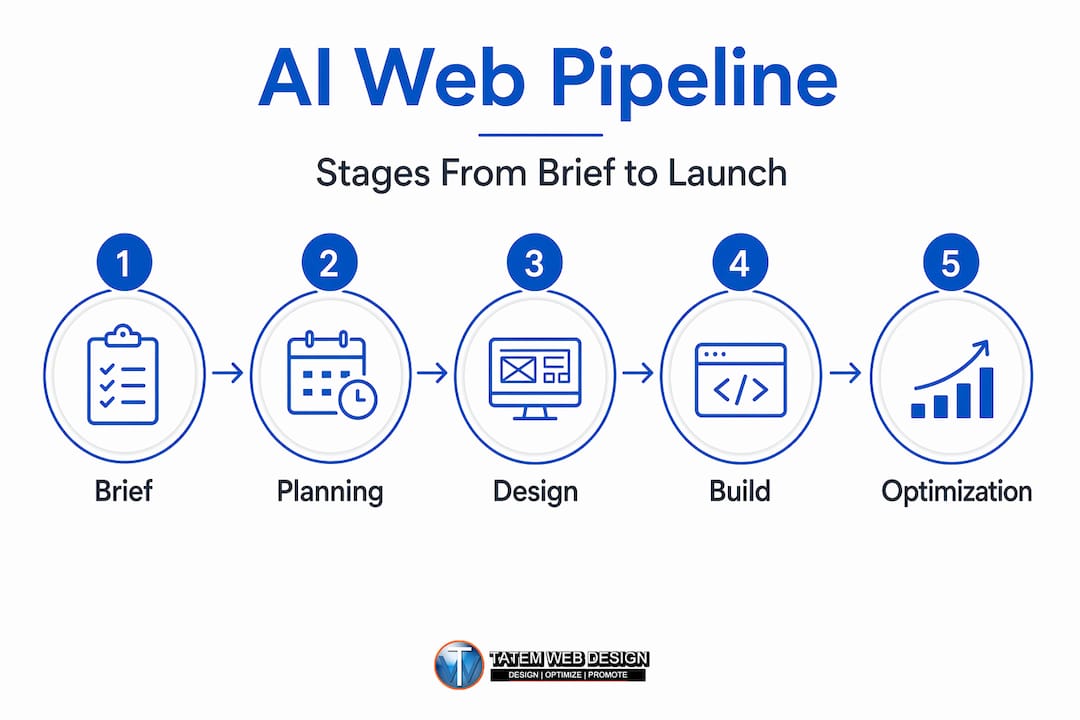
Here is how a professional AI website generation pipeline works:
- Intent interpretation. You describe your business, goals, target audience, and tone preferences. The AI parses this input to extract structured requirements, not just keywords.
- Sitemap planning. An AI planning agent maps the logical structure of the site, determining which pages are needed, how they relate, and what content each page requires. Sitemaps and wireframes are generated in under 20 minutes by coordinated agentic systems.
- Design generation. A specialized design agent creates layouts, color schemes, and component hierarchies based on your industry, brand inputs, and conversion best practices.
- Development. A development agent writes the code, often building on a CMS like WordPress for scalability. 46% of new code in modern web applications is now AI-generated or AI-suggested.
- Content creation. A content agent writes page copy, headlines, CTAs, and metadata aligned with your brand voice and SEO targets.
- SEO configuration. An SEO agent handles structured data, meta tags, internal linking logic, and performance tuning.
- Hosting and deployment. A DevOps agent configures the hosting environment, security settings, and performance layers.
- Ongoing management. Post-launch, AI agents monitor uptime, flag security issues, suggest content updates, and track performance metrics.
The table below shows how each specialized agent contributes to the final product.
| Agent type | Primary function | Output |
|---|---|---|
| Planning agent | Interprets brief, builds sitemap | Page structure, content map |
| Design agent | Generates layouts and visual hierarchy | Wireframes, design tokens |
| Development agent | Writes and tests code | Functional CMS-based website |
| Content agent | Writes copy, meta tags, CTAs | Page content, SEO copy |
| SEO agent | Configures technical SEO | Structured data, page speed |
| DevOps agent | Deploys and monitors the live site | Hosting config, security setup |
Pro Tip: If you’re working with an AI web design vendor, ask for a breakdown of which pipeline stages use AI autonomously and which require human review. That answer tells you more about quality control than any portfolio screenshot will.
What is AI automation in websites at this level? It’s the replacement of a six-person project team’s sequential work with a parallel, orchestrated system that completes the same scope in a fraction of the time.
Integrating AI into your existing web design workflow
Knowing what AI-powered web design can do is one thing. Knowing how to fold it into your actual workflow without losing control of quality or brand integrity is another. This is where most professionals make avoidable mistakes.
The most common error is jumping straight into design generation without mapping user flows first. You can get a beautiful AI-generated layout that performs poorly because it doesn’t match how your actual customers think and move through a site. Map your key user journeys first: what does a first-time visitor need to do within 30 seconds to become a lead? That answer should drive your brief to the AI, not the other way around.
Prompting matters more than most people admit. Vague inputs produce vague outputs. When you direct an AI design tool, be specific about structure, not just aesthetics. Ask for semantic, hierarchical content blocks. Specify that above-the-fold content must contain your primary value proposition and a single call-to-action. The more structured your input, the more usable your output.
Here is a practical integration checklist for professionals adding AI to their workflow:
- Map user flows and conversion goals before any design work begins
- Write a structured brief that includes audience profile, brand tone, competitor context, and desired CTA
- Use AI for UI copywriting drafts, then apply human brand review before publishing
- Generate image variations with AI tools, then curate rather than auto-publish
- Build on a CMS backbone like WordPress so AI-generated pages are extensible, not static
- Use AI for custom code generation in animations and API integrations, but have a developer review output
- Schedule a monthly AI-assisted audit of performance metrics, SEO, and accessibility
Maintaining brand voice is the area where businesses most often let AI slip too far into autopilot. AI is excellent at pattern matching and can produce credible copy, but it does not know your unique positioning, your client relationships, or the specific phrasing that makes your brand recognizable. A human editorial pass is not optional. It’s the step that separates a professional AI-built site from a forgettable one.
Pro Tip: Use AI to generate three to five homepage headline variations, then score them against your brand voice guide and test the top two. You’ll ship better copy faster than if a human wrote one draft from scratch.
Challenges and limitations you need to know
AI web design is genuinely powerful. It also has real limitations, and ignoring them is how businesses end up with sites that look professional but fail audits, attract security threats, or create legal liability.
Quality control is the first concern. AI agents produce errors of omission as readily as errors of commission. A development agent might write functional code that passes initial tests but misses edge cases in mobile rendering or form validation. A content agent might produce copy that is grammatically correct but factually wrong about your services. Automated QA catches a lot, but not everything. Human oversight remains critical for product decisions, brand voice, security, and final publishing judgment.
“AI accelerates web design tasks at scale, but the judgment calls that protect your brand, your users, and your legal standing still require human expertise. Automation does not equal absolution from responsibility.”
Accessibility and legal compliance deserve specific attention. While AI tools automatically identify and fix a significant share of common accessibility violations, that coverage is not complete. WCAG 2.1 compliance requires contextual judgment: Is this alt text genuinely descriptive or just technically present? Does this color contrast ratio work for users with specific visual impairments in context? An automated scan passes. A real audit finds the gaps.
Security is another area where AI introduces new considerations. AI-generated code can include vulnerabilities if the training data included insecure patterns. Sites built on AI platforms inherit any security assumptions baked into those platforms. You need to apply your own security standards on top of, not instead of, what the AI provides. For businesses handling sensitive client data, HIPAA compliance or PCI compliance requirements do not bend to accommodate AI-generated shortcuts.
Copyright and intellectual property in AI-generated content remain legally unsettled. Images generated by AI tools may incorporate patterns from copyrighted training data. Copy generated by AI may inadvertently reproduce protected phrases. Document your AI-generated assets, use tools with clear licensing terms, and have your legal team review any policy pages or terms that the AI wrote.
The ethical dimension matters too. AI can generate content at a scale that floods the internet with generic, low-value pages. Choosing to build a site that genuinely serves your visitors, rather than one optimized purely for search crawlers, is a strategic and ethical decision that only humans can make.
My honest take on AI web design after years in the field
I’ve watched web design evolve from hand-coded HTML tables to WordPress to page builders, and now to AI-generated sites built in hours. Each shift triggered the same fear: “This will put designers out of work.” Each time, the fear was wrong about the outcome, even when it was right about the disruption.
What I’ve found is that AI doesn’t replace good designers. It exposes average ones. The designers who built their value entirely around execution speed and template customization are under real pressure. The designers who built their value around strategy, conversion thinking, and client relationships are thriving because AI makes them faster, not redundant.
What I’ve learned from integrating agentic AI into complex projects is that the quality ceiling is determined almost entirely by the quality of the brief. Weak inputs produce weak sites, regardless of how sophisticated the AI is. The most experienced professionals I’ve worked with spend more time on the brief than the average person spends on an entire project. That discipline is what separates AI-built sites that convert from AI-built sites that look like templates.
The misconception I’d most like to see professionals abandon is that AI web design is a cost-cutting shortcut. It absolutely can cut costs. But its real value is in what you can do with the time and resources you recover. You can build better strategies. You can serve more clients. You can run more tests and iterations. The businesses winning with AI are not the ones using it to do less. They’re using it to do more, faster.
The future I see is one where web design trends continue pushing toward agent-responsive design, where sites are built not just for human visitors but for AI agents and autonomous browsers that increasingly mediate how people find and interact with businesses online. That shift is closer than most business owners realize.
— Matt
Let Tatemweb build your AI-powered website
Tatemweb has spent over 26 years designing and building websites for Florida businesses, and they’ve fully integrated agentic AI into every stage of that process. Whether you’re a real estate firm in Stuart, a healthcare practice in Palm Beach, or a legal professional across the Treasure Coast, Tatemweb builds custom AI websites that are fast, secure, SEO-optimized, and tailored to your specific industry and audience.
Their work goes beyond design. Tatemweb’s full AI services portfolio includes AI chatbots, AI lead capture tools, AI content writing, local SEO, cybersecurity compliance consulting, and AI agent implementation using frameworks like NemoClaw, OpenClaw, and Perplexity Computer. You get a complete digital growth partner, not just a website vendor.
Call Tatemweb directly at 772-224-8118 to schedule a consultation and find out exactly how AI-powered web design can help your business outperform competitors online.
FAQ
What is AI web design in simple terms?
AI web design uses artificial intelligence to automate the planning, building, and optimization of websites, including layout, code, content, and SEO, so sites can be built faster and perform better than through traditional manual methods.
How does AI actually design a website?
Agentic AI systems interpret a business brief, then deploy specialized agents that handle sitemap planning, visual design, coding, content writing, SEO configuration, and deployment, producing a fully functional website in a fraction of the traditional timeline.
What are the main benefits of AI-powered websites?
The core benefits include up to 80% faster build times, an average 19% increase in conversion rates through AI-optimized layouts, improved page speed scores, automated SEO configuration, and ongoing AI-managed performance monitoring after launch.
Can AI web design replace human designers?
No. AI handles execution and automation extremely well, but human designers remain responsible for brand strategy, quality assurance, accessibility compliance, legal review, and the creative direction that makes a site genuinely effective and differentiated.
What is AI automation in websites after they launch?
Post-launch AI automation includes continuous security monitoring, performance tracking, automated content suggestions, uptime management, and SEO adjustments, capabilities that modern agentic platforms handle autonomously as part of full lifecycle website management.
Recommended
- AI-Driven Website Design Trends for Florida Businesses | Tatem Web Design
- How to Use AI to Build a Website: The Complete Guide for Florida Businesses | Tatem Web Design
- AI Website Design Florida | AI-Built Websites for Every Industry | Tatem Web Design
- Top AI Tools for Web Design: Boost Your | Tatem Web Design
Tatem Web Design
26+ YearsWeb Design & SEO Specialist · Tatem Web Design
Matt Tatem has been designing websites professionally since 1999, making Tatem Web Design one of Florida's longest-running web agencies. Based in Stuart, FL, he specializes in WordPress, local SEO, Shopify e-commerce, and cybersecurity consulting for small businesses.

Rank in ChatGPT in 90 Days With a Practitioner Led Checklist
Follow a practitioner led 90 day plan to get cited by ChatGPT: allow OAI-SearchBot, publish short answer capsules with schema, and track Bing AI Performance.

AI SEO Content Playbook: 16 GEO Signals for Agencies & Teams
A practical playbook mapping the GEO-16 signals to hands-on editorial workflows, review controls, and metrics. For agencies and in-house teams scaling AI...

Copy Ready Local Schema Markup for SMBs + Google Validation
Copy ready JSON-LD examples and Google validation steps for SMBs' local schema markup. Audit, implement, and verify each location page with confidence.