
WordPress vs. eCommerce: What Business Owners Must Know
The core difference between WordPress and eCommerce platforms is this: WordPress is a general-purpose content management system (CMS) that requires plugins to sell online, while dedicated eCommerce platforms are purpose-built to manage sales, inventory, and payments from day one. That distinction shapes every decision you make about cost, maintenance, and growth. WordPress powers 43% of all websites on the internet, yet it was not designed as a sales platform. Knowing which tool fits your business model saves you months of frustration and thousands of dollars in rework.
What is the difference between WordPress and eCommerce platforms?
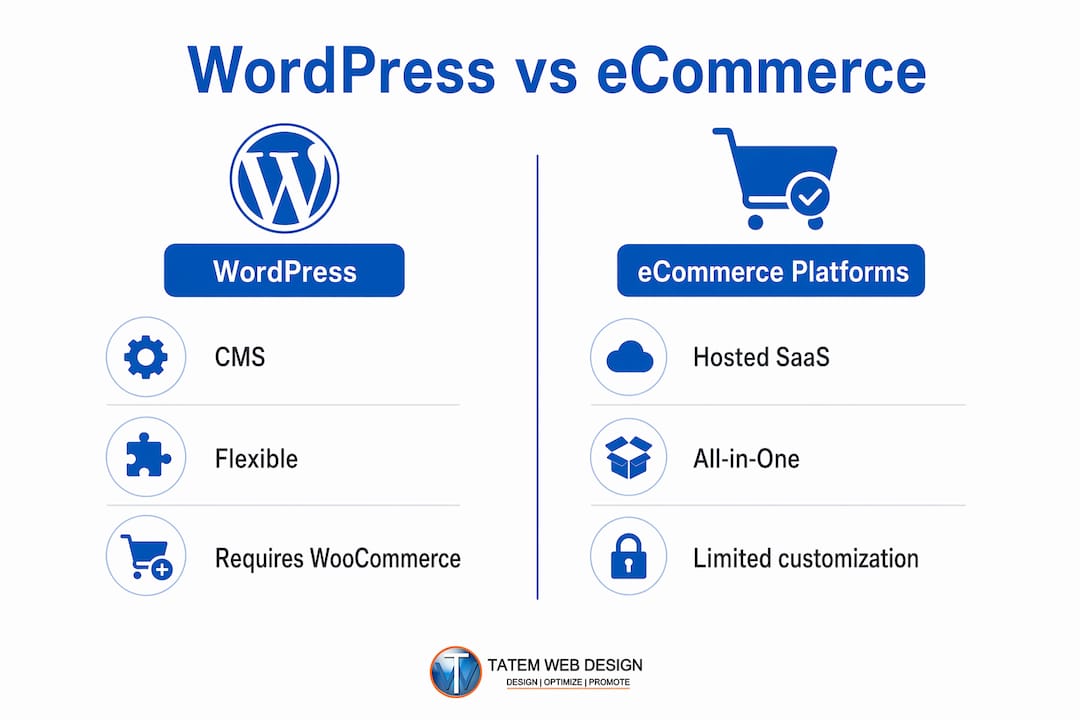
WordPress is an open-source CMS built for publishing content. It manages pages, blog posts, media, and user permissions with a flexible architecture that supports thousands of plugins. To sell products online, you add WooCommerce, the most widely used shopping cart plugin for WordPress. WooCommerce transforms a WordPress site into an online store by adding product pages, a shopping cart, checkout flows, and payment processing.
The critical point most business owners miss: WooCommerce requires WordPress and cannot function independently. Installing WooCommerce means you are also taking on the responsibilities of a WordPress site owner, including hosting, security updates, plugin compatibility, and server performance. You are not just running a store. You are running a web server.

Dedicated eCommerce platforms work differently. They are hosted software-as-a-service (SaaS) products where the vendor manages the infrastructure, security, and core commerce features. You pay a monthly fee and focus on selling. The platform handles the rest. This is the fundamental split in the WordPress vs. eCommerce platform comparison, and it determines which option fits your business.
What are WordPress’s core features and how do they support eCommerce?
WordPress excels at content. Its block editor, media library, taxonomy system, and plugin ecosystem make it the most flexible publishing platform available. For businesses that need a rich content presence alongside an online store, this matters enormously.
Here is what WordPress with WooCommerce brings to the table:
- Content marketing power. WordPress supports blogs, landing pages, resource libraries, and SEO-optimized content at a depth no dedicated eCommerce platform matches. If content drives your customer acquisition, this is a real advantage.
- Full design control. Thousands of themes and page builders like Elementor and Divi give you complete control over layout, branding, and user experience without writing code.
- Plugin ecosystem. WooCommerce alone has hundreds of extensions for subscriptions, memberships, bookings, and advanced shipping rules. The broader WordPress plugin library adds CRM integrations, email marketing, and analytics tools.
- Self-hosting flexibility. You choose your hosting provider, server configuration, and data storage location. This matters for businesses with specific compliance requirements, such as HIPAA or PCI standards.
- Ownership. You own your data, your code, and your store. No vendor can change pricing or shut down your platform.
WordPress suits businesses where selling is one function among many. A law firm that sells online courses, a healthcare provider offering appointment bookings, or a media company with a merchandise store all benefit from WordPress’s content-first architecture. Tatemweb regularly builds custom WordPress websites for professional services firms that need both content depth and transactional capability.
Pro Tip: Before installing WooCommerce, audit your WordPress plugin essentials list. Every plugin you add increases load time and introduces potential security vulnerabilities. Keep your stack lean from the start.
How do dedicated eCommerce platforms function and what are their advantages?
Dedicated eCommerce platforms are built with one goal: selling products online as efficiently as possible. Every feature, from checkout flow to inventory management, is designed around the commerce experience. You do not configure a CMS to sell. You configure a store to sell.
Native platform integration covers payments, checkout, and inventory management in a single hosted environment. That means fewer failure points, faster load times, and a checkout experience optimized by the platform vendor across millions of transactions. Business owners who prioritize conversion rates over content flexibility gain a real operational advantage here.
Key advantages of dedicated eCommerce platforms include:
- Managed infrastructure. The vendor handles server uptime, security patches, and performance scaling. You never worry about your store going down during a traffic spike.
- Built-in commerce features. Abandoned cart recovery, discount codes, tax calculation, and multi-currency support come standard. On WordPress, each of these requires a separate plugin.
- Predictable pricing. Monthly subscription fees cover hosting, security, and core features. You budget with certainty rather than managing variable server and developer costs.
- Faster launch time. A business owner with no technical background can launch a functional store in days, not weeks.
- App ecosystems. Most platforms offer curated app stores with vetted integrations for marketing, shipping, and analytics.
The tradeoff is real: dedicated eCommerce platforms limit your control over the underlying code and server environment. If your business needs deep content marketing, complex custom workflows, or specific compliance configurations, a platform’s built-in tools may not be enough. For pure commerce operations, though, the managed approach removes significant operational burden.
What are the cost differences and operational responsibilities?
Cost is where the WordPress vs. eCommerce platform comparison gets complicated. WordPress software is free. That fact leads many business owners to assume WordPress is the cheaper option. The reality is more nuanced.
WordPress and WooCommerce total cost of ownership
WooCommerce is free to install, but a production-ready store requires managed hosting ($50–$500+ per month), premium plugins ($1,000–$3,000+ per year), and developer support for setup, customization, and ongoing maintenance. Security hardening, SSL certificates, and backup systems add further cost. Over three years, these expenses accumulate significantly, and they require active management to avoid performance and security failures.
Dedicated eCommerce platform pricing
Dedicated eCommerce platforms charge a predictable monthly fee that covers hosting, security, and core features. This pricing model removes the variable cost of self-hosting but introduces transaction fees on some plans. For businesses with high sales volume, those transaction fees can exceed the cost savings from managed infrastructure.
| Cost Category | WordPress with WooCommerce | Dedicated eCommerce Platform |
|---|---|---|
| Software license | Free | Monthly subscription fee |
| Hosting | $50–$500+/month (you manage) | Included in subscription |
| Plugins and extensions | $1,000–$3,000+/year | Mostly included or app store |
| Developer support | Variable, often significant | Minimal for standard setups |
| Security management | Your responsibility | Vendor managed |
| Transaction fees | None (payment gateway fees only) | Possible per-transaction fee |
Business owners frequently underestimate the complexity of managing a WordPress eCommerce site. Expert-level maintenance is not optional. It is the difference between a store that converts and one that loses customers to slow load times or security breaches.
Pro Tip: When calculating three-year costs for WordPress, include at least one major developer engagement per year for updates, plugin conflicts, and performance tuning. That cost is real and predictable once you plan for it.
What customization and scalability differences matter most?
Customization is WordPress’s strongest argument. You control every line of code, every template, and every checkout step. No platform restriction limits what you can build. For businesses with unique workflows, complex product configurations, or specific brand requirements, this flexibility is genuinely valuable.
The cost of that flexibility is performance risk. Plugin bloat from multiple WooCommerce extensions degrades checkout speed and hurts conversion rates. Each plugin adds overhead and a potential failure point. A WooCommerce store running 40 plugins requires expert optimization to maintain the load times that customers expect. SaaS platforms are built for speed from the ground up, and their checkout flows are tested across millions of transactions.
“When selling is a feature among content, WordPress with WooCommerce offers unmatched flexibility. When selling is the core business, dedicated eCommerce platforms provide a superior out-of-the-box experience.” This distinction is the clearest guide for matching platform to business model.
Scalability follows the same pattern. WordPress scales well with the right hosting infrastructure and developer support. Large catalogs, high transaction volumes, and international selling are all achievable on WordPress. They require deliberate architecture decisions, though. Dedicated eCommerce platforms scale more automatically because the vendor manages infrastructure growth. For businesses expecting rapid sales growth without a dedicated technical team, the managed approach reduces risk considerably.
Pairing either platform with eCommerce advertising management amplifies results. Traffic quality matters as much as platform performance, and a well-optimized ad program drives the right buyers to your store regardless of which platform you choose.
Which platform fits your business and selling needs?
The right platform depends on what your business does first and what it does second. Here is a practical framework for making the decision:
-
Your store is the business. You sell physical or digital products as your primary revenue source. You need fast checkout, reliable inventory management, and minimal technical overhead. A dedicated eCommerce platform fits this model. It removes operational complexity so you focus on sales.
-
Content drives your customer acquisition. You publish articles, guides, case studies, or educational content that attracts buyers. Selling is important but secondary to your content strategy. WordPress with WooCommerce fits this model. The CMS architecture supports professional content writing and SEO at a depth no dedicated platform matches.
-
You have a technical team or budget for one. WordPress rewards businesses that invest in proper development and maintenance. Without that investment, self-hosting creates security and performance risks that hurt your store. If you lack technical resources, a managed platform removes that risk.
-
You need compliance-specific configurations. Healthcare, legal, and government businesses often need specific data handling, hosting locations, or security configurations. WordPress’s self-hosted model gives you that control. Tatemweb supports WordPress security best practices for businesses in regulated industries.
-
You want to launch fast with minimal setup. A dedicated eCommerce platform gets you selling in days. WordPress requires more setup time, especially when configuring WooCommerce, payment gateways, shipping rules, and security hardening.
The most common mistake business owners make is choosing WordPress because it is free, then discovering the real cost of self-hosting after launch. The second most common mistake is choosing a dedicated platform without realizing its content marketing limitations will constrain organic growth. Match the platform to your primary business activity, not to your budget assumptions.
Key Takeaways
WordPress suits content-driven businesses that sell, while dedicated eCommerce platforms suit businesses that sell first and publish second.
| Point | Details |
|---|---|
| WordPress is a CMS, not a store | WordPress requires WooCommerce to sell online; it is not an eCommerce platform by default. |
| WooCommerce adds real operational cost | Hosting, plugins, and developer support add $1,000–$3,000+ per year beyond the free software. |
| Managed platforms reduce technical burden | Dedicated eCommerce platforms handle hosting, security, and performance so you focus on sales. |
| Plugin bloat hurts conversion | Too many WooCommerce extensions slow checkout and reduce sales; keep the plugin stack lean. |
| Match platform to primary business activity | Content-first businesses benefit from WordPress; commerce-first businesses benefit from managed platforms. |
What I’ve learned after 26 years of building stores and sites
After building hundreds of websites for Florida businesses across real estate, healthcare, legal, and retail, I have watched the same mistake repeat itself. A business owner hears “WordPress is free” and assumes that means cheap. They launch a WooCommerce store, skip managed hosting, install 30 plugins, and six months later they are calling us because their checkout is broken and their Google rankings dropped.
The difference between WordPress and eCommerce platforms is not really about features. It is about who manages the complexity. WordPress puts that responsibility on you or your developer. A dedicated eCommerce platform absorbs it into the subscription price. Neither answer is wrong. But you need to be honest about your capacity before you commit.
What I tell business owners directly: if you are running a content-heavy operation where selling is one revenue stream among several, WordPress with WooCommerce is genuinely the better tool. The content marketing depth alone justifies the operational overhead when you have the right support. If you are building a store-first business and your team has no developer on staff, a managed platform will serve you better for the first two to three years of growth.
The businesses I have seen struggle most are the ones that chose WordPress because it felt familiar, not because it fit their model. Platform decisions are not permanent, but migrations are expensive. Get the decision right the first time by being clear about what your business does and what you need your website to do.
— Matt
Tatemweb builds both, and we help you choose the right one
Choosing between WordPress and a dedicated eCommerce solution is a business decision, not just a technical one. Tatemweb has spent over 26 years helping Florida businesses get this decision right, from content-rich WordPress sites with full WooCommerce integration to custom AI-enhanced eCommerce stores built for high-volume selling.
Whether you need a custom eCommerce website with WooCommerce, a managed store with AI-powered product pages, or a hybrid site that handles both content and commerce, Tatemweb delivers it with security, speed, and SEO built in. Our team handles hosting, plugin management, security hardening, and ongoing maintenance so you never carry that burden alone. Call us at 772-224-8118 or visit our AI website design services page to schedule a consultation.
FAQ
What is the main difference between WordPress and eCommerce?
WordPress is a content management system that requires the WooCommerce plugin to sell online, while dedicated eCommerce platforms are purpose-built for selling with payments, inventory, and checkout included by default.
Can WordPress be used as an eCommerce platform?
Yes. WordPress becomes an eCommerce platform when you install WooCommerce, but doing so requires you to manage hosting, security, and plugin updates as part of your ongoing operations.
Is WordPress or a dedicated eCommerce platform cheaper?
WordPress software is free, but total operating costs including hosting, plugins, and developer support often exceed the predictable monthly fees of a managed eCommerce platform over a three-year period.
What are the best shopping cart plugins for WordPress?
WooCommerce is the most widely used shopping cart plugin for WordPress and supports the broadest range of extensions for payments, shipping, subscriptions, and inventory management.
When should a business choose WordPress over a dedicated eCommerce platform?
Choose WordPress when content marketing drives your customer acquisition and selling is one function among several. Choose a dedicated eCommerce platform when selling is your primary business activity and you want managed infrastructure with minimal technical overhead.
Recommended
Tatem Web Design
26+ YearsWeb Design & SEO Specialist · Tatem Web Design
Matt Tatem has been designing websites professionally since 1999, making Tatem Web Design one of Florida's longest-running web agencies. Based in Stuart, FL, he specializes in WordPress, local SEO, Shopify e-commerce, and cybersecurity consulting for small businesses.

Rank in ChatGPT in 90 Days With a Practitioner Led Checklist
Follow a practitioner led 90 day plan to get cited by ChatGPT: allow OAI-SearchBot, publish short answer capsules with schema, and track Bing AI Performance.

AI SEO Content Playbook: 16 GEO Signals for Agencies & Teams
A practical playbook mapping the GEO-16 signals to hands-on editorial workflows, review controls, and metrics. For agencies and in-house teams scaling AI...

Copy Ready Local Schema Markup for SMBs + Google Validation
Copy ready JSON-LD examples and Google validation steps for SMBs' local schema markup. Audit, implement, and verify each location page with confidence.