
AI Business Services for SMBs: Your 2026 Guide
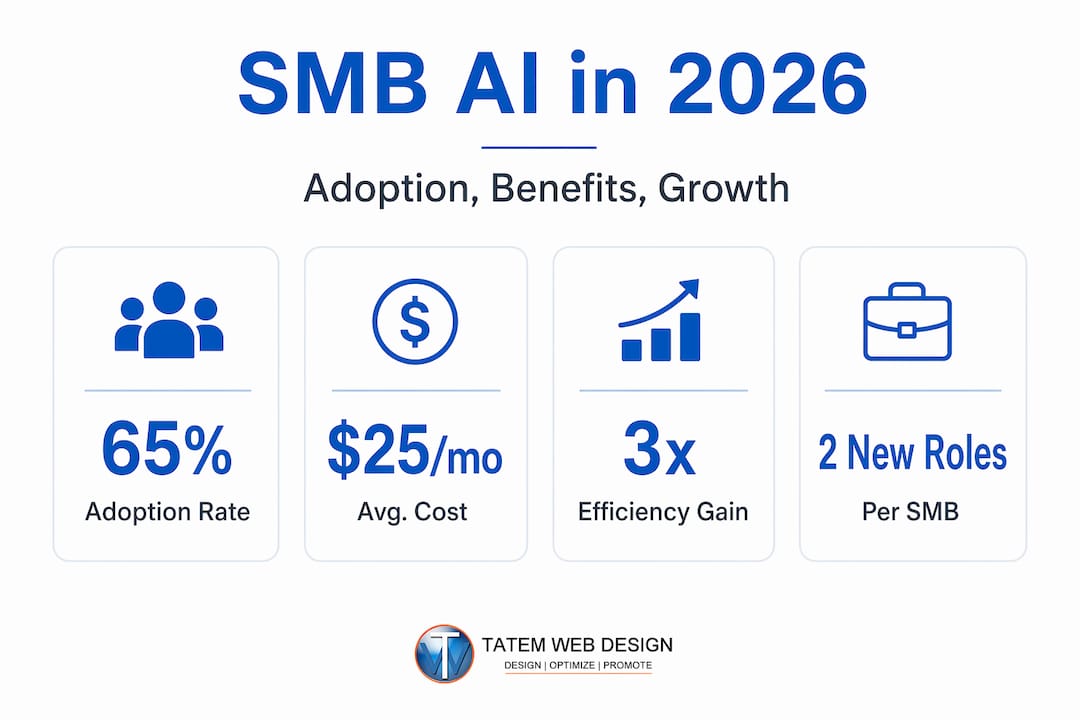
Most small business owners assume AI is either too expensive or too complicated to be worth pursuing. Both assumptions are wrong. The reality is that AI service costs dropped from roughly $50 per month in 2019 to $20 to $30 per month by 2025, and the tools themselves have become far more accessible. AI business services, the industry’s broader term for applied artificial intelligence solutions deployed across business functions, are now within reach for a dental office in Stuart, a law firm in Fort Lauderdale, or a real estate agency anywhere in Florida. This guide covers the practical tools and strategies that actually move the needle in automation, digital marketing, and cybersecurity for SMBs in 2026.
Table of Contents
- Key takeaways
- What AI business services look like for SMBs today
- How AI automation actually works in your business
- AI in digital marketing and customer engagement
- AI-enhanced cybersecurity for small businesses
- My honest take on AI business services for SMBs
- How Tatemweb helps Florida businesses put AI to work
- FAQ
Key takeaways
| Point | Details |
|---|---|
| AI costs have dropped sharply | Monthly AI service costs for SMBs fell from $50 in 2019 to $20–30 in 2025, making adoption realistic for almost any budget. |
| Automation goes beyond chatbots | Real AI automation connects to your CRM, billing, and inbox to execute multi-step workflows, not just answer questions. |
| AI lifts ad performance measurably | Google’s Smart Bidding Exploration delivered 27% more unique converting users on average in early 2026. |
| Cybersecurity AI protects without a big team | Platforms like WithSecure Elements detect threats proactively and include AI-assisted explanations at no extra charge. |
| Governance determines success | Putting governance frameworks in place before deploying AI prevents costly mistakes and keeps you in control. |
What AI business services look like for SMBs today
The phrase “artificial intelligence for business” used to conjure images of tech giants running massive data centers. That picture no longer fits. SMB AI adoption has shifted from isolated experimentation toward integrated operational use, meaning small businesses are not just trying AI. They are running it as part of daily operations.
Here is a breakdown of the core categories of AI solutions for businesses that are genuinely relevant to SMBs right now:
| Service Category | What it does | Common SMB use case |
|---|---|---|
| Marketing automation | Generates, schedules, and targets content using AI | Email campaigns, social ads, SEO content |
| Generative AI platforms | Creates written, visual, or conversational content | Product descriptions, blog posts, customer replies |
| AI cybersecurity | Monitors, detects, and responds to threats automatically | Threat detection, compliance alerts, vulnerability scans |
| Process automation | Executes multi-step workflows across connected systems | Lead routing, invoice processing, appointment scheduling |
| AI customer support | Handles inquiries 24/7 through intelligent agents | Chat, email triage, FAQ resolution |
Adoption is not uniform across industries. Healthcare practices, legal firms, and real estate agencies tend to adopt AI customer support and marketing tools first because the ROI is immediately visible in lead volume and time saved. Contractors and service businesses often start with process automation because reducing manual scheduling and billing errors delivers fast results.
The most important shift happening right now is the move from business intelligence AI tools, the dashboards and reports you review manually, to intelligent business applications that act on data without waiting for you. That gap matters. Reviewing a weekly sales report is passive. Having an AI agent flag a churning client and automatically trigger a follow-up email is operational.
How AI automation actually works in your business
Most people hear “automation” and think of a chatbot that answers “What are your hours?” That is the surface level. Real automating of business processes looks entirely different when it is wired correctly.

AI chat agents built for business integrate directly with your CRM, inbox, and billing systems. They use audit logs and role-based permission controls so that every action the AI takes is traceable and reversible. The difference between a chat widget and a true AI agent is that the agent can pull a client record, update an appointment, send a confirmation email, and flag the interaction for review, all without a human in the loop.
Here is how a well-structured AI automation rollout typically works for an SMB:
- Map your workflows first. Identify two or three repetitive processes that consume significant staff time. Lead intake, appointment booking, and invoice follow-up are common starting points.
- Select a platform that integrates with your existing tools. If you use QuickBooks, a CRM like HubSpot, or a scheduling system, your AI platform must connect natively or via API. Disconnected tools create more work, not less.
- Establish governance before you go live. The NIST AI Risk Management Framework recommends setting governance mechanisms first so you can map, measure, and manage AI behavior consistently. This is not bureaucracy. It is how you avoid the AI sending a billing email to the wrong client.
- Run a controlled pilot. Deploy the automation on one workflow, one team, or one client segment. Measure error rate, time saved, and any customer experience impact before expanding.
- Scale with centralized monitoring. Platforms like Google’s Gemini Enterprise Agent Platform support both low-code and developer-grade environments with centralized controls and runtime security to prevent uncontrolled automations from running loose in your systems.
The governance point deserves extra attention. Many SMBs skip it because it sounds like a corporate concern. It is not. AI governance frameworks are what separate businesses that use AI confidently from businesses that are constantly cleaning up AI mistakes.
Pro Tip: Before purchasing any AI automation tool, ask the vendor one specific question: “What happens when the AI makes a wrong decision?” If they cannot explain their audit trail and rollback process clearly, that platform is not ready for your business.
AI in digital marketing and customer engagement
Digital marketing is where many SMBs see their fastest return from machine learning services for business. The reason is straightforward. AI can test, optimize, and personalize at a scale that no human marketing team can match, and it does so continuously.
Here is where AI-driven customer support and marketing tools are delivering real results for SMBs:
- Paid search advertising. Google’s Smart Bidding Exploration reported 27% more unique converting users on average in early 2026. For a small business spending $1,500 per month on Google Ads, that kind of lift means more leads without a higher budget.
- AI Max for Search campaigns. Google AI Max expands reach dynamically and uses AI Brief, a tool that lets advertisers guide the messaging, tone, and compliance requirements of AI-generated ad copy. For regulated industries like healthcare or legal services, that control is not optional.
- Final URL Expansion. Rather than manually routing every ad to a specific landing page, AI analyzes the search intent and directs users to the page most likely to convert. A search for “emergency dental Stuart FL” does not need to land on your homepage when AI can send it straight to your emergency services page.
- Email marketing automation. AI tools analyze open rates, click patterns, and time-of-day behavior to send the right message at the right moment. Businesses using AI-powered email automation consistently report higher open rates because the segmentation is more precise than manual list management can achieve.
- Lead capture chatbots. Conversational AI platforms integrate with your CRM to provide 24/7 personalized responses, qualify leads based on preset criteria, and schedule consultations without human involvement. For a small law firm or medical practice, this alone can reclaim hours of front-desk time every week.
The one balance worth watching is brand voice. AI-generated content can sound generic when the guardrails are too loose. Use AI to handle the volume and scheduling, but keep a human in the loop for tone review, especially on anything client-facing that represents your reputation.
AI-enhanced cybersecurity for small businesses
Cybersecurity is where SMBs are most vulnerable and where AI delivers some of its most concrete value. The challenge is that most small businesses do not have a dedicated IT security staff. They have a general IT contact, or a part-time managed service provider, and hope for the best.
AI changes that equation significantly. Platforms built specifically for mid-market SMBs now consolidate threat detection, monitoring, and response guidance into a single dashboard, with AI assistants that explain what is happening in plain language.
Key capabilities to look for in any AI cybersecurity solution:
- Proactive threat detection. WithSecure Elements flags threats before attackers exploit them rather than alerting you after a breach has occurred. This is the difference between prevention and disaster recovery.
- Exposure management. AI continuously scans your environment for vulnerabilities, misconfigured systems, and outdated software, giving you a running risk score instead of a quarterly audit report.
- Extended detection and response (XDR). XDR correlates signals from endpoints, networks, and email to detect attack patterns that individual tools would miss. For a business running ten to fifty workstations, this level of visibility was previously only available at enterprise budgets.
- AI-assisted threat interpretation. The WithSecure platform includes a GenAI assistant at no extra charge that translates technical security alerts into plain-language explanations with recommended next steps. You do not need to know what a “lateral movement attempt” means if the AI tells you exactly what to do about it.
- Compliance automation. For businesses operating under HIPAA, PCI, or CMMC requirements, AI can continuously verify that your configurations meet compliance standards and alert you when something drifts out of alignment.
Pro Tip: If you are in healthcare, legal, or government contracting, pair your AI cybersecurity platform with formal compliance consulting. AI tools catch technical threats well, but compliance gaps often live in policies and training, not just technology. Tatemweb’s AI security enhancements and cybersecurity training services address both sides of that equation.
The shift toward agentic AI in cybersecurity is particularly significant. Where older security tools detected and alerted, agentic AI can reason about a threat, decide on a response, and act on that decision autonomously. For an SMB without a 24/7 security operations center, that capability is a genuine force multiplier.
My honest take on AI business services for SMBs
I have worked with business owners across real estate, healthcare, and professional services for over two decades. Here is what I have actually observed when SMBs adopt AI, and it is not what the marketing materials usually say.
The businesses that get real value from AI are not the ones that buy the most tools. They are the ones that pick two or three specific problems, deploy AI against those problems with clear success metrics, and build from there. I have watched businesses spend thousands on AI platforms they barely use because they bought the idea of AI transformation without a concrete implementation plan.
The governance piece is where I see the biggest gap. Most SMB owners I talk to think governance means red tape. What it actually means is knowing what your AI is doing, who approved it, and how to fix it when something goes wrong. That is not a corporate formality. That is basic operational control over a tool that is making decisions on your behalf.
My other observation: the businesses most reluctant to adopt AI are often the ones with the most to gain. A three-person accounting firm handling 200 client files manually is drowning in work that AI could handle in minutes. The hesitation is understandable. Starting with one automated workflow, measuring the outcome, and scaling gradually is the most reliable path I have seen work.
Start with the problem, not the technology. Then find the AI that solves it.
— Matt
How Tatemweb helps Florida businesses put AI to work
Tatemweb has spent over 26 years helping Florida businesses build a stronger digital presence, and the firm’s AI practice is built on that same foundation of practical, results-oriented work. Whether you are a medical practice needing AI-built website design that reflects your brand and ranks in local search, or a professional services firm looking for custom AI agent setup using platforms like NemoClaw, Claude, or Perplexity Computer, Tatemweb configures solutions to your actual operations, not a generic template.
The service portfolio covers the full range of what SMBs need: AI automation, local SEO, AI email marketing, lead capture chatbots, and AI-powered cybersecurity including HIPAA, PCI, and CMMC compliance consulting. Every engagement is supported by a team that understands the unique pressures of running a business in Florida’s competitive markets.
If you are ready to stop wondering what AI could do for your business and start seeing results, call Tatemweb directly at 772-224-8118 to schedule a consultation. You can also explore the full range of AI business solutions online to find the right starting point for your goals.
FAQ
What are AI business services?
AI business services are technology solutions that apply artificial intelligence to specific business functions, including marketing automation, customer support, cybersecurity, and process management. The term covers everything from AI chatbots and ad optimization tools to full agentic platforms that execute multi-step workflows.
How much do AI services cost for small businesses?
Monthly costs for core AI business tools have dropped significantly, with many SMBs spending between $20 and $30 per month as of 2025. More advanced platforms and custom AI agent configurations carry higher costs, but entry-level tools are now accessible to businesses of almost any size.
How does AI improve cybersecurity for small businesses?
AI cybersecurity platforms proactively detect threats before they escalate, consolidate monitoring into a single dashboard, and use AI assistants to translate technical alerts into plain-language guidance. Platforms like WithSecure Elements are specifically designed for SMBs without dedicated security teams.
What is the biggest mistake SMBs make with AI automation?
Skipping governance. Deploying AI without defined audit trails, role-based permissions, and a clear rollback process creates operational risk. Setting up governance mechanisms before going live is what the NIST AI Risk Management Framework specifically recommends for consistent and safe AI use.
Can AI really help with digital marketing for a local Florida business?
Yes, and the results are measurable. Google’s Smart Bidding Exploration delivered 27% more unique converting users in early 2026, and AI-powered email marketing and local SEO tools help small businesses reach the right audience at the right time without significantly increasing ad spend.
Recommended
- AI web solutions for Florida SMBs: industry, compliance, growth | Tatem Web Design
- AI Services Florida | AI Web Design, SEO, Chatbots & More | Tatem Web Design
- AI For Business Florida | Onsite AI Integration & Consulting | Tatem Web Design
- What Is AI Web Design? Your 2026 Business Guide | Tatem Web Design
Tatem Web Design
26+ YearsWeb Design & SEO Specialist · Tatem Web Design
Matt Tatem has been designing websites professionally since 1999, making Tatem Web Design one of Florida's longest-running web agencies. Based in Stuart, FL, he specializes in WordPress, local SEO, Shopify e-commerce, and cybersecurity consulting for small businesses.

Rank in ChatGPT in 90 Days With a Practitioner Led Checklist
Follow a practitioner led 90 day plan to get cited by ChatGPT: allow OAI-SearchBot, publish short answer capsules with schema, and track Bing AI Performance.

AI SEO Content Playbook: 16 GEO Signals for Agencies & Teams
A practical playbook mapping the GEO-16 signals to hands-on editorial workflows, review controls, and metrics. For agencies and in-house teams scaling AI...

Copy Ready Local Schema Markup for SMBs + Google Validation
Copy ready JSON-LD examples and Google validation steps for SMBs' local schema markup. Audit, implement, and verify each location page with confidence.