
How to Choose a CMMC Consultant for Your Business
A CMMC consultant is a cybersecurity professional who helps U.S. businesses achieve and maintain compliance with the Department of Defense’s Cybersecurity Maturity Model Certification requirements. The formal industry term is Registered Practitioner (RP) or Registered Practitioner Organization (RPO), designations defined by the Cyber AB to distinguish advisory roles from certified assessment roles. These specialists conduct gap analyses against NIST SP 800-171, build remediation roadmaps, author System Security Plans, and prepare your organization for a formal third-party assessment. For any business pursuing a DoD contract in 2026, working with a qualified CMMC compliance advisor is not optional. It is the difference between winning and losing government work.
What services does a CMMC consultant offer?
CMMC consulting services typically begin with a gap assessment that benchmarks your current security posture against all 110 NIST SP 800-171 controls required for Level 2 certification. This assessment identifies which controls are fully implemented, partially implemented, or missing entirely. The output is a prioritized list of deficiencies your organization must address before a C3PAO can certify you.
Remediation planning follows the gap assessment. Your CMMC readiness consultant works with your IT team to close identified gaps, whether that means reconfiguring access controls, deploying multi-factor authentication, or establishing incident response procedures. The consultant does not just hand you a list of problems. They build a structured remediation roadmap with realistic milestones tied to your certification timeline.
Documentation preparation is where many contractors underestimate the workload. A qualified CMMC implementation specialist produces three core deliverables that distinguish substantive readiness from superficial compliance theater:
- System Security Plan (SSP): A defensible, control-by-control description of how your organization implements each NIST 800-171 requirement.
- Plan of Action and Milestones (POA&M): A formal record of open deficiencies, planned remediation steps, and target completion dates.
- Evidence Index: A catalog linking each assessment objective to specific artifacts, screenshots, configurations, and policies that prove compliance.
Beyond initial certification, a strong CMMC certification expert provides ongoing guidance to keep your security posture current. Policies change, personnel turn over, and new systems get added to your environment. Continuous monitoring and evidence management prevent your compliance from degrading between certification cycles.
Pro Tip: Ask any prospective consultant to show you a sample SSP and evidence index from a prior engagement. If they cannot produce sanitized examples, they likely lack the hands-on documentation experience your certification will require.
How to choose the right CMMC consultant for your business
The Cyber AB ecosystem defines three primary advisory roles, and understanding them is the first step in evaluating CMMC consulting firms. Choosing the wrong type of firm wastes time and money.

| Credential | Role | Limitations |
|---|---|---|
| Registered Practitioner (RP) | Individual advisor providing readiness guidance and documentation support | Cannot perform certification assessments |
| Registered Practitioner Organization (RPO) | Firm employing RPs that delivers advisory and readiness services | Cannot perform certification assessments |
| C3PAO (Certified Third-Party Assessment Organization) | Authorized firm that conducts official CMMC Level 2 certification assessments | Cannot also serve as your readiness consultant due to independence rules |
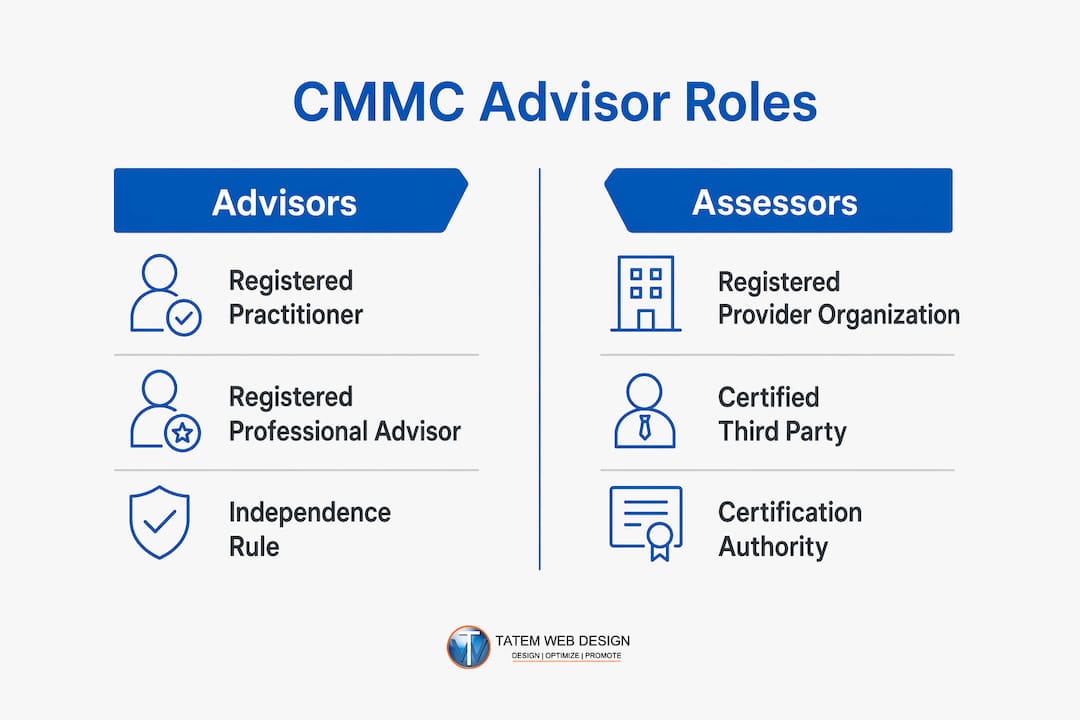
The independence rule is the most misunderstood aspect of the CMMC ecosystem. A strict three-year independence rule prohibits any firm that provided consulting or readiness services from also conducting that same client’s CMMC assessment. This rule exists to prevent conflicts of interest and preserve certification integrity. If a firm offers to both prepare you and assess you, that is a red flag, not a value-add.
When evaluating individual consultants, verify the specific people assigned to your engagement, not just the firm’s credentials. An RPO may be legitimately registered, but the individual practitioner working your account matters just as much. Ask for their RP or RPA certification number and verify it in the Cyber AB Marketplace.
Criteria for selecting a qualified CMMC assessment services provider include written independence policies, clearly stated scopes of work, demonstrated experience with your industry’s CUI handling practices, and verifiable references from prior DoD contractor clients. Thorough vetting of consultants by verifying individuals assigned, written independence policies, and demonstrated experience prevents costly compliance missteps.
Pro Tip: Search the Cyber AB Marketplace at cyberab.org before signing any contract. Every legitimate RPO and C3PAO is listed there. If a firm is not in the Marketplace, they are not operating within the official CMMC ecosystem.
Cost is also a practical filter. Full CMMC Level 2 readiness engagements range from $15,000 for small, templated environments to six figures for complex organizations with large CUI footprints. That range reflects scope, not quality. A smaller contractor with a well-defined CUI boundary and existing security controls can achieve readiness at the lower end of that range with the right consultant.
Steps involved in a typical CMMC consulting engagement
A well-run CMMC consulting engagement follows a defined sequence. Skipping steps or compressing the timeline creates documentation gaps that C3PAO assessors will find. Effective CMMC readiness typically takes 6 to 18 months, depending on your starting security posture and the complexity of your environment.
Here is the standard sequence for a Level 2 readiness engagement:
- Scoping and CUI/FCI identification. The consultant maps every system, application, and data flow that touches Controlled Unclassified Information (CUI) or Federal Contract Information (FCI). This scoping exercise defines the assessment boundary and directly affects cost and complexity.
- Gap analysis against NIST SP 800-171. Each of the 110 controls is evaluated against your current environment. The consultant scores your implementation status and calculates your preliminary SPRS score, which DoD contractors must self-report.
- Remediation planning and execution. The consultant builds a prioritized remediation roadmap. Your team executes the technical and administrative fixes, with the consultant providing guidance, reviewing configurations, and validating completed controls.
- System Security Plan authoring. The SSP is drafted to reflect your actual implemented environment, not a template. Every control narrative must be defensible under assessor scrutiny.
- POA&M development. Any controls not fully implemented by the assessment date are documented in the POA&M with realistic completion timelines. Assessors expect open POA&M items. What they do not accept is undocumented gaps.
- Evidence collection and index creation. Artifacts supporting each control are gathered, labeled, and organized into an evidence index. This package becomes the handoff document your C3PAO assessor reviews.
- Readiness review and mock assessment. Many consultants conduct an internal readiness review that simulates the C3PAO assessment process. This step surfaces last-minute gaps before the formal assessment.
- C3PAO assessment scheduling and handoff. The consultant prepares the final handoff package and coordinates with your chosen C3PAO.
The scheduling constraint deserves special attention. C3PAO assessment slots must be booked 6 to 9 months in advance due to limited assessor availability. Organizations that complete remediation quickly but failed to schedule early end up waiting months for an open slot. Book your assessment appointment before your remediation is complete, not after.
For businesses pursuing government contracting compliance, understanding these milestones upfront prevents the most common and costly mistake: treating CMMC as a sprint when it is a structured, evidence-driven process.
Why ongoing CMMC compliance management matters
CMMC certification is not a one-time event. It is a three-year cycle that requires continuous evidence management, policy maintenance, and security monitoring to remain valid. Organizations that treat certification as a finish line rather than a baseline consistently struggle during recertification assessments.
“Treating CMMC compliance as ongoing and evidence-driven allows companies to reduce audit surprises and maintain long-term readiness.” — Bitsight
The risk-management mindset behind this principle is practical. Personnel changes, new software deployments, network reconfigurations, and vendor additions all create potential compliance gaps. A CMMC compliance advisor who provides ongoing support catches these changes before they become assessment findings. Continuous monitoring and evidence tracking, rather than a one-time audit approach, is what prevents surprises during third-party assessments.
Consultants who specialize in ongoing compliance management typically provide quarterly evidence reviews, policy update cycles tied to NIST guidance changes, and supply chain risk monitoring for your subcontractors. The supply chain dimension is increasingly important. If your subcontractors handle CUI on your behalf, their compliance posture directly affects your certification status.
Technology tools are now central to sustained compliance. Platforms that automate evidence mapping, track control implementation status, and generate real-time compliance dashboards reduce the manual burden on your internal team. Open Approach’s validated CMMC Level 2 certification, independently verified in coordination with a certifying C3PAO, demonstrates how organizations that invest in structured, ongoing compliance programs achieve credible, defensible certification outcomes.
Pro Tip: Ask your consultant whether they use a GRC (Governance, Risk, and Compliance) platform to manage your evidence. Tools like Drata, Vanta, or a purpose-built CMMC platform automate evidence collection and flag control drift before it becomes a finding. Manual spreadsheet-based tracking is a liability at scale.
Ongoing compliance also carries a strategic advantage beyond avoiding penalties. DoD program offices increasingly favor contractors who demonstrate mature, continuous security practices over those who scramble to certify before contract award. Your compliance posture becomes a competitive differentiator in proposal evaluations.
Key takeaways
Choosing the right CMMC consultant requires verifying credentials, understanding independence rules, and committing to compliance as a continuous process rather than a one-time certification event.
| Point | Details |
|---|---|
| Verify consultant credentials | Confirm RP, RPA, or RPO status in the Cyber AB Marketplace before signing any contract. |
| Understand the independence rule | The firm that prepares you cannot assess you. A three-year separation is required by the Cyber AB. |
| Plan for 6 to 18 months | Readiness engagements take time. Book your C3PAO assessment slot 6 to 9 months before you expect to be ready. |
| Demand core deliverables | A defensible SSP, POA&M, and evidence index are the minimum outputs of any legitimate readiness engagement. |
| Treat compliance as continuous | Evidence management and policy maintenance between certification cycles prevent costly gaps during recertification. |
What I’ve learned from watching contractors get CMMC wrong
After working with dozens of businesses navigating cybersecurity compliance, the pattern I see most often is this: contractors underestimate the documentation burden and overestimate their starting security posture. They assume their existing IT setup is “mostly compliant” and expect a consultant to fill a few gaps. What they discover during the gap analysis is that their CUI boundary is poorly defined, their access controls are inconsistent, and their policies exist as templates they never actually implemented.
The second mistake I see is hiring a consultant based on price alone. A $5,000 “CMMC readiness package” from an unverified vendor is not a bargain. It is a liability. When the C3PAO assessor asks for evidence and your SSP does not match your actual environment, no amount of last-minute scrambling fixes that. The Cyber AB’s independence rules exist precisely because the stakes are high. The consultant who prepares you shapes the quality of your evidence. Cutting corners there costs you the contract.
What actually works is treating the consultant relationship as a partnership, not a transaction. The organizations I have seen succeed at CMMC certification share three traits: they started early, they vested their internal team in the process, and they chose a consultant who could explain every control in plain language rather than hiding behind jargon. Compliance is not a technical problem. It is an organizational discipline problem. The right consultant helps you build that discipline, not just produce paperwork.
My honest advice: schedule your C3PAO assessment slot before your remediation is finished. The assessor calendar is the binding constraint, not your readiness timeline. And once you are certified, do not let your evidence management lapse. The three-year recertification cycle arrives faster than you expect.
— Matt
How Tatemweb supports your cybersecurity and compliance goals
Tatemweb brings over 26 years of experience in cybersecurity compliance services to businesses across Florida and beyond, including CMMC Level 2 compliance consulting tailored for DoD contractors. Whether you need gap analysis support, SSP authoring, or ongoing compliance monitoring, Tatemweb’s team combines deep regulatory knowledge with AI-powered tools that automate evidence tracking and reduce your compliance overhead.

Explore Tatemweb’s AI security enhancements designed specifically for government contractors who need continuous monitoring and defensible compliance posture. You can also review the full range of CMMC compliance services available for Florida businesses. Call Tatemweb directly at 772-224-8118 to schedule a consultation and find out exactly where your organization stands before your next DoD contract opportunity arrives.
FAQ
What does a CMMC consultant actually do?
A CMMC consultant conducts gap analyses against NIST SP 800-171, builds remediation roadmaps, authors System Security Plans, and prepares your organization’s evidence package for a formal C3PAO certification assessment. They are advisory specialists, not assessors.
What is the difference between an RPO and a C3PAO?
An RPO provides non-certified advisory and readiness services, while a C3PAO conducts the official CMMC Level 2 certification assessment. These roles are strictly separated by the Cyber AB to prevent conflicts of interest.
How much does CMMC consulting cost?
CMMC Level 2 readiness engagements range from $15,000 for small, well-scoped environments to six figures for complex organizations. Cost depends on the size of your CUI footprint, your starting security posture, and the scope of remediation required.
How long does CMMC readiness take?
Most Level 2 readiness engagements take 6 to 18 months from initial gap analysis to assessment-ready status. The critical scheduling constraint is C3PAO availability, which requires booking assessment slots 6 to 9 months in advance.
Can the same firm consult and assess my organization?
No. The Cyber AB’s Code of Professional Conduct enforces a three-year independence rule that prohibits any firm from both preparing and assessing the same client for CMMC Level 2 certification. Any firm offering both services for the same engagement is operating outside the rules.
Recommended
Tatem Web Design
26+ YearsWeb Design & SEO Specialist · Tatem Web Design
Matt Tatem has been designing websites professionally since 1999, making Tatem Web Design one of Florida's longest-running web agencies. Based in Stuart, FL, he specializes in WordPress, local SEO, Shopify e-commerce, and cybersecurity consulting for small businesses.

Rank in ChatGPT in 90 Days With a Practitioner Led Checklist
Follow a practitioner led 90 day plan to get cited by ChatGPT: allow OAI-SearchBot, publish short answer capsules with schema, and track Bing AI Performance.

AI SEO Content Playbook: 16 GEO Signals for Agencies & Teams
A practical playbook mapping the GEO-16 signals to hands-on editorial workflows, review controls, and metrics. For agencies and in-house teams scaling AI...

Copy Ready Local Schema Markup for SMBs + Google Validation
Copy ready JSON-LD examples and Google validation steps for SMBs' local schema markup. Audit, implement, and verify each location page with confidence.