
Cybersecurity Consultant: What Business Leaders Must Know
Most business owners assume a cybersecurity consultant is someone who fixes technical problems after a breach. That assumption costs companies millions. The real role of a cybersecurity consultant, more precisely called an information security advisor in formal practice, is far more strategic. These professionals identify and assess security issues, then design layered defense strategies spanning prevention, detection, and response. For any organization serious about protecting revenue, reputation, and regulatory standing, understanding what these experts actually do is the first step toward using them effectively.
Table of Contents
- Key Takeaways
- What a cybersecurity consultant actually does
- Integrating cyber risk into enterprise risk management
- Compliance and regulatory obligations consultants help you meet
- OT and industrial cybersecurity: a different discipline
- How to hire a cybersecurity consultant who delivers real value
- My honest take on why most businesses underuse this resource
- How Tatemweb helps protect your business
- FAQ
Key Takeaways
| Point | Details |
|---|---|
| More than IT support | A cybersecurity consultant shapes risk strategy for executive leadership, not just your technical team. |
| Enterprise risk integration | Effective consultants embed cyber risk directly into your organization’s enterprise risk portfolio for governance oversight. |
| Compliance is non-negotiable | Consultants prepare documentation and evidence trails that satisfy SEC disclosure rules and industry audit requirements. |
| OT environments need specialists | Operational technology environments require consultants trained in IEC 62443 and safety-critical risk frameworks. |
| Credentials and deliverables matter | Ask for risk register integration artifacts and configuration validation evidence, not just a written report. |
What a cybersecurity consultant actually does
The title sounds technical, but the job is fundamentally about decision support. A skilled IT security consultant works at the intersection of technology and business strategy. They translate what is happening inside your systems into language your board, your CFO, and your legal team can act on.
The core services most consultants provide fall into a clear pattern:
- Vulnerability assessments and penetration testing: Identifying exploitable weaknesses across your network before attackers do. This includes network penetration testing against live environments, not just theoretical reviews.
- Security policy development: Writing and refining policies that govern how employees handle data, access systems, and respond to incidents. Without written policies, you have no audit trail and no legal protection.
- Incident response planning: Building a documented playbook so your team knows exactly what to do when, not if, a breach occurs.
- Risk assessment services: Mapping your threat exposure against your tolerance for disruption, financial loss, and reputational damage.
- Configuration validation: Verifying that your systems are actually set up securely, not just assuming they are because your vendor said so.
The best consultants do not stop at producing reports. They present findings in terms of business impact. A network security expert who tells you “you have an unpatched vulnerability in your VPN” is giving you half the picture. One who says “this vulnerability could expose patient records and trigger HIPAA penalties of up to $1.9 million” is giving you information you can act on immediately.
Pro Tip: When interviewing a prospective consultant, ask them to explain their last three findings in plain business terms. If they can’t do it without a glossary, they will struggle to communicate with your leadership team when it matters most.

Integrating cyber risk into enterprise risk management
This is where the gap between good consultants and great ones becomes visible. Most organizations treat cybersecurity as a separate silo managed by the IT department. The NIST Cybersecurity Framework 2.0 explicitly links cybersecurity outcomes to enterprise risk management and emphasizes communicating cyber risks directly to senior leaders. That is a policy shift with real consequences for how you structure your consulting engagement.
Here is how a well-structured cyber risk management engagement should unfold:
- Build a cybersecurity risk register. This is a living document that catalogs specific threat scenarios, not generic categories. Each entry includes the likelihood of the scenario occurring and the business impact if it does. NIST guidance updated in 2026 describes scenario-based risk documentation as the preferred method for prioritizing and monitoring risks over time.
- Score risks using likelihood and impact, separately. Collapsing both dimensions into a single number hides critical information. A low-likelihood, catastrophic-impact event deserves different treatment than a high-likelihood, low-impact one.
- Feed cyber risks into your enterprise risk portfolio. The NIST IR 8286C Rev. 1 framework makes clear that cybersecurity risk registers should not exist in isolation. They belong inside the broader enterprise risk profile that your board and executive team review alongside financial, operational, and legal risks.
- Report to leadership in business terms. Your consultant should prepare a summary that shows risk exposure in dollars and operational disruption, not in technical severity scores.
“Cyber risk registers should not be isolated but combined into holistic enterprise risk profiles for oversight.” — NIST IR 8286C Rev. 1
This integrated approach does something important. It removes cybersecurity from the IT department’s inbox and places it in the boardroom where funding, policy, and strategic decisions are made. When your data protection consultant can demonstrate that a specific unmitigated risk represents a $2.4 million exposure, budget conversations change quickly.
The practical benefit for you as a business owner is that you stop making security investments based on vendor fear, uncertainty, and doubt. You start making them based on prioritized, quantified risk information that aligns with your actual business objectives.
Compliance and regulatory obligations consultants help you meet
Regulatory requirements around cybersecurity have grown sharply. For publicly traded companies, SEC rules now require material incident disclosure within four business days of determining a breach is material, plus annual disclosures covering risk management processes and governance oversight. These are not suggestions. Non-compliance carries enforcement consequences that compound the damage of the original incident.
An experienced information security advisor helps you build compliance infrastructure before you need it under pressure:
- Documentation and evidence trails: Auditors do not accept verbal assurances. Your consultant should produce written policies, configuration validation records, and risk assessment outputs that can be presented during regulatory review.
- Framework alignment: Whether your obligation runs through HIPAA, PCI DSS, CMMC, or SEC governance rules, your consultant maps your controls to the specific requirements and identifies gaps before regulators do.
- Incident response documentation: Regulators want to see that you had a plan. Your consultant builds and tests that plan so you can demonstrate reasonable care.
- Audit readiness reviews: Scheduling internal assessments before external ones gives you time to remediate findings rather than explaining them under scrutiny.
Pro Tip: Request that your consultant deliver evidence artifacts alongside their recommendations. Security configuration checklists that produce verifiable security posture records are worth far more to your auditors than a consultant’s narrative summary alone.
If your business handles patient data, partnering with specialists who provide HIPAA compliance consulting ensures your cybersecurity program meets the specific technical safeguards and documentation standards that healthcare regulations require. Getting this right proactively is substantially cheaper than responding to an OCR investigation after the fact.
OT and industrial cybersecurity: a different discipline
If your organization operates manufacturing equipment, utilities infrastructure, building automation, or any industrial control system, standard IT cybersecurity consulting is not sufficient. Operational technology environments carry risks that simply do not exist in traditional office networks, and the consequences of a security failure extend beyond data loss into physical safety and operational continuity.
The table below captures the key differences between IT and OT consulting priorities:
| Dimension | IT cybersecurity | OT cybersecurity |
|---|---|---|
| Primary concern | Data confidentiality | Safety, availability, and process integrity |
| System downtime tolerance | Hours to days | Often near-zero tolerance |
| Patching flexibility | Frequent, scheduled | Constrained by vendor and operational windows |
| Governing standards | NIST CSF, ISO 27001 | IEC 62443, NIST CSF adapted for OT |
| Incident impact | Financial, reputational | Physical harm, environmental, regulatory |
OT-specialized consultants translate technical findings into operational risk language that production managers and operations leadership understand. Safety, availability, and integrity risks all require different mitigation approaches, and the right consultant knows that applying a standard IT patch policy to a programmable logic controller can shut down production or, in serious cases, create physical hazards.
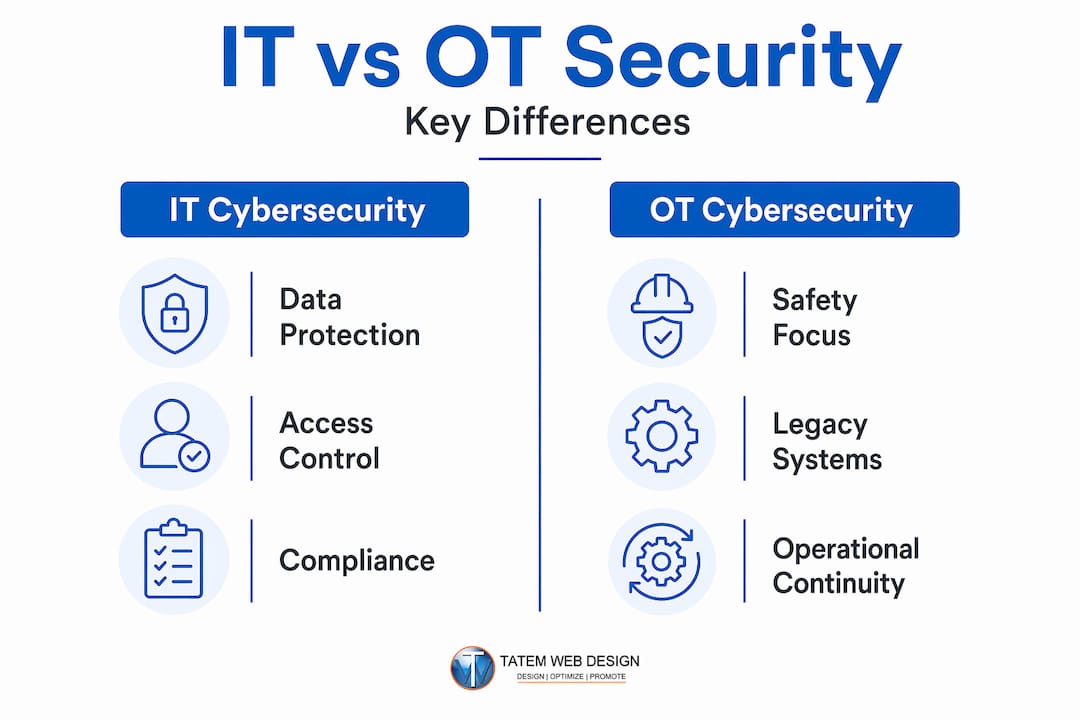
Assessments in this environment include readiness evaluations that account for legacy equipment with no security features, air-gap verification, network segmentation between operational and business networks, and vendor access controls. If your facility has not had an OT-specific security assessment, the risk exposure is likely higher than your IT reports suggest.
How to hire a cybersecurity consultant who delivers real value
Credentials matter, but they are a filter, not the final answer. Here is a process that consistently yields better outcomes than posting a job description and reviewing resumes.
- Define your scope before you search. Are you hiring for a one-time risk assessment, ongoing advisory support, compliance preparation, or all three? Consultants specialize, and the certifications relevant to governance work, such as CISSP or CISM, differ from those relevant to technical testing, such as CEH or OSCP.
- Ask for references from comparable organizations. A consultant who has worked extensively with healthcare providers understands HIPAA-specific risks in a way that a generalist cannot replicate quickly. Match their experience to your sector.
- Set deliverable expectations in writing. A risk register integration deliverable, as outlined in NIST IR 8286C, is more valuable than a standalone security report. Ask for outputs that plug into your existing risk management and reporting infrastructure.
- Require configuration validation evidence. Reports that describe what should be configured are useful. Records that prove what is actually configured are what auditors and executives need. Your consultant should use established checklist programs to produce documented proof of your security posture.
- Plan for ongoing engagement, not a single project. Threats evolve. A consultant who builds your risk register in January and never revisits it is giving you a snapshot that will be outdated by March.
Pro Tip: When reviewing proposals from top cybersecurity consulting firms, watch for consultants who default to generic frameworks without asking about your specific business processes first. The best engagements start with your operational reality, not a pre-built template.
The question of how to hire a cybersecurity consultant often comes down to communication fit as much as technical expertise. Your consultant will need to present findings to people who did not study computer science. Verify that ability before you sign a contract.
My honest take on why most businesses underuse this resource
I have worked alongside organizations of every size, and the pattern is nearly universal. Leadership treats cybersecurity as an IT expense until something goes wrong, and then it briefly becomes a crisis priority before sliding back into the technical team’s backlog. The irony is that the businesses getting the most value from a cybersecurity consultant are the ones using them proactively, before a breach, before an audit, and before a regulator calls.
What I have seen work is when the consultant’s deliverables land directly in front of the CEO and the CFO in language they recognize. Not a 40-page technical report but a one-page risk summary showing three scenarios, their financial exposure, and the cost of mitigation versus the cost of inaction. That conversation changes everything about how security investments get approved.
The thing that consistently surprises business owners is the leverage they gain. A well-scoped engagement covering cybersecurity risk assessments and risk register integration often surfaces five to ten material risks the organization had no visibility into. Fixing those risks costs a fraction of what a single breach event would cost, yet they went unaddressed because no one had framed them as business problems.
My advice is this: stop waiting for a triggering event. The businesses that treat their information security advisor as a strategic partner, not a vendor, build resilience that their competitors cannot replicate quickly. That advantage compounds over time.
— Matt
How Tatemweb helps protect your business
Tatemweb has spent over 26 years helping Florida businesses build security programs that go beyond technical fixes. As a full-service digital agency based in Stuart, Florida, Tatemweb combines expert cybersecurity consulting with AI-powered security enhancements that provide continuous monitoring and adaptive threat protection your business can rely on around the clock. From HIPAA and PCI compliance consulting to CMMC Level 2 readiness, the team delivers the kind of documentation and risk management outputs that satisfy auditors and inform executive decision-making. If you want to see what a properly scoped cybersecurity protection plan looks like for your specific industry and risk profile, call Tatemweb directly at 772-224-8118 to schedule a consultation.
FAQ
What does a cybersecurity consultant actually do?
A cybersecurity consultant identifies security vulnerabilities, designs layered defense strategies, develops security policies, and translates technical risk into business impact language for executive leadership. Their role spans prevention, detection, and incident response planning.
How is a cybersecurity consultant different from an IT manager?
An IT manager maintains daily operations and infrastructure, while a cybersecurity consultant focuses specifically on risk identification, threat modeling, compliance preparation, and strategic security governance. Consultants are typically engaged for specialized expertise rather than ongoing system management.
What credentials should I look for when hiring a consultant?
For governance and advisory work, look for CISSP or CISM certifications. For technical assessment work, CEH or OSCP credentials indicate hands-on testing capability. Always ask for references from organizations in your industry.
Do small businesses need cybersecurity assessment services?
Yes. Small and mid-sized businesses are frequently targeted precisely because their defenses are weaker than larger enterprises. A focused cybersecurity assessment can identify your highest-priority exposures at a fraction of the cost of recovering from a breach.
What is a cybersecurity risk register and why does it matter?
A cybersecurity risk register is a documented inventory of threat scenarios, each rated by likelihood and business impact. According to NIST guidance, integrating this register into your enterprise risk portfolio gives leadership the visibility needed to make informed decisions about security investments.
Recommended
Tatem Web Design
26+ YearsWeb Design & SEO Specialist · Tatem Web Design
Matt Tatem has been designing websites professionally since 1999, making Tatem Web Design one of Florida's longest-running web agencies. Based in Stuart, FL, he specializes in WordPress, local SEO, Shopify e-commerce, and cybersecurity consulting for small businesses.

Rank in ChatGPT in 90 Days With a Practitioner Led Checklist
Follow a practitioner led 90 day plan to get cited by ChatGPT: allow OAI-SearchBot, publish short answer capsules with schema, and track Bing AI Performance.

AI SEO Content Playbook: 16 GEO Signals for Agencies & Teams
A practical playbook mapping the GEO-16 signals to hands-on editorial workflows, review controls, and metrics. For agencies and in-house teams scaling AI...

Copy Ready Local Schema Markup for SMBs + Google Validation
Copy ready JSON-LD examples and Google validation steps for SMBs' local schema markup. Audit, implement, and verify each location page with confidence.