
Earn Perplexity Pages Citations in 3–4 Weeks for SEO Teams
Yes, Perplexity Pages can cite your content, but only if the page is built for extraction, not just ranking. The single highest-impact move you can make this week is twofold: insert a direct, sub-60-word answer under every H2, and confirm PerplexityBot can actually reach and render that content. Everything else on this checklist, crawl access, freshness, brand clarity, third-party evidence, builds on those two fixes.
TL;DR:
- Ensuring PerplexityBot can access your site requires explicit allow rules in robots.txt and no blocking WAF filters targeting AI crawlers.
- Insert a clear, under-60-word answer directly under each H2 on every page to improve extractability for Perplexity citations.
- Consistent branding, schema markup with current dates, and external evidence like press mentions significantly boost your chances of being cited.
- Conduct prompt testing by asking realistic buyer questions and tracking citation improvements over several weeks to measure progress.
- Most citations occur within a few weeks after structural and crawl access improvements, not from content quality alone.
Table of Contents
- What Signals Does Perplexity Look for on a Page?
- The Five-Pillar Perplexity Readiness Checklist
- How Do You Execute a 3 to 4 Week Perplexity Optimization Plan?
- Quick Implementation Checklist for Technical and Content Fixes
- How Do You Measure Perplexity Citations and Referral Value?
- How Tatemweb Puts This Playbook Into Practice
- Why Being Cited Beats Being Ranked
- Get Help Building Perplexity-Ready Pages
- Where to Verify These Claims and Read Further
- Sources
- FAQ
What Signals Does Perplexity Look for on a Page?
Perplexity’s retrieval layer checks a handful of concrete signals before it ever gets to synthesis. Miss one and your content, however good, never reaches the shortlist.
Crawlability first. Check robots.txt for explicit PerplexityBot rules, review your web application firewall or CDN logs for blocked requests, and confirm the bot’s hits are actually landing in your server logs. A WAF rule written to stop scrapers will often catch AI crawlers as unintended collateral damage.
Extractability second. Perplexity favors short, self-contained answer chunks, with cited paragraphs running around 43 words on average, plus comparison tables and list-shaped FAQs it can lift without rewriting.
Freshness and brand clarity round out the list.
- A visible last-updated date paired with
dateModifiedschema, since many cited URLs were refreshed within roughly 90 days of the Page’s generation - Consistent entity naming across your About page, schema markup, and
sameAssocial profiles - External evidence: press mentions, partner pages, and review profiles that corroborate what your own page claims
The Five-Pillar Perplexity Readiness Checklist
A practical framework for Perplexity SEO breaks down into five pillars, and they work in sequence, not in isolation. Skipping crawl access to jump straight to content polish is like painting a house with the front door boarded shut.
- Crawl access. Explicitly allow PerplexityBot in
robots.txt, audit WAF rules for AI-crawler exceptions, and confirm bot hits in your access logs. - Answer-ready structure. Every H2 gets a direct answer under 60 words, followed by supporting detail, tables, or a short FAQ block.
- Brand entity clarity. Standardize your business name, update schema, and align
sameAslinks across every profile that mentions you. - External evidence. Secure press coverage, partner page mentions, directory listings, and active review profiles that back up your claims independently.
- Measurement. Build a small prompt map of queries your buyers actually type, then track which URLs get cited and what happens after the click.
Pro Tip: Run your own homepage or cornerstone service page through three or four realistic buyer prompts in Perplexity right now. If your competitor gets cited and you don’t, the gap is almost always pillar one or pillar two, not your writing quality.
How Do You Execute a 3 to 4 Week Perplexity Optimization Plan?
Treat this like a newsroom sprint, not a quarterly SEO project. Each week has a distinct job, and skipping ahead usually means redoing work later.
Week 1: Access audit. Pull your robots.txt file and confirm there’s no blanket disallow catching PerplexityBot. Check your WAF and CDN dashboards for any rule that challenges or blocks AI user agents. Sample your server logs for PerplexityBot hits over the past 30 days. Run a render test on your top five pages to confirm content loads without requiring heavy client-side JavaScript.
Week 2: Content rewrites. Go page by page and insert a direct answer chunk under each H2. Convert dense paragraphs into comparison tables where a table communicates faster than prose. Build a five to eight question FAQ block using the exact phrasing your buyers use in search.
Week 3: Evidence work. Pitch a short press mention or update an existing partner page that links back to you. Refresh your Google Business Profile and any industry directory listing with current, consistent business details. Ask a partner or vendor to update their citation of your business if it’s outdated.
Week 4: Measurement and iteration. Run your prompt map against the rewritten pages. Track which URLs now appear in citations that didn’t before. Compare referral sessions and note anything that moved.
By the end of week four, you should have a documented before-and-after for at least three cornerstone pages, and a repeatable process for the rest of your site.
Quick Implementation Checklist for Technical and Content Fixes
These are the exact moves to make once the audit above surfaces a gap.
- Robots.txt line. Add an explicit allow rule for the PerplexityBot user agent near the top of the file, and avoid a catchall disallow that inadvertently sweeps it up.
- WAF rule review. Search your firewall’s bot-management rules for anything targeting “AI crawlers” or “scrapers” as a category, since these often net PerplexityBot without naming it.
- Answer-chunk recipe. Under each H2, write one paragraph that states the direct answer in the first sentence, adds one qualifying detail in the second, and stops before 60 words.
- Schema and dates. Add
ArticleorFAQPageschema with an honestdateModifiedvalue, and display that same date visibly on the page, not buried in the footer. - Log verification. Filter server logs by user agent string for PerplexityBot and confirm hits correspond to the pages you just updated.
How Do You Measure Perplexity Citations and Referral Value?
Perplexity referral sessions show up in most analytics platforms as a distinct referrer, so tag your cornerstone URLs and watch that segment separately from organic search.
Run a small, fixed set of prompts, ten to fifteen realistic buyer questions, on a monthly cadence and log which domains get cited each time. That prompt-level testing is the only reliable way to confirm a structural change actually moved the needle, since Perplexity’s citations shift with source updates elsewhere on the web too.
Track four numbers: citation rate across your prompt set, click-through from cited URLs where visible, assisted conversions tied to Perplexity-referred sessions, and downstream behavior like time on page. Perplexity’s own reported user growth, tracked in app download data, suggests the referral channel is only going to matter more over the next few quarters, not less.
- Refresh cornerstone pages periodically to stay within the freshness window that seems to matter most for citations.
- Re-run your prompt map after every major content update, not just on a quarterly schedule.
How Tatemweb Puts This Playbook Into Practice
Turning a dense service page into an answer-chunk asset is mechanical once you know the pattern, but it takes time most in-house teams don’t have. Tatemweb’s AI content creation work restructures existing pages into the direct-answer, table, and FAQ format Perplexity favors, while AI SEO optimization handles the crawl-access audit, schema updates, and log verification that make extraction possible in the first place. For businesses layering in chatbots or lead capture on top of that content, business AI agent setup connects the two.
Why Being Cited Beats Being Ranked
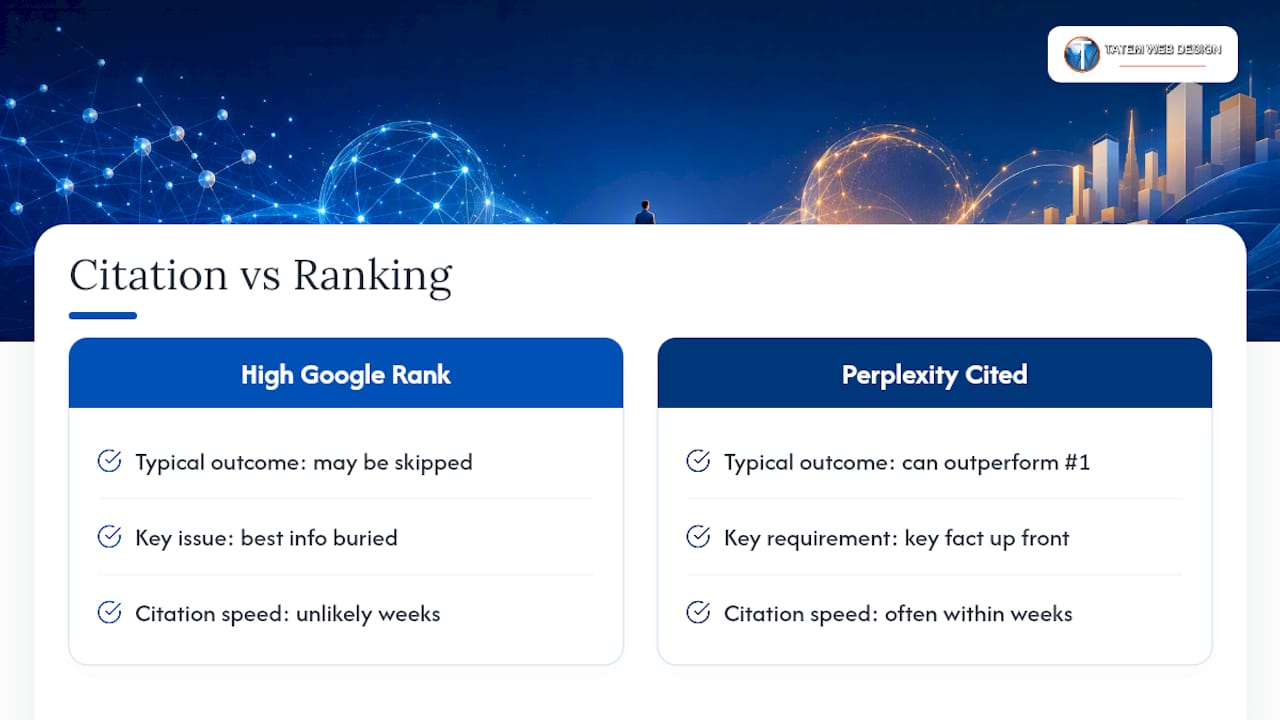
Most SEO teams still chase position one and treat citations as a bonus. That’s backwards. A page ranked tenth on Google can outperform a page ranked first if the tenth-place page is the one Perplexity actually lifts into its answer.
I’ve seen the gap between “well-optimized” and “extraction-ready” content up close: a page can have solid backlinks and clean on-page SEO and still get skipped, simply because its best information sits three paragraphs deep instead of in the first sentence under the heading. Restructure that one paragraph, and the citation often follows within weeks.
— Matt
Get Help Building Perplexity-Ready Pages
Most agencies still price and structure their SEO work around Google rankings alone, leaving Perplexity citations as an afterthought nobody audits. This audit is built into the process from the start: crawl access checks, answer-chunk rewrites, and schema fixes bundled into one engagement instead of separate vendor invoices.
If you’re not sure where your own pages stand, Tatemweb’s AI SEO optimization service starts with exactly the crawl and extractability audit this article walks through, then moves into the content rewrites and measurement setup to track results. Businesses that need the underlying site rebuilt for speed and clean rendering, a real factor in whether PerplexityBot can parse your content at all, can pair that with reliable hosting starting at $41.99 per month on the Launch plan. Call 772-224-8118 or visit the AI services page to get a straight answer on where your cornerstone pages currently stand.
Where to Verify These Claims and Read Further
Perplexity’s own Help Center and llms.txt guidance remain the canonical technical reference. For tactical depth, review the Auspia five-pillar framework, the Ranki Pages guide, and this partner AEO playbook.
Sources
Perplexity Pages are persistent, shareable explainers built from cited web sources, launched as a creator-facing feature that turns a research session into a standing published asset. Unlike a search results page that refreshes every time someone queries it, a Page sticks around, gets indexed, and keeps citing the URLs that fed it.
How does a URL earn a spot in that citation list? Perplexity runs live retrieval, ranks candidate pages against the query, then synthesizes an answer with a large language model. That ranking step rewards content that is easy to lift cleanly, not content that merely ranks well on Google.
This is the part classic SEO practitioners underestimate: keyword density and backlink profiles matter less here than whether a paragraph can stand alone as a quotable answer. Freshness and source diversity carry more weight than they do in traditional search, which means a page that hasn’t been touched in a year is competing at a real disadvantage regardless of its domain authority.
- Perplexity SEO: How to Optimize Your Brand for AI Search, Citations, and Referral Traffic | AuspiaAI Blog
- Perplexity Pages Explained — and How to Get Into Them (2026 Guide)
FAQ
What Is a Perplexity Page?
A Perplexity Page is a persistent, publicly shareable explainer built from cited web sources, introduced as a feature that turns a research query into a standing published asset.
How Does PerplexityBot Access My Site?
PerplexityBot crawls your site the way other bots do, respecting robots.txt rules, so you need an explicit allow rule and a WAF configuration that doesn’t mistakenly block its user agent string.
What Is llms.txt and Do I Need One?
llms.txt is a discovery file referenced in Perplexity’s Help Center documentation that helps AI systems understand your site’s structure; it’s not mandatory, but it supports faster, cleaner discovery.
How Long Does It Take to Get Cited on Perplexity Pages?
There’s no fixed timeline, but structural fixes like answer chunks and confirmed crawl access can produce citation changes within a few weeks once retested against your prompt map.
Can Tatemweb Help With Perplexity SEO Specifically?
Yes. Tatemweb’s AI SEO optimization service covers the crawl audit, content restructuring, and measurement setup this playbook describes, priced on request based on your site’s scope.
Recommended
Tatem Web Design
26+ YearsWeb Design & SEO Specialist · Tatem Web Design
Matt Tatem has been designing websites professionally since 1999, making Tatem Web Design one of Florida's longest-running web agencies. Based in Stuart, FL, he specializes in WordPress, local SEO, Shopify e-commerce, and cybersecurity consulting for small businesses.

Rank in ChatGPT in 90 Days With a Practitioner Led Checklist
Follow a practitioner led 90 day plan to get cited by ChatGPT: allow OAI-SearchBot, publish short answer capsules with schema, and track Bing AI Performance.

AI SEO Content Playbook: 16 GEO Signals for Agencies & Teams
A practical playbook mapping the GEO-16 signals to hands-on editorial workflows, review controls, and metrics. For agencies and in-house teams scaling AI...

Copy Ready Local Schema Markup for SMBs + Google Validation
Copy ready JSON-LD examples and Google validation steps for SMBs' local schema markup. Audit, implement, and verify each location page with confidence.