
SEO Trends in 2026: What Marketers Must Prioritize
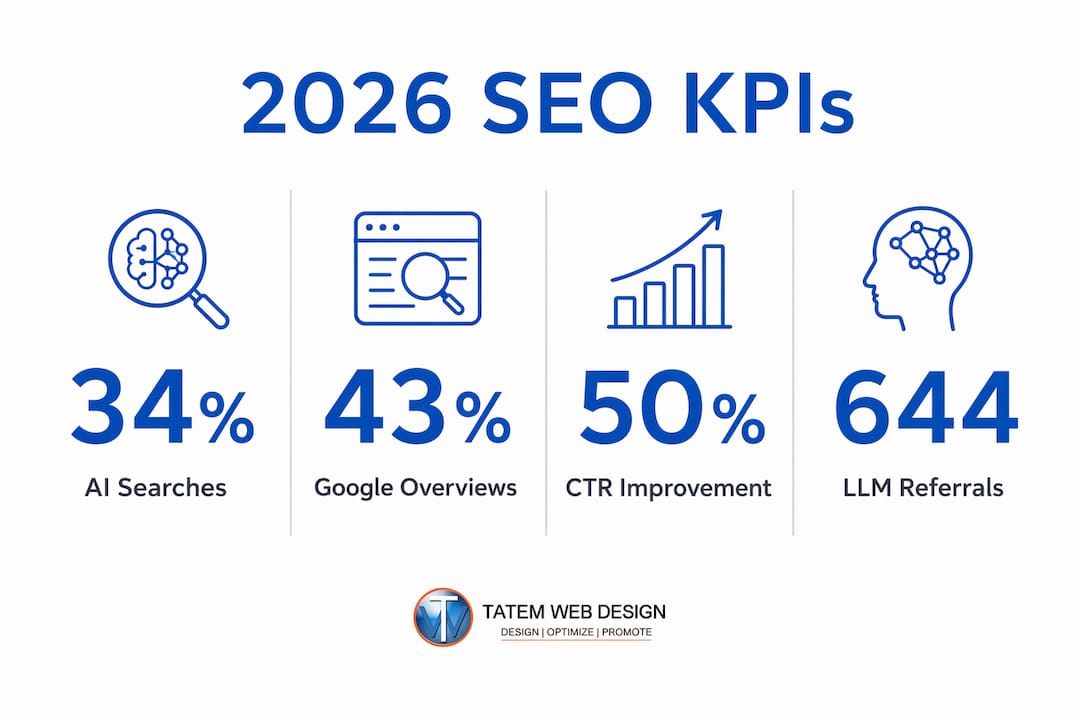
The six highest-impact SEO trends shaping 2026 are AI-driven search with Generative Engine Optimization (GEO) and Answer Engine Optimization (AEO), Trust-forward E-E-A-T with visible first-hand experience, LLM citation optimization for ChatGPT and Perplexity, branded-search growth as a ranking signal, video and social search on YouTube and TikTok, and entity-level Knowledge Graph optimization. Your single most urgent action this quarter: audit whether your top-traffic pages are structured to be cited by AI Overviews, because 34% of online searches now route through AI-powered surfaces outside traditional Google organic results.
Here is where to focus across your team right now:
- SEO lead: Run a GEO/AEO citation audit on your top 20 pages. Check whether each page opens with a concise, sourceable answer.
- Content team: Add author pages with verifiable credentials, original data, and dated first-hand details to every high-value article.
- Brand/PR: Launch a structured brand-mention campaign across podcasts, trade media, and YouTube to increase citation probability in AI responses.
- Product/Dev: Implement Organization, Person, and HowTo schema across your site. Fix Core Web Vitals and confirm mobile-first indexing is clean.
- Analytics: Add LLM referral tracking, branded-search volume, and AI Overview citation counts to your reporting dashboard.
Pro Tip: Before you touch a single piece of content, open ChatGPT, Claude, and Perplexity and search your brand name plus your top service category. What comes back tells you exactly where your citation gap is today.
Table of Contents
- What are the biggest SEO trends in 2026 for AI-driven search?
- Why does Trust now outrank raw expertise in Google’s 2026 quality standards?
- How do you get cited by ChatGPT, Claude, and Perplexity?
- Why are brand signals replacing some backlink dependency in 2026?
- How should you treat YouTube and TikTok as search engines in 2026?
- How do you keep humans in the loop with AI-assisted content?
- How does entity SEO and Knowledge Graph optimization improve AI visibility?
- What KPIs and tools should you use to measure SEO in 2026?
- What does the data say about LLM referrals and search-surface distribution?
- What is the 90/180/365-day SEO playbook for 2026?
- Key Takeaways
- The SEO priorities I would focus on if I ran search in 2026
- Tatemweb’s AI-integrated SEO services can accelerate your 2026 playbook
- Sources and further reading
- FAQ
What are the biggest SEO trends in 2026 for AI-driven search?
GEO and AEO are not optional upgrades to your existing SEO process. They are a parallel discipline with their own success metrics, and the gap between classic organic rank and AI citation visibility is wider than most teams realize. The overlap between top-10 Google organic results and AI Overview citations shrank to just 17%–38% in April 2026. Ranking first in Google does not mean you appear in the AI Overview for the same query.
Google AI Overviews now appear in 43% of searches, up from 15% just a year ago. AI Mode visits increased dramatically over the past year, reflecting strong user adoption. These systems cite sources based on conciseness, factual verifiability, and structural clarity, not just domain authority. A page that opens with a 40-word direct answer to the query, followed by two supporting facts and a named source, is far more likely to be pulled into an AI Overview than a 3,000-word article that buries its conclusion.
The practical shift: Google is no longer primarily a gateway to your website. For a growing share of queries, it is the destination. Your content must be structured to satisfy the query on the results page while still earning the click for users who want depth.
Tactically, here is what increases your citation probability in AI Overviews and AI Mode:
- Open every page with a direct, 30–50 word answer to the primary query.
- Include two to three verifiable supporting facts with named sources inline.
- Use clear H2 and H3 question headings that mirror natural language queries.
- Add FAQ schema and HowTo schema where the content supports it.
- Keep paragraphs short. AI systems prefer extractable chunks, not dense prose.
Pro Tip: Test your pages by pasting your target query into Google’s AI Mode and Perplexity. If your page is not cited, look at what is. Copy the structural pattern, not the content, of the pages that do appear.
New search constructs like “query fan-out” and “llms.txt” spiked in keyword volume through 2025–2026, signaling that keyword research itself needs a refresh. Add these emerging terms to your taxonomy and track how AI systems interpret multi-step queries in your niche.

Why does Trust now outrank raw expertise in Google’s 2026 quality standards?
Google’s March 2026 core update was one of the most volatile on record, and the pattern across sites that gained and lost visibility was consistent: Trust and visible first-hand Experience outperformed comprehensive-but-impersonal content. The 2026 revision to Google’s Quality Rater Guidelines elevated Trust as the most important letter in E-E-A-T and expanded the examples of what first-hand Experience looks like on a page.
From the 2026 QRG analysis: “Content that demonstrated genuine firsthand involvement — specific details, original outcomes, and verifiable author credentials — began to outperform content that was comprehensive but impersonal.” Sites that added structured author pages with verifiable credentials saw measurable ranking improvements within weeks of the March update.
The practical implication is that author identity now functions as ranking infrastructure. A well-researched article with no named author, no credentials, and no original data is increasingly vulnerable. Here is the checklist your editorial team needs to meet 2026 QRG expectations:
- Author pages: Real name, verifiable credentials, consistent bylines across your site and external publications.
- First-hand content signals: Original photos, screenshots, specific outcome data, and dated case details on every high-value page.
- Editorial oversight: A visible editorial policy and clear site ownership signals (About page, contact information, named team members).
- Structured data: Article schema with author markup, Person schema on author pages, and Organization schema at the site level.
- External validation: Author mentions, citations, or profiles on reputable external sites that help Google connect your content to a recognized entity.
For YMYL content, including healthcare, legal, and financial topics, the stakes are higher. E-E-A-T signals correlate with roughly 24% of ranking weight for YMYL queries, compared to about 8% across all queries. If your site touches any of those categories, treat these signals as a baseline requirement, not an optimization tactic.
Recovery after the March 2026 update followed a specific pattern: sites that regained visibility added genuine experience layers, including first-person outcome sections, original data, and author credentials tied explicitly to specific claims. Surface-level rewrites without added substance did not move the needle. For service-based businesses, a professional services website guide that builds trust signals into the site architecture from the start is far more effective than retrofitting them later.
Pro Tip: Google’s own John Mueller has said E-E-A-T is not something you add to a page after the fact. If the underlying experience does not exist, no author bio format will fix it. Build the experience first, then document it.
How do you get cited by ChatGPT, Claude, and Perplexity?
Ranking first in Google and being cited by an LLM are two different outcomes that require two different strategies. SEO has effectively split into Traditional SEO (targeting blue-link rankings) and Citation SEO (optimizing to be used as a source by LLMs and AI Overviews). Teams that resource only one of these are leaving visibility on the table.
What LLMs look for when selecting sources comes down to four factors:
- Concise, verifiable claims. LLMs prefer pages where the key fact is stated clearly in the first paragraph, not buried in paragraph eight.
- Named entities and structured facts. Specific tool names, organization names, statistics with sources, and defined concepts increase citation probability.
- Strong brand signals. Pages from brands with consistent off-site mentions, knowledge panel presence, and high branded-search volume are cited more frequently.
- Clear provenance. Inline references, named authors, and visible publication dates signal that the content is trustworthy and attributable.
On-page implementation that improves LLM citation likelihood includes: opening each page with a “lead answer” paragraph of 30–50 words, using definition-style H2 headings (“What is X?”), adding inline citations to named sources, and including a structured FAQ section at the bottom of key pages.
For measurement, track LLM referrals in Google Analytics 4 by filtering for referral traffic from chatgpt.com, perplexity.ai, and claude.ai. These numbers are still small for most sites, but brands recorded hundreds of thousands of trackable LLM-referred sessions per month recently, with ChatGPT dominating this referral traffic. The trend is directionally clear even if the absolute volume is modest today. Set up a monthly report now so you have a baseline when volume grows.
Tatemweb’s AI agent setup services include NemoClaw, Claude, and Perplexity integrations that can help you understand how these systems interact with your content and where your citation gaps are.
Why are brand signals replacing some backlink dependency in 2026?
Branded search volume and off-site brand mentions now correlate strongly with AI visibility. Investing in brand mentions across relevant outlets, including podcasts, YouTube, and trade media, materially increases citation probability in both Google AI Overviews and LLM responses. The mechanism is straightforward: AI systems are trained on the web, and brands that appear consistently across authoritative sources are treated as more reliable references.
A brand SERP audit is the fastest way to identify your gaps. Check these five areas:
- Knowledge panel: Does your brand have one? Is the information accurate and complete?
- NAP consistency: Is your business name, address, and phone number identical across Google Business Profile, your website, and major directories?
- About page: Does it clearly state who you are, what you do, and who leads the organization?
- Wikipedia or Wikidata presence: For larger brands, a Wikidata entry strengthens entity recognition.
- Branded search volume trend: Is it growing? A flat or declining branded search trend is a signal that your brand-building activity needs attention.
Low-effort wins that grow brand mentions include: submitting to industry directories, appearing as a guest on relevant podcasts, publishing original research that other sites cite, and maintaining an active YouTube channel with consistent branding. Each of these creates a named-entity signal that both Google and LLMs can reference.
Pro Tip: Set up a Google Alert and a brand-mention monitoring tool for your brand name, your key team members’ names, and your top service categories. Unlinked mentions are nearly as valuable as linked ones for entity recognition. Reach out and request a link when it makes sense.
How should you treat YouTube and TikTok as search engines in 2026?
YouTube and TikTok are primary discovery surfaces for a significant and growing share of queries, particularly for how-to, product review, and local service searches. Optimizing for these platforms is no longer a social media task. It is a core component of multi-surface SEO.
For YouTube, the search optimization levers are:
- Titles: Mirror the exact language your audience uses in search queries. “How to [specific task] in [specific context]” consistently outperforms creative or branded titles for discovery.
- Chapters and timestamps: Add chapter markers with keyword-rich labels. YouTube surfaces these in search results and Google sometimes pulls them into AI Overviews.
- Transcripts: Upload a corrected transcript. YouTube’s auto-captions are indexable but error-prone. A clean transcript improves both search ranking and accessibility.
- Descriptions: Write the first 150 characters as a standalone summary. Include your primary keyword and a link back to the relevant page on your site.
For TikTok, the optimization priorities shift:
- Hook the viewer in the first two seconds. TikTok’s algorithm weights completion rate heavily, and a strong opening drives both retention and search visibility.
- Use on-screen captions. TikTok indexes caption text for search, and captions improve accessibility.
- Research hashtags as keywords. TikTok’s search function treats hashtags as topic signals. Use three to five specific hashtags per video rather than broad ones.
- Pin a comment with a link to your website or a related resource. This creates a citation path back to your domain.
Cross-posting video content to YouTube Shorts, Instagram Reels, and your own site’s blog (with an embedded transcript) multiplies the citation signal without multiplying production effort. The AI-powered website features that support video embedding and structured content display make this syndication workflow significantly easier to manage at scale.

How do you keep humans in the loop with AI-assisted content?
AI is a production tool, not a Trust signal. The central safeguard in 2026 is human oversight: AI drafting speeds output, but E-E-A-T-compliant content requires human-authored experience, verification, and visible provenance. Teams that skip the human layer are producing content that looks complete but fails quality review.
The workflow that passes both quality and Trust tests looks like this:
- Prompt design: Brief the AI with specific context, including the author’s credentials, the target audience, and the primary claim the piece must support.
- Draft pass: Use AI to generate structure, pull in supporting facts, and draft body sections. Treat the output as a first draft, not a finished product.
- SME review: A subject-matter expert reads the draft and adds first-hand details, corrects inaccuracies, and flags any claims that lack verifiable sources.
- Original data integration: Add at least one piece of original data, a screenshot, a specific outcome, or a dated case detail that the AI could not have generated.
- Final editorial sign-off: A named editor reviews for accuracy, tone, and E-E-A-T compliance before publication.
Red flags that signal an AI-first process will be penalized: bulk content generation with no named authors, anonymous bylines, no original data or images, and identical page structures across dozens of URLs. Google’s 2026 QRG tightened site reputation abuse rules, making third-party guest sections and leased subdomains riskier without integrated editorial oversight.
A substantial majority of marketing teams now use AI-powered SEO tools for keyword research and on-page optimization. The competitive advantage is no longer in using AI. It is in using it better than your competitors while keeping the human quality layer intact. Tatemweb’s AI content creation services are built around exactly this human-in-the-loop model.
Pro Tip: Add a “How this article was created” disclosure to your author page or editorial policy. Transparency about your AI-assisted process, combined with named human oversight, is a Trust signal, not a liability.
How does entity SEO and Knowledge Graph optimization improve AI visibility?
Structured entities are the connective tissue between your content and the AI systems that cite it. When Google and LLMs can identify your brand, your authors, and your content topics as consistent named entities with verifiable attributes, your citation probability increases across every surface.
The schema types that deliver the most impact in 2026:
- Organization schema: Name, URL, logo, contact information, and social profiles. This is the foundation of brand entity recognition.
- Person schema: For each named author, include name, job title, affiliation, and links to external profiles (LinkedIn, industry publications).
- Article schema: With author, datePublished, dateModified, and publisher fields populated.
- HowTo schema: For any instructional content. These are frequently pulled into AI Overviews.
- Dataset schema: If you publish original research or data, marking it up as a Dataset increases citation probability significantly.
Internal linking reinforces entity context. Build topic clusters where a pillar page covers the broad concept and supporting pages cover specific subtopics, all linking back to the pillar. This pattern tells both Google and LLMs that your site has depth on a given entity, not just a single page.
Author pages deserve their own entity treatment. Each author page should include Person schema, a consistent headshot, a list of published articles on your site, and links to the author’s external profiles. This is the single fastest way to connect your content to a recognized human entity in Google’s Knowledge Graph.
Pro Tip: Use Google’s Rich Results Test and Schema Markup Validator after every schema implementation. Errors in structured data are invisible to the naked eye but immediately visible to crawlers. A broken Organization schema does more harm than no schema at all.
What KPIs and tools should you use to measure SEO in 2026?
Traffic alone is no longer a sufficient measure of SEO performance. A page that appears in 50 AI Overviews per month but drives zero clicks is still delivering brand visibility and citation authority. Your reporting stack needs to reflect the multi-surface reality of search in 2026.
| Metric | Source | Collection Method | Cadence |
|---|---|---|---|
| Organic click-through rate by page | Google Search Console | Export top pages report | Weekly |
| AI Overview citation count | Third-party AI tracking tools | Manual audit + automated alerts | Monthly |
| LLM referral sessions | Google Analytics 4 | Referral source filter (chatgpt.com, perplexity.ai) | Monthly |
| Branded search volume | Google Search Console | Brand query filter | Monthly |
| Core Web Vitals (LCP, INP, CLS) | Search Console / PageSpeed Insights | Automated monitoring | Weekly |
| Video search impressions | YouTube Studio / TikTok Analytics | Platform native reports | Monthly |
| Brand mention volume | Brand monitoring tools | Automated alerts | Weekly |
| Assisted conversions | GA4 multi-touch attribution | Conversion path report | Monthly |
A multi-surface measurement stack combining Search Console, AI Overview tracking, brand-mention listening, and video analytics is now the baseline for demonstrating real SEO return on investment. Teams that report only on organic sessions are systematically undercounting the value of their SEO work.
For tooling, you need coverage across four categories: traditional rank tracking, AI citation monitoring, brand mention listening, and video analytics. No single tool covers all four. Build a stack that pulls data into a unified monthly report, and assign a named owner to each data source.
The AI SEO optimization services Tatemweb provides include reporting setup that covers these multi-surface KPIs, so you are not building the measurement infrastructure from scratch.
What does the data say about LLM referrals and search-surface distribution?
The headline number: 34% of online searches in 2026 occur on AI-powered discovery surfaces outside traditional Google organic results. That is not a projection. It is a measured share from an industry report covering current search behavior.
Search-surface distribution in 2026 breaks down roughly as follows. Google AI Overviews now appear in 43% of searches, up from 15% a year ago, per Similarweb data reported by TechCrunch. AI Mode visits reached 279 million by May 2026. On the LLM side, brands recorded 644,478 trackable LLM-referred sessions per month as of May 2026, with ChatGPT holding 92.4% of that referral share. Only a small minority of U.S. ChatGPT desktop queries currently include citations, though this share is growing, and the proportion of visits landing on webpages increased significantly following a recent search update.
The traffic displacement reality: A peer-reviewed study found that Google’s AI Overviews reduced daily traffic to English Wikipedia articles by approximately 15% after their introduction. For Culture articles, the decline was larger compared to other topics. These are not projections from a vendor with a product to sell. They are causal estimates from a difference-in-differences research design across 161,382 matched article-language pairs.
For visualization, plot these four data series on a single timeline chart: Google organic click-through rate trend, AI Overview appearance rate, LLM referral session volume, and branded search volume. The divergence between organic CTR and AI Overview appearance rate is the clearest visual argument for investing in GEO/AEO now.
What is the 90/180/365-day SEO playbook for 2026?
The prioritization principle is simple: low-effort, high-Trust wins first. The actions that take one to two weeks and directly address the 2026 QRG Trust mandate deliver faster, more durable returns than technical projects that take months to implement. Start with what Google and LLMs are already evaluating, then build the infrastructure underneath.
90-day priorities (days 1–90)
- GEO/AEO citation audit (SEO lead, 2 weeks): Review your top 20 pages. Add a 30–50 word lead answer to each. Implement FAQ schema.
- Author page rollout (Content lead, 3 weeks): Create or update author pages with real credentials, headshots, and Article schema with author markup.
- LLM citation pilot (SEO lead, 1 week): Set up GA4 referral tracking for chatgpt.com, perplexity.ai, and claude.ai. Establish your baseline.
- Brand SERP audit (Brand/PR, 1 week): Check knowledge panel accuracy, NAP consistency, and About page completeness.
- Core Web Vitals fix (Dev, 2–4 weeks): Address any LCP or INP failures flagged in Search Console.
180-day priorities (days 91–180)
- Entity schema implementation (Dev + SEO, 4 weeks): Deploy Organization, Person, and HowTo schema across the site.
- Brand mention campaign (Brand/PR, ongoing): Secure three to five podcast appearances or trade media placements per month.
- Video search optimization (Content, ongoing): Optimize YouTube channel with chapters, corrected transcripts, and keyword-rich descriptions.
- AI-assisted content workflow (Content lead, 2 weeks to set up): Implement the prompt-draft-SME-review-sign-off process for all new content.
365-day priorities (days 181–365)
- Topical authority build (Content, ongoing): Publish pillar-and-cluster content structures for your two to three core topic areas.
- Original research publication (Content + Brand, quarterly): Publish one original data study per quarter to generate citations and brand mentions.
- Multi-surface reporting dashboard (Analytics, 4 weeks): Build the unified dashboard covering all eight KPIs from the measurement section.
| Action | Owner | Effort | Business Impact |
|---|---|---|---|
| GEO/AEO citation audit | SEO lead | Low (1–2 weeks) | High: direct AI visibility gain |
| Author page rollout | Content lead | Low (2–3 weeks) | High: Trust signal, ranking recovery |
| Brand mention campaign | Brand/PR | Medium (ongoing) | High: AI citation probability |
| Entity schema deployment | Dev + SEO | Medium (4 weeks) | Medium: Knowledge Graph presence |
| Original research publication | Content + Brand | High (quarterly) | High: long-term citation authority |
Only 19% of small businesses have optimized content for AI-powered search experiences as of 2026. That gap is your competitive opening. The 90-day actions above are exactly where Tatemweb’s AI business services for SMBs can accelerate execution for teams without the internal bandwidth to run this playbook alone.
Key Takeaways
The single most important shift in SEO for 2026 is that AI-driven surfaces now account for 34% of searches, making GEO/AEO optimization and Trust-forward E-E-A-T the two non-negotiable priorities for any team that wants to maintain and grow visibility.
| Point | Details |
|---|---|
| AI surfaces demand parallel strategy | 34% of searches route through AI-powered platforms; optimize for citation probability alongside traditional rank. |
| Trust outranks raw expertise | The 2026 QRG elevated Trust above Expertise; author pages with real credentials are now ranking infrastructure. |
| LLM citations are measurable now | ChatGPT holds 92.4% of LLM referral traffic; set up GA4 tracking for chatgpt.com, perplexity.ai, and claude.ai today. |
| Brand signals reduce backlink dependency | Consistent off-site mentions across podcasts, YouTube, and trade media directly increase AI citation probability. |
| Tatemweb accelerates the playbook | Tatemweb’s AI SEO, author-credentialed content, and entity schema services map directly to the 90-day priority actions above. |
The SEO priorities I would focus on if I ran search in 2026
The conventional wisdom in SEO right now is to treat AI Overviews as a threat to manage. That framing is wrong, and it leads teams to defensive tactics, blocking AI crawlers, chasing zero-click mitigation, when the real opportunity is to become the source AI systems cite.
If I were running SEO strategy today, my top three priorities would be: first, restructure every high-value page for citation probability, not just rank position. The 17%–38% overlap between Google’s top-10 organic results and AI Overview citations means you can rank well and be invisible in AI responses simultaneously. Those are two separate problems requiring two separate fixes. Second, treat author identity as technical infrastructure. The March 2026 core update made this concrete: sites that added structured author pages with verifiable credentials saw measurable ranking improvements within weeks. This is not a content quality nicety. It is a ranking signal that most sites have not fully implemented. Third, invest in brand mentions before you need them. The brands that appear consistently in LLM responses are the ones that have been building off-site entity signals for months or years. You cannot manufacture that overnight, but you can start a structured campaign today.
The client relevance here is direct. The playbook items that deliver the fastest returns, author page rollouts, entity schema, AI citation audits, and brand mention campaigns, are exactly the services Tatemweb delivers for Florida businesses…
Tatemweb’s AI-integrated SEO services can accelerate your 2026 playbook
The 2026 SEO playbook requires more than content updates. It requires a site architecture that signals Trust to both Google and LLMs, author infrastructure that meets the new QRG standards, and a measurement stack that tracks performance across every search surface. That is a significant lift for any team managing it without dedicated support.
Tatemweb builds AI-powered websites with entity schema, author markup, and GEO/AEO-ready page structures built in from day one, not retrofitted later. The services that map directly to the playbook priorities above include AI SEO optimization, AI-assisted content writing with human editorial sign-off, AI agent and chatbot implementation for brand engagement, and brand SERP work including knowledge panel setup and NAP consistency audits. For Florida businesses that need to move fast on the 90-day priorities, Tatemweb provides the technical and content execution so your team can focus on strategy. Call 772-224-8118 or visit Tatemweb’s AI services page to schedule a consultation and get a clear picture of where your site stands today.
Sources and further reading
Authoritative sources cited in this article, with brief annotations for follow-up research:
- Google’s AI search is rapidly becoming the default | TechCrunch — Similarweb data on AI Overview appearance rates, AI Mode visit growth, and ChatGPT citation and referral trends through May 2026.
- Impact of AI Search Summaries on Website Traffic | arXiv — Peer-reviewed difference-in-differences study estimating a 15% traffic reduction to English Wikipedia pages after Google AI Overview rollout across 161,382 article-language pairs.
- AI SEO by the Numbers: 2026 Industry Report | Overrank — Survey-based industry report covering search-surface distribution, AI tool adoption rates, and small-business AI optimization gaps.
- AI Traffic Report July 2026 | Previsible — LLM referral session data showing 644,478 monthly sessions and ChatGPT’s 92.4% share of that traffic as of May 2026.
- SEO Industry Intelligence Report 2026 | AI SEO Journal — Industry intelligence data on the 17%–38% overlap between Google organic top-10 and AI Overview citations, and the Traditional SEO vs. Citation SEO framework.
- 10 SEO Trends Firsthand in 2026 | Ahrefs — Practitioner analysis of keyword-volume shifts, brand-mention correlation with AI visibility, and the GEO/AEO parallel-discipline framework.
- E-E-A-T Audit 2026: Quality Rater Guidelines Changes | FastTool — Detailed breakdown of the 2026 QRG revisions, including Trust elevation, site reputation abuse tightening, and author transparency requirements.
- E-E-A-T in 2026: What Google Actually Requires | Time Business News — Analysis of the March and May 2026 core updates, YMYL ranking weight data, and recovery patterns from sites that added Experience signals.
- Google Search Quality Rater Guidelines | Google — The primary operational document Google uses to train quality raters; the definitive reference for E-E-A-T criteria and YMYL standards.
FAQ
What are the top SEO trends in 2026?
The top trends are AI-driven search optimization (GEO and AEO), Trust-forward E-E-A-T with visible first-hand experience, LLM citation optimization for ChatGPT and Perplexity, branded-search growth as a ranking signal, and video search on YouTube and TikTok. Structuring content for AI Overview citation probability is the single highest-impact action for most sites this year.
How does Google AI Overviews affect organic traffic?
AI Overviews now appear in 43% of Google searches as of July 2026, and a peer-reviewed study found they reduced daily traffic to cited pages by approximately 15%. The overlap between top-10 Google organic results and AI Overview citations is only 17%–38%, meaning high organic rank does not guarantee AI visibility.
What is the difference between GEO and traditional SEO?
Traditional SEO targets blue-link rankings in Google’s organic results. Generative Engine Optimization (GEO) targets citation probability in AI-generated answers from Google AI Overviews, ChatGPT, Claude, and Perplexity. These require different page structures, formatting, and success metrics, and teams should resource both as separate disciplines.
How do you track LLM referral traffic?
Set up a referral source filter in Google Analytics 4 for chatgpt.com, perplexity.ai, and claude.ai. Brands recorded 644,478 LLM-referred sessions per month as of May 2026, with ChatGPT accounting for 92.4% of that volume. Establishing a baseline now lets you measure growth as LLM referral traffic scales.
How quickly can E-E-A-T improvements affect rankings?
Sites that added structured author pages with verifiable credentials and first-hand content signals after the March 2026 core update saw measurable ranking improvements within weeks. Surface-level rewrites without genuine Experience additions generally did not produce results, so the quality of the additions matters more than the speed of implementation.
Recommended
Tatem Web Design
26+ YearsWeb Design & SEO Specialist · Tatem Web Design
Matt Tatem has been designing websites professionally since 1999, making Tatem Web Design one of Florida's longest-running web agencies. Based in Stuart, FL, he specializes in WordPress, local SEO, Shopify e-commerce, and cybersecurity consulting for small businesses.
What a CMMC Level 2 Assessment Requires and How to Prepare
Prepare for your CMMC Level 2 assessment by understanding requirements, assessment paths, and mapping your Controlled Unclassified Information.

A Data Retention Policy Is Your Rulebook for Keeping and Deleting Data
Establishing a clear data retention policy helps manage data risk, ensuring compliance and effective data management for your organization.
Law Firm Local SEO: A Practical Playbook for More Local Clients
Unlock more local clients for your law firm with effective local SEO strategies. Optimize your Google Business Profile and boost your visibility!