
Professional website design: An expert guide for Florida businesses
Florida’s business landscape is more competitive than ever, and if you believe a polished template from a drag-and-drop builder is enough to win customers online, that assumption is quietly costing you revenue. The gap between a website that looks good and one that actually works, ranks, converts, and scales is enormous. For small to medium-sized businesses in Florida, that gap can mean the difference between steady lead flow and digital invisibility. This guide cuts through the confusion and gives you a clear, practical picture of what professional website design actually means, why it matters for your market, and how AI is reshaping what’s possible right now.
Table of Contents
- What defines professional website design?
- DIY vs. professional: Side-by-side comparison
- Core principles: Function and user experience
- AI in professional website design: Automation and digital marketing
- Red flags and must-avoid mistakes in web design
- Our perspective: Why local expertise and ongoing strategy matter most
- Next steps: Florida web design for growth, automation, and security
- Frequently asked questions
Key Takeaways
| Point | Details |
|---|---|
| DIY vs. Professional Impact | DIY websites cost less at first but struggle to scale or convert, while professional design unlocks higher ROI. |
| Core Design Principles | Mobile optimization, user testing, and SEO are essential for online success in 2026. |
| AI Integration | AI tools streamline marketing, automate routine tasks, and create smarter customer experiences. |
| Pitfalls to Avoid | Too many plugins, poor layouts, and skipping SEO basics all hurt site performance and rankings. |
| Value of Local Experts | Local Florida web designers deliver ongoing support, compliance, and market insights for lasting growth. |
What defines professional website design?
Now that we’ve debunked the myth that appearance alone leads to success, let’s define what actually sets professional website design apart from the templates and DIY shortcuts most business owners try first.
Professional website design is not about picking the prettiest layout. It is a business-driven process that aligns your website’s structure, content, and performance with your specific goals. That means building for your actual customers, not for a generic internet user. It means your site loads fast on a phone in Stuart, Florida, just as easily as it does on a desktop in Miami. And it means every button, headline, and image is placed with purpose.
Here are the core elements that separate a professionally designed website from a DIY build:
- Custom branding: Your logo, colors, fonts, and visual identity are built consistently into every page so customers recognize and trust you immediately.
- Mobile-first optimization: Over 60% of web traffic comes from mobile devices, and Google indexes mobile versions of sites first. Professional design prioritizes mobile layouts, not just responsiveness as an afterthought.
- Clear calls to action (CTAs): Every page guides visitors toward the next step, whether that’s calling your office, filling out a form, or buying a product.
- Strong SEO foundation: Clean code, semantic HTML, proper heading structure, optimized metadata, and fast load times are built in from the start, not bolted on later.
- Scalability: Your website is architected to grow with your business, whether you add new services, locations, or e-commerce capabilities down the road.
- Security: Professional builds include SSL certificates, secure forms, and software management practices that protect you and your visitors.
DIY templates can look attractive, but they lack optimization and scale. A custom professional design carries a higher upfront cost, but businesses consistently see 100 to 400% conversion ROI improvements compared to template builds. That is not a small margin. That is the difference between a site that pays for itself and one that quietly drains your marketing budget.
If you are exploring modern alternatives, AI website design offers another level of capability, pairing smart automation with professional custom builds. Many Florida businesses are now using AI to build websites that are faster to launch, easier to update, and better equipped to convert visitors into customers.
Pro Tip: The investment in professional design is not a cost, it is a revenue multiplier. When you track leads and conversions over 12 months, expert-built sites consistently outperform DIY alternatives by a measurable margin.
DIY vs. professional: Side-by-side comparison
Understanding the core features is one thing, but what do these choices look like side-by-side? Here’s a direct comparison for Florida business owners weighing their options.
| Factor | DIY/Template | Professional Design |
|---|---|---|
| Upfront cost | Low ($0 to $500) | Moderate to high ($2,000+) |
| Load speed | Often slow | Optimized for fast performance |
| SEO readiness | Limited/basic | Built-in, strategic |
| Mobile optimization | Basic template response | Custom mobile-first design |
| Conversion rate | Low (1 to 2%) | Higher (3 to 8%+) |
| AI/automation support | Very limited | Fully integrated |
| Scalability | Hits walls quickly | Designed for long-term growth |
| Security | Plugin-dependent | Built-in security architecture |
| Ongoing support | Self-service only | Professional team available |
The numbers tell the real story. A DIY site with a 1% conversion rate on 1,000 monthly visitors generates 10 leads. A professionally designed site with a 5% conversion rate on the same traffic delivers 50 leads. That is five times the business from the exact same audience, without spending more on ads.
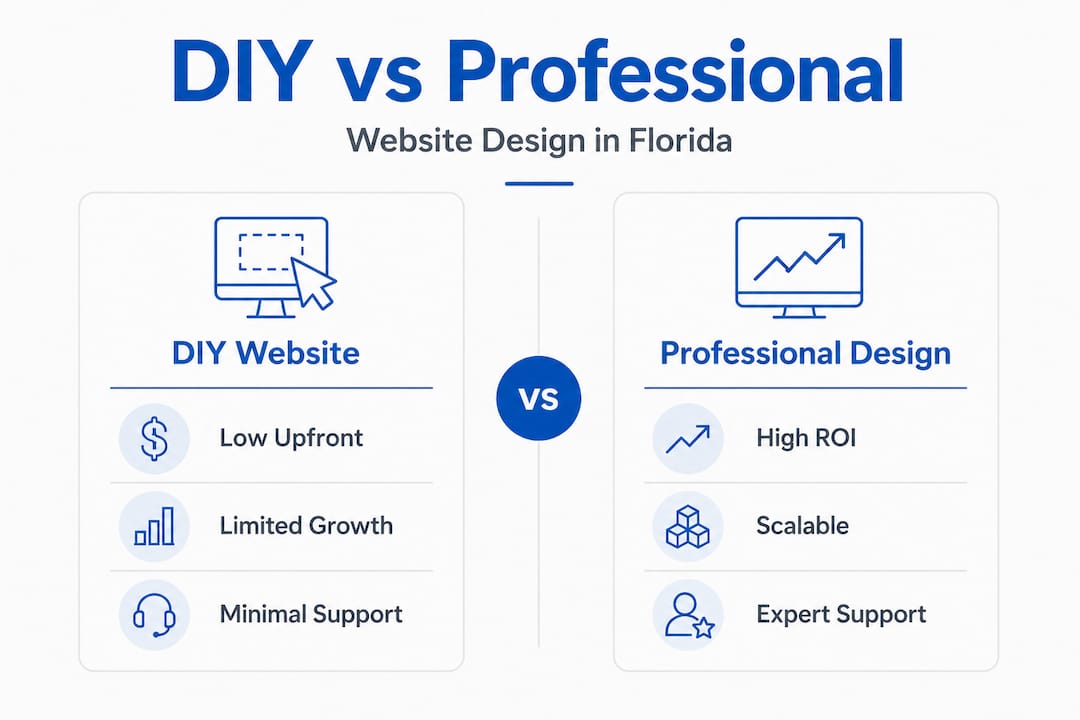
DIY tools like Wix and Squarespace are genuinely fast and cheap to start. That is their advantage. But they hit limits quickly when your business grows, when you need custom booking flows, when you want to integrate a CRM, or when you want your site to appear at the top of Google search results for competitive Florida keywords. Templates are built for average needs. Your business is not average.
Professional designs also make it far easier to build a secure AI eCommerce site when you are ready to sell products online, because the architecture is already in place to handle payment processing, inventory integration, and customer account management securely.
Pro Tip: If your Florida business wants both visibility in local search and the ability to scale your services, professional design wins decisively on long-term gains. Think of it as building on a solid foundation versus renting a temporary space.
Core principles: Function and user experience
With those differences clear, let’s dig into what makes a website stand out in both appearance and practical results, because knowing what to look for helps you make smarter decisions.
User-centered design is the foundation. That means the website is built around your customer’s needs, expectations, and behaviors, not just your preferences as the business owner. Professional designers create user personas, conduct usability testing, and structure navigation so visitors find what they need in three clicks or fewer. When visitors struggle to find information, they leave. And they rarely come back.
Google has formalized the technical standards for user experience through Core Web Vitals, a set of measurable signals that directly influence your search rankings. The three key metrics are:
- LCP (Largest Contentful Paint): How quickly the largest element on your page loads. It should load in under 2.5 seconds.
- INP (Interaction to Next Paint): How fast your page responds when a user clicks, taps, or types. Under 200 milliseconds is ideal.
- CLS (Cumulative Layout Shift): Whether your page jumps around as it loads, which frustrates users and signals poor quality to Google.
“Core Web Vitals including LCP, INP, and CLS are now critical for Google rankings and directly affect how your site performs in organic search results.”
Failing any of these three metrics can push your website below competitors in search results, no matter how good your content is. Professional designers build with these standards in mind from day one, while most DIY templates are not architected to meet them without significant manual intervention.
AI and automation tools perform best when they are layered onto a custom, branded user experience. Trying to add chatbots or lead automation to a poorly structured template often creates friction rather than reducing it. A solid technical base is what allows smart tools to do their job well. If you want to understand how fast website development connects directly to revenue, the relationship between speed and conversions is direct and measurable.
For businesses serving specific Florida communities, local design expertise also matters. Firms like those serving Hutchinson Island web design clients understand the regional context, seasonal traffic patterns, and local audience behavior that generic providers simply do not factor in.
AI in professional website design: Automation and digital marketing
Modern web design is not just about code or looks. It is increasingly about smart automation driven by AI. Here’s what that means for your Florida business in practical terms.
Florida small and medium-sized businesses are using AI tools to automate tasks that used to require staff time or expensive marketing agencies. From routing incoming leads to the right salesperson, to sending personalized follow-up emails, to showing different website content based on visitor behavior, AI is turning websites into active business tools rather than passive brochures.
| AI Tool | Primary Function | Business Benefit |
|---|---|---|
| AI chatbots (e.g., nemoclaw) | 24/7 customer Q&A and lead capture | Never miss a lead, even after hours |
| AI email automation | Personalized follow-up sequences | Higher open rates and repeat visits |
| AI SEO content tools | Automated blog and page optimization | Consistent search visibility |
| AI lead scoring | Prioritizes high-value prospects | Sales team focuses on best leads |
| Perplexity Computer | Research and competitive intelligence | Faster strategy decisions |
| openclaw | Business workflow automation | Reduces manual admin tasks |
Here is a practical numbered process for integrating AI into your existing or new website:
- Audit your biggest time drains. Identify where your team spends time on repetitive tasks, like answering the same questions or manually following up with leads.
- Choose AI tools that solve specific problems. Do not adopt AI for the sake of it. Match tools to the gaps you identified in step one.
- Integrate AI with your CRM or booking system. Connecting your website’s AI chatbot or lead form to your customer management system creates seamless data flow.
- Test with real users before going live. Run your AI features with a small group of real customers to catch friction points before full launch.
- Review performance monthly. AI tools improve when you monitor their output and refine their settings based on real conversion data.
The key principle is to prioritize custom UX alongside AI integration. A chatbot that interrupts your user experience does more harm than good. AI should feel invisible and helpful, not intrusive. Pairing AI features with a well-designed site ensures they enhance rather than disrupt the visitor journey.
For Florida businesses particularly concerned about online threats, learning how to use AI to secure your website is another critical layer of the modern professional site strategy.
Pro Tip: Do not chase every new AI feature that launches. Prioritize the tools that solve a real, documented problem in your customer journey. One well-integrated AI chatbot that captures leads overnight is worth more than five half-implemented tools that confuse visitors.
Red flags and must-avoid mistakes in web design
Before you invest in a new website, know these costly pitfalls that even the best intentions can create, especially for Florida businesses working with tight budgets and high competition.
The most common and damaging mistake is plugin overload. Sites that run more than 35 plugins experience a 23% slowdown in loading speed, and slow sites lose rankings and visitors fast. WordPress sites are particularly vulnerable to this issue, because the ease of adding plugins makes it tempting to keep layering on features without removing old ones.
Other critical errors that hurt Florida businesses include:
- Ignoring mobile design: Building a desktop-first site and hoping it adapts to mobile is not enough in 2026. Specific mobile layouts, button sizing, and navigation menus must be designed intentionally.
- Low-contrast text: Text that blends into the background fails accessibility standards and makes your site harder to read for a large portion of your audience, including older Florida demographics.
- Crowded CTAs: Having too many competing calls to action on one page confuses visitors and reduces the likelihood that they take any action at all.
- Skipping speed tests: Most business owners never run a speed test after their site goes live. Google PageSpeed Insights is free and reveals exactly where your site is losing performance.
- Non-semantic HTML: This is a coding issue where the underlying structure of your pages does not clearly communicate their meaning to search engines. It quietly undermines your SEO without any visible signs.
- Layout shifts (high CLS scores): When images, fonts, or ad blocks load after the text and push content around, it creates a jarring experience and signals low quality to Google.
- No ongoing testing: Launching a site and never reviewing its analytics, heatmaps, or A/B test results means you are flying blind on what works.
“CLS scores above 0.1 and layout instability are among the fastest ways to lose search ranking and visitor trust simultaneously.”
Even with AI tools in place, skipping strategy and testing produces poor growth. AI cannot fix a fundamentally broken user experience. The technical foundation must be solid before automation adds real value. For businesses in retail or service industries, avoiding these mistakes is especially important because eCommerce conversions depend on trust, speed, and clean design working together.
Our perspective: Why local expertise and ongoing strategy matter most
So what’s our take after helping hundreds of Florida businesses compete and succeed online? The technology matters, but it is not the most important variable. The most important variable is whether your web design partner actually understands your market, your customers, and your business goals well enough to make ongoing strategic decisions on your behalf.
Out-of-state or generic web agencies often deliver technically adequate websites that fail in the Florida market. They do not understand the seasonal shifts in customer behavior in coastal communities. They do not know the compliance landscape for healthcare or legal businesses operating under Florida statutes. They do not factor in local search patterns, the hyper-local competition in markets like Stuart, Fort Pierce, or Palm City, or the specific trust signals that Florida consumers respond to. A site built for a generic American audience is not the same as a site built for your Florida customers.
What makes the real difference over time is ongoing performance strategy. A professional web partner does not just build your site and walk away. They review your analytics quarterly, identify pages that are losing traffic or conversions, recommend content updates based on local search trends, and keep your technical foundation current as Google’s algorithms evolve. That kind of iterative improvement is what compounds into real ROI.
We have also seen that businesses operating across multiple locations benefit enormously from structured growth strategies. Exploring multi-location web growth options with a partner who builds for scale means you do not have to rebuild your entire site every time you open a new office or service area.
Here is the uncomfortable truth most agencies will not say: a beautiful website without a strategic partner behind it is a depreciating asset. The internet changes constantly. Your competitors are investing. If your site is static, you are falling behind even if you do nothing wrong. You need someone asking the right questions about your business every few months, not just once when the project kicks off.
Pro Tip: When evaluating web design partners, listen for the questions they ask you. A great partner asks about your customers, your sales process, your top revenue drivers, and your five-year goals. A vendor just asks about your colors and logo preferences.
Next steps: Florida web design for growth, automation, and security
If you’re ready to put these ideas into action, here’s how to get started and why local expertise makes a difference.
The principles in this guide are actionable right now, and you do not have to figure them out alone. At Tatem Web Design, we have spent over 26 years helping Florida businesses build websites that generate real leads, rank in local search, and grow securely. We specialize in custom AI website design, AI-powered e-commerce, local SEO, cybersecurity compliance, and AI chatbot integration for businesses across industries including real estate, healthcare, legal, marine, and professional services.
Whether you are launching a new site, replacing an underperforming template, or ready to add AI automation to your current setup, we have the tools and the local expertise to move fast without cutting corners. Our AI-powered builds are optimized for security, speed, and search visibility from day one. Call us directly at 772-224-8118 to schedule a no-pressure consultation and find out exactly how we can help your Florida business grow with the latest AI-integrated web solutions.
Frequently asked questions
How much does professional website design cost compared to DIY?
DIY websites are cheaper upfront, but professional design consistently offers stronger ROI because custom pro design typically increases conversions by 100 to 400% over template builds, paying for itself through increased leads and sales.
What technical standards should a professional website meet in 2026?
Your website should meet Core Web Vitals standards for speed (LCP), interactivity (INP), and visual stability (CLS), as these metrics directly influence your Google rankings and visitor experience.
How does AI improve a professional website?
AI automates lead generation, personalizes marketing messages for each visitor segment, and strengthens your site’s security posture while improving the overall user experience through smarter navigation and faster responses.
What are the most common mistakes in DIY website design?
The top mistakes include plugin bloat above 35, neglecting mobile-specific design, and skipping SEO fundamentals like proper heading structure, metadata, and page speed optimization.
Do I need a local Florida designer, or can I use an out-of-state provider?
A local expert understands Florida’s unique search patterns, seasonal business behavior, and regional compliance considerations, giving you a competitive advantage that out-of-state providers simply cannot replicate from a distance.
Recommended
- Industry website design examples to inspire your Florida business | Tatem Web Design
- Mobile responsive design to boost your Florida business | Tatem Web Design
- Web Design Stuart Florida | #1 Rated Website Design Company | Tatem Web Design
- Technology Website Design FL - Tech Company Websites | Tatem Web Design
Tatem Web Design
26+ YearsWeb Design & SEO Specialist · Tatem Web Design
Matt Tatem has been designing websites professionally since 1999, making Tatem Web Design one of Florida's longest-running web agencies. Based in Stuart, FL, he specializes in WordPress, local SEO, Shopify e-commerce, and cybersecurity consulting for small businesses.
What a CMMC Level 2 Assessment Requires and How to Prepare
Prepare for your CMMC Level 2 assessment by understanding requirements, assessment paths, and mapping your Controlled Unclassified Information.
A Data Retention Policy Is Your Rulebook for Keeping and Deleting Data
Establishing a clear data retention policy helps manage data risk, ensuring compliance and effective data management for your organization.
Law Firm Local SEO: A Practical Playbook for More Local Clients
Unlock more local clients for your law firm with effective local SEO strategies. Optimize your Google Business Profile and boost your visibility!