
The Role of Digital Branding in Business Growth
Digital branding is the strategic practice of shaping and managing your brand’s identity and reputation across every online channel to build trust and drive business growth. The industry term for this discipline is “brand identity management,” but most business owners and marketers know it by its practical name. A 2026 quantitative study of 130 respondents confirmed that digital branding strategies have a positive and significant impact on competitive advantage, with brand trust identified as the single most influential factor in online customer decisions. That finding reframes branding from a design exercise into a revenue driver. When you control how customers perceive your business online, you control the conditions under which they decide to buy.
What are the key components of the role of digital branding?
Digital branding is not one thing. It is a system of four interconnected components, and weakness in any one of them undermines the others.
Online brand presence is the foundation. Presence means your business appears consistently and credibly wherever your customers look, whether that is Google Search, social media, or a local directory. Without visible presence, no other branding effort reaches its audience. A well-built website, active social profiles, and accurate business listings all contribute to presence.

Digital engagement is how your brand creates an emotional connection with customers. Engagement goes beyond likes and shares. It includes the tone of your customer service emails, the way your chatbot responds to questions, and how your content makes a reader feel understood. Customers who feel a genuine connection with a brand return more often and refer others more readily.
Content consistency is the pillar most businesses underestimate. Consistency means your messaging, visual identity, and tone stay recognizable across every channel, from your website to your Instagram caption to your invoice template. Consistency builds brand recognition and reduces friction in buying decisions. When customers recognize you instantly, they spend less mental energy deciding whether to trust you.
Brand trust is the outcome all three components build toward. Trust is the most influential factor in online customer decisions, and it does not appear overnight. It accumulates through repeated, coherent experiences. A customer who sees the same professional tone on your website, in your emails, and in your social posts begins to expect reliability. That expectation becomes trust.
- Presence: Be visible where your customers search, including Google, social platforms, and industry directories.
- Engagement: Communicate with warmth and clarity at every touchpoint, not just in marketing campaigns.
- Consistency: Use the same voice, colors, and core message across your website, email, and social media.
- Trust: Deliver on every promise your brand makes, from response time to product quality.
Pro Tip: Map every customer touchpoint your business owns, from the first Google result to the post-purchase email. Then audit each one for tone and visual consistency. Gaps in that map are where trust erodes.
Building a strong brand presence online requires more than a good logo. It requires a deliberate system that works the same way every time a customer encounters you.
How does digital branding influence competitive advantage and business growth?
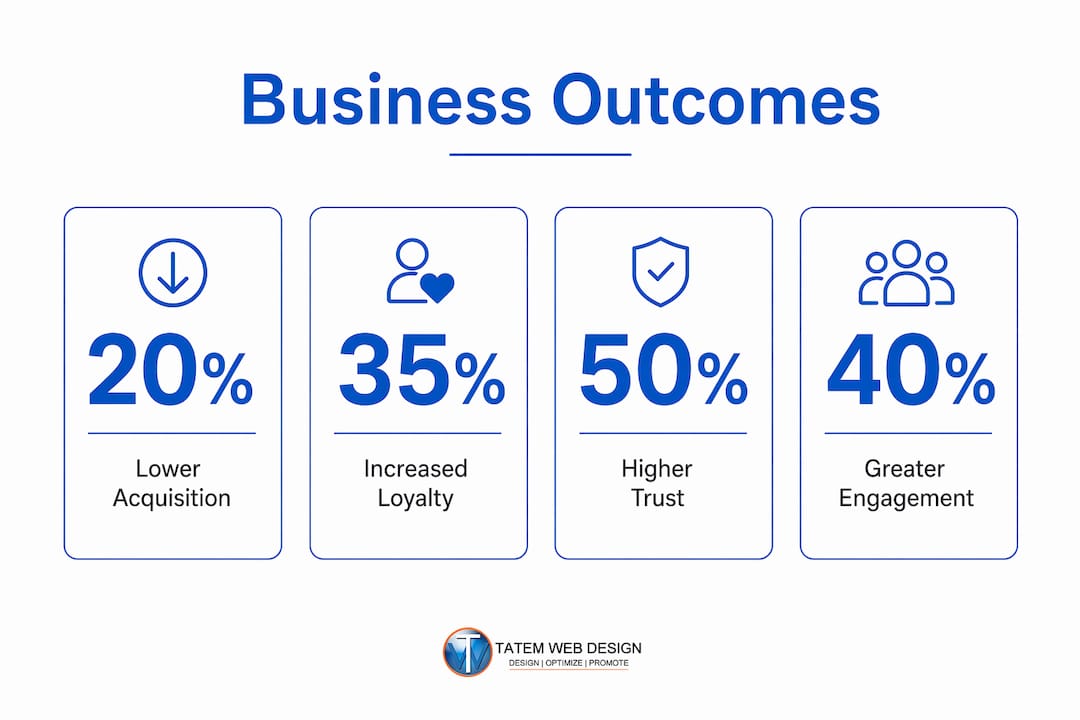
The business case for digital branding is measurable, not theoretical. A strong digital brand reduces cost per acquisition, improves conversion rates, shortens sales cycles, and reinforces customer retention. Each of those outcomes compounds over time, meaning the brand you build this year lowers your marketing costs next year.
Brand trust reduces consumer uncertainty. When a prospect lands on your website and immediately recognizes a consistent, professional identity, they spend less time evaluating whether you are credible. That shortened evaluation period translates directly into faster purchase decisions. For service businesses in Florida, where referrals and reputation drive a significant share of new business, this effect is especially powerful.
“A strong digital brand does not just attract customers. It removes the obstacles that stop them from buying. Trust is the mechanism that converts attention into revenue.”
Consistent messaging also lowers acquisition costs across paid and organic channels. When your brand identity is clear, your advertising copy writes itself. Your sales team spends less time explaining who you are and more time closing. Your content ranks better because it signals authority on a defined topic rather than scattered expertise.
The table below summarizes the key business outcomes tied to strong digital branding.
| Business Outcome | How Digital Branding Drives It |
|---|---|
| Lower cost per acquisition | Recognized brands require less persuasion at each touchpoint |
| Higher conversion rates | Trust reduces hesitation and shortens the decision process |
| Shorter sales cycles | Consistent messaging pre-qualifies prospects before contact |
| Stronger customer retention | Emotional connection and reliability reduce churn |
| Pricing power | Trusted brands compete on value, not just price |
Digital branding and digital marketing are not the same thing. Marketing is the set of tactics you use to reach customers, including ads, SEO, and email campaigns. Branding is the identity those tactics carry. Digital branding functions as a comprehensive strategic mechanism rather than a single promotional activity. Marketing without branding generates traffic. Branding without marketing generates recognition without reach. You need both, but branding sets the conditions under which marketing succeeds.
For personal service professionals, understanding personal branding strategies alongside business branding creates a compounding trust effect, especially in industries like law, accounting, and healthcare where clients hire the person as much as the firm.
What common misconceptions exist about digital branding?
The most damaging misconception is that branding equals a logo and a color palette. Visual identity is one expression of a brand, not the brand itself. Digital branding encompasses all experiences and interactions that shape the narrative customers have with your company online. A beautiful logo on a slow, confusing website sends a contradictory message. The visual says “professional.” The experience says “unreliable.”
A second misconception is that consistency alone is enough. Consistency without clear positioning produces what one marketing analysis calls “consistently forgettable” branding. If your business looks polished but never communicates a clear reason why customers should choose you over anyone else, weak positioning makes your brand invisible despite its visual coherence. Repetition amplifies your message. It does not create one.
Here are the most common digital branding mistakes and how to avoid them:
- Confusing branding with marketing: Branding defines who you are. Marketing communicates that identity to the right audience. Treat them as separate disciplines with separate budgets and owners.
- Prioritizing visuals over voice: Your tone of voice, the words you choose, and the promises you make carry more weight than your color scheme. Customers remember how you made them feel.
- Ignoring brand experience: A customer who waits three days for an email reply experiences your brand as unresponsive, regardless of how professional your website looks.
- Copying competitors: Matching a competitor’s visual style or messaging positions you as a follower. Differentiated, authentic messaging builds a brand that customers remember for the right reasons.
- Treating branding as a one-time project: Brand identity requires ongoing management, not a single redesign every five years.
Pro Tip: Write a one-sentence brand positioning statement before you redesign anything. It should name your audience, the problem you solve, and why you solve it better than the alternative. Every visual and content decision should pass through that filter.
Content marketing strategies for small businesses work best when they are built on a clear brand foundation. Without that foundation, content production becomes expensive noise.
How can businesses implement digital branding strategies for sustained success?
Effective implementation follows a defined process. Skipping steps produces the inconsistency that erodes trust. Follow this sequence to build a brand that holds up across every channel.
-
Define your brand positioning. Write a clear statement that identifies your audience, the specific problem you solve, and your point of difference. This statement becomes the filter for every future brand decision.
-
Audit your current digital presence. Review your website, social profiles, Google Business Profile, email templates, and any advertising. Note where your tone, visuals, or messaging contradict each other. Inconsistencies are trust gaps.
-
Develop a consistent brand expression. Create a simple brand guide that documents your logo usage, color palette, typography, tone of voice, and core messages. Share it with everyone who creates content or communicates with customers.
-
Integrate branding across all channels. Your website, social media, email campaigns, and customer service must all carry the same identity. Social media integration with your website is one of the fastest ways to create a coherent brand experience across platforms.
-
Align branding with your sales and customer experience teams. Your sales team’s language should reflect your brand positioning. Your customer service responses should match your brand tone. Branding that stops at the marketing department never reaches its full potential.
-
Manage your reputation in real time. Digital brand management extends beyond messaging to include governance, content systems, and real-time reputation monitoring. A single unaddressed negative review can undermine months of consistent brand building. Assign someone to monitor mentions, reviews, and comments weekly.
-
Measure brand trust and engagement. Track metrics like Net Promoter Score, review ratings, direct traffic volume, and branded search queries. These numbers tell you whether customers trust you enough to seek you out directly. Rising branded search volume is one of the clearest signals that your branding is working.
Trust-building in digital branding requires coherence, clarity, and consistency across your website, social media, email, and customer service. It is not a one-time act. It is a discipline that compounds over time, and businesses that treat it that way consistently outperform those that treat branding as a periodic project.
Responsive web design best practices are a critical part of brand consistency. A website that breaks on mobile sends a message about your attention to detail that no amount of good copy can fix.
Key Takeaways
Digital branding builds competitive advantage through four measurable pillars: presence, engagement, consistency, and trust, with trust functioning as the primary driver of customer purchase decisions.
| Point | Details |
|---|---|
| Trust drives decisions | Brand trust is the most influential factor in online customer choices, per 2026 research. |
| Consistency reduces friction | Consistent messaging across channels shortens sales cycles and lowers acquisition costs. |
| Branding is not marketing | Branding defines your identity; marketing distributes it. Conflating the two weakens both. |
| Positioning must be clear | Visual consistency without differentiated positioning produces forgettable, ineffective branding. |
| Measurement confirms progress | Track branded search volume, NPS, and review ratings to verify that trust is growing. |
Why branding is the most undervalued investment in digital business
After working with businesses across industries, the pattern I see most often is this: a business invests heavily in paid advertising, SEO, and social media, then wonders why their cost per lead keeps rising. The answer is almost always the same. They are paying to reach people who do not yet trust them, and they have done nothing to change that.
Branding is the infrastructure that makes every other marketing investment more efficient. When your brand is clear and consistent, your ads convert better because the landing page feels familiar. Your SEO content ranks better because it signals authority on a defined topic. Your sales team closes faster because prospects arrive pre-sold on your credibility.
The businesses I have seen build lasting competitive advantage treat branding as an ongoing operational discipline, not a design project. They revisit their positioning annually. They audit their touchpoints quarterly. They measure trust metrics the same way they measure revenue. That discipline is what separates brands customers seek out from brands customers stumble across.
The uncomfortable truth is that most businesses skip the positioning work because it is harder than picking a color scheme. But a brand built on a clear, differentiated position is the one that customers remember, refer, and return to. That is the only kind worth building.
— Matt
How Tatemweb’s AI-powered web design supports your digital brand
Building a consistent, trusted digital brand requires the right technical foundation, and that is where Tatemweb delivers real results for Florida businesses.
Tatemweb’s AI website design services create fast, secure, and visually consistent websites that reflect your brand identity from the first click. Their AI email marketing integration keeps your brand voice consistent across every customer communication. With over 26 years of experience serving industries from healthcare to legal to real estate, Tatemweb builds digital brand foundations that attract leads and hold up under scrutiny. Call 772-224-8118 to schedule a consultation and see what a properly built digital brand can do for your business.
FAQ
What is the role of digital branding in business?
Digital branding shapes how customers perceive your business across every online channel, building the trust that drives purchase decisions. A 2026 study confirmed it has a direct, measurable impact on competitive advantage.
How does digital branding differ from digital marketing?
Digital branding defines your identity and reputation. Digital marketing uses tactics like ads and SEO to distribute that identity to your audience. Branding sets the conditions under which marketing succeeds.
Why is brand trust the most important factor in digital branding?
Brand trust reduces consumer uncertainty, shortens the decision process, and converts attention into revenue. Research identifies it as the single most influential factor in online customer decisions.
How often should a business update its digital brand?
Brand positioning should be reviewed annually, and all digital touchpoints should be audited quarterly. Trust-building requires ongoing coherence, not periodic redesigns.
What metrics measure digital branding success?
Track branded search volume, Net Promoter Score, direct traffic, and online review ratings. Rising numbers in these areas confirm that customers are actively seeking out your brand rather than stumbling across it.
Recommended
Tatem Web Design
26+ YearsWeb Design & SEO Specialist · Tatem Web Design
Matt Tatem has been designing websites professionally since 1999, making Tatem Web Design one of Florida's longest-running web agencies. Based in Stuart, FL, he specializes in WordPress, local SEO, Shopify e-commerce, and cybersecurity consulting for small businesses.

Rank in ChatGPT in 90 Days With a Practitioner Led Checklist
Follow a practitioner led 90 day plan to get cited by ChatGPT: allow OAI-SearchBot, publish short answer capsules with schema, and track Bing AI Performance.

AI SEO Content Playbook: 16 GEO Signals for Agencies & Teams
A practical playbook mapping the GEO-16 signals to hands-on editorial workflows, review controls, and metrics. For agencies and in-house teams scaling AI...

Copy Ready Local Schema Markup for SMBs + Google Validation
Copy ready JSON-LD examples and Google validation steps for SMBs' local schema markup. Audit, implement, and verify each location page with confidence.