
Professional Services Website Guide for Business Owners
A professional services website is defined as a conversion-focused digital asset that communicates your firm’s expertise, builds client trust, and generates qualified inquiries on a predictable schedule. Most small to medium service firms treat their website as an online brochure. That is the single most expensive mistake you can make. This professional services website guide covers every structural, technical, and content decision that separates a site that attracts clients from one that simply exists. Platforms like Webflow give you design control without developer dependency, while tools like Klaviyo handle lead nurturing after the inquiry. Websites optimized for specific professional services can increase consultation bookings by up to 300% after a strategic redesign. That number reflects what happens when strategy replaces guesswork.
What does a professional services website guide actually cover?
Before you write a single line of copy or choose a color palette, you need to define what your website is supposed to accomplish. This is where most business owners skip ahead and pay for it later.
Start by identifying your primary client with precision. Not “small businesses” or “individuals.” Think in terms of specific roles and industries: a CFO at a 50-person manufacturing company in Florida, or a physician practice owner looking for HIPAA-compliant digital infrastructure. The more precisely you define that person, the more directly your content can speak to their actual concerns.

Once you know who you are talking to, assign one primary conversion goal to each page. Every website page must have a single clear desired visitor action to avoid confusion and increase conversion. A homepage that asks visitors to call, subscribe, download, and book simultaneously converts none of those actions reliably.
Before a visitor acts, they need to believe three things:
- You understand their specific problem better than they do
- You have solved it before for someone like them
- Working with you carries less risk than the alternatives
Your website’s job is to build all three beliefs before the visitor leaves. Set measurable targets from the start. A realistic benchmark for a well-structured professional services site is five to ten high-quality inquiries per month, tracked by lead source and quality, not just raw traffic volume.
Pro Tip: Map out the three questions every visitor needs answered before they contact you. Then check whether your current homepage answers all three within the first screen. If it does not, that is your first redesign priority.
What pages and content structure build the most trust?
The architecture of your website determines whether visitors find what they need or leave frustrated. Each page has a specific job, and understanding that job prevents the most common structural mistakes.
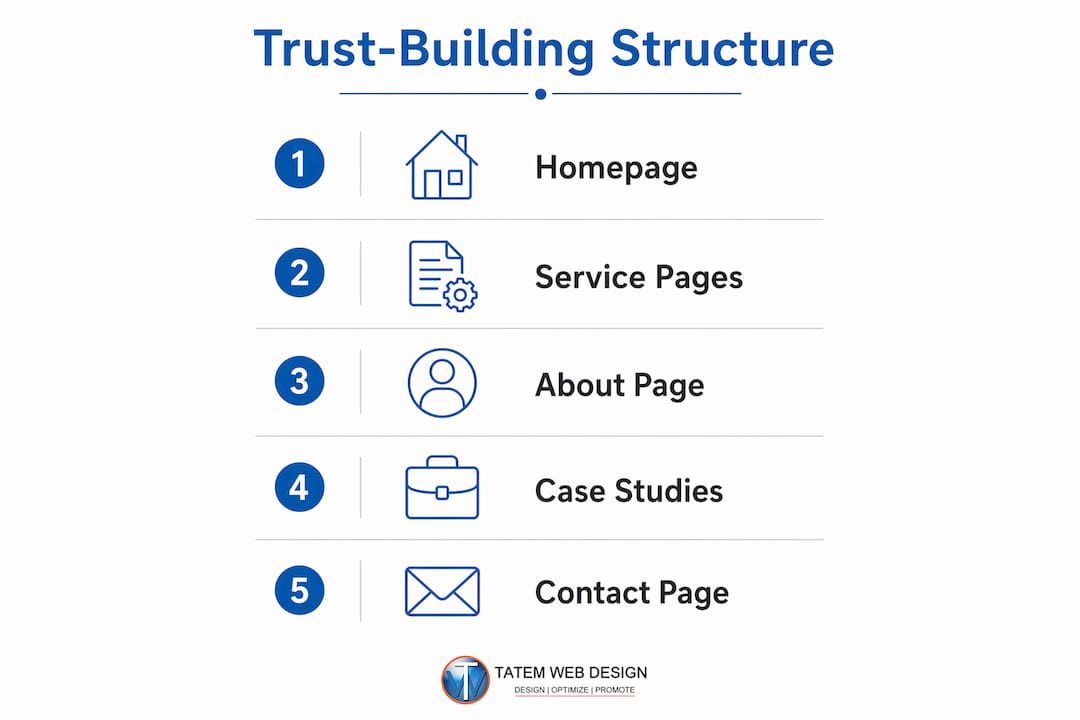
The homepage as a routing layer
Your homepage is not a summary of everything you do. It is a strategic routing layer that guides visitors toward the pages built to convert them. Think of it as a well-organized reception desk, not a lobby filled with posters. The homepage should answer what you do, who you serve, and what the visitor should do next, all within seven seconds of arrival. Anything beyond that belongs on a dedicated page.
Dedicated service pages
Each service you offer deserves its own page with specific, detailed descriptions. A law firm that lists “litigation, contracts, and real estate” on a single page is invisible to search engines and unconvincing to prospects. A dedicated lawyer website page for each practice area, written in the language your clients actually use, performs significantly better in both search rankings and conversion. The same logic applies to accountants, consultants, healthcare providers, and every other professional service category.
The About page
About pages that humanize the team and align with client values lead to higher conversions because buyers make decisions based on people, not faceless organizations. Your About page should tell the story of why your firm exists, who leads it, and what you believe about your clients’ problems. Credentials matter, but they close the deal only after the story creates connection.
Case studies as your highest-converting content
Case studies structured as situation, approach, and specific outcome are the highest-converting content type for B2B professional services. A case study for an accountant might read: “A 35-person construction company was losing $40,000 annually to misclassified expenses. We restructured their chart of accounts and implemented monthly reconciliation. They recovered $38,000 in the first year.” That is specific, credible, and far more persuasive than any testimonial. Launching without proof assets like case studies severely limits conversion and prolongs the time it takes to see a return on your investment.
The contact page
Most contact pages are an afterthought. Yours should be a conversion page. Remove every field that is not necessary. Add a brief statement about what happens after someone submits the form, for example, “We respond within one business day.” Include a phone number for visitors who prefer to call. The lower the friction, the higher the completion rate.
Pro Tip: Add a single qualifying question to your contact form, such as “What is your biggest challenge right now?” This filters out low-quality inquiries and gives your team context before the first conversation.
How do technical performance and SEO affect your site’s results?
A professionally designed website that loads slowly or ranks nowhere is not doing its job. Technical performance and search visibility are not optional extras. They are the foundation that makes everything else work.
Website speed correlates directly with conversion rates, and the recommended target for Largest Contentful Paint is under 2.5 seconds. Every additional second of load time reduces the probability that a visitor stays long enough to become a lead. Google’s Core Web Vitals scores now factor directly into search rankings, which means slow sites pay twice: once in lost visitors and again in lost rankings.
Accessibility compliance is a professionalism marker that most firms overlook. Meeting WCAG 2.1 AA standards is not just about avoiding legal exposure. It signals to clients that your firm pays attention to details that others miss. For healthcare providers, legal firms, and government contractors, this matters even more.
Mobile-first design is no longer a best practice. It is the baseline. The majority of professional service searches now happen on mobile devices, and a site that performs poorly on a phone loses those prospects before they ever reach your content.
From an SEO perspective, the most effective approach for service firms combines two strategies:
- Service pages targeting specific search intent: Each page targets one service in one geography, for example, “HIPAA compliance consulting Stuart Florida” rather than a generic services overview
- Thought leadership content that is perspective-driven: Thought leadership should be deeply relevant and perspective-driven, not volume-oriented, to build organic authority and attract ideal clients
Technical SEO fundamentals round out the foundation. Clean URL structures, an XML sitemap submitted to Google Search Console, proper heading hierarchy on every page, and descriptive meta titles all contribute to how search engines understand and rank your content.
| Technical factor | Target benchmark |
|---|---|
| Largest Contentful Paint | Under 2.5 seconds |
| Mobile responsiveness | Fully responsive on all screen sizes |
| Accessibility standard | WCAG 2.1 AA compliance |
| URL structure | Descriptive, keyword-relevant, no parameters |
| Sitemap | XML sitemap submitted to Google Search Console |
How do you measure whether your website is actually working?
Most business owners check their website traffic once a month and call it measurement. Real optimization requires tracking the right signals and acting on what you find.
The primary metric for a professional services website is lead volume and quality. Raw traffic tells you almost nothing. What matters is how many visitors request a consultation, call your office, or submit a contact form, and whether those people match your ideal client profile. Aim for five to ten high-quality inquiries per month as a baseline, then work to improve both the number and the fit.
Here is a structured approach to measuring and improving performance:
- Set up conversion tracking in Google Analytics 4. Track form submissions, phone click-throughs, and any downloadable resources as conversion events. Without this, you are flying blind.
- Analyze traffic sources. Organic search, direct traffic, and referral traffic each tell a different story. If most of your traffic is direct, your SEO is underperforming. If organic traffic is high but conversions are low, your content or calls to action need work.
- Map the visitor journey. Use tools like Microsoft Clarity or Hotjar to see where visitors drop off. A high exit rate on your service pages usually means the content is not answering the visitor’s question fast enough.
- Audit your calls to action. Vague phrases like “Learn More” or “Get in Touch” underperform compared to specific ones like “Book a Free 30-Minute Consultation” or “See How We Helped a Law Firm Cut Costs by 40%.”
- Add proof assets progressively. If you launched without case studies, add them as your first content priority. Their absence is the single most common reason professional service sites fail to convert despite strong traffic.
Strategic clarity over marketing spin builds the trust necessary for high-ticket professional services. When you audit your site, ask whether every page demonstrates your problem-solving process or simply describes your services in abstract terms. The former converts. The latter does not.
Pro Tip: Review your contact form submissions monthly and categorize each inquiry as ideal, acceptable, or poor fit. If more than 40% are poor fit, your homepage messaging is attracting the wrong audience and needs to be refined.
Custom design vs. theme-based websites: which approach fits your firm?
Every professional service firm eventually faces this decision. The right answer depends on your budget, timeline, and how much brand differentiation matters to your growth strategy.
Custom website design offers full control and brand differentiation but costs more and takes longer to build, whereas theme-based design launches faster with less uniqueness. Neither approach is universally superior. The question is which trade-off your business can absorb right now.
| Factor | Theme-based website | Custom website |
|---|---|---|
| Launch timeline | 2 to 6 weeks | 8 to 20 weeks |
| Cost range | Lower upfront investment | Higher upfront investment |
| Brand uniqueness | Limited by template constraints | Fully differentiated |
| Conversion optimization | Generic layouts | Tailored to your client journey |
| Long-term maintenance | Dependent on theme updates | Controlled by your team or agency |
| Best for | Early-stage firms, tight timelines | Established firms, competitive markets |
Theme-based solutions built on WordPress, Joomla, or Drupal work well for firms that need a credible online presence quickly and plan to invest in content before design. A well-configured WordPress site with strong content will outperform a poorly planned custom site every time. The platform is not the differentiator. The strategy is.
Custom design makes the most sense when:
- Your firm operates in a competitive local market where differentiation is a direct revenue driver
- Your client journey is complex and requires a tailored user experience to guide prospects through multiple decision stages
- You are ready to invest in a site built to generate leads from day one, not just establish presence
For Florida-based professional service firms competing in markets like real estate, legal, healthcare, and financial services, the features of effective service websites in 2026 increasingly favor custom or AI-assisted builds that combine speed with brand precision.
Key takeaways
A professional services website converts visitors into clients when it combines strategic page architecture, specific proof assets, and technical performance with a clear single conversion goal on every page.
| Point | Details |
|---|---|
| Define one goal per page | Assign a single conversion action to each page to avoid splitting visitor attention. |
| Case studies convert best | Structure case studies as situation, approach, and outcome to build credibility with B2B buyers. |
| Speed is non-negotiable | Target Largest Contentful Paint under 2.5 seconds to protect both rankings and conversion rates. |
| Custom vs. theme depends on goals | Choose custom design for competitive differentiation; choose theme-based for speed and budget efficiency. |
| Measure lead quality, not just traffic | Track inquiry fit monthly and refine homepage messaging when poor-fit leads exceed 40% of submissions. |
What I have learned building service websites that actually convert
After working with professional service firms across legal, healthcare, accounting, and consulting sectors, the pattern that separates high-performing sites from expensive disappointments is almost always the same. It is not the design. It is the willingness to be specific.
Most business owners resist specificity because they fear narrowing their audience. A law firm that says “we handle all business legal matters” feels safer than one that says “we represent Florida construction contractors in contract disputes.” But the generalist position is invisible online and unconvincing in person. The specialist position attracts exactly the right client and commands higher fees.
The second mistake I see consistently is treating the website as a one-time project. A site that was well-optimized in 2023 is not well-optimized in 2026. Search intent shifts, competitors improve, and your own service mix evolves. The firms that see compounding returns from their websites treat them as living assets, updating case studies quarterly, refreshing service page content annually, and monitoring Core Web Vitals on a schedule.
Trust is built through storytelling and proof, not through design alone. A beautifully designed site with vague copy and no case studies will lose to a modest site with three detailed client success stories and a clear explanation of the firm’s process. If you are about to invest in a redesign, make sure your proof assets are ready before launch. Launching without them is like opening a restaurant without a menu. The space might look great, but visitors leave hungry.
For Florida firms specifically, local specificity in content, referencing the markets you serve, the regulations you understand, and the industries you know, creates a trust signal that no amount of generic copy can replicate. That local depth is what separates a site that ranks for “accountant Stuart Florida” from one that ranks for nothing at all. You can explore how this plays out in practice by reading about website design that grows your business with real examples from firms that made the shift.
— Matt
How Tatemweb builds professional service websites that generate real leads
Tatemweb has spent over 26 years designing and building websites for professional service firms across Florida, including law firms, accounting practices, healthcare providers, and real estate companies. The agency combines custom design with AI-driven tools to deliver sites that are fast, search-optimized, and built around your specific client acquisition goals. Whether you need a full custom build or an AI-accelerated website that launches in record time, Tatemweb’s team handles design, content, SEO, and ongoing support under one roof. If you are ready to turn your website into a consistent source of qualified leads, explore AI website design options or call Tatemweb directly at 772-224-8118 to schedule a consultation.
FAQ
What is a professional services website?
A professional services website is a conversion-focused site designed to communicate a firm’s expertise, build client trust, and generate qualified inquiries. It differs from a general business site by prioritizing proof assets, specific service pages, and a clear client journey over broad brand awareness.
How many pages does a professional services site need?
At minimum, a professional services site needs a homepage, one dedicated page per service, an About page, a case studies or results page, and a contact page. Each page should target a specific search intent and carry one primary conversion goal.
How long does it take to build a professional services website?
Theme-based builds typically launch in two to six weeks, while custom-designed sites take eight to twenty weeks depending on complexity. Firms that have case studies and content ready before the build begins consistently see faster launches and earlier ROI.
What budget should I plan for a professional services website?
Professional services websites range from a basic brochure site at the lower end to a full client-generation system at the higher end, with ROI measured by lead volume targeting five to ten quality inquiries per month. Budget decisions should be driven by your revenue per client and how many new clients you need to justify the investment.
Why is my professional services website not generating leads?
The most common causes are vague homepage messaging that fails to answer key visitor questions within seven seconds, the absence of case studies, and calls to action that are too generic to motivate action. Auditing these three elements first resolves the majority of conversion problems without requiring a full redesign.
Recommended
Tatem Web Design
26+ YearsWeb Design & SEO Specialist · Tatem Web Design
Matt Tatem has been designing websites professionally since 1999, making Tatem Web Design one of Florida's longest-running web agencies. Based in Stuart, FL, he specializes in WordPress, local SEO, Shopify e-commerce, and cybersecurity consulting for small businesses.

Rank in ChatGPT in 90 Days With a Practitioner Led Checklist
Follow a practitioner led 90 day plan to get cited by ChatGPT: allow OAI-SearchBot, publish short answer capsules with schema, and track Bing AI Performance.

AI SEO Content Playbook: 16 GEO Signals for Agencies & Teams
A practical playbook mapping the GEO-16 signals to hands-on editorial workflows, review controls, and metrics. For agencies and in-house teams scaling AI...

Copy Ready Local Schema Markup for SMBs + Google Validation
Copy ready JSON-LD examples and Google validation steps for SMBs' local schema markup. Audit, implement, and verify each location page with confidence.