
What Is E-Commerce SEO? A 2026 Guide for Store Owners
E-commerce SEO is the practice of optimizing an online store so it ranks prominently in search engine results and attracts shoppers who are ready to buy. Search engine optimization (SEO) for online stores covers product pages, site architecture, technical health, and content strategy working together. About 75% of users never scroll past the first page of results, which means a store buried on page two is effectively invisible. Getting this right is not optional for any business that depends on organic traffic for growth.
What is e-commerce SEO and why does it matter for your store?
E-commerce SEO is the process of making your online store visible to people searching for what you sell. The industry term is “search engine optimization,” and in an e-commerce context it applies specifically to product pages, category pages, site structure, and the technical signals that search engines use to rank content. Every element of your store sends signals to Google and other search engines about what you sell, how trustworthy your site is, and whether your pages deserve to rank.

The importance of e-commerce SEO comes down to one fact: organic search traffic converts at a higher rate than most paid channels because the shopper already has intent. Someone searching “waterproof hiking boots size 10” is not browsing. They are ready to buy. Ranking for that query puts your product in front of a motivated buyer at no cost per click.
E-commerce search optimization also compounds over time. A well-optimized product page built today can drive traffic for years. Paid ads stop the moment you stop paying. That compounding effect is why store owners who invest in SEO early build a durable competitive advantage that is very hard for late movers to close.
The core elements of e-commerce SEO include product page content depth, category page structure, keyword targeting, internal linking, site speed, and technical signals like structured data and canonical tags. Each element reinforces the others. A fast site with thin product descriptions still underperforms. A content-rich store with a broken site architecture loses rankings to a technically cleaner competitor.
How do product and category pages impact e-commerce SEO?
Product pages are the revenue engine of your store, and they are also the primary ranking targets for transactional keywords. Thin product pages under 100 words are invisible in modern search. Standard products need 500–800 words of content, and premium or complex products need 1,000–1,500 words to achieve adequate topical depth. That content should answer real buyer questions: sizing, materials, use cases, compatibility, and care instructions.
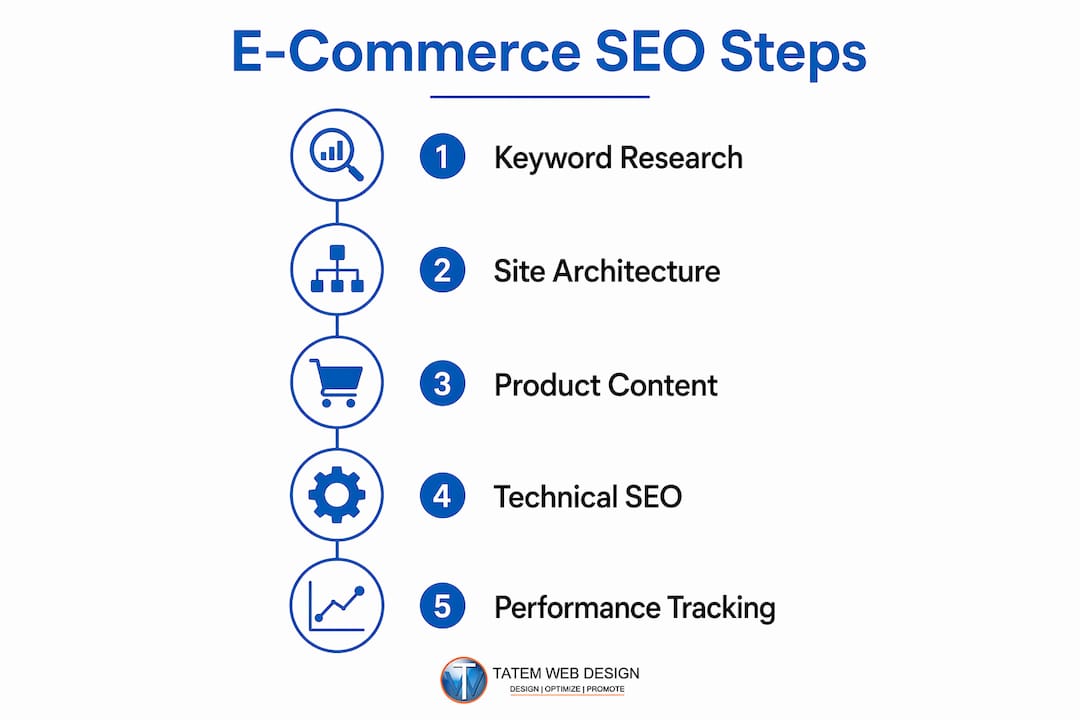
Category pages carry equal weight in e-commerce SEO basics. A well-optimized category page ranks for broader, higher-volume terms like “women’s running shoes” while individual product pages target specific queries like “Nike Air Zoom Pegasus 41 women’s size 8.” Category pages need a short introductory paragraph with the target keyword, a clear heading structure, and internal links to featured products.
Keyword placement follows a consistent pattern across both page types:
- Page title and H1 heading: Include the primary keyword naturally, not forced.
- URL slug: Keep it short, descriptive, and keyword-aligned (e.g., /waterproof-hiking-boots/).
- First 100 words of body content: Use the primary keyword and one close variant.
- Image alt text: Describe the image accurately and include the keyword where it fits naturally.
- Meta description: Write for clicks, not just keyword inclusion. A compelling meta description raises click-through rate, which is itself a ranking signal.
Quality content on product pages does more than satisfy search engines. It reduces bounce rate by answering questions before the shopper has to look elsewhere. It supports purchase decisions by building confidence. And it gives Google enough context to understand exactly what the page is about, which improves ranking precision.
Pro Tip: Add a short FAQ section at the bottom of each product page targeting “people also ask” queries related to that product. These questions often appear directly in Google search results and can double your page’s visibility without any additional link building.
For deeper guidance on writing product pages that rank and convert, product page SEO strategies from Tatemweb cover the full process from keyword mapping to content structure.
What is the importance of site architecture and technical SEO for online stores?
Site architecture determines how easily search engines can find and index your pages. A poorly structured store forces Google’s crawler to waste its crawl budget on low-value pages, leaving important product and category pages under-crawled or unranked. Experts recommend flat site architecture with a maximum of three clicks from the homepage to any product page. That structure keeps every page close to the root domain, which signals importance to search engines.
Technical SEO for e-commerce stores involves four interconnected priorities:
- Crawlability and indexation: Submit an XML sitemap to Google Search Console. Use robots.txt to block low-value pages like cart, checkout, and account pages from being crawled.
- Canonical tags and faceted navigation: Filter pages created by size, color, or price selectors generate hundreds of near-duplicate URLs. Managing faceted navigation with canonical tags or noindex directives prevents index bloat and keeps search engines focused on your primary category pages.
- Core Web Vitals and site speed: Pages failing Core Web Vitals are systematically outranked by pages that pass. This is no longer a minor ranking boost. It is a gating mechanism. Largest Contentful Paint (LCP), Cumulative Layout Shift (CLS), and Interaction to Next Paint (INP) are the three metrics Google measures. A score in the green range on all three is the baseline for competitive rankings.
- Structured data and schema markup: Product schema tells Google your page’s price, availability, and review rating. That data can appear directly in search results as rich snippets, increasing click-through rate without any change in ranking position.
| Technical Factor | What It Controls | Priority Level |
|---|---|---|
| Flat site architecture | Crawl efficiency and page authority flow | High |
| Canonical tags | Duplicate content and index bloat | High |
| Core Web Vitals | Ranking eligibility and user experience | Critical |
| Product schema markup | Rich results and click-through rate | Medium |
| XML sitemap | Indexation speed for new pages | Medium |
Pro Tip: Run your store through Google Search Console’s Core Web Vitals report before doing anything else. Fix any pages marked “Poor” first. A single high-traffic category page with a failing LCP score can suppress rankings across your entire site.
For a full breakdown of the technical signals that determine search performance, technical SEO fundamentals from Tatemweb covers the principles that apply directly to e-commerce stores.
How does keyword research and content strategy support e-commerce SEO success?
Keyword research is the process of identifying the exact phrases your customers type into search engines at different stages of the buying process. E-commerce SEO strategies require targeting two distinct types of intent: commercial intent and informational intent. Commercial keywords like “buy leather wallet men” or “best espresso machine under $300” signal a shopper close to a purchase. Informational keywords like “how to clean a leather wallet” or “espresso vs drip coffee” signal a shopper in the research phase.
Both types matter. Product and category pages target commercial keywords. Blog posts, buying guides, and how-to articles target informational keywords. The informational content builds topical authority, which lifts the rankings of your commercial pages. A store that only publishes product pages competes on a narrow front. A store with supporting content competes across the entire buying journey.
Google Keyword Planner is a reliable starting point for identifying search volume and keyword variations. The process for building a keyword map looks like this:
- Start with your top five product categories and brainstorm 10 seed keywords for each.
- Enter those seeds into a keyword research tool and filter for terms with clear commercial or informational intent.
- Group keywords by topic cluster, not just by individual page. One cluster might include a category page, three product pages, and two supporting blog posts.
- Assign one primary keyword and two to three secondary keywords to each page. Never target the same primary keyword on two different pages.
Internal linking is one of the most undervalued tactics in e-commerce search optimization. When a blog post about “how to choose hiking boots” links to your hiking boots category page, it passes authority and signals topical relevance. That signal compounds every time you publish new content that links back to core pages. A deliberate internal linking structure built around your keyword clusters accelerates ranking growth faster than most external link-building campaigns.
What ongoing practices and challenges affect e-commerce SEO over time?
E-commerce SEO is not a one-time setup. Search algorithms update, competitors publish new content, and your own catalog changes constantly. The stores that maintain strong rankings treat SEO as an ongoing operational practice, not a launch-phase project.
The most common ongoing challenges for e-commerce store owners include:
- Content decay: Product descriptions written two years ago may no longer match current search intent or keyword patterns. Audit your top 20 product pages every six months and refresh content that has lost ranking positions.
- Scaling to large catalogs: Large e-commerce sites with hundreds of thousands of pages require cloud crawlers rather than desktop tools to audit SEO and catch indexation issues. Desktop crawlers time out or miss pages entirely on sites of that scale.
- AI-driven search and zero-click results: Google’s AI Overviews now answer many informational queries directly in the search results page, reducing clicks to informational content. The counter-strategy is to optimize for featured snippets and structured answers that appear within those AI summaries, keeping your brand visible even when the user does not click through.
- Algorithm updates: Core algorithm updates can shift rankings significantly within days. Stores with strong technical health and genuine content depth recover faster than stores that relied on thin pages or manipulative tactics.
Focusing on core SEO basics like clear product naming, clean URLs, and keyword-aligned headers delivers more ranking impact than attempting to master all 200-plus ranking factors at once. That principle holds especially true for newer stores with limited resources. Pick the highest-impact fundamentals, execute them well, and build from there.
Pro Tip: Schedule a quarterly SEO audit covering three areas: pages that dropped in ranking, pages with declining click-through rates in Google Search Console, and any new crawl errors. Fixing these three categories consistently is more effective than chasing every new SEO trend.
Key Takeaways
E-commerce SEO succeeds when product page depth, technical health, keyword intent alignment, and consistent site maintenance work together as a system.
| Point | Details |
|---|---|
| Rankings determine visibility | 75% of shoppers never scroll past page one, making top rankings the primary traffic lever. |
| Content depth drives product rankings | Standard product pages need 500–800 words; premium products need 1,000–1,500 words to rank. |
| Technical health gates eligibility | Pages failing Core Web Vitals are systematically outranked regardless of content quality. |
| Internal linking compounds growth | Linking from supporting content to category and product pages accelerates ranking gains over time. |
| Basics outperform complexity | Clear product naming, clean URLs, and keyword-aligned headers deliver more impact than chasing 200-plus ranking factors. |
Why I think most store owners overcomplicate e-commerce SEO
After working with e-commerce businesses across retail, healthcare, and professional services, the pattern I see most often is not ignorance of SEO. It is paralysis from overcomplication. Store owners read about E-A-T signals, entity optimization, and topical authority graphs, and they freeze. They do nothing because the full picture feels too large to act on.
The stores I have seen grow fastest in organic search did not master every ranking factor. They picked five things and executed them consistently. They wrote real product descriptions instead of copying manufacturer copy. They fixed their site speed before launching a content strategy. They built internal links every time they published a new blog post. That is it.
The AI-driven search shift in 2026 adds one new priority: write content that answers questions directly and completely, because AI Overviews pull structured answers from pages that are clear, authoritative, and well-organized. That is not a new SEO trick. It is the same principle that has always worked. Clear writing, honest content, and a technically sound site. If you want to know whether your content is AI-citation ready, the standard is the same as it has always been for Google: depth, clarity, and genuine usefulness.
The compounding nature of SEO is real, but it only compounds if you start. A product page optimized today earns traffic for years. A site audit completed this quarter prevents ranking drops next quarter. The incremental improvements add up faster than most store owners expect, and the gap between stores that do this consistently and stores that do not widens every year.
— Matt
Tatemweb builds e-commerce stores designed to rank from day one
Tatemweb has spent over 26 years building websites that perform in search, and the team brings that experience directly to custom e-commerce web design for Florida businesses. Every store Tatemweb builds is structured for crawlability, loaded with SEO-ready architecture, and backed by AI-powered content tools that keep product pages competitive.
Whether you are launching a new store or rebuilding one that has stalled in search rankings, Tatemweb’s AI-powered web and SEO services cover the full stack: site architecture, product page content, technical audits, and ongoing optimization. Call Tatemweb directly at 772-224-8118 to schedule a consultation and see exactly where your store stands in search.
FAQ
What is e-commerce SEO in simple terms?
E-commerce SEO is the process of optimizing an online store so it ranks higher in search engine results and attracts shoppers without paid advertising. It covers product pages, site structure, technical performance, and keyword-aligned content.
How long does e-commerce SEO take to show results?
Most stores see measurable ranking improvements within three to six months of consistent optimization. Technical fixes like site speed and canonical tags can produce results faster, while content-driven gains take longer to compound.
What are the most important e-commerce SEO basics to start with?
Start with clean URLs, keyword-aligned product titles and headers, and product descriptions of at least 500 words. Fix any Core Web Vitals failures before investing heavily in content or link building.
Why does site speed matter so much for online store SEO?
Core Web Vitals have moved from optional ranking signals to gating mechanisms. Pages that fail LCP, CLS, or INP thresholds are systematically outranked by pages that pass, regardless of content quality.
How does internal linking help e-commerce SEO?
Internal links pass authority from supporting content to product and category pages, helping search engines understand which pages are most important. A consistent internal linking practice compounds ranking gains faster than most external link-building efforts.
Recommended
Tatem Web Design
26+ YearsWeb Design & SEO Specialist · Tatem Web Design
Matt Tatem has been designing websites professionally since 1999, making Tatem Web Design one of Florida's longest-running web agencies. Based in Stuart, FL, he specializes in WordPress, local SEO, Shopify e-commerce, and cybersecurity consulting for small businesses.
What a CMMC Level 2 Assessment Requires and How to Prepare
Prepare for your CMMC Level 2 assessment by understanding requirements, assessment paths, and mapping your Controlled Unclassified Information.

A Data Retention Policy Is Your Rulebook for Keeping and Deleting Data
Establishing a clear data retention policy helps manage data risk, ensuring compliance and effective data management for your organization.
Law Firm Local SEO: A Practical Playbook for More Local Clients
Unlock more local clients for your law firm with effective local SEO strategies. Optimize your Google Business Profile and boost your visibility!