
E-commerce web development: A complete guide for Florida SMBs
Building an online store sounds straightforward until you realize the gap between “putting products online” and actually running a profitable, secure, and legally compliant e-commerce operation. Florida small and medium-sized businesses face a layered set of challenges that national platforms and generic tutorials simply don’t address: state-specific AI and cybersecurity regulations, fierce regional competition, and the technical complexity of systems that need to handle payments, inventory, and customer data without breaking a sweat. This guide strips away the oversimplifications and gives you a clear, actionable picture of what real e-commerce web development involves in 2026.
Table of Contents
- Defining e-commerce web development: Beyond basic online stores
- Core features and essential tech: What powers a great e-commerce website?
- Tackling complexity: Integration, AI, compliance, and the Florida challenge
- Building it right: Process, partners, and avoiding common pitfalls
- The uncomfortable truth: What most Florida SMBs miss about e-commerce development
- Boost your Florida e-commerce success with expert support
- Frequently asked questions
Key Takeaways
| Point | Details |
|---|---|
| E-commerce requires more | Launching a true e-commerce site means securing transactions and data, not just listing products. |
| AI and compliance matter | Modern Florida SMBs must juggle AI-driven growth and complex local cybersecurity laws. |
| Integration complexity grows | Headless commerce and omnichannel sales boost opportunity but demand more technical expertise. |
| Avoid costly mistakes | Missed technical details or compliance gaps can lead to lost sales and legal exposure. |
| Expert help pays off | Working with local, experienced partners shortens your path to compliant e-commerce success. |
Defining e-commerce web development: Beyond basic online stores
Most business owners hear “e-commerce website” and picture a product grid, a shopping cart, and a payment button. That surface view misses about 90% of what actually needs to be built, configured, and maintained to keep an online store performing well and staying out of legal trouble.
E-commerce web development is the process of architecting, building, and maintaining digital environments that support secure transactions, real-time inventory management, customer account systems, order processing, logistics integration, and data protection. It is, in every meaningful way, a software engineering challenge layered on top of a design challenge. The two disciplines demand very different skill sets, and conflating them is one of the most common and costly mistakes Florida SMBs make.
What makes e-commerce distinctly more complex than regular web design:
- Payment processing infrastructure requires PCI DSS compliance, tokenization, and fraud detection logic that standard websites never touch
- Inventory management must sync across multiple channels in real time, with no tolerance for overselling or data conflicts
- Customer data handling involves personally identifiable information (PII) subject to state and federal laws, including Florida’s own Digital Bill of Rights
- Order management connects your storefront to fulfillment, shipping APIs, and warehouse systems that all need to stay in sync
- Performance under load must hold up during peak seasons, promotions, or traffic spikes without crashing or slowing checkout
Understanding web design basics helps you see where design ends and engineering begins. A visually appealing storefront is only as good as the systems running underneath it.
“Edge cases like inventory overselling demand reservations with atomic database updates, while duplicate events require idempotency keys and outbox patterns to prevent order errors that erode customer trust instantly.”
For Florida SMBs specifically, added complexity comes from a diverse customer base that spans tourists, retirees, and tech-savvy younger buyers, all with different device preferences and expectations. Local competition from established brands with bigger tech budgets makes it even more critical to invest in converting visitors to customers through superior site architecture, not just attractive design. Getting this foundation right from day one is what separates stores that scale from those that stall.

Core features and essential tech: What powers a great e-commerce website?
Once you understand the scope of what you’re building, the next logical question is: what exactly needs to be inside it? The features that power a truly competitive online store go well beyond the visible interface. They operate in the background, silently protecting your revenue, your customers, and your reputation.
Here are the core capabilities every Florida SMB e-commerce site needs to get right:
- Inventory management system that updates stock levels in real time across all sales channels, preventing the nightmare scenario of selling items you no longer have
- PCI-compliant checkout using tokenized payment processing through providers like Stripe, Square, or Authorize.net, which shifts the most sensitive compliance burden away from your own servers
- Mobile-first user experience (UX) designed and tested on actual devices, not just browser emulators, because mobile commerce now accounts for the majority of online purchases in retail categories
- Marketing automation tools including email capture, abandoned cart recovery, upsell triggers, and loyalty program integrations that generate revenue on autopilot
- Built-in analytics and reporting connecting to Google Analytics 4, Meta Pixel, and server-side tracking to give you accurate attribution data even as browser privacy restrictions tighten
- Secure customer data handling covering encrypted storage, HTTPS everywhere, access controls, and data retention policies compliant with applicable state and federal standards
- Search and filtering functionality that lets shoppers find exactly what they want in seconds, because friction in product discovery is a direct conversion killer
| Feature | Basic platform (SaaS) | Custom-built solution |
|---|---|---|
| Setup speed | Fast (days) | Slower (weeks to months) |
| Customization | Limited | Unlimited |
| Scalability | Platform-dependent | Built to your specs |
| Integration flexibility | Pre-built apps only | Any API or service |
| Total cost of ownership | Monthly fees add up | Higher upfront, lower long-term |
| AI personalization capability | Generic | Deeply tailored |
A critical technical area that many SMBs learn about the hard way is e-commerce edge cases: inventory overselling (solved with atomic reservation updates), out-of-stock variant handling, duplicate order events (managed through idempotency keys), checkout concurrency issues under high traffic, and mobile UX friction that silently kills conversion rates. These are not hypothetical scenarios. They happen in production stores every day.
One technology gaining serious traction among Florida businesses is headless commerce. In a headless setup, the front-end presentation layer is decoupled from the back-end commerce engine. This lets you deliver the same product catalog and checkout across a website, mobile app, social media storefront, and even a kiosk, without duplicating backend logic. The tradeoff is integration complexity: every front-end channel needs to communicate cleanly with the backend through APIs, and that requires skilled developers and careful planning.
Good custom e-commerce design accounts for these architectural decisions from the start. Retrofitting a headless architecture onto a poorly planned store is expensive and disruptive. For improving conversion rates, the right architecture matters as much as design choices. And if you’re planning for organic growth, product page SEO tips will only work if your technical foundation supports proper indexing, canonical URLs, and structured data markup.
Pro Tip: Before choosing a platform, map out every third-party system you need to connect: your accounting software, your shipping carrier, your email provider, your CRM. Then verify that your chosen platform has clean, well-documented APIs for each one. Surprise integration failures after launch are one of the top reasons Florida e-commerce projects go over budget.
Tackling complexity: Integration, AI, compliance, and the Florida challenge
With a solid technical foundation in place, the next layer of complexity is where many Florida SMBs genuinely struggle. Integration, artificial intelligence, and regulatory compliance are not optional extras in 2026. They are the arena where competitive advantages are won and lost, and where legal exposure can shut down a business overnight if ignored.
Integration: The connective tissue of your operation
Modern e-commerce does not run in isolation. Your store is the center of an ecosystem that includes your ERP (Enterprise Resource Planning) system, your POS (point of sale) terminals if you run a physical location, your email marketing platform, your customer service tools, your social media feeds, and your logistics providers. Headless commerce enables omnichannel reach across web and app channels but significantly increases integration complexity, making it ideal for businesses ready to invest in AI personalization but demanding careful orchestration.
For a Florida retailer selling across a physical Stuart storefront, a Shopify website, Amazon, and Instagram Shopping simultaneously, even a small data sync failure can mean oversold products, incorrect pricing, or customers receiving conflicting information. These failures destroy trust and generate refunds and chargebacks.
AI: Personalization, automation, and the compliance minefield
AI is transforming what’s possible in e-commerce. Machine learning algorithms can predict what each visitor is most likely to buy and surface those products first. AI chatbots can handle customer service inquiries at 2 a.m. with no staff involvement. Automated pricing engines can respond to competitor pricing changes in real time. Explore what AI for business truly enables at the operational level and you’ll find capabilities that were reserved for enterprise budgets just five years ago.
However, the compliance dimension of AI is where many SMBs get caught flat-footed. Florida’s state AI regulations create patchwork compliance challenges for SMBs using AI sales tools, with federal standards increasingly preferred to simplify multi-state operations. If you use AI to power product recommendations, pricing decisions, or customer communications, you may be subject to disclosure requirements, bias auditing obligations, and data usage restrictions that your platform’s default settings don’t automatically satisfy.
| Feature | Traditional e-commerce | AI-driven/omnichannel e-commerce |
|---|---|---|
| Product recommendations | Manual or rule-based | Dynamic, behavior-based personalization |
| Customer service | Human agents or static FAQ | AI chatbots with natural language processing |
| Pricing | Static or manually updated | Real-time competitive pricing algorithms |
| Inventory forecasting | Historical averages | Predictive demand modeling |
| Compliance complexity | Moderate | Higher, requires ongoing monitoring |
| SMB entry cost | Lower | Higher upfront, significant ROI potential |
Exploring dedicated AI services for e-commerce gives Florida SMBs a structured path to adopting these capabilities without the legal and technical risks of doing it piecemeal. The critical word here is “structured.” Bolt-on AI without proper integration planning creates security gaps, data inconsistencies, and compliance liabilities that can be very difficult to untangle after the fact.
Florida-specific compliance considerations
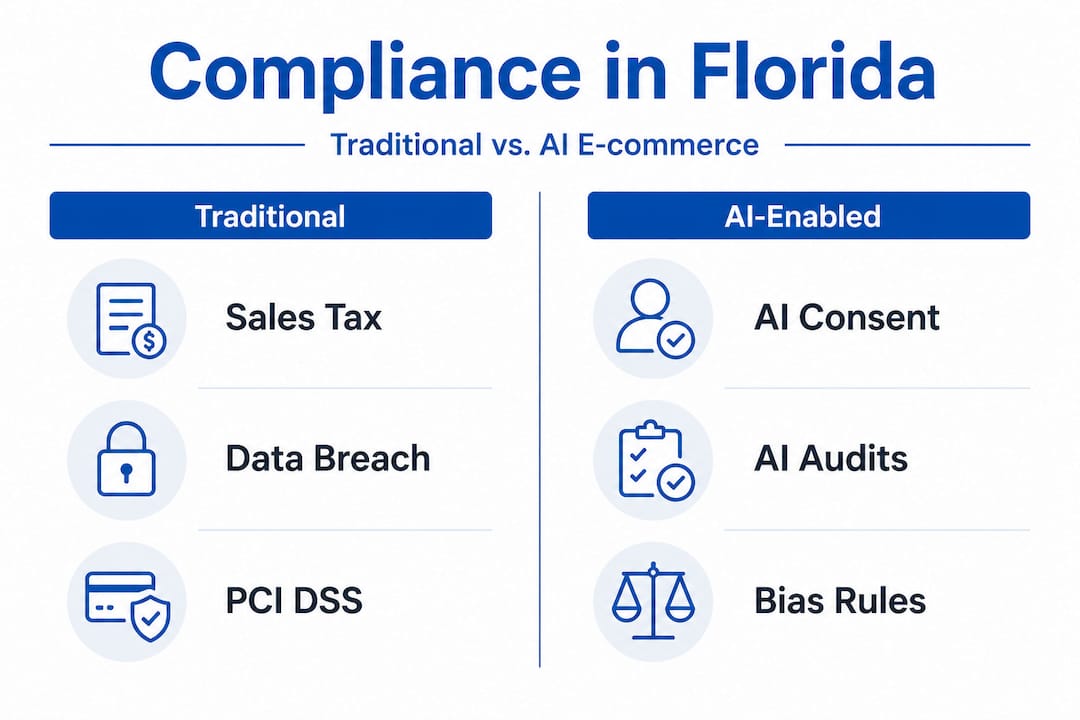
Beyond AI regulations, Florida e-commerce businesses must contend with sales tax nexus rules, data breach notification requirements under Florida’s Information Protection Act, and, for industries like healthcare or finance, additional federal overlay compliance including HIPAA, PCI DSS, and CMMC. A medical supply company in Palm Beach Gardens and a marine equipment retailer in Stuart face very different compliance profiles, and both need expert guidance to get it right.
Building it right: Process, partners, and avoiding common pitfalls
Understanding the challenges is half the battle. The other half is execution, and that requires a structured process, the right partners, and a clear-eyed view of where most Florida e-commerce launches go wrong.
A practical roadmap for Florida SMBs:
-
Define your requirements in detail before touching any platform or code. Document every product category, every integration, every compliance requirement, and every user type who will interact with your store, from customers to warehouse staff to marketing managers.
-
Choose your technology stack intentionally. SaaS platforms like Shopify or BigCommerce work well for businesses with relatively standard needs. Custom builds using WordPress WooCommerce, Joomla, or headless frameworks work better for businesses with complex integrations, unique workflows, or aggressive growth plans.
-
Establish minimum security baselines before launch. This includes SSL everywhere, PCI-compliant payment processing, web application firewall configuration, automated malware scanning, and a clear data backup and recovery plan. Security retrofitted after a breach is always more expensive than security built in from the start.
-
Build and test on real devices, not just desktop browsers. Mobile UX friction, as noted by systems architects studying checkout concurrency and mobile UX failure patterns, is a persistent revenue leak in stores that were designed on desktop and never properly tested on phones.
-
Create a launch checklist that covers performance testing under simulated load, all payment gateway scenarios including declined cards and refunds, inventory edge cases, email notification flows, tax calculation accuracy, and legal pages including terms of service and privacy policy.
-
Plan for post-launch monitoring and iteration. Your store is not finished on launch day. You need ongoing performance tracking, security monitoring, SEO reporting, conversion analysis, and a roadmap for adding features as your business grows.
The mistakes that cost Florida SMBs the most:
- Launching without a mobile-optimized checkout and watching conversion rates sit 40% to 60% below potential
- Skipping compliance review for AI tools, then facing regulatory scrutiny months later
- Underestimating integration work by assuming platforms “just connect” out of the box
- Choosing platforms based on price alone without considering long-term scalability costs
- Not implementing AI chatbots for leads and leaving significant after-hours revenue on the table
Pro Tip: Work with developers who specialize in Florida SMB e-commerce and have demonstrable experience with both PCI compliance and AI integration. A generalist developer who’s never dealt with idempotency keys, payment gateway failover, or state AI disclosure requirements will cost you more in fixes than the initial savings justified.
The uncomfortable truth: What most Florida SMBs miss about e-commerce development
Here’s what two-plus decades of working with Florida businesses has taught us: the single most dangerous phrase in e-commerce is “it should be easy to set up.” That phrase has cost Florida business owners hundreds of thousands of dollars in aggregate, not because the businesses lacked ambition, but because the tools that make setup easy rarely make operations scalable, secure, or legally defensible.
The marketing materials for every major e-commerce platform show a beaming entrepreneur launching their store in an afternoon. What they don’t show is the compliance attorney bill when an undisclosed AI pricing tool triggers a state investigation. They don’t show the developer invoice for emergency fixes when an overselling bug sends 47 orders for a product that had 3 units in stock. They don’t show the revenue lost during three days of downtime after a preventable security breach.
Florida’s regulatory environment in 2026 is particularly unforgiving in this regard. State AI regulations create genuine compliance complexity for SMBs using AI sales tools, and the patchwork nature of state-by-state requirements means that a tool perfectly legal in Georgia may expose your Florida business to liability. Many SMBs only discover this after they’ve deployed the tool and it’s already processing customer interactions.
We’ve seen the pattern repeatedly: a business invests $5,000 in a quick-launch store, runs it for 18 months, then needs $25,000 in remediation work to fix security gaps, integration failures, and compliance issues that were baked in from day one. Strategic investment up front, especially in AI compliance review, security architecture, and proper product page optimization, consistently delivers better ROI than the “launch fast, fix later” approach.
The other thing most SMBs underestimate is the ongoing nature of e-commerce management. Technology is not “set it and forget it” in 2026. Platform vulnerabilities are discovered and patched constantly. AI regulations are evolving in real time. Customer expectations for performance, personalization, and mobile experience are rising every quarter. Businesses that build monitoring, testing, and iteration into their operational rhythm outperform those that treat the launch as the finish line. This is not pessimism. It’s a clear-eyed recognition that the businesses we’ve seen thrive long-term in Florida’s e-commerce market are the ones that treat their digital infrastructure the same way they treat their best employees: with ongoing investment, attention, and care.
Boost your Florida e-commerce success with expert support
You now have a framework most Florida SMBs never get access to until they’ve already made expensive mistakes. The gap between understanding this landscape and successfully navigating it is where the right partner makes all the difference.
At Tatem Web Design, we’ve spent over 26 years building, securing, and scaling digital operations for Florida businesses across industries including healthcare, legal, marine, real estate, and retail. Our team builds custom e-commerce site design solutions engineered for performance, compliance, and conversion from day one. We integrate advanced AI cybersecurity services to protect your customer data and keep your store audit-ready under Florida’s evolving regulatory requirements. And our full suite of Florida AI solutions gives you the personalization and automation advantages of enterprise-grade technology at an SMB-friendly scale. Call us at 772-224-8118 to schedule a consultation and find out exactly what your store needs to compete and win.
Frequently asked questions
What is the difference between e-commerce web development and regular web design?
E-commerce web development focuses on secure shopping, payment processing, inventory management, and customer data protection, while regular web design is primarily about visual presentation and content delivery. The technical complexity of handling checkout concurrency and transaction security makes e-commerce development a distinct engineering discipline.
Why is AI integration important for Florida e-commerce businesses?
AI enables Florida SMBs to personalize product recommendations, automate customer service, and optimize pricing in real time, delivering competitive advantages that rule-based systems cannot match. However, Florida AI regulations create compliance obligations that require careful review before deploying AI sales or customer service tools.
What are the most common e-commerce development mistakes SMBs make?
The most frequent mistakes include launching without a properly tested mobile checkout, ignoring security configurations, skipping AI compliance reviews, and underestimating integration complexity between platforms. Inventory edge cases like overselling and duplicate order events are also commonly overlooked until they cause real customer damage.
How do Florida-specific AI and cybersecurity laws affect my e-commerce site?
Florida’s AI and cybersecurity regulations impose disclosure, data handling, and audit requirements that affect any business using AI-driven tools for sales, pricing, or customer communications. The state AI compliance patchwork means you need a legal and technical review of every AI tool you deploy, not just a check of the platform’s default settings.
Recommended
Tatem Web Design
26+ YearsWeb Design & SEO Specialist · Tatem Web Design
Matt Tatem has been designing websites professionally since 1999, making Tatem Web Design one of Florida's longest-running web agencies. Based in Stuart, FL, he specializes in WordPress, local SEO, Shopify e-commerce, and cybersecurity consulting for small businesses.
What a CMMC Level 2 Assessment Requires and How to Prepare
Prepare for your CMMC Level 2 assessment by understanding requirements, assessment paths, and mapping your Controlled Unclassified Information.
A Data Retention Policy Is Your Rulebook for Keeping and Deleting Data
Establishing a clear data retention policy helps manage data risk, ensuring compliance and effective data management for your organization.
Law Firm Local SEO: A Practical Playbook for More Local Clients
Unlock more local clients for your law firm with effective local SEO strategies. Optimize your Google Business Profile and boost your visibility!