
What Is Local SEO and Why Your Business Needs It
Local SEO is the practice of optimizing your online presence so your business shows up when nearby customers search for what you sell, primarily through Google Business Profile, Google Maps, and local organic search results. If you rely on customers within driving distance, whether that’s a storefront, a service call, or an appointment, local SEO is not optional. It’s how you get found before your competitor down the street does.
You need this if you fall into any of these categories:
- Storefront retailers who depend on foot traffic and “near me” searches
- Local service providers (plumbers, electricians, HVAC techs) who compete for calls in a defined radius
- Multi-location businesses or service-area businesses that need visibility across several ZIP codes without a physical office in each one
Your first move should take five minutes: search your own business name on Google right now. If your Google Business Profile isn’t claimed, verified, and accurate, you’re invisible in the exact moment a nearby customer is ready to buy.
Key Takeaways
Local SEO works when relevance, distance, and prominence are all optimized together, with Google Business Profile completeness and consistent NAP data driving the fastest early gains.
| Point | Details |
|---|---|
| Claim your Google Business Profile | Verify and complete every field, since Google ties this directly to local ranking eligibility. |
| Fix NAP consistency first | Match your business name, address, and phone number across your top citations before anything else. |
| Prioritize review velocity | Steady new reviews influence prominence more than a one-time review push. |
| Track behavioral signals | Clicks, calls, and direction requests are increasingly shaping local rankings, not just static data. |
| Consider a managed plan | Tatemweb builds audits, GBP management, and reporting into one coordinated local SEO engagement. |
Where to Learn More About Local Search
- Google Business Profile Help: the primary source for how Google itself explains local ranking factors.
- Semrush’s local ranking factors guide: tactical, step-by-step recommendations for GBP and citation work.
- Schema: the technical specification for structured data markup on local pages.
Table of Contents
- How Does Local Search Ranking Work?
- What Are the Core Components of Local SEO?
- How Do You Actually Build a Local SEO Strategy?
- How Do You Measure Whether Local SEO Is Working?
- What Trends Are Shaping Local SEO Right Now?
- How Tatemweb Builds Local Visibility for Florida Businesses
- Sources
- FAQ
How Does Local Search Ranking Work?
Google ranks local results using three signals: relevance, distance, and prominence. Understanding how each one functions tells you exactly where to spend your energy.
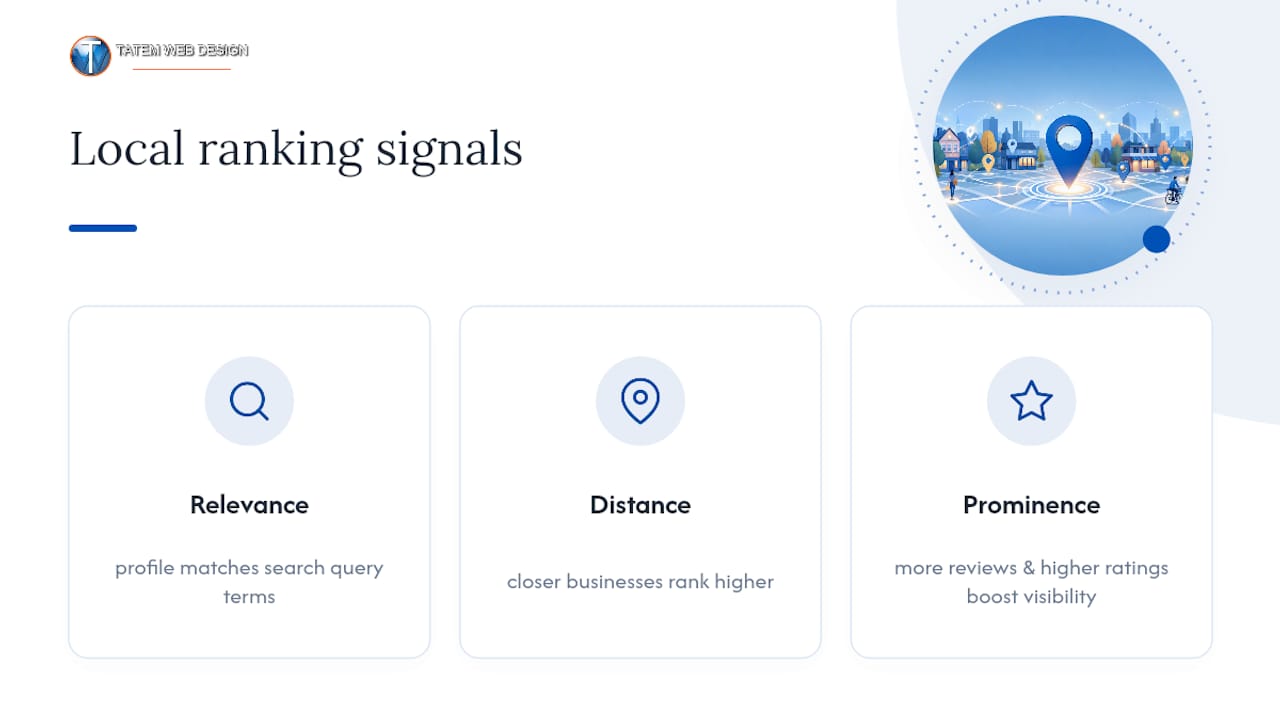
Relevance measures how well your business profile matches what someone is searching for. A dentist who lists “cosmetic dentistry” and “teeth whitening” as services will surface for those searches; one who just lists “dentist” won’t compete for the specific terms.
Distance calculates how far your business is from the searcher’s location, or from the location terms they used. A plumber three miles from a searcher generally has an edge over one twelve miles away, even with a similar profile, because Google factors physical proximity into every local query.
Prominence reflects how well known and well reviewed your business is, both online and offline. A restaurant with 400 reviews and a 4.7 rating carries more prominence than a newer spot with 12 reviews, regardless of how good the food is.
These signals show up across three surfaces: the Local Pack (the map with three business listings that appears above organic results for local queries), standard local organic results below it, and Google Maps itself, which many customers now treat as a search engine in its own right. A simple way to picture it: imagine a bullseye with your business at the center, relevance and prominence expand or shrink that target’s visibility, while distance decides who’s standing close enough to see it.
Google states plainly that local ranking depends mainly on relevance, distance, and prominence, and that businesses with complete, accurate Business Profile information are more likely to surface for relevant searches. Behavioral signals, meaning how people actually interact with your listing, are increasingly shaping that prominence score, a shift covered in more detail later.
What Are the Core Components of Local SEO?
Local SEO isn’t one task, it’s eight interlocking ones. Here’s your working checklist, organized by what actually moves rankings.
- Google Business Profile optimization: primary category, complete services list, updated hours, Q&A monitoring, and fresh photos added monthly.
- NAP consistency (citations): your business Name, Address, and Phone number must match exactly across every directory, from your website footer to Yelp to industry-specific listings.
- Reviews and reputation management: a steady flow of new reviews, plus timely responses to both positive and negative feedback.
- On-page and local content: dedicated landing pages for each service and each location you serve, written for actual search terms people use.
- Local schema and structured data: LocalBusiness schema markup that tells search engines your address, hours, and service area in a format they can parse instantly.
- Local link signals: mentions and backlinks from local news sites, chambers of commerce, and community organizations.
- Technical performance and mobile speed: a site that loads fast on a phone, since most local searches happen on mobile.
- Local keyword targeting: matching your content to how nearby customers actually phrase their searches, not just industry jargon.
For Google Business Profile specifically, the sub-tasks that matter most are choosing the right primary category, filling out every service with a description, uploading photos regularly, and answering the Q&A section before a competitor answers it for you with wrong information.
Pro Tip: If you can only fix three things this week, fix Google Business Profile completeness, NAP consistency across your top ten citations, and review velocity. Those three carry disproportionate weight in both the Local Pack and organic local results, according to BrightLocal’s breakdown of Google’s local algorithm.
How Do You Actually Build a Local SEO Strategy?
You don’t need to fix everything at once, and trying to will burn you out before you see results. Here’s a phased approach that prioritizes impact over perfection.
- Days 0-7 (immediate): claim and verify your Google Business Profile, correct any NAP inconsistencies you spot on your top five directories, and add at least ten photos.
- Weeks 2-8 (short-term): build or update local landing pages for each service and location, request reviews from your last 20 customers, and add LocalBusiness schema to your homepage and location pages.
- Months 2-6 (medium-term): pursue local link opportunities (sponsorships, chamber memberships, local press), publish consistent Google Business Profile posts, and track keyword rankings monthly to catch drops early.
Cost expectations vary widely depending on how much you do yourself versus hand off. A few benchmarks:
- DIY tools: free (Google Business Profile itself) to a few hundred dollars per year for citation-management or rank-tracking software.
- Freelancer help: often a few hundred dollars per month for ongoing management.
- Agency packages: typically several hundred to a few thousand dollars per month, depending on the number of locations and competitiveness of your market.
Most businesses see early movement (impressions and profile views climbing) within 30 to 60 days, with meaningful ranking gains taking 90 to 180 days depending on competition.
If you’re vetting an agency or freelancer, ask them directly: What’s included in the audit? How do they handle citation cleanup across existing listings? What’s their process for generating reviews without violating platform rules? And how often will you get a report you can actually read, not just a spreadsheet of jargon?
How Do You Measure Whether Local SEO Is Working?
Tracking the right numbers keeps you from guessing whether your efforts are paying off.
- Local Pack visibility: are you showing up in the map results for your target keywords?
- Google Business Profile views and actions: how many people saw your listing and then clicked for directions, called, or visited your website.
- Organic local traffic: visits to your site that originated from local search queries.
- Phone calls and direction requests: two of the clearest signs someone is close to converting.
- Conversion rate from local landing pages: are visitors booking, calling, or filling out a form once they arrive?
- Review count and average rating: both a ranking input and a trust signal for anyone comparing you to competitors.
For tools, lean on Google Business Profile Insights for profile-level data, Google Search Console for the exact queries driving organic clicks, Google Analytics for on-site behavior and conversions, plus a rank-tracking tool for local keywords and a review-monitoring tool to catch new feedback fast.
Set a reporting cadence and stick to it: check weekly for the first month, then move to monthly. Expect early signals (profile views, search impressions) within 30 days, ranking movement by 90 days, and measurable traffic or lead growth by 180 days for most competitive markets.
Which Industries Benefit Most from Local SEO?
Restaurants, plumbers, medical practices, legal offices, retail stores, multi-location franchises, and mobile service businesses all lean on local search, but the priorities differ by type. A restaurant or retail storefront should focus on driving physical visits, meaning “directions” actions and accurate hours matter most. A service-area business like a plumber or electrician should invest more heavily in dedicated service-area pages, broad citation coverage, and keywords tied to the specific towns they cover rather than a single address.

Regulated industries carry extra nuance. A medical practice often needs appointment-booking integration and careful compliance language on landing pages, while a law office may need location-specific pages for each jurisdiction it practices in.
What Trends Are Shaping Local SEO Right Now?
Behavioral signals are becoming a bigger part of how Google ranks local businesses. Whitespark’s 2026 Local Search Ranking Factors report finds that user-interaction signals, how people click, request directions, call, and interact with reviews, are gaining weight alongside traditional factors like citations and on-page content.
The practical takeaway: a technically perfect listing that nobody engages with can still lose ground to a less polished one that gets clicked, called, and visited. That means your job isn’t just filling out fields correctly, it’s making your listing genuinely appealing to click. Add real photos, keep hours and services current, and give people an obvious reason to choose you over the next three listings down. A listing can hold steady on paper and still slide in rank if engagement drops, since Google appears to treat sustained interaction as an ongoing vote of confidence rather than a one-time checkbox.
What Small Business Owners Get Wrong About Local SEO
Most small businesses treat their Google Business Profile like a business card: fill it out once, forget it exists. That’s backwards. The listing that wins is the one that gets touched regularly, new photos, fresh posts, prompt review responses, because engagement itself has become part of the ranking equation.
Pro Tip: Add a specific offer or seasonal update to your Google Business Profile posts every two weeks. Listings with structured, current information consistently pull higher click-through rates than static ones.
Results build over months, not days. Anyone promising overnight rankings is selling you something that doesn’t exist.
How Tatemweb Builds Local Visibility for Florida Businesses
Tatemweb is the practical alternative to piecing together local SEO yourself or gambling on a freelancer with no accountability. We combine Google Business Profile management, local content and landing pages, citation cleanup, review-generation systems, and local link building into one coordinated plan, backed by monthly reporting you can actually understand.
An engagement typically starts with a full audit of your current listings and citations, followed by a prioritized 90-day plan, then implementation and monthly reporting that tracks the same KPIs covered above, calls, direction requests, and organic visibility. If your business also needs a faster, AI-optimized website to support that visibility, our AI Website Design service builds SEO-ready sites in a fraction of the usual timeline. Call Tatemweb at 772-224-8118 to schedule a local SEO audit and see exactly where your listings stand today.
Sources
- Tips to improve your local ranking on Google - Google Business Profile Help
- Local SEO ranking factors: Your complete guide
FAQ
Is Doing Local SEO Worth It?
Yes, for any business serving customers within a defined geographic area. Local queries tend to carry high purchase intent, meaning the people searching are often ready to call, visit, or book.
How Do You Do Local SEO on Google Specifically?
Start by claiming and fully completing your Google Business Profile, then keep your NAP consistent across directories, gather reviews steadily, and build local landing pages with accurate service and location details.
What Is the Difference Between Local SEO and General SEO?
General SEO targets rankings for broad, often national search terms, while local SEO focuses on ranking within the Local Pack and local organic results for searches tied to a specific city, neighborhood, or service area.
How Much Should You Pay for Local SEO?
Costs range from free DIY tools up to several hundred dollars monthly for a freelancer, or several hundred to a few thousand dollars monthly for a full agency package, depending on how many locations and how competitive your market is.
Can Tatemweb Manage Local SEO for My Business?
Yes. Tatemweb handles Google Business Profile management, citation cleanup, local content, and review generation as part of a coordinated local SEO engagement for Florida small businesses.
Recommended
Tatem Web Design
26+ YearsWeb Design & SEO Specialist · Tatem Web Design
Matt Tatem has been designing websites professionally since 1999, making Tatem Web Design one of Florida's longest-running web agencies. Based in Stuart, FL, he specializes in WordPress, local SEO, Shopify e-commerce, and cybersecurity consulting for small businesses.

Rank in ChatGPT in 90 Days With a Practitioner Led Checklist
Follow a practitioner led 90 day plan to get cited by ChatGPT: allow OAI-SearchBot, publish short answer capsules with schema, and track Bing AI Performance.

AI SEO Content Playbook: 16 GEO Signals for Agencies & Teams
A practical playbook mapping the GEO-16 signals to hands-on editorial workflows, review controls, and metrics. For agencies and in-house teams scaling AI...

Copy Ready Local Schema Markup for SMBs + Google Validation
Copy ready JSON-LD examples and Google validation steps for SMBs' local schema markup. Audit, implement, and verify each location page with confidence.