
Why Small Businesses Need SEO: A Practical Owner’s Guide
Small businesses need SEO because it is the most reliable, cost-efficient way to get found by customers who are already searching for what you sell. Without it, you are invisible to the buyers most likely to convert.
Here is what SEO delivers for a small business:
- Consistent lead generation from people actively searching for your services
- Local customer capture through Google Maps, the local pack, and directory listings
- Long-term cost efficiency as organic traffic compounds over time without paying per click
- Credibility and trust because ranking well signals authority to new visitors
- Competitive positioning against larger brands that dominate paid channels
The rest of this guide covers the concrete benefits, how SEO turns a search into a paying customer, a five-step starter plan with realistic timelines and costs, common pitfalls, how to measure results, and when to bring in professional help.
Key Takeaways
| Point | Details |
|---|---|
| SEO drives consistent leads | a majority of SMBs say their website is a major lead source; organic search captures high-intent buyers. |
| Timeline is 6–12 months | Expect first signals at months 4–6 and meaningful ROI by months 6–12 for most competitive terms. |
| Budget sweet spot | SMB agency retainers typically run $1,500–$5,000/month; DIY costs $0–$200 in tools. |
| GEO/AEO is a near-term edge | AI Overviews appear on a notable share of U.S. queries; structured FAQ content increases citation chances. |
| Tatemweb for Florida SMBs | Tatemweb provides AI-optimized sites, local SEO, and conversion tracking built for the Florida market. |
Table of Contents
- Why small businesses need SEO: the plain-language case
- 1. SEO puts you in front of buyers who are ready to act
- 2. Local SEO captures nearby customers before they call anyone else
- 3. SEO compounds over time, making each dollar work harder
- 4. SEO builds credibility that paid ads cannot buy
- 5. SEO delivers measurable ROI that most small businesses can track
- 6. SEO helps you compete with larger brands on a smaller budget
- 7. GEO/AEO positions you inside AI-generated answers
- How SEO turns a search into a paying customer
- A practical starter plan: five steps, realistic timelines, and costs
- Common SEO challenges small businesses face
- How to measure SEO success with the tools you already have
- When to DIY your SEO and when to hire professional help
- The SEO insight most small business owners miss
- Tatemweb’s local SEO and AI website services for Florida SMBs
- Sources
- FAQ
Why small businesses need SEO: the plain-language case
Search engine optimization (SEO) is the practice of making your website and online presence easier for search engines to find, understand, and recommend. For a small business owner, that translates into three practical areas:
- On-page: the words, headings, and structure on your web pages that tell Google what you do and where you do it
- Technical: site speed, mobile-friendliness, and clean code that let search engines crawl your site without friction
- Off-page and local: your Google Business Profile, directory listings, backlinks, and customer reviews that establish your reputation and geographic relevance
One more shift worth noting: AI-generated overviews now appear on a significant share of U.S. searches. Optimizing for those AI citations, often called Generative Engine Optimization (GEO) or Answer Engine Optimization (AEO), is becoming a practical priority alongside traditional SEO. Structured FAQ content, clear headlines, and schema markup increase your chances of being cited in those summaries.
1. SEO puts you in front of buyers who are ready to act
Organic search captures people at the exact moment they need your product or service. That intent gap is what separates SEO traffic from social media traffic: a person who searches “emergency plumber Stuart FL” is far closer to buying than someone who scrolls past a Facebook ad.
Local search data from Statista confirms that searching for local businesses is a frequent, habitual behavior among U.S. and Canadian consumers. If your business does not appear in those results, a competitor takes the call.
Pro Tip: Use Google Search Console’s “Performance” report to see exactly which queries already bring visitors to your site. You may find high-intent phrases you are not yet targeting.
2. Local SEO captures nearby customers before they call anyone else
For most small businesses, the highest-value SEO real estate is the local pack: the three map listings that appear at the top of a Google results page for location-based queries. Appearing there requires a complete, optimized Google Business Profile, consistent name-address-phone (NAP) data across directories, and a steady stream of genuine customer reviews.

The U.S. Chamber of Commerce highlights that local SEO lets small businesses target customers in their immediate area and track the effectiveness of those efforts, something broad advertising rarely allows. A dentist in Stuart, Florida, does not need national visibility. She needs to be the first result when someone nearby searches “dentist near me.”
3. SEO compounds over time, making each dollar work harder
Paid ads stop the moment you stop paying. SEO builds an asset. A well-optimized page published today can generate leads for years without additional spend. That compounding dynamic is what makes SEO one of the highest-ROI channels available to a small business with a limited budget.
Comparative data supports this directly: inbound channels like SEO produce leads at roughly $135 per lead, compared to approximately $346 per lead for outbound methods. Outbound gets results faster, but SEO wins on unit economics over a 12-to-24-month horizon.
4. SEO builds credibility that paid ads cannot buy
Ranking organically signals to a potential customer that Google trusts your site. Most people know ads are paid placements; an organic top-three result reads as an earned endorsement. That trust gap matters most in professional services, healthcare, legal, and financial categories where buyers are cautious.
Pair organic rankings with a strong review profile and you have a credibility stack. Statista’s local review usage data shows that a large share of consumers consult reviews before choosing a local business. Reviews feed both your local pack ranking and the trust a visitor feels when they land on your listing.
5. SEO delivers measurable ROI that most small businesses can track
According to a 2026 SMB survey by WordStream, a majority of small businesses rated their SEO performance as very or somewhat effective, and many said their website is a major source of leads. Those are not vanity metrics: they reflect real revenue attribution from owners who track where their customers come from.
The same survey found that a significant portion of SMBs reported traffic disruption in the past year, largely tied to algorithm updates and the rise of AI overviews. That disruption is a reason to invest more strategically in SEO, not less.
6. SEO helps you compete with larger brands on a smaller budget
A national chain can outspend you on TV and display ads. It cannot always outrank you for hyper-local queries where your geographic relevance and community reputation are genuine advantages. A well-executed local SEO strategy, including location-specific pages, local backlinks, and a complete Google Business Profile, can put a small business above a national competitor for searches in its own backyard.
Forbes has framed SEO as a small-business necessity precisely because it levels the playing field in a way that most other marketing channels do not.
7. GEO/AEO positions you inside AI-generated answers
AI Overviews from Google appear on a significant portion of U.S. queries, according to SMB SEO benchmarks from QuickSEO. When an AI overview answers a question, it cites sources. If your site is not structured to be cited, you lose that visibility entirely, even if you rank on page one.
The fix is practical: publish FAQ pages with schema markup, write clear and direct answers to common customer questions, and use descriptive headings. These are the same signals AI systems use to pull citations. Most SMBs have not yet prioritized GEO/AEO measurement, which means early movers gain a real advantage.
Pro Tip: Search your top three customer questions in Google and check whether an AI overview appears. If it does, read which sites it cites and model your content structure after theirs.
How SEO turns a search into a paying customer
The path from query to sale is shorter than most business owners realize. A potential customer searches “roof repair near me” on a phone. Google returns a local pack with three map listings. The customer taps the listing with the most reviews and a complete profile, clicks the phone number, and calls. That entire journey takes under two minutes.
SEO activities map directly to each step: keyword-optimized pages feed organic results, a complete Google Business Profile feeds the local pack, directory citations reinforce the listing’s authority, and review management drives the tap-to-call decision. For service businesses, the local pack is often the highest-converting channel on the site.
The modern layer is AI. When a user asks a voice assistant or an AI chatbot “who is the best HVAC company in Stuart?” the answer comes from structured, crawlable content on your site and your listing data. Owning your Google Business Profile, keeping your NAP consistent across directories, and publishing clear FAQ content all increase the probability that AI systems surface your business. For a deeper look at local SEO tactics specific to Stuart, Florida, Tatemweb’s blog covers the practical steps in detail.
A practical starter plan: five steps, realistic timelines, and costs
Getting SEO off the ground does not require a massive budget. It requires the right sequence.
Step 1: Claim and complete your Google Business Profile (Week 1)
Verify your listing, add photos, set your service area, and write a keyword-rich business description. This single action is the highest-return hour you will spend on SEO. See Tatemweb’s Google Business Profile optimization guide for a complete walkthrough.
Step 2: Fix critical technical issues (Weeks 1–4)
Run a free crawl with Google Search Console. Fix broken links, ensure your site loads in under three seconds on mobile, and confirm your site has an SSL certificate. Professional web hosting directly affects these technical baselines.
Step 3: Publish three location-specific pages or FAQs (Weeks 2–6)
Write one page for each core service, targeting the city or neighborhood you serve. Add a FAQ section with schema markup. Use keyword research for local SEO to find the exact phrases your customers type.
Step 4: Set up conversion tracking (Week 2)
Connect Google Analytics 4 and Search Console. Set up goal tracking for phone calls, form submissions, and booking clicks. Without this, you cannot prove SEO is working. Microsoft Clarity is a free behavior analytics tool that adds heatmaps and session recordings with minimal setup.
Step 5: Build a repeatable content cadence (Month 2 onward)
Publish one piece of locally relevant content per month: a how-to article, a neighborhood guide, or a case study. Pair this with a basic link-building strategy for local businesses to build authority over time. For content ideas and execution, a content marketing strategy keeps the calendar from going blank.
Timeline and cost comparison
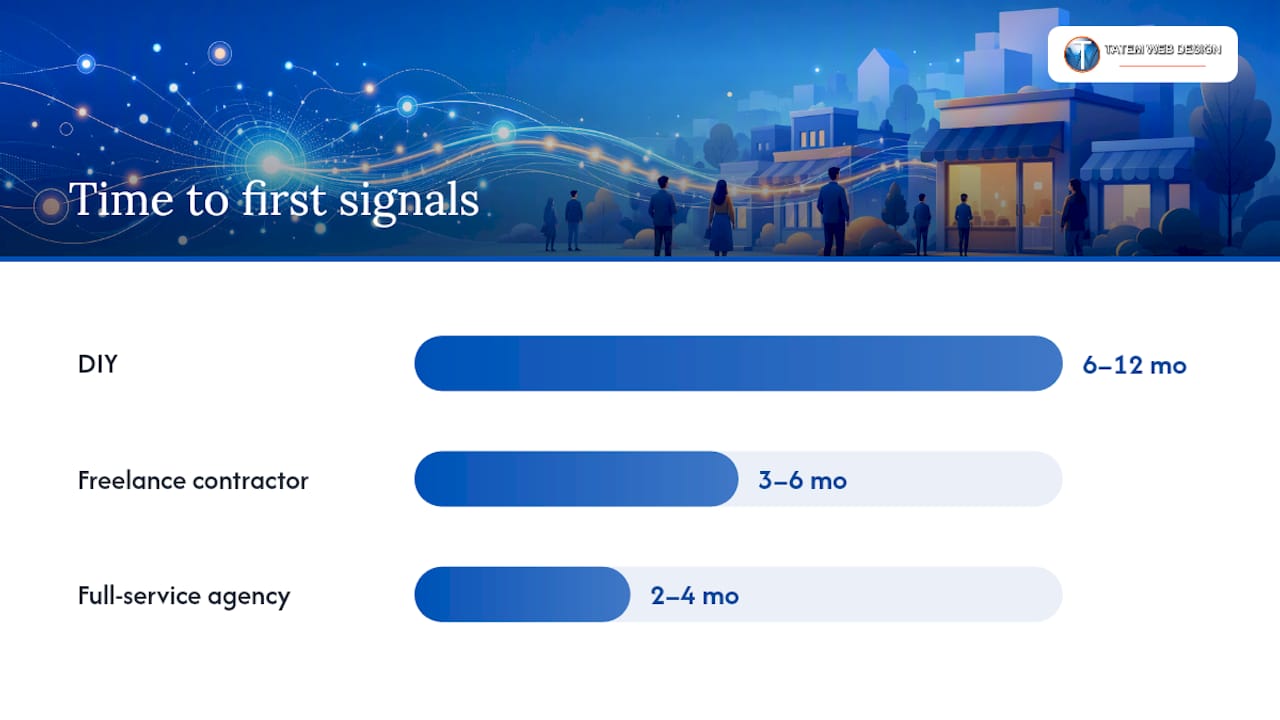
Industry benchmarks from QuickSEO put the realistic window for meaningful SEO ROI at 6–12 months, with first signals appearing earlier. The budget sweet spot for SMB retainers is commonly in the mid-thousands per month for agency-managed work.
| Approach | Typical monthly cost | Time to first signals | Skills required | Expected outcome |
|---|---|---|---|---|
| DIY | $0–$200 (tools) | 6–12 months | Moderate; 5–10 hrs/week | Slow growth; high effort |
| Freelance contractor | $500–$1,500 | 3–6 months | Low; review and approve | Steady progress on core tasks |
| Full-service agency | $1,500–$5,000+ | 2–4 months | Low; monthly check-ins | Faster results; broader coverage |
Pro Tip: Spend your first dollar on Google Business Profile and Search Console setup. Both are free and deliver faster signals than any paid tool.
Common SEO challenges small businesses face
SEO is not plug-and-play. Knowing the predictable hurdles in advance keeps you from quitting too early or spending on the wrong things.
- Time-to-results impatience: Most SMBs see meaningful movement between months 4 and 6. Owners who expect results in 30 days often abandon a strategy that was working. Set written expectations at the start: months 1–3 are foundation, months 4–6 are first signals, months 6–12 are first ROI.
- Content production gaps: Consistent publishing is hard when you are running a business. A simple editorial calendar with one topic per month, batched and written quarterly, solves most of this.
- Algorithm and AI disruption: Nearly 40% of SMBs reported traffic disruption in the past year. Diversifying across organic, local pack, and GEO/AEO reduces the impact of any single algorithm change.
- Attribution blind spots: If you cannot tie organic traffic to leads or sales, you cannot defend the budget. Set up goal tracking in GA4 before you start, not after.
- Budget and expertise gaps: Many small businesses either overspend on the wrong tactics or underspend and see no results. The starter plan above prioritizes the highest-return actions first.
Red flags when hiring an SEO vendor:
- Guarantees of a “#1 ranking” on Google (no one can guarantee this)
- Vague deliverables with no written scope or timeline
- Link-building schemes involving private blog networks or paid links
- No monthly reporting or refusal to share Search Console access
- High turnover in account managers with no continuity of strategy
For a partner-level perspective on what to expect from a local SEO services provider, that resource covers vetting criteria in practical detail.
How to measure SEO success with the tools you already have
Tracking SEO does not require expensive software. The core tools are free and the KPIs are straightforward.
| KPI | What it indicates | Primary tool |
|---|---|---|
| Organic sessions | Overall search visibility and traffic trend | Google Analytics 4 |
| Branded organic volume | Brand awareness and direct search growth | Google Search Console |
| Leads from organic channels | Revenue attribution from SEO | GA4 goal tracking |
| Goal conversion rate | Quality of traffic and landing page effectiveness | GA4 |
| Local pack impressions and clicks | GBP visibility and local search performance | Google Business Profile Insights |
| AI citation presence | GEO/AEO visibility in AI overviews | Manual spot-checks on target queries |
Check these six metrics monthly. A rising organic session count with a flat conversion rate signals a content or landing page problem, not an SEO problem. Falling local pack impressions usually point to a GBP issue or a competitor gaining reviews.
Pro Tip: In GA4, create a simple segment for “Organic / Google” traffic and set up a conversion event for every phone call click and form submission. That one setup turns a traffic report into a lead report.
- Review Search Console weekly for crawl errors and new ranking opportunities
- Check Google Business Profile Insights monthly for call and direction clicks
- Run a manual AI overview spot-check on your top five customer queries each quarter
- Use Microsoft Clarity for free session recordings to see where visitors drop off
When to DIY your SEO and when to hire professional help
The honest answer depends on four variables: your available time, your site’s technical complexity, your competitive market, and how fast you need results.
DIY makes sense when:
- You are in an early-stage business with more time than budget
- Your market is low-competition and local (a single-city service area with few direct competitors)
- You can commit 5–10 hours per week consistently
- Your site is on a standard CMS like WordPress, Joomla, or Drupal with no major technical debt
Hiring help makes sense when:
- You are in a competitive market where top-ranking competitors have established domain authority
- Your site has technical issues you cannot diagnose or fix yourself
- You need results within a defined time window (a product launch, a seasonal push)
- You have tried DIY for six months and organic traffic has not moved
Questions to ask any agency or contractor before signing:
- What specific deliverables are included each month?
- What KPIs will you report on, and how often?
- What does the first 90 days look like in concrete terms?
- Who manages my account, and what is the process if that person leaves?
- What are the exit terms if I am not satisfied?
Insist on a written scope of work, a defined reporting cadence, and exit terms that do not lock you in for more than 90 days without a performance review. A reputable agency will not resist any of those requests.
The SEO insight most small business owners miss
Most of the conversation around SEO focuses on rankings. That is the wrong frame. Rankings are a leading indicator. Revenue is the metric that matters, and the path from ranking to revenue runs through conversion rate, not just traffic volume.
The businesses that get the most from SEO are the ones that treat it as a full-funnel discipline: they optimize for discovery, yes, but they also make sure the page a visitor lands on is clear, fast, and built to convert. That distinction rarely shows up in the generic SEO advice you find online, but it is where the real leverage sits for a small business with limited traffic volume.
The other underrated move: GEO/AEO. Most SMBs are not yet measuring whether they appear in AI overviews. That gap is an opportunity right now, before the space gets crowded. Publishing structured FAQ content and clear, direct answers to common customer questions costs almost nothing and can put a small business inside an AI-generated answer that reaches thousands of searchers per month. The window to do this cheaply is open, but it will not stay open indefinitely.
Tatemweb’s local SEO and AI website services for Florida SMBs
For Florida small businesses that want faster results without the trial-and-error of DIY, Tatemweb delivers AI-optimized website design and local SEO built specifically for the Florida market. The approach combines technical site health, Google Business Profile optimization, structured content for AI citation, and conversion tracking, all configured from day one rather than bolted on later.
A discovery consultation with Tatemweb starts with a 30-minute site and visibility audit: you leave with a prioritized quick-wins list, a realistic timeline, and a clear picture of where your competitors are outranking you and why. For businesses ready to add AI-powered lead capture and chatbots alongside SEO, those tools are integrated into the same build, not sold as a separate project. Call Tatemweb directly at 772-224-8118 or visit the AI services overview to schedule your audit.
Sources
- Online local business search frequency (U.S. & Canada) — Statista
FAQ
Why do small businesses need SEO if they already run paid ads?
Paid ads stop generating traffic the moment you stop funding them. SEO builds organic visibility that compounds over time, producing leads at roughly $135 each compared to $346 for outbound methods, making it a more cost-efficient long-term channel.
How long does SEO take to show results for a small business?
Most small businesses see first signals between months 4 and 6, with meaningful ROI typically arriving in the 6–12 month window for competitive terms. Early technical fixes and Google Business Profile optimization can show movement sooner.
What is the minimum budget a small business needs for SEO?
DIY SEO costs $0–$200 per month in tools. A freelance contractor runs $500–$1,500 per month. Full-service agency retainers for SMBs typically fall in the $1,500–$5,000 per month range, based on industry benchmarks.
What is GEO or AEO, and does a small business need it?
GEO (Generative Engine Optimization) and AEO (Answer Engine Optimization) refer to optimizing your content to appear in AI-generated search summaries. queries. Publishing structured FAQ content and clear answers is a practical step any small business can take now.
How can Tatemweb help a Florida small business with SEO?
Tatemweb provides AI-optimized websites, local SEO, Google Business Profile setup, and conversion tracking built specifically for Florida SMBs. A 30-minute discovery audit identifies quick wins and a realistic roadmap. Call 772-224-8118 or visit Tatemweb to get started.
Recommended
Tatem Web Design
26+ YearsWeb Design & SEO Specialist · Tatem Web Design
Matt Tatem has been designing websites professionally since 1999, making Tatem Web Design one of Florida's longest-running web agencies. Based in Stuart, FL, he specializes in WordPress, local SEO, Shopify e-commerce, and cybersecurity consulting for small businesses.
What a CMMC Level 2 Assessment Requires and How to Prepare
Prepare for your CMMC Level 2 assessment by understanding requirements, assessment paths, and mapping your Controlled Unclassified Information.
A Data Retention Policy Is Your Rulebook for Keeping and Deleting Data
Establishing a clear data retention policy helps manage data risk, ensuring compliance and effective data management for your organization.
Law Firm Local SEO: A Practical Playbook for More Local Clients
Unlock more local clients for your law firm with effective local SEO strategies. Optimize your Google Business Profile and boost your visibility!