
What Is WordPress Development? A 2026 Guide
WordPress development is the practice of building, customizing, and maintaining websites using the WordPress content management system and its supporting technologies. As of 2026, WordPress powers 42.2% of all websites globally and holds 59.6% of the CMS market share. That dominance makes understanding WordPress development one of the most practical skills a business owner or developer can pursue. The core work involves creating themes, building plugins, and writing code in PHP 8.3 and JavaScript to produce websites that are fast, secure, and built to grow. Whether you are a Florida business owner evaluating your options or a developer starting out, this guide covers what you need to know.
What is WordPress development and what does it actually involve?
WordPress development is the technical process of using the WordPress platform to design, build, and extend websites beyond what standard templates offer. The industry term for this work is CMS development, and WordPress is the most widely used CMS in the world. Development work falls into three main categories: theme development, plugin development, and site configuration. Each category requires a different skill set, but all three share the same foundation of PHP, MySQL, and the WordPress core API.
Professional WordPress developers must master JavaScript, CSS, HTML, database management, and UX/UI principles to build responsive and secure websites. This is a full-stack discipline, not a drag-and-drop exercise. A business owner clicking through a page builder is using WordPress. A developer writing a custom plugin that connects your site to a CRM is doing WordPress development. The distinction matters because the depth of what you can build changes completely once you move from user to developer.

WordPress web development also includes performance tuning, security hardening, and deployment workflows. A finished site is only part of the job. Maintaining that site, keeping it updated, and protecting it from vulnerabilities are ongoing development responsibilities that directly affect your business.
What core technologies power WordPress development?
Modern WordPress development requires PHP 8.3 as the minimum back-end language, paired with MySQL or MariaDB for database management. PHP handles all server-side logic, from processing form submissions to querying the database and rendering page templates. MySQL stores everything: posts, users, settings, and plugin data. Understanding how these two technologies interact is the foundation of any serious WordPress project.
The front end of WordPress development relies on HTML, CSS, and JavaScript. These three languages control what visitors see and how they interact with your site. Modern WordPress projects also use build tools like Node.js and npm to compile assets, and package managers like Composer to manage PHP dependencies.
The Block Editor, known as Gutenberg, now drives both content editing and Full Site Editing. FSE replaced the old theme system by centralizing design controls inside a file called theme.json. This file acts as a single source of truth for typography, colors, spacing, and layout. Developers who still build sites using classic PHP templates are working with an outdated approach.
Key development tools every WordPress developer uses today:
- WP-CLI: A command-line tool for managing WordPress installations without touching the admin dashboard
- Composer: Manages PHP packages and keeps dependencies version-controlled
- Local by Flywheel or DevKinsta: Local development environments that mirror production servers
- Node.js and npm: Required for compiling JavaScript and CSS in block-based themes
- Git: Version control for tracking code changes and collaborating with teams
Pro Tip: Set up a local development environment before touching any live site. Tools like Local by Flywheel let you build and test changes safely, then push only confirmed code to production.
How does WordPress architecture work: themes, plugins, and hooks?
WordPress architecture is built on three layers: the core software, themes, and plugins. The core handles fundamental operations like routing, database queries, and user authentication. Themes control the visual presentation of your site, including page templates, layout structures, and design tokens. Plugins add or extend functionality, from contact forms and SEO tools to payment gateways and membership systems.
The most important architectural concept in WordPress is the hook system. Hooks are the mechanism that allows developers to modify or extend WordPress behavior without editing core files. There are two types:
- Action hooks: Let you execute custom code at specific points in the WordPress loading process, such as after a post is published or when a user logs in
- Filter hooks: Let you modify data before it is displayed or saved, such as changing the content of a post or altering a query result
Modifying core files breaks updates and creates security vulnerabilities. Every WordPress update overwrites core files, so any changes made directly to them disappear. Hooks solve this problem by giving developers a clean, supported way to extend functionality that survives updates.
Full Site Editing and theme.json changed how themes are built in 2026. Design tokens defined in theme.json now replace the old functions.php approach for registering colors, fonts, and spacing. This shift means theme development today is more structured and more predictable than it was three years ago.
Pro Tip: Learn the WordPress Gutenberg block editor before writing any custom theme code. Understanding how blocks consume theme.json settings will save you hours of debugging later.
What are modern WordPress development workflows and best practices?
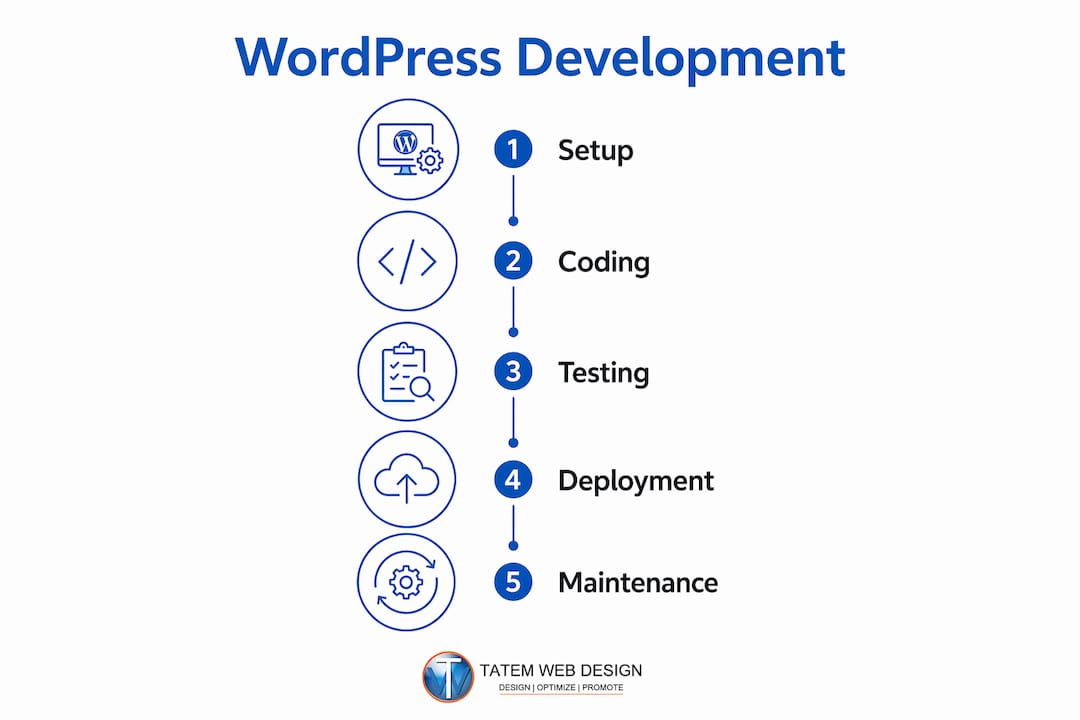
Professional WordPress development follows structured workflows that prevent the most common and costly mistakes. The biggest mistake teams make is manually copying files between environments. Automated deployments using CI/CD tools like GitHub Actions remove human error from the deployment process and create a reliable, repeatable path from development to production.
Version control is non-negotiable. Every line of custom code belongs in a Git repository. This applies to theme files, plugin code, and configuration files. When you version-control your configurations, you prevent database drift, the problem that occurs when your development database and production database fall out of sync.
- Set up version control first. Initialize a Git repository before writing a single line of code. Commit early and commit often.
- Use environment variables for sensitive data. Never hardcode database credentials or API keys into theme or plugin files.
- Follow the DRY principle. DRY stands for “Don’t Repeat Yourself.” Write reusable functions and hooks instead of copying the same logic across multiple files.
- Automate testing. Use PHPUnit for PHP unit tests and tools like Playwright for end-to-end browser testing. Catching bugs before deployment costs far less than fixing them after.
- Harden security from day one. Sanitize all user inputs, validate data on the server side, and use WordPress nonces to protect forms from cross-site request forgery attacks.
- Document your code. Future developers, including your future self, will thank you. Use PHPDoc blocks for functions and inline comments for complex logic.
“The difference between a WordPress site that lasts five years and one that breaks in six months is almost always the workflow, not the code itself.” — Advanced Custom Fields development team
WordPress security best practices are not optional additions to a project. They are part of the development process from the first line of code. Sites that treat security as an afterthought become liabilities, not assets.
What are the practical applications of WordPress development for businesses?
WordPress development translates directly into business results across a wide range of industries. A custom-built WordPress site is not just a digital brochure. It is a system that can generate leads, process payments, manage appointments, and connect to your existing business tools.
Common business applications include:
- Custom business websites: Law firms, medical practices, real estate agencies, and accounting firms use custom WordPress themes to present a professional brand and capture client inquiries
- E-commerce stores: WooCommerce, the leading WordPress e-commerce plugin, powers online stores for businesses selling physical products, digital downloads, and subscriptions
- Content platforms: News sites, blogs, and educational platforms use WordPress’s built-in post types and taxonomy system to organize and publish large volumes of content
- Membership sites: Custom plugins and access control systems restrict content to paying members, making WordPress a viable platform for online courses and communities
- Professional service portals: Booking systems, client dashboards, and document portals are all buildable within WordPress using custom post types and role-based access controls
The WordPress REST API, stable since version 4.7, allows external applications to access WordPress content programmatically. This means your WordPress site can feed content to a mobile app, a digital signage system, or a third-party marketing platform without any manual exports.
| Business Type | WordPress Application | Key Technology |
|---|---|---|
| Retail / E-commerce | Online store with cart and checkout | WooCommerce, PHP, MySQL |
| Healthcare / Medical | Appointment booking and HIPAA-aware forms | Custom plugins, REST API |
| Real estate | Property listings with search and filters | Custom post types, WP Query |
| Legal / Professional services | Lead capture and client portal | Custom themes, role management |
| Content / Media | High-volume publishing platform | Gutenberg, REST API, CDN |
WordPress website design for professional services requires more than a good-looking template. It requires custom development that aligns the site’s architecture with how the business actually operates.
Key Takeaways
WordPress development is a full-stack discipline built on PHP 8.3, MySQL, the Gutenberg Block Editor, and a hook system that makes every customization safe, updatable, and maintainable.
| Point | Details |
|---|---|
| WordPress dominates the web | WordPress powers 42.2% of all websites globally, making it the most practical CMS to build on. |
| Hooks are the foundation | Use actions and filters to extend WordPress safely without ever touching core files. |
| FSE replaced classic themes | Full Site Editing and theme.json now centralize all design controls in modern WordPress projects. |
| Automation prevents disasters | CI/CD tools like GitHub Actions and version control eliminate the manual errors that break sites. |
| REST API opens integrations | The WordPress REST API connects your site to mobile apps, external tools, and headless front ends. |
Why I tell every client to start with monolithic WordPress first
After years of building WordPress sites for businesses across Florida, the single most consistent mistake I see is developers jumping straight into headless WordPress before they understand how the platform actually works. Headless WordPress, where you use WordPress as a back end and a separate JavaScript framework as the front end, is a legitimate architecture. But it is the wrong starting point.
Mastering monolithic WordPress first is not a conservative opinion. It is practical advice grounded in how data flows through the system. If you do not understand how WordPress structures posts, taxonomies, and meta fields, you will not understand why your REST API responses look the way they do. You will spend weeks debugging problems that a solid foundation would have prevented.
The other lesson I keep coming back to is this: the hook system is not just a technical feature. It is a philosophy. Every time you reach for a core file edit, you are choosing short-term convenience over long-term stability. Hooks force you to write code that respects the platform. That discipline pays off every time WordPress releases an update and your site keeps working without a single change.
Start with the WordPress plugin essentials and the block editor. Get comfortable with theme.json. Build something real. Then, once you understand the full data model, explore headless if your project actually needs it. Most business sites do not.
— Matt
How Tatemweb builds WordPress sites that work for your business
Tatemweb has spent over 26 years building custom WordPress websites for businesses across Florida, from Stuart to Miami. The team handles everything from custom theme development and plugin creation to performance tuning and security hardening.
What sets Tatemweb apart is the integration of AI tools directly into the development process. Every site is built with automated SEO, AI-driven content systems, and lead capture tools that work from day one. Whether you need a custom AI-built website for a professional services firm or a WooCommerce store for your Florida retail business, Tatemweb delivers sites built to modern standards with real business outcomes in mind. Call 772-224-8118 to schedule a consultation and see what a properly built WordPress site can do for your business.
FAQ
What is WordPress development in simple terms?
WordPress development is the process of building and customizing websites using the WordPress platform, including writing code in PHP and JavaScript to create themes, plugins, and custom features.
Is WordPress development easy to learn?
The basics are accessible, but professional WordPress development requires full-stack skills including PHP, JavaScript, CSS, HTML, and database management. Most developers need six to twelve months of consistent practice to work at a professional level.
What is the difference between WordPress theme development and plugin development?
Theme development controls how a site looks, including layout, typography, and color. Plugin development adds or extends functionality, such as booking systems, payment processing, or custom data types.
What is the WordPress hook system?
The hook system is a set of actions and filters that let developers modify WordPress behavior without editing core files. This keeps sites updatable and secure while allowing unlimited customization.
Do I need to know PHP to do WordPress development?
Yes. PHP 8.3 is the primary back-end language for WordPress. You can use page builders without PHP, but any serious custom development, including themes and plugins, requires PHP knowledge.
Recommended
Tatem Web Design
26+ YearsWeb Design & SEO Specialist · Tatem Web Design
Matt Tatem has been designing websites professionally since 1999, making Tatem Web Design one of Florida's longest-running web agencies. Based in Stuart, FL, he specializes in WordPress, local SEO, Shopify e-commerce, and cybersecurity consulting for small businesses.
What a CMMC Level 2 Assessment Requires and How to Prepare
Prepare for your CMMC Level 2 assessment by understanding requirements, assessment paths, and mapping your Controlled Unclassified Information.
A Data Retention Policy Is Your Rulebook for Keeping and Deleting Data
Establishing a clear data retention policy helps manage data risk, ensuring compliance and effective data management for your organization.
Law Firm Local SEO: A Practical Playbook for More Local Clients
Unlock more local clients for your law firm with effective local SEO strategies. Optimize your Google Business Profile and boost your visibility!