
What a CMMC Level 2 Assessment Requires and How to Prepare
A CMMC Level 2 assessment requires proving you’ve implemented all 110 NIST SP 800-171 Revision 2 security requirements, and you’ll do that through one of two paths: a Level 2 (Self) self-assessment or a Level 2 (C3PAO) certification assessment. Your specific solicitation or DFARS clause tells you which one applies, not your preference. Both paths result in a certification cycle that requires an annual affirmation from a senior company official.
Your immediate next step is administrative, not technical. Pull the contract clause language and confirm which assessment path you’re locked into, then map exactly where Controlled Unclassified Information (CUI) touches your environment.
- Level 2 (Self) or Level 2 (C3PAO): determined by the solicitation, not your choice
- Certification cycle: 3 years, with annual senior-official affirmation required
- First move: identify your CUI scope before you do anything else
Key Takeaways
CMMC Level 2 certification depends on proving all 110 NIST SP 800-171 requirements with finalized evidence, correct scoping, and disciplined role separation between remediation and assessment.
| Point | Details |
|---|---|
| Confirm your assessment path first | Check your DFARS clause to determine Level 2 (Self) versus Level 2 (C3PAO) before spending on remediation. |
| Scope before you remediate | Build an asset inventory and network diagram to isolate CUI and avoid securing systems that never needed to be in scope. |
| Evidence must be final, not draft | Assessors require dated, signed artifacts; draft policies and unsigned logs produce NOT MET findings. |
| Budget beyond the DoD estimate | Published assessment cost figures don’t include remediation, which typically drives the real first-cycle spend higher. |
| Get local, hands-on readiness support | Tatem Web Design offers Florida-based CMMC consulting covering SSP development, scoping, evidence prep, and staff training. |
Table of Contents
- What Does a CMMC Level 2 Assessment Actually Require?
- Do I Need a Self-Assessment or a C3PAO Certification?
- How Do You Scope a CMMC Level 2 Assessment Correctly?
- How Do Assessors Actually Test Your Controls?
- What’s a Practical Readiness Checklist Before Assessment Day?
- What Happens After You Pass, and What Are the POA&M Rules?
- What Does a CMMC Level 2 Assessment Actually Cost?
- What Evidence and Documentation Do Assessors Expect?
- What Has Tatem Web Design Learned From Contractors Preparing for Level 2?
- Who Needs to Be Involved in Assessment Preparation?
- What Trips Up Contractors During Level 2 Assessments Most Often?
- What Does the Full Timeline From Preparation to Certification Look Like?
- How Do You Choose and Work With a C3PAO?
- What Should You Do After the Assessment Ends?
- An Editorial Take on What Actually Matters in Level 2 Prep
- How Tatem Web Design Supports Your Level 2 Readiness
- Sources
- FAQ
What Does a CMMC Level 2 Assessment Actually Require?
Level 2 rests entirely on NIST SP 800-171 Revision 2, organized into 14 control families covering access control, incident response, media protection, and system integrity, among others. Meeting these 110 requirements isn’t a percentage game.
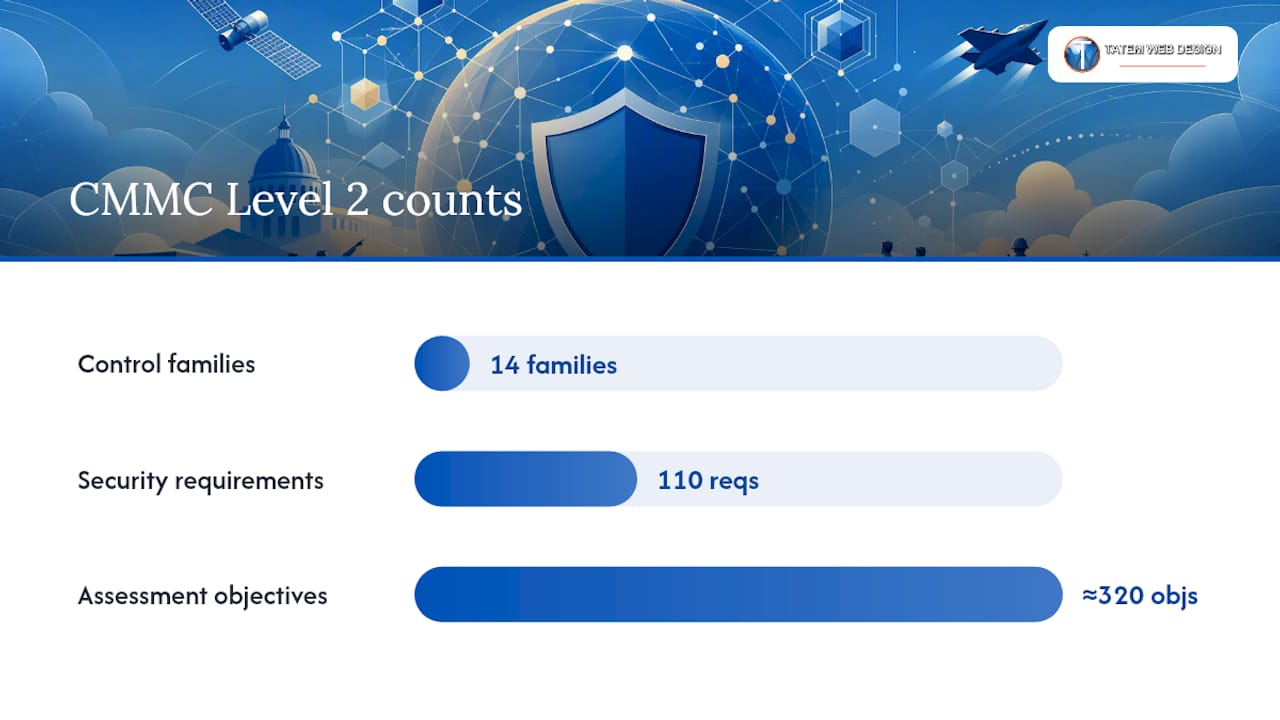
Each requirement breaks down into multiple assessment objectives, and every objective must land as MET for the parent requirement to pass. Miss one objective within a 12-part requirement, and the whole requirement fails. Teams that expect partial credit for “mostly compliant” controls are consistently the ones surprised by their scores.
Statistic Callout: Level 2 assessments evaluate approximately 320 individual assessment objectives across 110 security requirements. A single NOT MET objective fails the entire parent requirement, regardless of how well the rest of that control is implemented.
The regulatory backbone for all of this sits in 32 CFR §170.14 through §170.19, which defines scoping, assessment procedures, and reporting mechanics. Practically, this means:
- Every control family needs documented, implemented evidence, not just a policy statement
- Objectives are assessed individually, so gaps hide inside requirements that look complete on paper
- The assessment guide, not internal judgment, defines what counts as sufficient evidence
Do I Need a Self-Assessment or a C3PAO Certification?
The answer lives in your contract, not in your risk appetite. DFARS 252.204-7021 and 252.204-7025 specify which CMMC level and assessment type apply to a given solicitation, and contracting officers write that requirement directly into the clause. If your contract calls for Level 2 (Self), you assess your own environment and post the score to the Supplier Performance Risk System (SPRS). If it calls for Level 2 (C3PAO), an accredited third-party assessment organization conducts the review and results get submitted to eMASS.
Here’s what doesn’t change between the two paths:
- The technical bar is identical. Both paths assess the same 110 requirements against the same objectives.
- The difference is entirely procedural. Who performs the review and where the score gets filed changes; what gets reviewed does not.
- Role separation matters in both cases. A company that hired a consultant to build its System Security Plan cannot have that same firm serve as its C3PAO assessor. Remediation and assessment are supposed to stay independent functions, even under self-assessment, because SPRS submissions are legally attestable.
Some contractors treat the self-assessment path as the “easy” option because there’s no external assessor in the room. That instinct causes real damage down the line.
Pro Tip: Score your self-assessment as if a C3PAO auditor were standing over your shoulder. SPRS submissions carry the same legal weight as a certification assessment, and a False Claims Act exposure doesn’t care which path you took.
How Do You Scope a CMMC Level 2 Assessment Correctly?
Scoping decides your entire cost structure before a single control gets remediated. Get it wrong, and you’ll spend on securing systems that never needed to be in scope at all.
The CMMC Scoping Guide – Level 2 breaks your environment into four categories under 32 CFR §170.19: CUI Assets that process, store, or transmit CUI directly; Security Protection Assets that safeguard the CUI environment (think firewalls, SIEM tools, identity providers); Specialized Assets like IoT devices or test equipment that touch the environment but can’t run standard security agents; and Out-of-Scope Assets that never contact CUI in any form.
You need two documented artifacts before an assessor ever looks at your environment: a complete asset inventory and a network diagram showing data flow. Assessors will ask for both, and “we can build one” is not an acceptable answer during the assessment window.
| Asset Category | What It Means | Assessment Impact |
|---|---|---|
| CUI Assets | Directly process, store, or transmit CUI | Full 110-requirement scrutiny applies |
| Security Protection Assets | Provide security functions for the CUI boundary | Assessed for the specific function they perform |
| Specialized Assets | IoT, OT, test equipment touching the environment | Documented but assessed differently than standard IT |
| Out-of-Scope Assets | No contact with CUI | Excluded, but the exclusion must be justified in writing |
The real cost lever is isolation. Identify where CUI originates and where it flows, then use network segmentation or a dedicated cloud enclave (a Microsoft GCC High tenant is a common example) to shrink the number of systems that need full control implementation. A contractor running CUI through a general-purpose file share touched by 40 employees faces a dramatically larger remediation bill than one that routes the same data through a segmented enclave accessed by five.
How Do Assessors Actually Test Your Controls?
NIST SP 800-171A defines three assessment methods, and assessors mix all three depending on the requirement: examine, interview, and test.
- Examine means reviewing documents, configurations, and records, your SSP, firewall rule sets, access control lists, and training logs
- Interview means talking to the people who actually run the process, not just the person who wrote the policy
- Test means executing the control live, attempting an unauthorized login, checking whether a terminated employee’s account actually got disabled
Scoring runs on a strict pass/fail logic at the objective level, then rolls up to the requirement level. There’s no averaging. A requirement with nine MET objectives and one NOT MET objective is a failed requirement, full stop.
Statistic Callout: SPRS scoring assigns each requirement a weighted value of 1, 3, or 5 points, meaning a handful of failed high-value requirements can tank a score far more than several minor ones.
Evidence expectations trip up more contractors than the technical controls themselves. Assessors require final, dated artifacts. A policy document marked “DRAFT” or an unsigned training log doesn’t count, no matter how close it is to final. Assessment methods also demand dated, finalized documentation rather than work-in-progress materials, which means the week before your assessment window opens is the wrong time to be finishing your incident response plan.
What’s a Practical Readiness Checklist Before Assessment Day?
Work through this sequence in order, not in parallel. Skipping ahead to remediation before scoping is settled is the single most expensive mistake contractors make.
- Confirm your contract path. Pull the DFARS clause and verify whether you need Level 2 (Self) or Level 2 (C3PAO) before spending a dollar on anything else.
- Define your CMMC Assessment Scope. Build the asset inventory and network diagram first; every remediation decision downstream depends on this.
- Update or create your System Security Plan. Your SSP should map each of the 110 requirements to a specific implementation, not a generic narrative.
- Collect final artifacts and hash them. Build a manifest of every piece of evidence, config exports, policy PDFs, access logs, with a hash value attached to each file.
- Run internal mock assessments. Replicate the examine, interview, and test methods against your own environment before an assessor does it for you.
- Decide where you need outside help. A readiness consultant can find gaps you’ve missed, but keep that consultant separate from whoever performs your certification assessment.
Pro Tip: Run your mock interviews with the actual employees who’ll be in the room during the real assessment, not just your IT director. Assessors ask front-line staff how the incident response process works, and a mismatched answer between the SSP and the help desk technician is a common source of NOT MET findings.
Tools that automate evidence gathering, including GRC platforms designed for CMMC control mapping, can speed up steps four and five considerably. They still can’t substitute for finalized, human-approved policies and logs; the tool organizes evidence, it doesn’t create the underlying compliance.
What Happens After You Pass, and What Are the POA&M Rules?
Certification lasts three years, but the clock doesn’t stop ticking in between. 32 CFR §170.16 requires an annual affirmation from a senior company official confirming continued compliance, submitted every year of the cycle, not just at renewal.
Scoring can land you in one of two outcomes: Final status, meaning you hit all 110 requirements, or Conditional status, which allows a Plan of Action and Milestones (POA&M) for a limited set of unmet requirements above a defined score floor. Conditional status comes with a hard 180-day clock to close every open POA&M item and reach Final status. Miss that window, and your certification lapses.
- Final status: all 110 requirements MET, full three-year certification issued
- Conditional status: score meets the minimum floor, remaining gaps tracked via POA&M
- 180-day closeout: every POA&M item must reach MET status within 180 days or certification fails
- Annual affirmation: required every year of the 3-year cycle, not just at initial certification
Artifact retention runs six years under §170.17, and every artifact submitted to a C3PAO for certification assessments needs a hash value accompanying it in eMASS. Losing that evidence trail before the retention window closes creates real exposure if a follow-up audit or contract dispute ever surfaces.
What Does a CMMC Level 2 Assessment Actually Cost?
The Department of Defense published small-entity cost estimates when the CMMC 2.0 rule finalized: roughly $37,196 for a small-entity self-assessment and about $104,670 for a small-entity C3PAO certification assessment over three years. Those figures cover the assessment process itself, not the remediation required to pass it.
That gap between “cost to assess” and “cost to become assessable” is where most contractors get blindsided. Industry experience consistently shows first-cycle costs, once you factor in remediation work like access control rebuilds, logging infrastructure, and staff training, landing in the low-to-mid six figures for organizations that started with meaningful gaps.
Statistic Callout: DoD’s published estimates cover assessment logistics only. Remediation, closing the actual security gaps, is where real budgets get consumed, and that number varies enormously based on how disciplined your scoping was.
Primary cost drivers, in rough order of impact:
- Remediation scope: how many controls need to go from zero to fully implemented
- CMMC Assessment Scope size: more in-scope systems means more objectives to remediate and test
- Assessor fees: C3PAO engagements bill for preparation review, fieldwork, and reporting
- Internal staff time: documentation, interviews, and mock testing pull people off other work for weeks
Phased remediation, tackling your highest-point-value failing requirements first, spreads the financial impact across budget cycles instead of forcing one massive spend before a contract deadline.
What Evidence and Documentation Do Assessors Expect?
Your System Security Plan (SSP) is the master document, and it needs to map every one of the 110 requirements to a specific, named implementation. A generic SSP template with placeholder language is one of the fastest ways to trigger a NOT MET finding, because assessors examine the SSP first and then verify it against actual artifacts.
Typical acceptable evidence includes signed policy PDFs (access control, incident response, media handling), firewall and access control list exports, centralized log records showing monitoring activity, and dated training completion records for every employee with system access.
- Policy documents: final, signed, dated, not marked “draft” or “in review”
- Technical exports: firewall rules, IAM configurations, patch management logs
- Training records: completion dates tied to named employees, not a generic attendance sheet
- Incident response evidence: tabletop exercise records, actual incident logs if applicable
Build your hashed artifact manifest well before the assessment window. Each file gets a hash value (SHA-256 is standard), logged in a manifest that ties the hash to the file name and the control it supports. This manifest is what you hand to a C3PAO assessor, and it’s what gets retained for six years afterward.
Pro Tip: Set up change control on your evidence folder the day you start collecting artifacts. If a config file changes after you’ve hashed it, the hash breaks, and you’ll need to explain the discrepancy to an assessor rather than quietly re-uploading a new version.
What Has Tatem Web Design Learned From Contractors Preparing for Level 2?
Working with Florida defense contractors and subcontractors preparing for Level 2 readiness, the same mistakes surface repeatedly, and they’re almost always avoidable with earlier attention.
- Scope creep during remediation. Teams start with a tight CUI boundary, then quietly expand it mid-project by routing new data through unscoped systems, undoing months of isolation work.
- Draft artifacts submitted as final. Policies get written, reviewed, and then never formally signed off, leaving assessors with documents that don’t meet the finality standard.
- Over-reliance on compliance software. A GRC tool tracks your progress; it doesn’t write your incident response plan or train your staff, and treating it as a substitute for both creates gaps nobody notices until assessment day.
Tatem Web Design’s CMMC compliance consulting work with regional contractors focuses on closing exactly these gaps: building SSPs that map cleanly to the 110 requirements, running mock assessments that mirror the real examine/interview/test methodology, and keeping remediation and assessment functions properly separated.
Who Needs to Be Involved in Assessment Preparation?
CMMC Level 2 readiness fails as a solo IT project. It requires a defined team with clear ownership, because assessors interview multiple roles and expect consistent answers across all of them.
A senior company official has to sign the annual affirmation, which means that person needs enough visibility into the compliance posture to sign truthfully, not just trust a summary handed up from IT. That’s a governance decision, not a technical one, and it should be assigned early rather than scrambled together right before the affirmation deadline.
Your IT or security lead owns technical implementation: access controls, logging, patch management, encryption. A separate compliance or contracts manager should own documentation and the SSP, tracking how each requirement maps to evidence. HR or office administration typically owns training records, since assessors check completion dates tied to named employees, not blanket attendance logs.

Training deserves its own attention beyond a single annual session. Staff who handle CUI directly need role-specific security awareness training, and structured cybersecurity training programs that produce dated, per-employee completion records solve a documentation gap that catches many contractors off guard. A generic “all-hands security refresher” without individual tracking doesn’t satisfy the evidence standard assessors apply.

Set a recurring internal review cadence, quarterly at minimum, where the security lead, compliance owner, and senior official compare notes. Waiting until 60 days before your assessment window to coordinate these roles is a common reason readiness projects run out of time.
What Trips Up Contractors During Level 2 Assessments Most Often?
The gap between “we think we’re compliant” and “we can prove we’re compliant” is where most assessments run into trouble. Contractors frequently implement a control technically but never document the process behind it, and assessors can only score what’s evidenced.
Inconsistent interview answers are a recurring failure point. If your SSP says the IT manager reviews access logs weekly, but the interview reveals that review happens “whenever there’s time,” that mismatch reads as a control weakness even if logs are technically being reviewed.
Scope disputes also derail assessments mid-process. A contractor that labeled a shared file server as out-of-scope, only to have an assessor find CUI references buried in a subfolder, faces a scope correction that can add weeks to the process and expand the requirement count significantly.
Evidence staleness catches teams that prepared early and then didn’t refresh anything. A training log from 14 months ago doesn’t demonstrate current compliance if your policy requires annual refreshers, and an assessor will flag the gap.
Practical fixes that address most of this:
- Run a full internal mock assessment within 60 days of your actual assessment window, not six months out
- Cross-check every SSP claim against the artifact that proves it, line by line, before submission
- Assign one person to own scope boundary decisions so “out-of-scope” calls don’t get made informally by whoever’s closest to the system
Treating your self-assessment score with the same seriousness you’d apply to a C3PAO review closes most of these gaps before they become findings.
What Does the Full Timeline From Preparation to Certification Look Like?
Realistic timelines run considerably longer than contractors expect going in, mostly because remediation work, not the assessment itself, consumes most of the calendar.
Scoping and gap analysis typically take four to eight weeks for a mid-size contractor environment. This phase produces your asset inventory, network diagram, and an honest list of which of the 110 requirements are already MET versus which need work.
Remediation is the long pole. Organizations with moderate gaps, missing logging infrastructure, incomplete access controls, no formal incident response plan, commonly spend three to six months implementing and documenting fixes. Heavier gaps push that timeline past a year.
Evidence finalization and internal mock assessment should run in parallel with the tail end of remediation, roughly four to six weeks, to confirm artifacts are dated, signed, and hash ready.
If you’re on the C3PAO path, scheduling itself adds lead time. Accredited assessors book out weeks to months in advance depending on demand, so contact your chosen C3PAO well before you think you’re ready, not after. The actual fieldwork for a Level 2 certification assessment generally runs one to three weeks depending on scope size, followed by a reporting period before results post to eMASS.
Self-assessment contractors skip the scheduling bottleneck but shouldn’t skip the internal validation rigor. Posting a score to SPRS without a genuine internal mock assessment first is how contractors end up affirming compliance they can’t actually defend if questioned.
How Do You Choose and Work With a C3PAO?
Not every accredited C3PAO fits every contractor’s environment, and picking one late in your timeline limits your options considerably.
Start with the Cyber AB Marketplace, the authorized accreditation body’s public directory of certified C3PAOs, and verify current accreditation status directly rather than relying on a vendor’s own marketing claims. Accreditation status can change, and an out-of-date badge on a website isn’t verification.
Look for a C3PAO with direct experience in your specific environment type. A firm that’s assessed dozens of manufacturing CUI environments may have limited depth with cloud-native SaaS contractors, and that experience gap shows up in how efficiently the fieldwork proceeds.
Ask about scheduling lead time upfront. If your contract deadline is six months out and a C3PAO’s calendar is booked five months deep, that mismatch needs to surface in your planning now, not during a scramble later.
Confirm independence boundaries clearly before signing an engagement. A C3PAO cannot have provided your remediation consulting or built your SSP, so if you used an outside firm for readiness work, that firm is automatically disqualified from performing your certification assessment. Get this in writing before the engagement starts, not after fieldwork begins.
Finally, clarify what happens if you land in Conditional status. A C3PAO experienced with POA&M closeout timelines can guide you through the 180-day window efficiently; one unfamiliar with that process can leave you scrambling to interpret the requirements yourself.
What Should You Do After the Assessment Ends?
A passing score, Final or Conditional, doesn’t close the compliance file. It opens a new phase of maintenance that runs for the full three-year cycle.
If you landed in Conditional status, your first priority is the POA&M closeout. Every open item needs a documented remediation plan with a realistic path to MET status well inside the 180-day window, not a plan that assumes everything goes perfectly on the first attempt.
Beyond POA&M items, build a continuous monitoring rhythm rather than treating compliance as a one-time project. Quarterly internal reviews of access logs, patch status, and training completion catch drift before it becomes a finding at your next certification cycle. Configuration changes that happen mid-cycle, a new cloud service, a network change, a staffing shift affecting who touches CUI, should trigger a scope re-check rather than waiting until the next formal assessment.
Annual affirmation isn’t a rubber stamp. The senior official signing it should have a genuine review process behind that signature each year, supported by whatever internal monitoring cadence your organization runs. Treating year two and year three of the cycle with the same rigor as your initial assessment year is what actually keeps a certification defensible if a contract dispute or follow-up review ever puts it under scrutiny.
An Editorial Take on What Actually Matters in Level 2 Prep
Most guidance on CMMC Level 2 treats the 110 requirements as the hard part. They’re not. The hard part is discipline: finalizing artifacts before you think you’re ready, keeping remediation and assessment roles separate even when it’s inconvenient, and refusing to let scope quietly expand mid-project because it’s easier than saying no to a new data flow.
The contractors who struggle most aren’t the ones with the weakest technical controls. They’re the ones who treated their self-assessment as a lower-stakes version of a C3PAO review, then discovered that SPRS submissions carry the same legal exposure either way. Scoping discipline, not technical sophistication, is what separates a manageable readiness project from a six-figure fire drill.
If there’s one piece of advice worth acting on immediately, it’s this: confirm your contract path today, and schedule a readiness gap review before you assume your environment is closer to compliant than it actually is.
— Matt
How Tatem Web Design Supports Your Level 2 Readiness
Tatem Web Design is the local alternative to hiring a national compliance firm for CMMC Level 2 readiness in Florida, offering hands-on scoping, evidence preparation, and remediation support without the overhead of an out-of-state consultancy that’s never seen your actual environment.

Level 2 readiness touches more than paperwork. It requires secure infrastructure, trained staff, and evidence collection systems that hold up under assessor scrutiny. Tatem Web Design’s CMMC compliance consulting work covers SSP development, scoping and network diagram documentation, and mock assessments that mirror the real examine, interview, and test methodology. Their cybersecurity enhancement services address technical remediation, from access control rebuilds to logging infrastructure, while their staff training programs produce the dated, per-employee records assessors expect to see.
Every engagement stays U.S. based and Florida focused, built for small and mid-size defense subcontractors who need a partner that understands both the regulatory detail and the operational reality of running a business alongside a certification deadline. Call 772-224-8118 or visit Tatem Web Design to schedule a readiness gap review before your next contract deadline forces the conversation.
Sources
FAQ
Is there a CMMC Level 2 self-assessment option?
Yes. Level 2 (Self) is a valid path determined by your solicitation’s DFARS clause, and it requires posting your score to SPRS with the same technical rigor as a C3PAO certification assessment.
How much does a CMMC Level 2 assessment cost?
DoD’s published small-entity estimates run about $37,196 for a self-assessment and $104,670 for a C3PAO certification assessment over three years, though remediation costs typically push real first-cycle spending well beyond those figures.
Is CMMC Level 2 suspended?
No. CMMC 2.0, including Level 2 requirements, is a finalized rule that took effect through the DoD’s 2026 rulemaking, and contracting officers are actively including CMMC clauses in applicable solicitations.
How often is a CMMC Level 2 assessment required?
Certification runs on a three-year cycle, with an annual senior-official affirmation required every year in between to confirm continued compliance.
Can Tatem Web Design help with CMMC Level 2 readiness?
Yes. Tatem Web Design provides CMMC compliance consulting for Florida contractors covering scoping, SSP development, evidence preparation, and staff training aligned to Level 2 requirements.
Recommended
Tatem Web Design
26+ YearsWeb Design & SEO Specialist · Tatem Web Design
Matt Tatem has been designing websites professionally since 1999, making Tatem Web Design one of Florida's longest-running web agencies. Based in Stuart, FL, he specializes in WordPress, local SEO, Shopify e-commerce, and cybersecurity consulting for small businesses.

Rank in ChatGPT in 90 Days With a Practitioner Led Checklist
Follow a practitioner led 90 day plan to get cited by ChatGPT: allow OAI-SearchBot, publish short answer capsules with schema, and track Bing AI Performance.

AI SEO Content Playbook: 16 GEO Signals for Agencies & Teams
A practical playbook mapping the GEO-16 signals to hands-on editorial workflows, review controls, and metrics. For agencies and in-house teams scaling AI...

Copy Ready Local Schema Markup for SMBs + Google Validation
Copy ready JSON-LD examples and Google validation steps for SMBs' local schema markup. Audit, implement, and verify each location page with confidence.