
Cybersecurity Compliance for SMBs: 2026 Guide
Cybersecurity compliance is defined as the practice of meeting legally mandated and industry-recognized standards that protect sensitive digital information, IT systems, and the people whose data your business handles. For small and medium-sized businesses, this means navigating data protection regulations like GDPR, CCPA/CPRA, HIPAA, and sector-specific cybersecurity standards that carry real financial penalties for failure. The stakes are not abstract. Regulators across the U.S., Europe, and emerging markets are actively enforcing these rules, and SMBs are no longer exempt from scrutiny. This guide breaks down the frameworks you need to know, the pitfalls that trip up most business owners, and the practical steps to build a compliance program that actually holds up under audit.
What are the main cybersecurity compliance frameworks SMBs need to know?
The regulatory environment for cybersecurity compliance is fragmented by geography, industry, and business size. Understanding which rules apply to your business is the first step toward building a defensible program.
GDPR remains the most far-reaching data protection law in the world. In force since May 2016, it applies to any organization that handles the personal data of EU residents, regardless of where the business is physically located. A Florida-based law firm with a single EU client falls under its scope. GDPR requires documented consent, data subject rights, breach notification within 72 hours, and appointed data protection officers in certain cases. Penalties reach up to 4% of global annual revenue, which makes non-compliance a genuine financial risk even for a 10-person firm.

NIS2 is the EU’s updated directive on network and information security. It applies to organizations with 50 or more employees or annual turnover above €10 million operating in critical sectors. NIS2 mandates incident reporting within 24 hours for early warnings, 72 hours for full notification, and one month for a final report. That timeline is tight, and most SMBs are not operationally ready to meet it without pre-built escalation procedures.
In the United States, no single federal privacy law exists, which creates a patchwork of state-level compliance requirements. California’s CCPA/CPRA is the strictest and most influential, granting consumers rights to access, delete, and opt out of the sale of their personal data. If your business serves California residents, CCPA/CPRA sets the floor. Virginia’s CDPA, Colorado’s CPA, and Texas’s TDPSA add further layers. The practical approach is to design your compliance program around the strictest applicable rules and apply them uniformly.
Sector-specific rules add another layer. HIPAA governs protected health information for healthcare providers, insurers, and their business associates. PCI DSS applies to any business that processes, stores, or transmits payment card data. CMMC Level 2 applies to defense contractors working with the U.S. Department of Defense. Globally, emerging legislation like Sri Lanka’s proposed Cybersecurity Regulatory Authority signals that mandatory annual compliance readiness, with fines for failure, is becoming a worldwide standard, not just a Western concern.
| Framework | Who it applies to | Key requirement |
|---|---|---|
| GDPR | Any org handling EU resident data | 72-hour breach notification, documented consent |
| NIS2 | EU-sector orgs, 50+ employees or €10M+ turnover | 24-hour early warning, supply chain security |
| CCPA/CPRA | Businesses serving California residents | Consumer data rights, opt-out mechanisms |
| HIPAA | Healthcare providers and business associates | Protected health information safeguards |
| PCI DSS | Any business processing card payments | Cardholder data environment controls |
| NIST CSF | Voluntary, but widely adopted | Security maturity framework for audits |
What are the common challenges SMBs face in achieving cybersecurity compliance?
Most SMBs do not fail at compliance because they lack technology. They fail because they misunderstand what compliance actually requires.
The most common mistake is treating compliance as an IT issue. Cyber compliance is an enterprise risk function, not a technical checkbox. Regulators do not just want to see firewalls and antivirus software. They want documented governance frameworks, board-level accountability, written policies, and evidence that leadership is actively involved in oversight. A business owner who delegates compliance entirely to an IT manager and never reviews policies is already failing the governance test.
Here are the most common compliance gaps Tatemweb sees across SMB clients:
- Treating compliance as a one-time project. Regulations change. Threats evolve. A compliance program built in 2023 and never updated will have gaps by 2026.
- No documented incident response plan. When a breach occurs, most SMBs improvise. That improvisation costs time, money, and regulatory goodwill.
- Vendor and supply chain blind spots. NIS2 Article 22 requires vendor risk questionnaires, contractual clauses, and audit rights. If your software vendors or cloud providers are not vetted, your compliance posture has a hole in it.
- Missing executive accountability. Documented governance and board oversight are required to bridge the gap between IT measures and actual compliance. Auditors look for this specifically.
- Poor documentation habits. Compliance is not just about doing the right things. It is about proving you did them. Without logs, records, and written evidence, your controls do not exist from a regulatory standpoint.
Pro Tip: Schedule a quarterly 30-minute leadership review of your compliance status. Put it on the calendar the same way you would a financial review. Regulators treat governance as a leadership responsibility, not an IT one.
The vendor problem deserves special attention. SMBs in regulated markets must demonstrate operational accountability and local support capabilities to win client procurement and retain business relationships. If you serve enterprise clients or government agencies, your compliance posture directly affects your ability to win contracts. A weak vendor management process is not just a regulatory risk. It is a revenue risk.
How can SMBs build an effective cybersecurity compliance program?
Building a compliance program does not require a dedicated legal team or a six-figure budget. It requires a structured approach, consistent execution, and the right framework to guide your decisions.
-
Conduct an asset inventory and risk assessment. You cannot protect what you do not know you have. List every system, application, database, and device that touches sensitive data. Then assess the risk each one carries. This inventory becomes the foundation of every compliance decision you make.
-
Implement baseline technical controls. Multi-factor authentication (MFA) on all accounts, automated patch management, encrypted backups tested at least quarterly, and endpoint protection are non-negotiable starting points. These controls address the most common attack vectors and satisfy requirements across HIPAA, PCI DSS, and NIST CSF simultaneously.
-
Adopt the NIST Cybersecurity Framework as your operating model. NIST CSF is viewed as the gold standard for evaluating security maturity and demonstrating operational effectiveness to regulators. Its five functions, Identify, Protect, Detect, Respond, and Recover, map directly to what auditors want to see. Using NIST CSF as your backbone means your program speaks the language regulators understand.
-
Write and maintain governance documentation. Every policy needs to be written down: acceptable use, data classification, access control, incident response, and vendor management. These documents are what compliance auditors review first. Without them, your technical controls are invisible from a regulatory perspective.
-
Build a vendor risk management process. Create a short vendor questionnaire covering data handling practices, security certifications, breach notification procedures, and subcontractor policies. Require vendors who handle your data to sign data processing agreements. Review high-risk vendors annually. This process satisfies NIS2 supply chain requirements and protects you from third-party breaches.
-
Establish an incident response plan with named owners. Pre-established escalation paths and a responsible individual for regulatory notifications are required under NIS2 and recommended under every major framework. Your plan should specify who declares an incident, who notifies regulators, who communicates with affected customers, and what the documentation trail looks like.
-
Train your team. Human error causes the majority of security incidents. Regular phishing simulations, annual security awareness training, and role-specific training for employees who handle sensitive data are all cost-effective controls that reduce risk and satisfy compliance requirements.
Pro Tip: Use the NIST CSF self-assessment tool to score your current security posture before spending money on new technology. Most SMBs discover that documentation and process gaps, not technology gaps, are their biggest compliance vulnerabilities.
For businesses in healthcare, working with a specialist on HIPAA cybersecurity requirements early in the process prevents costly retrofitting later. The same principle applies to defense contractors pursuing CMMC certification and retailers managing PCI DSS scope.
What are effective strategies for ongoing compliance and audit readiness?
Building a compliance program is a starting point. Keeping it current is the real work, and it is where most SMBs fall short.
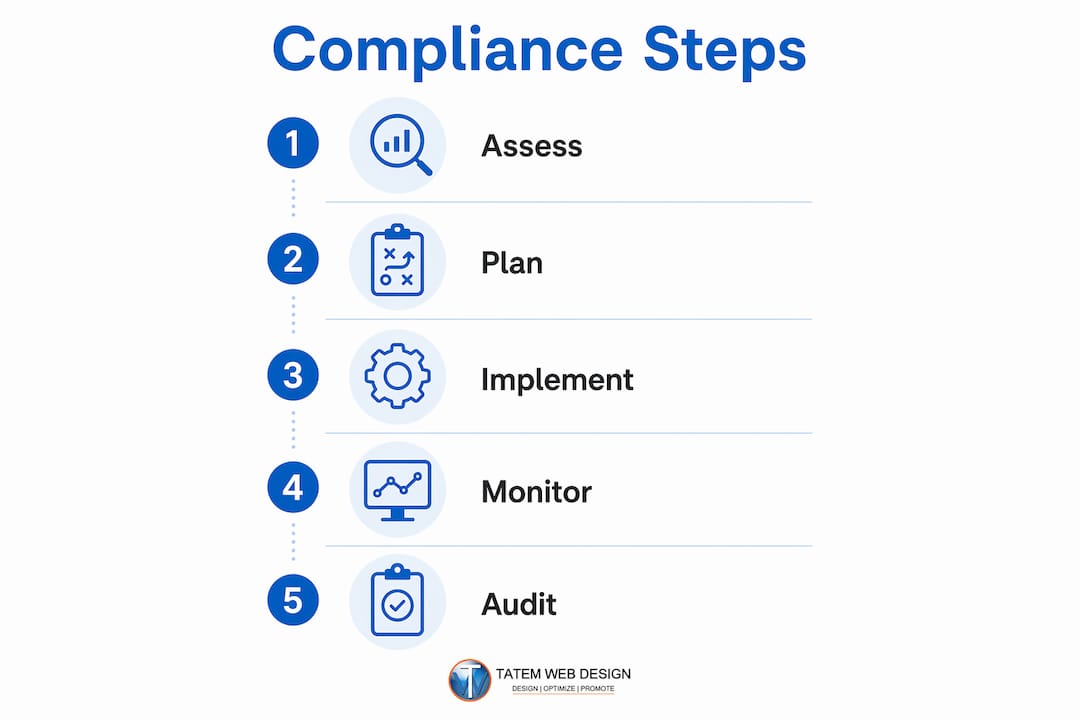
Cybersecurity compliance is moving toward continuous, evidence-driven monitoring rather than periodic audits. Regulators increasingly expect proof of ongoing oversight, not a binder of policies that was last updated two years ago. This shift has practical implications for how you structure your compliance activities throughout the year.
The table below outlines a practical annual compliance calendar for SMBs:
| Quarter | Activity | Purpose |
|---|---|---|
| Q1 | Risk assessment update and asset inventory review | Identify new systems, changed risks, and regulatory updates |
| Q2 | Vendor risk reviews and contract audits | Verify supply chain security and update data processing agreements |
| Q3 | Security awareness training and phishing simulation | Reduce human error risk and document employee training completion |
| Q4 | Full policy review, incident response drill, and audit prep | Confirm documentation is current and test response readiness |
Continuous monitoring means more than running automated scans. It means your IT and compliance teams are coordinating regularly, your leadership receives quarterly compliance status reports, and your incident response plan is tested at least once a year. Effective compliance programs require coordination between IT and compliance teams to keep pace with evolving regulations and threats. In an SMB, this often means one person wears both hats, which makes written procedures even more critical.
Audit readiness is not a sprint you run before an auditor arrives. It is a posture you maintain year-round. Keep a compliance evidence folder organized by control category. Every time you complete a patch cycle, run a backup test, or conduct a vendor review, log it with a date and the name of the person responsible. When an auditor asks for evidence of your patch management process, you hand over a log, not a verbal explanation.
For businesses scaling across state lines or internationally, staying compliant during business expansion requires mapping new regulatory obligations before entering new markets, not after. A Florida healthcare practice opening a second location in Texas, for example, needs to assess whether Texas-specific privacy rules or additional HIPAA business associate agreements apply before the first patient record is created in the new system.
The role of AI tools in compliance monitoring is growing. Automated log analysis, anomaly detection, and policy management platforms can reduce the manual burden of continuous monitoring significantly. For SMBs without dedicated compliance staff, these tools turn what would be a full-time job into a manageable weekly review process.
Key takeaways
Cybersecurity compliance requires documented governance, continuous monitoring, and cross-functional leadership involvement, not just technical controls, to satisfy regulators and protect your business.
| Point | Details |
|---|---|
| Compliance is an enterprise function | Leadership must own governance and documentation, not just the IT team. |
| Know your applicable frameworks | GDPR, CCPA/CPRA, HIPAA, PCI DSS, and NIST CSF each apply based on your sector and geography. |
| Vendor risk is your risk | Vet every vendor that touches your data with questionnaires, contracts, and annual reviews. |
| Documentation is your defense | Written policies, logs, and evidence of ongoing oversight are what auditors actually evaluate. |
| Compliance is continuous | Quarterly reviews, annual training, and tested incident response plans keep your program audit-ready year-round. |
Why most SMBs are getting compliance backwards
After working with businesses across healthcare, legal, real estate, and professional services in Florida, the pattern is consistent. Business owners invest in security tools and then assume they are compliant. They are not. Compliance and security are related but distinct. You can have excellent security technology and still fail an audit because your governance documentation is missing, your leadership has never signed off on a policy, or your vendor agreements do not include the required data processing clauses.
The businesses that pass audits and win regulated contracts are not necessarily the ones with the most sophisticated technology. They are the ones where the owner or executive team treats compliance as a business function with the same rigor as accounting or HR. They have written policies. They review them. They train their staff. They document everything.
The other mistake I see constantly is waiting for a breach or a regulatory notice before taking compliance seriously. By that point, the cost of remediation is five to ten times higher than the cost of building the program correctly from the start. A cybersecurity consultant engaged early in the process pays for itself many times over, not just in avoided penalties, but in the competitive advantage that comes from being able to demonstrate compliance to enterprise clients and government procurement officers.
The SMBs that treat compliance as a competitive asset rather than a regulatory burden are the ones winning the contracts, retaining the clients, and building businesses that scale without regulatory landmines waiting for them.
— Matt
How Tatemweb helps SMBs achieve and maintain cybersecurity compliance
If you have read this far and recognized gaps in your current compliance posture, you are not alone. Most SMBs in Florida are operating with incomplete programs, and the regulatory environment is only getting stricter.
Tatemweb has spent over 26 years helping businesses in Stuart, Florida and across the state build security programs that satisfy regulators, protect sensitive data, and support business growth. From AI-powered security enhancements that automate continuous monitoring to company cybersecurity training that reduces human error risk, Tatemweb offers the full range of services SMBs need to get compliant and stay that way. For businesses with specific regulatory obligations, Tatemweb’s cybersecurity compliance services cover HIPAA, CMMC, PCI, and PII requirements. Call 772-224-8118 to schedule a consultation today.
FAQ
What is cybersecurity compliance?
Cybersecurity compliance is the practice of meeting legally mandated and industry-recognized standards designed to protect sensitive data and IT systems. Applicable frameworks include GDPR, HIPAA, PCI DSS, CCPA/CPRA, and NIST CSF, depending on your industry and the data you handle.
How is cybersecurity compliance different from cybersecurity?
Cybersecurity focuses on technical controls that protect systems from attack. Compliance focuses on documented governance, written policies, and evidence of ongoing oversight that satisfy regulatory requirements. A business can have strong security technology and still fail a compliance audit due to missing documentation or lack of leadership accountability.
What cybersecurity frameworks apply to small businesses?
The applicable frameworks depend on your sector and geography. NIST CSF applies broadly as a voluntary best-practice standard. HIPAA applies to healthcare. PCI DSS applies to businesses processing card payments. GDPR applies if you handle EU resident data. CCPA/CPRA applies if you serve California consumers.
How often should SMBs conduct security compliance audits?
Regulators expect continuous oversight rather than annual point-in-time audits. A practical approach is quarterly compliance reviews covering risk assessments, vendor oversight, and policy updates, combined with an annual full audit readiness exercise and incident response drill.
What is the biggest compliance mistake SMBs make?
The most common mistake is treating compliance as an IT-only issue and neglecting the governance, documentation, and leadership accountability that regulators actually evaluate. Technical controls without written policies, signed governance frameworks, and documented evidence of ongoing oversight will not satisfy an auditor.
Recommended
Tatem Web Design
26+ YearsWeb Design & SEO Specialist · Tatem Web Design
Matt Tatem has been designing websites professionally since 1999, making Tatem Web Design one of Florida's longest-running web agencies. Based in Stuart, FL, he specializes in WordPress, local SEO, Shopify e-commerce, and cybersecurity consulting for small businesses.

Rank in ChatGPT in 90 Days With a Practitioner Led Checklist
Follow a practitioner led 90 day plan to get cited by ChatGPT: allow OAI-SearchBot, publish short answer capsules with schema, and track Bing AI Performance.

AI SEO Content Playbook: 16 GEO Signals for Agencies & Teams
A practical playbook mapping the GEO-16 signals to hands-on editorial workflows, review controls, and metrics. For agencies and in-house teams scaling AI...

Copy Ready Local Schema Markup for SMBs + Google Validation
Copy ready JSON-LD examples and Google validation steps for SMBs' local schema markup. Audit, implement, and verify each location page with confidence.