
CMMC Level 2 Cost for U.S. Contractors: $75K–$300K vs DoD $104,670
The Department of Defense models CMMC Level 2 assessment and affirmation at roughly $104,670 over three years for a small entity. Real-world first-cycle budgets rarely land there. Once you factor in gap remediation, documentation, and internal labor, most contractors spend $75,000 to $300,000 or more in year one. The gap between those two numbers isn’t a pricing error. It reflects what the DoD’s model assumes you’ve already fixed versus what most contractors still need to build.
TL;DR:
- Most contractors should budget between $75,000 and $300,000 in first-year costs, considering remediation, documentation, and internal labor, not just the DoD model estimate.
- Remediation expenses often exceed assessment fees, with infrastructure upgrades and staff hours being the largest and most overlooked cost drivers.
- Scoping assessments to a Controlled Unclassified Information enclave can reduce Year-1 costs by 40% to 60% compared to assessing entire networks.
- A typical first-cycle assessment, including remediation and evidence collection, can take 4 to 9 months for readiness plus an additional 3 to 6 months wait for assessor availability.
- A defensible quote must break down scope, assessor days, deliverables, exclusions, and contingencies, with internal labor costs recognized as a critical element.
Table of Contents
- What Does CMMC Level 2 Cost? DoD Baseline vs Market Reality
- Cost Breakdown by Component: Where the Money Actually Goes
- Typical Year‑1 Totals by Organization Profile
- How Scope Changes What You Pay
- What’s the Timeline for CMMC Level 2 Certification?
- How to Get a Defensible Quote and Cut Costs Without Cutting Corners
- Consultant vs In-House: What Should You Expect to Pay?
- Why Most CMMC Budget Overruns Are Predictable
- Get a Scoped CMMC Level 2 Estimate for Your Organization
- Sources
- FAQ
What Does CMMC Level 2 Cost? DoD Baseline vs Market Reality
The DoD’s own modeling, published in the Federal Register final rule, sets Level 2 three-year totals at $104,670 for small entities and $117,768 for other-than-small entities. Those figures bake in internal labor and a modeled C3PAO engagement, but they skip large remediation and engineering costs entirely.
That’s the catch. The DoD number assumes your organization already has NIST SP 800-171 controls largely implemented. Most don’t.
Market benchmarking tells a different story. First-cycle Level 2 budgets commonly run $75,000 to $300,000 or more, and separate industry analysis puts realistic first-cycle spend at $70,000 to $250,000+ once you count readiness work and remediation.
The difference boils down to three things:
- Prior implementation gap — DoD assumes NIST SP 800-171 is already in place; most contractors are starting from partial compliance.
- Remediation scope — new logging infrastructure, access controls, and encryption often cost more than the assessment itself.
- Internal labor — staff hours spent on documentation and evidence collection rarely make it into vendor quotes.
Cost Breakdown by Component: Where the Money Actually Goes
A defensible CMMC Level 2 budget breaks into distinct line items, and understanding each one helps you spot a quote that’s missing pieces. Here’s how the money typically splits.
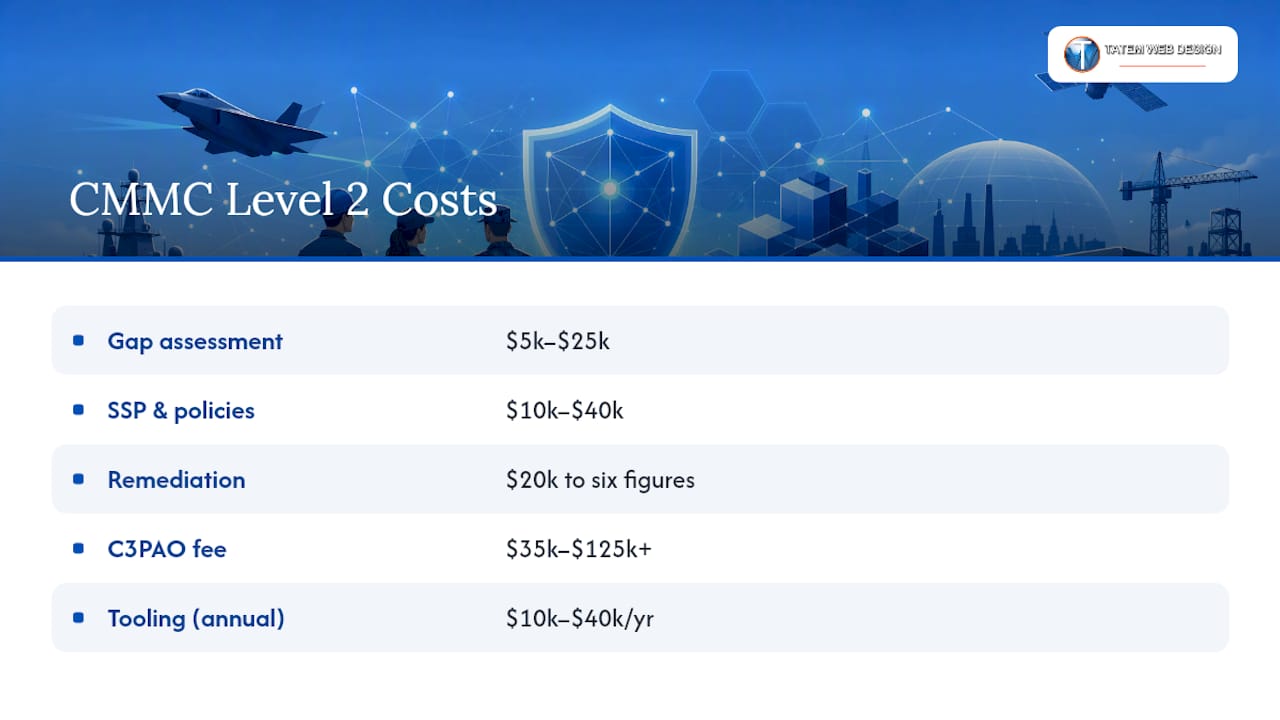
Gap assessment. A readiness or gap assessment against NIST SP 800-171 usually runs $5,000 to $25,000 depending on organization size and how much documentation already exists.
SSP and policy development. Building a System Security Plan and the supporting policy library often costs $10,000 to $40,000, especially if you’re starting from scratch rather than updating an existing plan.
Remediation. This is usually the largest line item. Closing control gaps, deploying logging tools, and hardening access management can range from $20,000 into six figures depending on your starting posture.
Pre-assessment or mock assessment. A dry run before the real thing typically costs $5,000 to $15,000, and it catches evidence gaps before a C3PAO does.
C3PAO assessment fee. Assessor invoices commonly fall between $35,000 and $125,000+, with many small and mid-sized contractors landing in the $50,000 to $85,000 range.
Tooling and licensing, SIEM/log retention, and MSP/MSSP support. These recurring costs vary widely but frequently total $10,000 to $40,000 annually.
Internal labor and annual affirmation. Staff time for evidence upkeep and the yearly affirmation requirement is often underestimated, and it doesn’t stop after certification.
Here’s the part that surprises most procurement teams: the assessor invoice, the number everyone fixates on, often represents only 20% to 30% of total first-cycle spend. Remediation and internal labor quietly eat the rest.
Pro Tip: Treat your readiness engagement as a separate, non-negotiable line item from the C3PAO assessment. Regulatory guidance requires independence between the two, and skipping readiness work is the single most common reason organizations fail their first assessment attempt.
Typical Year‑1 Totals by Organization Profile
Your closest match on the table below gives you a realistic starting point, not a guaranteed number. Actual totals shift with your starting security posture, how clean your evidence trail already is, and how aggressively you scope the assessment boundary.
The 25-user enclave figure comes directly from market benchmarking data showing a median of roughly $90,000. Organizations that scope tightly to a CUI enclave rather than assessing their entire network consistently land at the lower end of these bands. Those still carrying legacy IT debt, unpatched systems, or scattered documentation should plan toward the higher end.
How Scope Changes What You Pay
Scope is the single biggest lever you control, and it’s usually the first thing a competent consultant will challenge before writing a quote.
A CUI enclave isolates the systems, users, and data that actually touch Controlled Unclassified Information into a defined boundary, leaving the rest of your network out of assessment scope. Scoping to an enclave frequently cuts total Year-1 cost by 40% to 60% compared with assessing your entire enterprise for a similar user count, because both remediation work and assessor sampling shrink along with the boundary.
Managed enclave licensing typically runs on a per-user basis, often landing somewhere between $40 and $150 per user monthly depending on the tooling stack and whether managed detection is bundled in. The trade-off is real: a tightly scoped enclave saves money but requires strict discipline about what data flows in and out of it.

Specialized assets push costs the other direction. Operational technology, ITAR-controlled data, and GCC High environments all demand additional controls under guidance like NIST SP 800-172, and multi-site operations multiply assessor travel and sampling time. Each of these adds assessor days, and assessor days are billed hourly.
What’s the Timeline for CMMC Level 2 Certification?
Budgeting isn’t just about dollars. It’s about when those dollars need to be available, and assessor scarcity makes early planning essential.
- Readiness project. Most gap-to-remediation timelines run 4 to 9 months, depending on how much technical debt needs clearing.
- C3PAO booking. Lead times for assessor availability commonly run 3 to 6 months in 2026, longer in regions with fewer accredited assessors.
- Assessment duration. A small enclave assessment might take 3 to 5 assessor days; a full enterprise assessment can stretch past 10 days, and days translate directly to invoice size.
- Recertification. Level 2 certification runs on a triennial cycle, with annual affirmations in between that carry their own recurring labor cost.
Book your assessor slot the moment your readiness timeline is set, not after remediation wraps up. Waiting costs months.
How to Get a Defensible Quote and Cut Costs Without Cutting Corners
A vendor quote that skips key details is a red flag, not a bargain. Before you sign anything, make sure the proposal spells out:
- The scoping basis used to estimate assessor days and remediation hours.
- Assessor days and their hourly or daily rate, itemized separately from readiness work.
- Deliverables — SSP, POA&M, policy set, evidence package, and what happens if the assessment fails.
- Exclusions — what’s not covered, including travel, retesting, and tooling licenses.
- A contingency line for scope creep or unexpected remediation findings.
On the cost-reduction side, three tactics move the needle most: scoping to a CUI enclave instead of the whole enterprise, phasing remediation into prioritized waves rather than fixing everything at once, and sharing tooling or managed security services across multiple compliance obligations instead of buying single-purpose tools.
Pro Tip: Build your internal labor hours into the budget as a real cost, not a rounding error. Staff time spent gathering evidence and maintaining the SSP after certification is one of the most commonly missed line items in first-time CMMC budgets.
Consultant vs In-House: What Should You Expect to Pay?
Organizations with a mature IT security team and existing NIST SP 800-171 documentation can sometimes handle readiness work internally. Most others benefit from bringing in outside expertise, particularly for the gap assessment and SSP development phases where an outside eye catches gaps internal staff tend to miss.
Consultant pricing shows up in two shapes. Hourly engagements typically run $250 to $400 per hour for senior compliance specialists. Fixed-scope engagements bundle the gap assessment, SSP drafting, and remediation roadmap into a flat fee, which is often easier to budget against.
Before hiring anyone, ask directly:
- Are you affiliated with or receiving referral fees from any C3PAO?
- What deliverables are included versus billed separately?
- Can you show experience with an organization of our size and scope?
Why Most CMMC Budget Overruns Are Predictable
The organizations that blow past their CMMC budget almost always make the same two mistakes: they price the C3PAO fee first and treat remediation as an afterthought, or they skip the gap assessment entirely and get blindsided by findings mid-engagement. Both are avoidable with sequencing. Start with the gap assessment, price remediation as its own line item, and only then get a formal assessment quote. Organizations that follow that order consistently land closer to their original number. Read more on what a Level 2 assessment actually requires before requesting your first quote.
— Matt
Get a Scoped CMMC Level 2 Estimate for Your Organization
Tatemweb is the alternative to piecing together a generic IT vendor and a separate compliance consultant for CMMC Level 2 in Florida. One team handles your gap assessment, SSP development, remediation roadmap, and the ongoing evidence upkeep that keeps you audit-ready between annual affirmations.

A typical scoped engagement starts with a gap assessment against NIST SP 800-171, moves into prioritized remediation aligned to your budget rather than a one-size-fits-all list, and finishes with documentation packaged for your C3PAO assessment. Small businesses often start smaller. If you’re earlier in the process, the practical steps in CMMC for small business walk through what to prioritize first, and the consultant vetting checklist helps you compare quotes apples to apples.
Explore Tatemweb’s AI-driven cybersecurity compliance services or call 772-224-8118 to request a scoped estimate built around your actual environment, not a generic bracket.
Sources
- Cybersecurity Maturity Model Certification (CMMC) program — Federal Register (Final Rule)
- How Much Does CMMC Level 2 Compliance Cost? (2026 Guide) | 1TEN
- C3PAO Assessment Cost 2026: $35K–$125K+ Quote Guide
FAQ
Can You Self-Certify for CMMC Level 2?
No. Level 2 requires a third-party assessment from an accredited C3PAO for most contractors handling CUI; self-assessment only applies to a narrower subset of Level 2 requirements defined by contract terms.
How Long Does It Take to Get CMMC Level 2 Certified?
Most organizations need 4 to 9 months for readiness and remediation, plus a 3 to 6 month C3PAO booking lead time, resulting in timelines that vary depending on specific circumstances for most first-time contractors.
How Do You Obtain CMMC Level 2 Certification?
Start with a gap assessment against NIST SP 800-171, remediate identified gaps, complete your System Security Plan, then schedule and pass a formal assessment with an accredited C3PAO. The assessment preparation guide walks through each stage in order.
Does CMMC Level 2 Require GCC High?
Not automatically. GCC High becomes necessary when your environment handles export-controlled data or specific contract clauses require it; many Level 2 contractors meet requirements with a properly scoped commercial cloud enclave instead.
Recommended
Tatem Web Design
26+ YearsWeb Design & SEO Specialist · Tatem Web Design
Matt Tatem has been designing websites professionally since 1999, making Tatem Web Design one of Florida's longest-running web agencies. Based in Stuart, FL, he specializes in WordPress, local SEO, Shopify e-commerce, and cybersecurity consulting for small businesses.

Rank in ChatGPT in 90 Days With a Practitioner Led Checklist
Follow a practitioner led 90 day plan to get cited by ChatGPT: allow OAI-SearchBot, publish short answer capsules with schema, and track Bing AI Performance.

AI SEO Content Playbook: 16 GEO Signals for Agencies & Teams
A practical playbook mapping the GEO-16 signals to hands-on editorial workflows, review controls, and metrics. For agencies and in-house teams scaling AI...

Copy Ready Local Schema Markup for SMBs + Google Validation
Copy ready JSON-LD examples and Google validation steps for SMBs' local schema markup. Audit, implement, and verify each location page with confidence.