
Why Mobile Optimization Matters for Your Business
Mobile optimization is no longer optional. More than half of all global web traffic now comes from mobile devices, and Google uses the mobile version of your site as the primary reference for crawling and ranking every page you publish. If your site performs poorly on a phone, you are not just losing visitors; you risk losing search rankings, leads, and revenue.
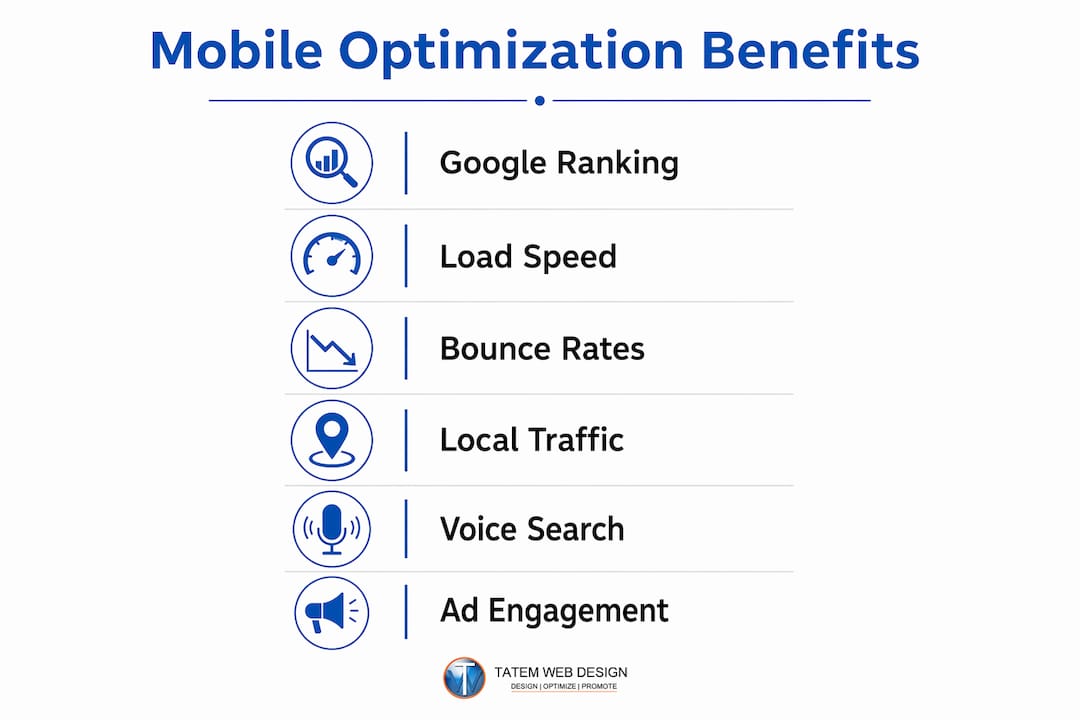
Here is what mobile optimization actually does for your business:
- Keeps visitors on your site by delivering fast load times and easy navigation
- Improves your Google rankings through mobile-first indexing, which evaluates your mobile experience first
- Reduces bounce rates by giving users what they need without friction
- Drives local conversions because mobile users searching nearby are ready to act fast
- Increases revenue since good mobile optimization can improve conversions by 200%
- Expands your ad reach since mobile devices generate over 60% of digital ad spend engagement
The businesses winning online right now built their digital presence around the mobile user first. Everything else followed.
Key benefits of mobile optimization you need to know
1. Your Google rankings depend on mobile performance
Google indexes every website based on its mobile version. That is not a future policy. It is the current reality. If your desktop site looks great but your mobile experience is slow or broken, Google ranks the broken version. For any business relying on organic search traffic, this single fact makes mobile-first web design a direct SEO priority, not a design preference.

2. Slow load times kill conversions before they start
Each additional second of mobile load time reduces conversions significantly. More than half of mobile visitors abandon a page if loading takes more than a few seconds, and each added second can reduce conversions by up to 27%. Speed is not a technical detail you can defer. It is the first impression your site makes.
3. Mobile bounce rates are dramatically higher without optimization
Mobile bounce rates are notably higher than desktop rates. That gap closes fast when you invest in a properly optimized experience. The same data shows that proper mobile optimization can greatly increase conversion rates. The difference between a site that converts and one that does not often comes down to whether it was built with mobile users in mind.
4. Local search traffic converts offline at a remarkable rate
Mobile users searching for services near them are not browsing casually. They are ready to call, visit, or buy. A significant share of local searches come from mobile devices, and “near me” searches are growing year over year. For a Florida business in healthcare, legal, real estate, or any professional service, showing up well in local mobile search translates directly to phone calls and foot traffic.

5. Voice search is reshaping how people find you
Mobile voice search accounts for a growing portion of all mobile queries globally. People ask their phones full questions rather than typing keywords. Content that answers those questions in plain, conversational language performs better in voice results. If your site still reads like a keyword list, you are invisible to a growing share of mobile searchers.
6. Mobile dominates digital advertising engagement
Mobile devices account for the majority of all digital advertising spending. If you are running paid campaigns and your landing pages are not optimized for mobile, you are paying for clicks that bounce immediately. Every dollar in your ad budget works harder when the destination page loads fast and converts on a small screen.
7. Core Web Vitals directly affect your search visibility
Google’s Core Web Vitals, specifically Largest Contentful Paint (LCP), Interaction to Next Paint (INP), and Cumulative Layout Shift (CLS), measure real user experience on mobile. Sites that pass Core Web Vitals thresholds show a notably lower bounce rate. These are not abstract metrics. They represent whether your pages feel fast and stable to the person reading them on a phone.
Stat to know: Mobile search accounts for more than half of all global search traffic. A site that is not built for mobile is missing the majority of its potential audience from the start.
Core elements that make mobile SEO work
Effective mobile optimization goes well beyond shrinking your desktop layout. It requires rethinking how users interact with your content on a small screen, where thumbs replace mice and patience runs thin.
- Responsive design: Responsive design is the only viable configuration in 2026. Separate mobile subdomains and fixed-width layouts are obsolete. A single responsive site adapts to every screen size and keeps your SEO signals consolidated.
- Page speed: LCP should load in under 2.5 seconds. INP should stay below 200 milliseconds. CLS should remain under 0.1. These Core Web Vitals thresholds are Google’s benchmarks for a passing mobile experience.
- Touch-friendly navigation: Buttons need to be large enough to tap accurately. Links spaced too close together cause mis-taps and frustration. Mobile SEO requires designing for touch navigation, not mouse clicks.
- Scannable content layout: Mobile users scan before they read. Short paragraphs, clear subheadings, and bold key points let visitors find what they need in seconds.
- Local SEO signals: Accurate Google Business Profile data, consistent NAP (name, address, phone) citations, and location-specific content all feed mobile local search performance.
- Above-the-fold priorities: Your most important content, your value proposition, your phone number, your call to action, must appear without scrolling on a standard phone screen.
- Minimal interface clutter: Pop-ups, auto-playing video, and dense navigation menus all hurt mobile UX and can trigger Google penalties for intrusive interstitials.
Pro Tip: Treat Core Web Vitals as long-term ranking assets, not one-time fixes. Sites that consistently pass all three thresholds build compounding SEO value over time, because Google rewards sustained performance, not just a single good audit.
Techniques for putting mobile optimization into practice
Knowing why mobile optimization matters is the first step. Knowing how to act on it is where most businesses fall short. These techniques give you a clear path forward.
- Start with a mobile-first design approach. Build your site for the smallest screen first, then scale up to desktop. This forces you to prioritize what actually matters and eliminates the bloat that slows mobile load times. Tatemweb’s mobile-first design guide walks through this process in detail.
- Test on real devices, not just browser simulators. Google’s PageSpeed Insights and Search Console’s Mobile Usability report catch technical issues, but nothing replaces loading your site on an actual iPhone or Android device to see what users experience.
- Audit your site speed regularly. Page speed degrades over time as you add plugins, images, and scripts. Schedule quarterly audits using PageSpeed Insights or GTmetrix to catch regressions before they affect rankings.
- Write for mobile scanning behavior. Keep paragraphs to three sentences or fewer. Use numbered lists and subheadings to break up content. Front-load every section with the key point so a user who only reads the first line still gets value.
- Consider progressive web apps (PWAs) for high-engagement use cases. PWAs load like websites but behave like apps, with offline capability and fast repeat visits. They work well for businesses with frequent return visitors, such as appointment-based services or e-commerce stores.
- Be cautious with AMP. Accelerated Mobile Pages were once a Google priority, but only 8% of news sites globally still use AMP, down from 22% in 2024. For most businesses, a fast responsive site built on Core Web Vitals standards outperforms AMP today.
- Optimize images for mobile delivery. Use WebP format, compress files before upload, and implement lazy loading so images below the fold do not slow initial page load.
- Simplify your forms. Every extra field on a mobile form reduces completion rates. Ask only for what you need. Use autofill-compatible field labels and large tap targets for input areas.
How mobile optimization drives real business growth
Mobile is now the primary channel through which customers discover, evaluate, and contact businesses. That shift has direct consequences for revenue, not just traffic numbers.
The connection between mobile experience and business outcomes is concrete. When a site loads slowly, visitors leave before they convert. Each additional second of mobile load time can reduce conversions by up to 27%, so for a business generating $10,000 a month from its website, a two-second delay could cost thousands in lost revenue every month. When navigation is clunky, users abandon their carts or never fill out a contact form. When local search signals are weak, a competitor with better mobile SEO captures the call instead. Local SEO improvements tied to mobile visibility can produce measurable gains in client acquisition for professional service businesses.
Google’s ranking algorithm reinforces this dynamic. Poor mobile UX creates what SEOs call “pogo-stick behavior,” where a user clicks your result, immediately bounces back to the search results, and clicks a competitor. Google interprets that pattern as a negative ranking signal, which pushes your page down over time. A well-optimized mobile experience breaks that cycle.
Tatemweb has worked with Florida businesses across healthcare, legal, real estate, and professional services for many years. The pattern is consistent: businesses that prioritize responsive web design and mobile performance see measurable improvements in both search visibility and lead volume. The technical work translates directly to the bottom line.
Is your site ready? Tatemweb can help
If your site is losing visitors to slow load times, poor mobile layouts, or weak local search visibility, Tatemweb builds AI-powered websites designed for mobile performance from the ground up. Every site Tatemweb delivers is responsive, fast, and built to meet Core Web Vitals standards so your rankings reflect the quality of your business.
Call Tatemweb directly at 772-224-8118 or visit tatemweb.com to schedule a consultation and see exactly what a mobile-first rebuild can do for your traffic and conversions.
Key Takeaways
Mobile optimization directly determines your search rankings, conversion rates, and local business visibility in 2026, making it the single highest-impact investment for any business with an online presence.
| Point | Details |
|---|---|
| Google ranks your mobile version | Mobile-first indexing means your mobile site performance controls your search rankings universally. |
| Speed is a conversion factor | Each added second of mobile load time can reduce conversions by up to 27%. |
| Bounce rates drop with optimization | Sites passing Core Web Vitals thresholds show a notably lower bounce rate. |
| Local mobile search drives action | 58% of local searches come from mobile devices, with “near me” queries growing 28% year over year. |
| Voice search demands new content | Mobile voice search accounts for 30% of all mobile queries globally, requiring conversational, question-answering content. |
FAQ
Why does mobile optimization matter for SEO?
Google uses your site’s mobile version as the primary basis for crawling and ranking, so a poor mobile experience directly lowers your search rankings regardless of how your desktop site performs.
How does slow mobile load time affect my business?
Each additional second of mobile load time can reduce conversions by up to 27%, and more than half of mobile visitors abandon a page that takes more than a few seconds to load.
Why is mobile navigation so important for user experience?
Mobile users navigate with their thumbs, not a mouse, so touch-friendly buttons, well-spaced links, and scannable layouts reduce friction and keep visitors engaged long enough to convert.
Why will mobile search keep growing in importance?
Mobile already accounts for 60% of all global search traffic, voice queries are rising, and consumer behavior continues shifting toward on-the-go, intent-driven searches that demand instant, local answers.
Recommended
Tatem Web Design
26+ YearsWeb Design & SEO Specialist · Tatem Web Design
Matt Tatem has been designing websites professionally since 1999, making Tatem Web Design one of Florida's longest-running web agencies. Based in Stuart, FL, he specializes in WordPress, local SEO, Shopify e-commerce, and cybersecurity consulting for small businesses.

Rank in ChatGPT in 90 Days With a Practitioner Led Checklist
Follow a practitioner led 90 day plan to get cited by ChatGPT: allow OAI-SearchBot, publish short answer capsules with schema, and track Bing AI Performance.

AI SEO Content Playbook: 16 GEO Signals for Agencies & Teams
A practical playbook mapping the GEO-16 signals to hands-on editorial workflows, review controls, and metrics. For agencies and in-house teams scaling AI...

Copy Ready Local Schema Markup for SMBs + Google Validation
Copy ready JSON-LD examples and Google validation steps for SMBs' local schema markup. Audit, implement, and verify each location page with confidence.