
How to Optimize Website SEO: Step-by-Step 2026 Guide
Website SEO optimization is the process of improving your site’s structure, content, and authority so search engines rank it higher and deliver more organic traffic to your business. Done correctly, it compounds over time. A law firm in Stuart, Florida that ranks on page one for “estate attorney near me” does not pay for that click. This guide covers the full SEO optimization process, from technical setup through content creation, link building, and performance tracking, including what changes in 2026 with AI-powered search engines like ChatGPT, Perplexity, and Google Gemini entering the picture.
What are the essential technical SEO steps to optimize your website?
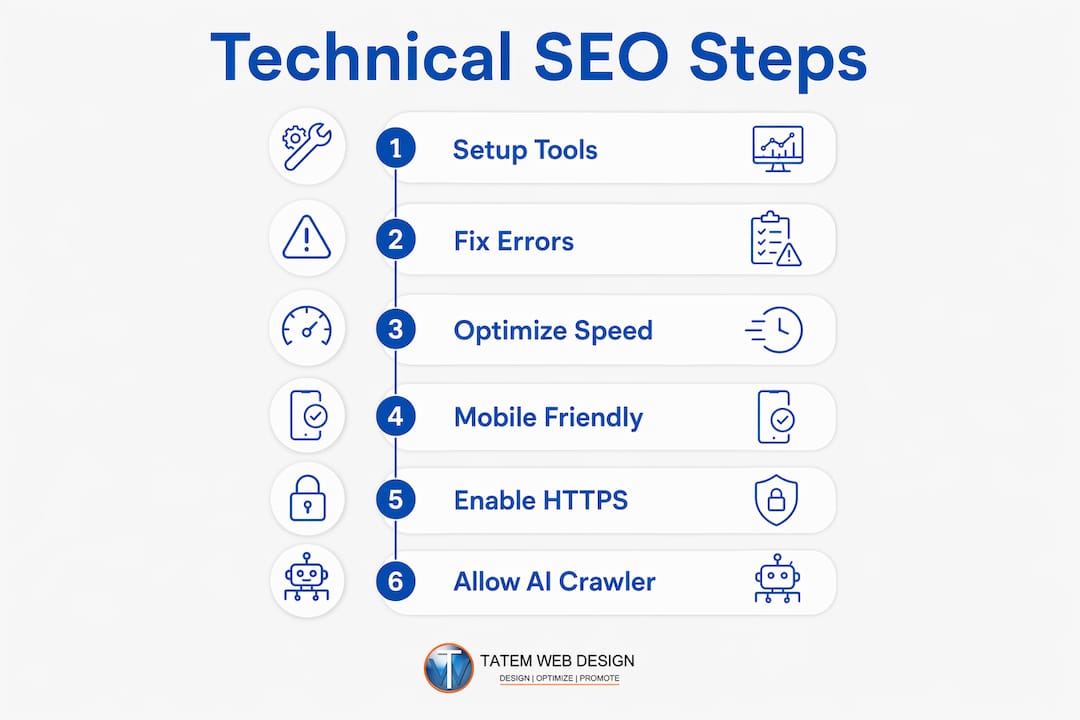
Technical SEO is the foundation every other optimization effort depends on. If search engines cannot crawl and index your pages, your content and backlinks do not matter. Start here before touching a single title tag.
Step 1: Set up your tracking and verification tools.

Google Search Console and Google Analytics 4 are the two non-negotiable tools for any SEO program. Search Console shows you which pages Google has indexed, which keywords trigger impressions, and where crawl errors exist. GA4 tracks how visitors behave once they land on your site, including bounce rates, session duration, and conversion paths. Connect both tools before making any changes so you have a clean baseline.
Step 2: Fix crawl errors and indexing issues.
Open Search Console’s Coverage report and resolve every “Excluded” or “Error” status page. Broken internal links, redirect chains, and orphaned pages all waste crawl budget. A site with 200 pages but 40 broken links signals poor maintenance to Google’s crawler.
Step 3: Optimize site speed.
Page speed directly affects both rankings and user experience. The table below outlines the most impactful speed improvements and their expected effect:
| Speed Optimization | Method | Impact |
|---|---|---|
| Image compression | Use WebP format, compress with tools like Squoosh or ShortPixel | Reduces page weight by 30-70% |
| Browser caching | Set cache headers via .htaccess or a plugin like W3 Total Cache | Cuts repeat-visit load time significantly |
| CDN deployment | Use Cloudflare or AWS CloudFront to serve assets from nearby servers | Reduces latency for geographically distributed users |
| Minify CSS/JS | Remove whitespace and comments from code files | Shaves 10-20% off render-blocking resource size |
Step 4: Confirm mobile-friendliness.
Google indexes the mobile version of your site first. Use Google’s Mobile-Friendly Test to verify your layout, font sizes, and tap targets meet current standards. A dentist’s website that renders poorly on an iPhone loses patients before they read a single sentence.
Step 5: Enable HTTPS.
An SSL certificate is a baseline trust signal. Any site still running HTTP in 2026 is actively penalized in rankings and flagged as “Not Secure” in Chrome, which destroys conversion rates.
Step 6: Allow AI crawlers in robots.txt.
Allowing AI bots like GPTBot and ClaudeBot in your robots.txt file is now a required step for visibility in AI-powered search. Blocking these crawlers means your content will never appear in ChatGPT answers, Perplexity citations, or Google AI Overviews. Check your robots.txt file and explicitly allow these bots.
Pro Tip: Run a free crawl with Screaming Frog SEO Spider on your site monthly. It surfaces broken links, duplicate title tags, missing meta descriptions, and redirect issues in one pass, saving hours of manual checking.
How to conduct effective keyword and prompt research for SEO in 2026
Keyword research is the process of identifying the exact phrases your target audience types into search engines, then mapping those phrases to pages on your site. In 2026, that definition expands. Keyword and prompt research combined are now required to capture both traditional Google traffic and the growing volume of queries processed by AI systems like ChatGPT, Perplexity, and Gemini.
Here is a practical research process you can follow:
- Start with Google Keyword Planner. Enter your core service or product category and export a list of related terms with monthly search volume and competition scores. Filter for terms with clear commercial or informational intent.
- Run manual SERP analysis. Search your top 10 target keywords in Google and study the results. Note which content formats rank (listicles, how-to guides, product pages), which questions appear in “People Also Ask,” and which featured snippets exist. These signals tell you exactly what Google wants to serve for that query.
- Conduct competitor keyword research. Use tools like Semrush or Ahrefs to identify which keywords your top three competitors rank for that you do not. This gap analysis often reveals high-value terms with lower competition. For local keyword research, focus on geo-modified terms like “web design Stuart FL” rather than broad national terms.
- Add prompt research for AI search. Open ChatGPT, Perplexity, and Gemini and ask questions your customers would ask. Note the phrasing. AI users tend to ask in full sentences: “What is the best web design agency for a small medical practice in Florida?” That phrasing is fundamentally different from a Google search for “web design Florida.” Build a separate column in your keyword spreadsheet for these prompt-style queries.
- Score and prioritize. Rank your keyword list by a combination of search volume, keyword difficulty, and business relevance. Target low-difficulty, high-relevance terms first to build early wins, then pursue competitive terms as your domain authority grows.
Pro Tip: Build a simple Google Sheet with five columns: keyword, monthly volume, keyword difficulty, search intent (informational, commercial, transactional), and target page. Update it monthly. This single document becomes your entire SEO content calendar.
What are best practices for creating and optimizing website content?
Content is where SEO either wins or loses. Search engines rank pages, not websites, so every page must be built around a specific keyword and user intent. The on-page SEO checklist for each page includes several non-negotiable elements.
Write a direct answer in the first 200 words. AI systems like Perplexity and Google AI Overviews pull citations heavily from the opening section of an article. State your core claim or definition in sentence one. Do not warm up with background context. A reader searching “how to improve website ranking” wants the answer immediately, not a paragraph about why rankings matter.
Optimize your title tags and meta descriptions.
Title tags between 50 and 60 characters perform best in search results because they display fully without truncation. A truncated title loses click-through rate. Meta descriptions should be 150 to 160 characters and include a clear benefit statement. Neither element is a direct ranking factor, but both directly affect whether users click your result.
Use a clear heading hierarchy.
Structure every page with one H1 (the page title), H2 headings for major sections, and H3 headings for subsections. This structure helps both Google and AI retrieval systems understand your content, which boosts citation chances in AI-powered search results. Align each heading with a real user question or search phrase.
Optimize images with descriptive alt text.
Every image on your site should have an alt text attribute that describes the image using your target keyword where natural. This serves two purposes: it makes your site accessible to visually impaired users, and it gives search engines additional context about the page’s topic.
Apply schema markup.
Schema markup for FAQ, HowTo, and Article content can increase click-through rates by 20 to 30% by triggering rich results in Google. For a healthcare provider or law firm, FAQ schema on a services page can generate star ratings, expanded answers, and featured snippets that dominate the SERP.
Refresh content before it decays.
Content with a traffic decline of 50% or more over 6 to 12 months is considered decayed and requires a structured refresh to recover rankings. This means adding new data, updating examples, restructuring headings, and republishing with a current date. Ignoring content decay is one of the most common reasons sites lose rankings without understanding why.
| On-Page Element | Best Practice | Why It Matters |
|---|---|---|
| Title tag | 50 to 60 characters, include primary keyword | Full display in SERPs, higher CTR |
| Meta description | 150 to 160 characters, include a benefit | Drives click decisions |
| H1 heading | One per page, matches search intent | Signals page topic to Google |
| Alt text | Descriptive, keyword-relevant | Accessibility and image search visibility |
| Schema markup | FAQ, HowTo, or Article type | Rich results and AI citation eligibility |
Pro Tip: Set a quarterly calendar reminder to audit your top 20 traffic pages in Google Search Console. If any page has lost more than 30% of its clicks year over year, schedule a content refresh before it crosses the 50% decay threshold.
How to build quality internal and external links to increase website authority?
Links are votes of confidence. Internal links distribute authority across your own site. External backlinks from other websites tell Google that your content is credible enough for others to reference. Both matter, and both require a deliberate strategy.
Internal linking best practices:
- Link each new page to at least two existing pages on your site and include three outbound links to related pages. This practice supports indexing and distributes page authority throughout your site structure.
- Use descriptive anchor text that reflects the target page’s keyword. “Learn more” and “click here” waste the SEO value of the link.
- Prioritize linking from your highest-traffic pages to your most important conversion pages. A popular blog post about “Florida business tax tips” should link to your accounting services page.
External link building strategies:
- Original research and data. Publish a study, survey, or dataset relevant to your industry. Original data earns natural editorial backlinks because other writers cite their sources. A Florida real estate agency that publishes quarterly market data will attract links from local news outlets and industry blogs.
- Expert roundups and contributed content. Reach out to industry publications and offer a contributed article or expert quote. These placements build both backlinks and brand authority in AI search systems, which increasingly weight brand mentions as trust signals.
- Personalized outreach. Identify sites that link to your competitors using Ahrefs or Semrush, then send targeted pitches explaining why your content is a better or complementary resource. Generic outreach emails get ignored. Personalized, specific pitches get responses.
- Replicate competitor backlinks. Use Ahrefs’ “Link Intersect” feature to find sites that link to multiple competitors but not to you. These are warm prospects because they already link to your category. For local business link building, focus on local chambers of commerce, industry associations, and regional news sites.
What to avoid: Never buy links, participate in private blog networks (PBNs), or use automated link-building tools. Google’s Spam Policies explicitly penalize these tactics, and a manual penalty can remove your site from search results entirely.
Pro Tip: Track your brand mentions using Google Alerts or a tool like Brand24. Unlinked brand mentions are easy wins. Contact the author and ask them to add a link to your site. Most will comply because the mention already exists.
How to measure, track, and iterate on your SEO performance
Measurement turns SEO from guesswork into a repeatable process. Without tracking, you cannot know which changes drove results or where to focus next.
Set up your core tracking:
- Google Search Console shows keyword rankings, impressions, clicks, and average position. Review the Performance report weekly to spot trending keywords and pages losing ground.
- Google Analytics 4 tracks organic traffic volume, user behavior, and goal completions. Set up conversion events for form submissions, phone calls, and purchases so you can tie SEO effort to revenue.
- AI visibility metrics including citations, prompt-based tracking, and sentiment analysis are now critical to measure alongside traditional metrics. Manually test your brand and key service queries in ChatGPT, Perplexity, and Gemini weekly to see if your site appears in AI-generated answers.
Build a weekly review routine:
- Check Search Console for new crawl errors or manual actions.
- Review top 10 pages by clicks and note any significant drops.
- Test 3 to 5 brand or service queries in AI search tools to monitor AI citation presence.
- Log findings in a shared document so you can spot patterns over time.
Quarterly iteration:
Conduct a full content audit every quarter. Pages that have lost significant traffic need a refresh with new data, updated examples, and restructured headings. Adjust your keyword targeting based on which terms are gaining impressions but not yet ranking in the top 10. Those are your highest-priority optimization targets.
Consistent publishing at a minimum of two posts per week outperforms irregular high-volume bursts over a 12-month period. Steady cadence signals to Google that your site is actively maintained, which supports crawl frequency and ranking stability.
Pro Tip: Create a simple monthly SEO scorecard with five metrics: organic sessions, keyword rankings for your top 20 terms, backlinks gained, pages with traffic decay, and AI citation appearances. Review it with your team or agency every month. Consistency in measurement produces consistency in results.
Key takeaways
Effective SEO optimization requires a structured process covering technical health, keyword research, content quality, link authority, and consistent measurement, with AI search visibility now an equal priority alongside traditional Google rankings.
| Point | Details |
|---|---|
| Technical SEO comes first | Fix crawl errors, enable HTTPS, and allow AI crawlers before optimizing content. |
| Keyword and prompt research | Research both Google keywords and AI prompt-style queries to capture all traffic sources. |
| Content quality and freshness | Refresh pages that lose 50% or more of traffic and apply schema markup for rich results. |
| Internal and external links | Link each new page to existing pages and earn editorial backlinks through original research. |
| Measure AI visibility too | Track AI citations in ChatGPT, Perplexity, and Gemini alongside Google Search Console data. |
Why most SEO guides miss the hardest part
I have worked on SEO for websites across real estate, healthcare, legal, and marine industries in Florida, and the pattern I see most often is not a lack of knowledge. It is a lack of follow-through on the unglamorous parts.
Most site owners set up Google Search Console once and never return to it. They publish a blog post, see no results in two weeks, and conclude SEO does not work. What they miss is that SEO success in 2026 requires measuring how well content fulfills search intent, not just whether traffic went up. A page can rank on page two for 15 keywords and still generate zero leads because the content does not match what the searcher actually wanted.
The piece that surprises most clients is content decay. A law firm I worked with had a blog post that drove 400 visits per month in 2023. By mid-2025, it was getting 60. Nobody touched it. The information was still accurate, but competitors had published fresher, more detailed versions. We rebuilt the post with updated data, added an FAQ schema block, restructured the headings around current search intent, and republished it. Traffic recovered to 350 visits per month within 90 days.
The other overlooked factor is entity management. Managing your entity’s footprint across trusted sources and implementing site-wide entity schema is what separates brands that appear in AI-generated answers from those that do not. Your Google Business Profile, Wikipedia presence, LinkedIn page, and schema markup all contribute to how AI systems understand and trust your brand. Most businesses treat these as separate tasks. They are one connected system.
My honest advice: pick three metrics that connect to revenue, track them weekly, and make one meaningful change per month. That discipline outperforms any tactical shortcut.
— Matt
Ready to build an SEO-optimized website that ranks and converts?
If following every step in this guide feels like a full-time job on top of running your business, you are not wrong. SEO done well requires consistent technical maintenance, content production, and performance analysis. Tatemweb builds AI-powered websites that are architected for search visibility from day one, with schema markup, speed optimization, mobile-first design, and AI crawler access built into every project.
Tatemweb serves businesses across Florida in real estate, healthcare, legal, marine, and professional services, with over 26 years of experience in web development and digital marketing. Call Tatemweb directly at 772-224-8118 to schedule a consultation and find out how an AI-built, SEO-ready website can put your business in front of the customers searching for you right now.
FAQ
What is website SEO optimization?
Website SEO optimization is the process of improving a site’s technical structure, content, and authority to rank higher in search engine results and attract more organic traffic. It covers technical setup, keyword targeting, on-page content, and link building.
How long does it take to see SEO results?
Most websites see measurable ranking improvements within 3 to 6 months of consistent optimization work. Competitive keywords in established markets can take 9 to 12 months to reach page one.
Why should I optimize website images for SEO?
Optimized images with descriptive alt text improve page load speed and give search engines additional context about your page’s topic, both of which support higher rankings. Uncompressed images are one of the most common causes of slow page speed.
How do I improve my site’s ranking in AI search results?
Allow AI crawlers like GPTBot and ClaudeBot in your robots.txt file, implement FAQ and Article schema markup, and write direct answers in the first 200 words of each page. These three steps significantly increase the likelihood of appearing in AI-generated answers on ChatGPT, Perplexity, and Google AI Overviews.
How often should I update my website content for SEO?
Publish new content at a minimum of two posts per week for sustained growth, and audit existing pages quarterly. Any page that has lost 50% or more of its traffic over 6 to 12 months needs a structured refresh with updated data and restructured headings.
Recommended
Tatem Web Design
26+ YearsWeb Design & SEO Specialist · Tatem Web Design
Matt Tatem has been designing websites professionally since 1999, making Tatem Web Design one of Florida's longest-running web agencies. Based in Stuart, FL, he specializes in WordPress, local SEO, Shopify e-commerce, and cybersecurity consulting for small businesses.

Rank in ChatGPT in 90 Days With a Practitioner Led Checklist
Follow a practitioner led 90 day plan to get cited by ChatGPT: allow OAI-SearchBot, publish short answer capsules with schema, and track Bing AI Performance.

AI SEO Content Playbook: 16 GEO Signals for Agencies & Teams
A practical playbook mapping the GEO-16 signals to hands-on editorial workflows, review controls, and metrics. For agencies and in-house teams scaling AI...

Copy Ready Local Schema Markup for SMBs + Google Validation
Copy ready JSON-LD examples and Google validation steps for SMBs' local schema markup. Audit, implement, and verify each location page with confidence.