
Website redesign guide: boost visibility and add AI
Your Florida business website might be quietly losing you customers right now. Slow load times, outdated design, and zero automation tell visitors you are behind the times, and they leave for a competitor who looks sharper and responds faster. A strategic website redesign, built around clear goals, SEO preservation, and AI integration, can reverse that trend and position your business to capture more leads, rank higher in local search, and run more efficiently than ever before.
Table of Contents
- What to prepare before a website redesign
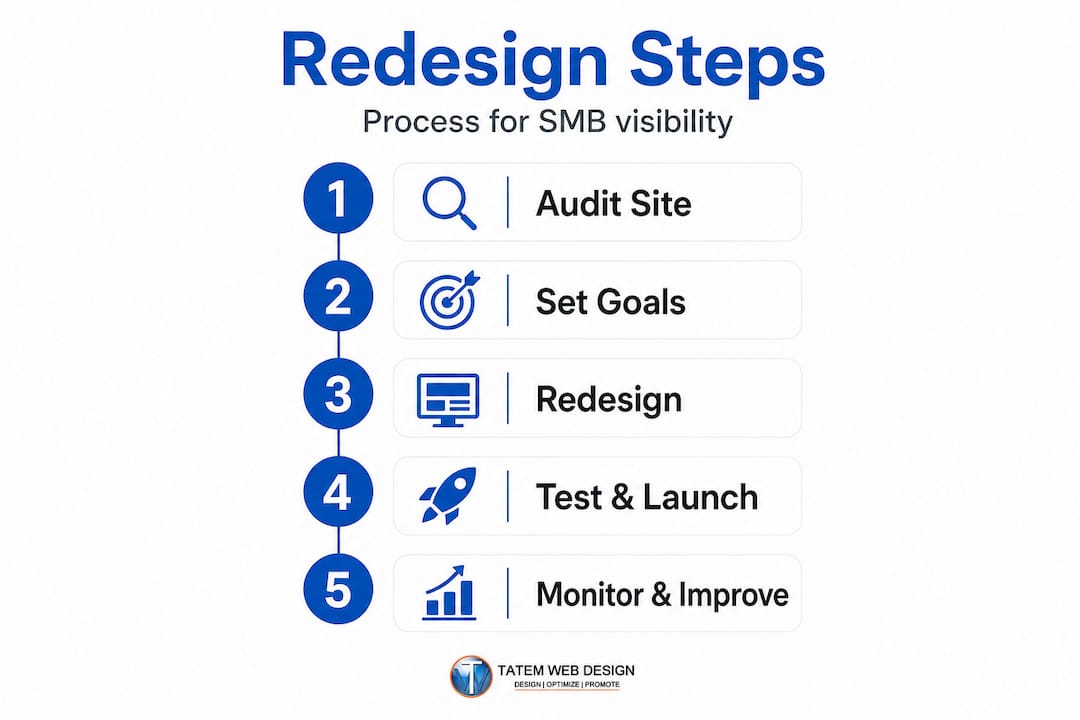
- Step-by-step website redesign process for Florida SMBs
- How to protect SEO during and after your redesign
- Testing, launch, and post-launch monitoring
- Integrating AI and automation for a lasting competitive edge
- The uncomfortable truth about website redesigns (and why AI isn’t a silver bullet)
- Unlock your new competitive edge with Florida’s AI website specialists
- Frequently asked questions
Key Takeaways
| Point | Details |
|---|---|
| Start with an audit | Assess your current website and define clear goals before diving into redesign work. |
| Plan for SEO security | Map old to new URLs, set redirects, and monitor post-launch to protect online traffic. |
| AI is an opportunity and a risk | Integrate AI thoughtfully—success depends as much on training and process as on technology. |
| Testing is critical | Thorough pre-launch QA and post-launch monitoring ensure your new site delivers on its promise. |
| Choose local expertise | Experienced Florida web and AI teams help you avoid pitfalls and maximize your competitive advantage. |
What to prepare before a website redesign
A successful redesign does not start with picking colors or fonts. It starts with data. Before you change a single page, you need a clear picture of where your site stands today and exactly where you want it to go.
According to a site-redesign SEO checklist, a defensible step-by-step method starts with auditing current performance, then setting measurable redesign goals, then mapping strategy to information architecture, content, and SEO-safe migration. Skipping this foundation is the number one reason redesigns stall or fail to deliver results.
Start by pulling your current website metrics. Look at organic traffic, top-performing pages, bounce rates, conversion rates, and where your visitors come from. These numbers become your baseline. Without them, you have no way to measure whether the new site is actually better. A Florida website design expert guide can help you understand what benchmarks matter most in competitive local markets.

Next, define what success looks like in specific terms. “More leads” is not a goal. “Increase contact form submissions by 30% within 90 days of launch” is a goal. Every design and content decision you make should connect back to those numbers.
Here is what you need to gather before any redesign work begins:
- Google Analytics and Search Console access
- Current sitemap and list of all live URLs
- Brand assets (logos, fonts, color palettes, style guides)
- Existing content inventory (pages, blog posts, images, videos)
- Competitor websites you want to outperform
- Accessibility audit results and mobile performance scores
- Any compliance documentation (HIPAA, ADA, PCI if applicable)
- Login credentials for hosting, domain registrar, and CMS
Pro Tip: Run a free automated SEO and speed audit using tools like Google PageSpeed Insights and Screaming Frog before your first planning meeting. You will walk in with real data instead of guesses, and that saves hours of back-and-forth with your design team.
Florida businesses face unique pressures here. The state’s tourism-driven economy means your site may need to handle traffic spikes during peak seasons, serve both local and out-of-state visitors, and meet website accessibility standards that protect you legally. Responsive web design is not optional in a market where most users browse on mobile devices.
| Asset/Benchmark | Example | Why it matters |
|---|---|---|
| Traffic sources | 60% organic, 30% direct | Tells you where to protect and grow |
| Top 10 pages by traffic | Homepage, services, blog | Prioritize these in redesign |
| Current page speed score | 45/100 on mobile | Baseline to beat post-launch |
| Backlink profile | 200 referring domains | Protects SEO equity during migration |
| Conversion rate | 1.2% on contact page | Sets improvement target |
| Accessibility compliance | WCAG 2.1 AA status | Reduces legal risk in Florida |
Step-by-step website redesign process for Florida SMBs
With your assets gathered and goals defined, you are ready to move through the actual redesign. This is where most business owners want to rush, and that urgency is understandable. But each step builds on the last, and cutting corners early creates expensive problems at launch.
Reputable redesign guides confirm that step sequences should follow this order: audit current performance, define goals, plan structure and content, map URL redirects, complete staging QA, launch, and then monitor post-launch. Here is how each step plays out for a Florida SMB:
- Audit your existing site. Crawl every page, document URLs, identify thin or duplicate content, and note what is working. This is your starting point.
- Set measurable redesign goals. Tie each goal to a metric: lead volume, page speed, bounce rate, local search ranking.
- Plan your information architecture and content. Decide which pages stay, which get merged, and which get cut. Map out the new navigation structure.
- Map all URLs and plan redirects. Every old URL that changes needs a 301 redirect to its new destination. Document this in a spreadsheet before you build anything.
- Build on a staging environment. Never redesign on a live site. Use a staging server to build and test without affecting your current visitors.
- Complete full QA testing. Test speed, mobile responsiveness, forms, links, and SEO elements on every page.
- Launch with a plan. Flip the switch during low-traffic hours, submit your new sitemap to Google, and verify all redirects are working.
- Monitor post-launch for 30 to 60 days. Watch analytics, Search Console, and conversion data daily at first, then weekly.
Understanding when and how to redesign your site is just as important as knowing the steps. If you are a startup, the startup website design guide offers additional context on building for growth from day one.
The biggest differentiator in 2026 is where you integrate AI into this process. Here is how conventional redesigns compare to AI-powered ones:
| Step | Conventional approach | With AI enhancements |
|---|---|---|
| Content audit | Manual page-by-page review | AI tools scan and score content automatically |
| Copywriting | Hire a writer or DIY | AI drafts pages; human edits for brand voice |
| SEO planning | Keyword research spreadsheets | AI identifies gaps and opportunities in minutes |
| User personalization | Static pages for all visitors | AI serves dynamic content based on visitor behavior |
| Lead capture | Static contact forms | AI chatbots qualify leads 24/7 |
| Post-launch analytics | Manual reporting | AI dashboards flag anomalies automatically |
Staying current with web design trends helps you make smarter choices at each of these steps, especially when deciding which AI features are worth the investment right now versus later.
Pro Tip: Build your redirect map in a shared spreadsheet from day one and update it every time a URL changes during the build. Waiting until launch day to document redirects is how businesses lose thousands of dollars in organic traffic overnight.
How to protect SEO during and after your redesign
This is where many otherwise well-planned redesigns go wrong. You can have a beautiful new site that loads fast and looks modern, and still watch your organic traffic drop 40% in the first month if SEO was not protected during the process.
SEO preservation during redesign depends on creating an explicit old-URL to new-URL redirect plan and validating that plan before launch to avoid redirect loops and chains. A redirect loop happens when URL A points to URL B, which points back to URL A. Search engines and browsers cannot resolve these, and visitors see an error. A redirect chain is slightly less damaging but still slows your site and dilutes link equity.
Here are the core SEO priorities to address before, during, and after your redesign:
- Document every current URL using a site crawler before you change anything
- Map 301 redirects for every URL that will change location or be removed
- Preserve title tags and meta descriptions for your highest-traffic pages
- Audit and update internal links so they point to new URLs, not old ones
- Update your XML sitemap immediately after launch and submit it to Google Search Console
- Fix broken links using a post-launch crawl within 48 hours of going live
- Add descriptive alt text to all images on the new site
- Verify structured data (schema markup) is intact after the redesign
“Mapping errors during a website redesign are one of the most common and preventable causes of significant organic traffic loss. Businesses that skip the validation step before launch often spend months recovering rankings they built over years.” Search Engine Land
The risk is real. Many Florida SMBs invest in a redesign to grow their business, only to see their SEO value erode because redirect planning was treated as an afterthought. Protecting what you have built is just as important as building something new.
After launch, set up a monitoring checklist that covers Google Search Console for crawl errors, Google Analytics for traffic drops, manual checks on your top 10 pages, and weekly form submission counts to verify lead capture is working.
Testing, launch, and post-launch monitoring
A staged, methodical launch is the difference between a smooth go-live and a crisis. The goal of this phase is to catch every problem before real customers see it.
Staging QA and post-launch monitoring are aligned in every serious redesign checklist because small mapping mistakes can cascade into visibility loss. One broken redirect or a missing meta tag on a key page can cost you rankings that took years to earn.
Follow this sequence for a clean launch:
- Set up a staging environment that mirrors your live hosting configuration exactly.
- Run a full QA checklist covering page speed on mobile and desktop, all form submissions, e-commerce checkout flows if applicable, internal and external links, image loading, and SEO elements on every page.
- Get stakeholder approval on the staging site before anything goes live.
- Schedule the launch during your lowest-traffic window, typically late evening or early morning on a weekday.
- Go live and immediately verify that all 301 redirects are working, the new sitemap is submitted, and analytics tracking is firing correctly.
- Monitor daily for the first two weeks, then weekly for the following month.
Pro Tip: Use a UAT (user acceptance testing) checklist shared with your team or vendor. Assign specific sections to specific people so nothing gets assumed to be “someone else’s job.” This single habit prevents most post-launch surprises.
“Skipping QA or treating post-launch monitoring as optional is the top cause of failed redesign ROI. A site that looks great but has broken forms, slow load times, or missing tracking is not delivering the business value you paid for.”
If you are working with an external agency, clarify in writing who is responsible for each post-launch task. If you are managing it internally, website update and maintenance services can fill the gaps and keep your site performing at its best over time.
Ongoing monitoring should track user behavior flows, lead quality from AI chatbots or forms, technical error rates, and the performance of any AI features you integrated. This data tells you what to optimize next.
Integrating AI and automation for a lasting competitive edge
A newly redesigned website gives you a clean foundation. Adding AI and automation on top of that foundation is where Florida SMBs can genuinely pull ahead of competitors who are still running static, manual websites.
Empirical research on AI-driven digital transformation in SMEs highlights that AI can accelerate creation, but risks around organizational readiness and external conditions can widen the digital divide. Operational change management and measurement matter as much as the tools themselves. In plain terms: AI works best when your team understands it, your processes support it, and you are tracking whether it is actually delivering results.
Here are the website areas where AI delivers immediate wins for most Florida SMBs:
- AI chatbots and live chat to qualify leads and answer questions 24/7, even when your office is closed
- Dynamic content personalization that shows different messages to first-time visitors versus returning customers
- AI-powered lead capture forms that adapt based on visitor behavior and reduce friction
- Automated analytics dashboards that surface insights without requiring manual report-building
- AI content generation for blog posts, service pages, and product descriptions that support your SEO strategy
- Predictive SEO tools that identify ranking opportunities before your competitors find them
Consider a real-world scenario: a marine services company in Stuart, Florida adds an AI chatbot to their redesigned site. The chatbot qualifies leads by asking about boat type, service needed, and timeline. It books appointments directly into the owner’s calendar. Within 60 days, the business is converting 22% more website visitors into booked consultations, without hiring additional staff.
The key to making this work is starting small. Pick one or two AI features that directly address your biggest business pain point, measure the results for 60 to 90 days, and then expand. Trying to implement every AI tool at once overwhelms your team and makes it impossible to know what is actually driving results.
Get buy-in from your staff early. If your team does not understand why the AI chatbot is there or how to handle leads it generates, the tool creates confusion instead of efficiency. Training does not have to be extensive, but it does have to happen.
The uncomfortable truth about website redesigns (and why AI isn’t a silver bullet)
After 26 years of building websites for Florida businesses across industries from healthcare to marine to legal services, we have seen the same pattern repeat itself. A business owner gets excited about a redesign, invests real money, and then watches the new site underperform. The technology was fine. The design was solid. The problem was always the same: the foundation was rushed.
Redesigns fail when goals are vague, when redirect mapping is skipped, when QA is compressed into two days before launch, and when nobody is assigned to monitor the site after it goes live. These are not technical failures. They are planning and process failures.
AI makes this worse if you are not careful. When a business adds AI chatbots, personalization tools, and automated analytics to a site that was not properly planned or tested, the AI amplifies the problems instead of solving them. A chatbot on a slow site with broken forms does not generate leads. It frustrates visitors.
The businesses that get the most out of a redesign are the ones that treat it as a process, not a project. They audit before they build. They document before they launch. They monitor after they go live. And they improve continuously based on real data rather than gut feelings.
Explore the expert insights on website redesign we have published to see how this plays out across different industries and business sizes. The pattern holds whether you are a dentist in Palm Beach Gardens or a law firm in Fort Lauderdale.
The businesses that win online in Florida are not necessarily the ones with the biggest budgets or the flashiest AI tools. They are the ones that execute the fundamentals well and build on that foundation consistently over time.
Unlock your new competitive edge with Florida’s AI website specialists
Moving from a guide like this to a real, live website that generates leads and outperforms your competition takes more than good intentions. It takes experienced execution.
At Tatem Web Design, we have spent over 26 years helping Florida businesses across Stuart, Palm Beach, and beyond redesign their websites for real, measurable growth. We handle everything from pre-redesign audits and SEO mapping to AI website design in Florida that integrates chatbots, lead capture tools, and dynamic personalization from day one. Our team at our professional website design agency builds fast, secure, and SEO-optimized sites in record time using the latest AI-powered web services. Call us at 772-224-8118 to schedule your consultation and find out exactly what your next redesign should look like.
Frequently asked questions
What is the first step in a website redesign?
Begin by auditing your current website’s performance, content, and SEO to establish a clear baseline. A step-by-step method starts with auditing current performance before any design or development work begins.
How can I preserve SEO when redesigning my website?
Use a detailed URL mapping and redirect plan, validate it before launch, and monitor after go-live to avoid losing search rankings. SEO preservation depends on creating an explicit old-URL to new-URL redirect plan and validating it before launch.
What are the risks of adding AI to my SMB website?
AI can accelerate growth but brings risks around staff readiness, workflow integration, and widening gaps if not managed with change measurement. Empirical research on AI in SMEs highlights that organizational readiness matters as much as the technology itself.
How long does a typical redesign take for a small business?
Most redesigns take 2 to 4 months from planning through launch, depending on project scope and decision-making speed.
What post-launch tasks should I monitor?
Track user behavior, technical errors, lead conversions, and AI feature performance using analytics and ongoing maintenance to ensure your new site keeps delivering results.
Recommended
Tatem Web Design
26+ YearsWeb Design & SEO Specialist · Tatem Web Design
Matt Tatem has been designing websites professionally since 1999, making Tatem Web Design one of Florida's longest-running web agencies. Based in Stuart, FL, he specializes in WordPress, local SEO, Shopify e-commerce, and cybersecurity consulting for small businesses.
What a CMMC Level 2 Assessment Requires and How to Prepare
Prepare for your CMMC Level 2 assessment by understanding requirements, assessment paths, and mapping your Controlled Unclassified Information.

A Data Retention Policy Is Your Rulebook for Keeping and Deleting Data
Establishing a clear data retention policy helps manage data risk, ensuring compliance and effective data management for your organization.
Law Firm Local SEO: A Practical Playbook for More Local Clients
Unlock more local clients for your law firm with effective local SEO strategies. Optimize your Google Business Profile and boost your visibility!