
What Is Website Optimization for Business Growth

Most business owners assume website optimization means stuffing pages with keywords. The reality is far more specific and far more urgent. A 1-second load delay can reduce conversions by up to 20%, and Google now ranks sites using a composite score that weighs speed, interactivity, and visual stability together. Understanding what website optimization actually is, and what it demands from your site today, is the difference between a site that quietly costs you customers and one that consistently earns them.
Table of Contents
- Key takeaways
- What website optimization actually means
- Technical performance and speed optimization
- User experience optimization beyond speed
- SEO-focused website optimization strategies
- Measuring, monitoring, and applying improvements
- My take after 26 years of working on websites
- How Tatemweb makes website optimization work for you
- FAQ
Key takeaways
| Point | Details |
|---|---|
| Optimization is multidimensional | Website optimization covers speed, UX, SEO, and technical health working together, not separately. |
| Speed directly impacts revenue | A single second of load delay costs conversions; fast sites outperform slow ones in both traffic and sales. |
| Core Web Vitals are now composite | Since March 2026, Google scores LCP, INP, and CLS together, meaning one failing metric can drag your ranking down. |
| Real-user data beats lab scores | Google uses Chrome User Experience Report field data for ranking, not just Lighthouse scores from your laptop. |
| Optimization never truly finishes | Continuous monitoring and incremental improvements drive sustained gains in performance and conversion rates. |
What website optimization actually means
People use the phrase “website optimization” to describe everything from tweaking a meta title to redesigning a checkout flow. So let’s establish a precise definition: website optimization is the ongoing process of improving a site’s technical performance, user experience, and search visibility so that more visitors complete the actions your business needs them to take.
That means it is not just SEO. It is not just speed. And it is absolutely not a one-time project you hand off to a developer and forget about.
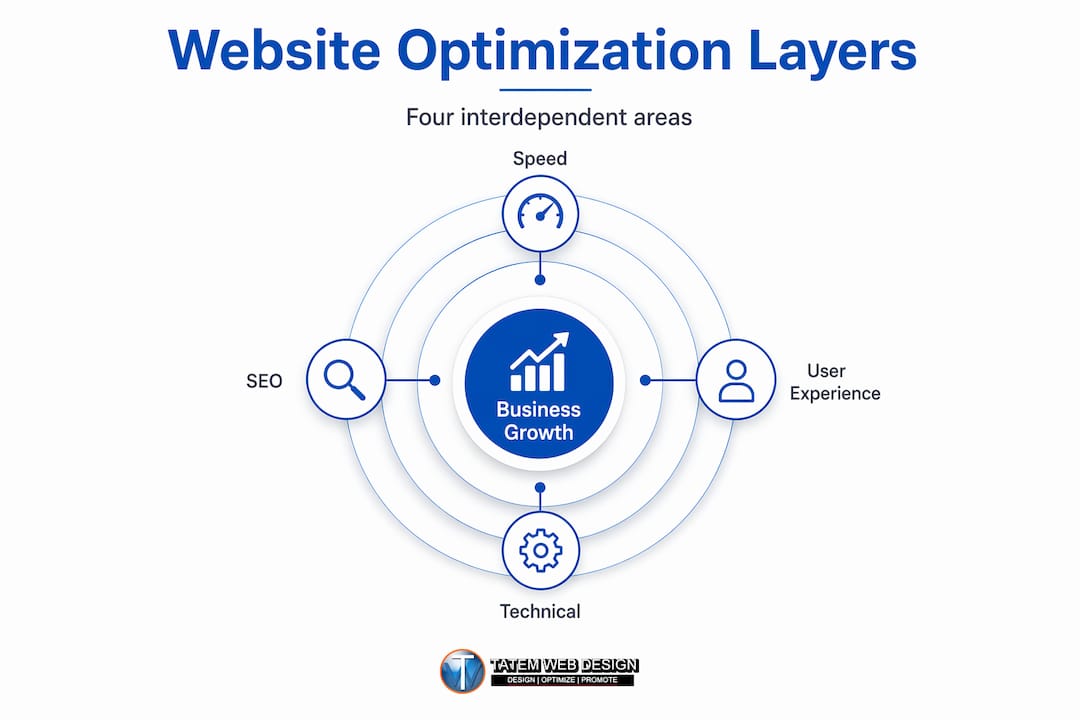
The core components of website optimization break down into four interconnected layers:
- Technical performance. How fast your pages load, how quickly the server responds, and how stable your layout is during that load.
- User experience (UX). How easily visitors find what they need, how intuitive the navigation is, and how well the design guides them toward a conversion.
- Search engine optimization (SEO). How well your content, structure, and signals align with what Google uses to determine relevance and authority.
- Business alignment. Whether the site’s goals, calls to action, and content actually reflect what your customers need at each stage of their decision.
These four layers are interdependent. A technically fast site with confusing navigation still loses customers. A beautifully designed site with no SEO foundation still won’t attract organic traffic. The benefits of website optimization only materialize when all four layers work together.
Google reinforced this reality in March 2026 by switching to a composite Core Web Vitals score that aggregates Largest Contentful Paint (LCP), Interaction to Next Paint (INP), and Cumulative Layout Shift (CLS) into a single ranking signal. If one metric fails, it pulls the entire score down. That alone should clarify why optimization requires a holistic approach, not a piecemeal one.
Technical performance and speed optimization
Speed is where website optimization becomes measurable fast. When visitors wait more than two seconds for a page to load, a significant portion leave before the page even finishes rendering. Portent’s research quantifies the damage at 4.42% conversion drop for every additional second of load time. For a Florida business generating $50,000 per month in online revenue, that math gets uncomfortable quickly.
Understanding what is website speed optimization requires looking at the specific technical factors that control it. Here is the sequence that matters most:
- Choose quality hosting first. Hosting quality is the single most important factor for website speed. A slow server produces a high Time to First Byte (TTFB), which delays everything that follows. Managed cloud hosting with server-side caching built in is the baseline.
- Add a Content Delivery Network (CDN). A CDN stores copies of your site’s assets on servers around the world, so a visitor in Miami loads content from a nearby node rather than a distant origin server. This alone can cut load times by 40 to 60 percent for geographically distributed traffic.
- Optimize images aggressively. Images account for 50 to 70% of total page weight on most sites. Converting them to next-generation formats like WebP or AVIF and using automated resizing tools improves Core Web Vitals scores without any visible quality loss to users.
- Minify and defer JavaScript and CSS. Large JavaScript bundles are the primary culprit behind poor INP scores. Deferring non-critical scripts means they load after the page is visible and interactive, rather than blocking it.
- Enable browser caching. When returning visitors load your site, cached assets like logos, fonts, and stylesheets load from their local browser rather than your server. This makes repeat visits feel instant.
- Implement lazy loading for images and videos. Off-screen media loads only when a visitor scrolls toward it, reducing initial page weight significantly.
Pro Tip: Prioritize fixes in this exact sequence: hosting and TTFB first, then CDN, then image optimization, then script management. Fixing JavaScript when your server is the bottleneck is like painting walls before fixing a leaking roof.
The table below shows Google’s current Core Web Vitals targets and what each metric measures:
| Metric | What it measures | Good threshold | Needs improvement |
|---|---|---|---|
| LCP (Largest Contentful Paint) | Time until the main content is visible | Under 2.5 seconds | 2.5 to 4 seconds |
| INP (Interaction to Next Paint) | Responsiveness to user input | Under 200 milliseconds | 200 to 500 milliseconds |
| CLS (Cumulative Layout Shift) | Visual stability during load | Under 0.1 | 0.1 to 0.25 |
Since March 2026, optimizing metrics in sequence starting with LCP, then INP, then CLS produces the greatest ranking stability. That order is not arbitrary. LCP improvements deliver the most visible impact on perceived speed, which also tends to improve user behavior signals that Google tracks.
User experience optimization beyond speed
Raw speed matters, but speed alone does not tell the full story. A page that loads in 1.2 seconds and then presents visitors with a cluttered layout, ambiguous navigation, or a buried contact form still fails. User experience optimization is about removing friction from the path between arrival and conversion.
Website usability factors that directly affect how long visitors stay and whether they take action include:
- Intuitive navigation. Menus should reflect how your customers think about your services, not how your internal team labels them. If a visitor cannot find your services page within two clicks, your structure needs work.
- Clear calls to action. Every page needs a single primary action you want visitors to take. Competing CTAs create paralysis, and paralysis produces bounces.
- Accessibility compliance. Alt text on images, sufficient color contrast, and keyboard-navigable menus serve both disabled users and search engines. Accessibility is not optional; it is part of optimization.
- Layout stability during load. Cumulative Layout Shift (CLS) measures how much your page elements move as the page loads. A button that shifts downward just before a visitor clicks it, causing them to click the wrong thing, is a conversion killer and a ranking signal.
- Mobile-first design. More than 60% of web traffic now comes from mobile devices. A design that works beautifully on desktop but forces mobile users to pinch and zoom is actively damaging your performance. Responsive web design practices are not a nice-to-have; they are the foundation.
Content presentation also shapes UX in ways that marketers sometimes overlook. Walls of text, generic stock photography, and ambiguous service descriptions all erode trust. Visitors make credibility judgments within seconds. Short paragraphs, descriptive headers, and specific proof points like client results or industry credentials signal that your business knows what it is doing.
Pro Tip: Run a five-second test on your homepage. Show it to someone unfamiliar with your business for five seconds, then ask them to describe what your company does. If they cannot answer clearly, your hierarchy and messaging need attention before any technical work will move the needle.

Friction-free user journeys consistently produce longer sessions and higher revenue per visitor. That connection between UX investment and measurable business outcome is why user experience belongs at the center of any website performance improvement plan, not at the margins.
SEO-focused website optimization strategies
What is SEO optimization in the context of website optimization? The two disciplines overlap more than most people realize, but they are not identical. SEO focuses specifically on signals that influence how search engines rank and display your site. Website optimization is broader: it includes everything that affects how visitors experience and engage with your site, regardless of how they arrived.
That said, the overlap is significant. Consider this comparison:
| Focus area | Pure SEO priority | Website optimization priority |
|---|---|---|
| Title tags and meta descriptions | High | High |
| Page load speed | Medium | Critical |
| Keyword placement in headings | High | Medium |
| Core Web Vitals | Medium | Critical |
| Internal link structure | High | High |
| Mobile responsiveness | High | Critical |
| Content clarity and readability | Medium | High |
On-page SEO elements including title tags, meta descriptions, and heading structure contribute to both visibility in search results and clarity for visitors. A well-written title tag that includes your primary keyword does two things: it tells Google what the page is about, and it tells the searcher why they should click.
The technical SEO layer includes site structure, crawlability, canonical tags, and XML sitemaps. These elements determine whether Google can efficiently find and index your content. A site with 50 great pages that are poorly structured and difficult to crawl may rank far below a competitor with 20 average pages that are technically clean.
Monitoring tools are non-negotiable if you want to know how you are actually performing. Google Search Console shows which queries drive traffic, which pages have indexing issues, and which URLs have Core Web Vitals problems. The Chrome User Experience Report (CrUX) provides field data from real users, which is what Google actually uses for ranking. Local SEO strategies also feed into overall search performance, particularly for Florida businesses competing for local search terms. Focusing solely on keywords or backlinks in 2026 is insufficient; site technical health is now equally essential for sustained rankings.
Measuring, monitoring, and applying improvements
Knowing how to optimize a website is one thing. Knowing whether your optimizations are working requires a measurement framework. Without it, you are making changes based on intuition rather than data, and that rarely produces predictable results.
Start with these tools and what each one tells you:
- Google PageSpeed Insights. Combines both lab data from a simulated test and real-user field data from CrUX. Use it as your first diagnostic pass for any page.
- Google Lighthouse. A more detailed audit tool built into Chrome DevTools. Produces scores for performance, accessibility, SEO, and best practices. Strong for identifying specific issues.
- Chrome User Experience Report (CrUX). Field data from real users represents actual visitor sessions, not simulated conditions. This is what Google uses for ranking decisions. A site that scores 95 in Lighthouse but has poor CrUX data may still underperform in rankings.
- Google Search Console. Tracks organic traffic trends, keyword positions, click-through rates, indexing status, and Core Web Vitals directly from Google’s perspective.
- Heatmap and session recording tools. Tools like these show where visitors click, how far they scroll, and where they abandon pages. This data is invaluable for UX decisions that raw performance metrics cannot reveal.
When prioritizing what to fix, sort issues by the combination of traffic volume and potential impact. A broken conversion path on your highest-traffic service page outranks a minor speed issue on a rarely visited blog post. Incremental improvements compound over time; each small fix contributes to a measurable trend in the right direction. Set up automated alerts in Google Search Console so you know immediately if a Core Web Vitals issue appears after a site update, rather than discovering it weeks later when rankings have already shifted. Understanding how speed affects revenue helps you translate technical metrics into business terms that justify the investment.
My take after 26 years of working on websites
I have spent more than two decades watching businesses invest in websites that fail to perform, and almost every time, the root cause is the same: they treated optimization as an afterthought rather than a foundation.
The most persistent misconception I see is business owners believing that ranking well means writing more keyword-heavy content. That mindset was barely sufficient ten years ago. Today, only 48% of mobile pages meet all three Core Web Vitals thresholds. That means more than half of sites are actively being suppressed in rankings by technical failures that have nothing to do with content quality.
The second lesson I keep relearning: hosting is not a commodity decision. I have seen perfectly built sites crawl because the client chose the cheapest shared hosting available. When we move those sites to managed cloud hosting with proper caching, the performance gains are immediate and dramatic. Start there before spending a dollar on anything else.
What I tell every business owner who asks me where to begin is this: stop looking at your Lighthouse score and start looking at your CrUX data. Google is not ranking your site based on how it performs in a lab simulation. It ranks based on how real visitors experience it. Those two numbers are often very different, and acting on the wrong one wastes time and money.
Balance is the hardest part of this work. The sites that perform best long-term are the ones where technical health, UX clarity, and SEO fundamentals all receive consistent attention. Neglect any one of the three and the other two stop pulling their full weight.
— Matt
How Tatemweb makes website optimization work for you
If reading through this article made you realize your site has real gaps in speed, user experience, or SEO, you are not alone. Most Florida businesses we speak with at Tatemweb have at least one significant performance issue they were not aware of. The challenge for most owners and marketing teams is that fixing these issues simultaneously requires technical expertise, UX knowledge, and SEO experience working together.

At Tatemweb, our AI-powered website design approach addresses speed, SEO, and user experience from the ground up. Sites we build are configured for Core Web Vitals compliance, mobile-first performance, and search visibility from day one rather than patched after the fact. We also integrate AI security enhancements and AI email marketing to turn your site into a complete lead generation and retention system. Our team has served healthcare providers, legal firms, real estate professionals, and local service businesses across Florida for over 26 years. Call us directly at 772-224-8118 to schedule a consultation and find out exactly what your site needs to perform at its best.
FAQ
What is website optimization in simple terms?
Website optimization is the process of improving a site’s speed, user experience, and search engine signals so more visitors take the actions your business needs. It combines technical, design, and SEO improvements that work together continuously.
How does website speed affect my search rankings?
Google uses Core Web Vitals (LCP, INP, and CLS) as direct ranking signals. Since March 2026, these three metrics are combined into a composite score, so a slow or unstable site can suppress rankings even if content and backlinks are strong.
What are the most impactful website speed optimization tips?
Start with quality hosting to reduce server response time, add a CDN for faster asset delivery, convert images to WebP or AVIF format, and defer non-critical JavaScript. These four changes address the majority of speed problems on most sites.
How do I know if my website optimization is actually working?
Use Google Search Console and PageSpeed Insights to track Core Web Vitals trends over time. Prioritize Chrome User Experience Report field data over simulated Lighthouse scores since Google uses real-user data for ranking decisions.
Why optimize your website if traffic is already coming in?
Existing traffic is only valuable if it converts. A site receiving 10,000 monthly visitors but converting at 1% generates far less revenue than one converting at 3%. Optimization turns traffic you already have into measurably more leads, calls, and sales.
Recommended
Tatem Web Design
26+ YearsWeb Design & SEO Specialist · Tatem Web Design
Matt Tatem has been designing websites professionally since 1999, making Tatem Web Design one of Florida's longest-running web agencies. Based in Stuart, FL, he specializes in WordPress, local SEO, Shopify e-commerce, and cybersecurity consulting for small businesses.

Rank in ChatGPT in 90 Days With a Practitioner Led Checklist
Follow a practitioner led 90 day plan to get cited by ChatGPT: allow OAI-SearchBot, publish short answer capsules with schema, and track Bing AI Performance.

AI SEO Content Playbook: 16 GEO Signals for Agencies & Teams
A practical playbook mapping the GEO-16 signals to hands-on editorial workflows, review controls, and metrics. For agencies and in-house teams scaling AI...

Copy Ready Local Schema Markup for SMBs + Google Validation
Copy ready JSON-LD examples and Google validation steps for SMBs' local schema markup. Audit, implement, and verify each location page with confidence.