
IT Cost Savings: A Practical Playbook for CIOs
IT cost savings mean targeted reduction of wasted technology spend while protecting or improving the value that spend delivers, not blunt across-the-board cuts. A value-first approach, the kind FinOps practitioners and firms like Oliver Wyman recommend, can cut costs by an estimated 10% to 30% while actually improving IT outcomes. Gartner frames this as a continuous capability, not a one-time event. If you need to move today, start here:
- Rightsize cloud compute — kill idle and overprovisioned instances first.
- Audit SaaS spend — every unused or duplicate license is pure waste.
- Optimize commitments — match reserved instances and savings plans to real usage.
- Enforce tagging and showback — you can’t manage what you can’t attribute.
Key Takeaways
| Point | Details |
|---|---|
| Optimize, don’t slash | Map spend to business capabilities before cutting so revenue-driving systems stay protected. |
| Start with cloud and SaaS | Rightsizing, commitment coverage, and SaaS audits deliver the fastest, lowest-complexity wins. |
| Measure unit economics | Track cost per transaction alongside total spend to confirm you cut waste, not capability. |
| Governance makes it stick | Quarterly reviews, tagging enforcement, and a named savings owner prevent gains from eroding. |
| Get help accelerating execution | Tatemweb supports Florida businesses with automation, SaaS consolidation, and backup verification. |
Table of Contents
- What Is IT Cost Optimization vs. Blunt Cost Cutting?
- High-Impact Tactics That Deliver Measurable IT Cost Savings
- The Five-Stage Framework for Sustained IT Cost Savings
- Which KPIs Actually Prove Your IT Cost Savings Are Real?
- Realistic Savings Ranges and Timelines for Quick Wins
- What Erodes IT Cost Savings, and How Governance Locks Them In
- Where Should You Actually Start This Quarter?
- How a Technology Partner Accelerates Your Cost-Saving Roadmap
- Sources
- FAQ
What Is IT Cost Optimization vs. Blunt Cost Cutting?
Cost cutting slashes budgets across the board and hopes nothing important breaks. IT cost optimization is ongoing and deliberate: you keep or grow the capabilities that drive revenue while eliminating the spend that doesn’t earn its place. The distinction matters because blunt cuts tend to boomerang, forcing emergency re-purchases within a year once teams realize they cut muscle instead of fat.
The scope of a real optimization effort covers more ground than most leaders assume:
- Cloud infrastructure (compute, storage, networking, data transfer)
- SaaS subscriptions and per-seat licensing
- On-premises hardware and its lifecycle costs
- IT operations and staffing overhead
- Procurement contracts and vendor terms
Forrester recommends mapping every dollar of IT spend to a specific business capability before cutting anything. That mapping exposes which systems actually support revenue and which are just legacy weight, and it protects you from cutting something a sales team depends on without realizing it. The organizing lens for all of this is a five-stage cycle: visibility, attribution, rightsizing, unit economics, and governance, detailed by CloudZero. Everything below builds on that framework.
High-Impact Tactics That Deliver Measurable IT Cost Savings
Here’s the tactical playbook. Each item below names an owner, a rough timeline, and the blocker that usually kills it if nobody plans for it.
-
Cloud rightsizing and scheduling. Owner: cloud/platform team. Pull utilization data and downsize instances running below 40% CPU, then schedule automatic shutdowns for non-production environments overnight and on weekends. Expect results in two to four weeks. The common blocker is fear of breaking something nobody remembers configuring. Fix it with a rollback plan before you touch anything.
-
Commitment optimization (reserved instances and savings plans). Owner: FinOps or finance. Reserved instances and savings-plan commitments often deliver 30% to 60% savings over on-demand pricing for steady-state compute, but only when matched to actual, sustained usage. This takes 60 to 90 days to execute properly because you need real usage data first, not guesswork.
-
Spot instances for batch and fault-tolerant workloads. Owner: engineering. Batch processing, CI/CD pipelines, and stateless workloads can run on spot capacity at a steep discount versus on-demand pricing. Implementation runs two to six weeks depending on how much retry logic your applications already have. The blocker is almost always application architecture that assumes uninterrupted compute.
-
SaaS audit and Software Asset Management (SAM). Owner: IT ops or procurement. Run a quarterly license audit against actual usage logs; industry guidance consistently finds overlapping and unused subscriptions across nearly every department. Expect meaningful recovery within 30 days of the first audit. The blocker is political: nobody wants to admit their team’s favorite tool goes unused.
-
Application rationalization and consolidation. Owner: enterprise architecture. Inventory every application, flag redundant tools serving the same function, and force a single-tool-per-function decision. Vendor sprawl is an organizational-debt problem, not a technology gap, and the fix is policy enforcement rather than another procurement cycle. This is a three to six month effort.
-
Enforce tagging and showback. Owner: FinOps with engineering buy-in. Mandate cost-center and application tags on every resource before it deploys, then publish showback reports so teams see their own spend. Automated tagging enforcement is one of the fastest, lowest-complexity wins available, typically live within two to three weeks. The blocker is inconsistent enforcement across teams that deploy independently.
-
Automation, infrastructure as code, and DevOps practices. Owner: platform engineering. Replacing manual provisioning with IaC templates cuts the operational hours spent on repetitive configuration and reduces costly configuration drift. Expect a one to three month rollout with measurable labor savings by month two.
-
Contract negotiation and vendor management. Owner: procurement, with finance support. Renegotiate at renewal, not mid-contract, and bring usage data to the table instead of asking for a discount on faith. This is a 90-day-plus cycle tied to your actual renewal calendar.
-
Security-driven cost avoidance. Owner: IT security and ops. Scheduled restore tests, a one-file recovery check completed in under 30 minutes, catch invalid backups before an incident makes the failure catastrophic, according to BackupAssist. This runs continuously once set up, with the first verification cycle inside 30 days.
Pro Tip: Pilot commitment purchases on your top three most stable workloads first, not your entire fleet. Overcommitting to reserved capacity you don’t end up using is one of the most common ways FinOps teams accidentally create new waste while chasing savings on paper.
The Five-Stage Framework for Sustained IT Cost Savings
Turning one-off wins into lasting savings takes a repeatable cycle. The five stages below, drawn from the framework CloudZero and IBM both point to, work in sequence and then loop.
- Visibility. Instrument every cloud account and SaaS contract with cost-monitoring tooling. Owner: FinOps lead. Minimum tooling: a cloud cost dashboard and a SaaS management platform.
- Attribution. Tag every resource to a cost center, team, or product line. Owner: engineering managers, enforced by FinOps policy.
- Rightsizing. Act on the visibility and attribution data by resizing, scheduling, or eliminating waste. Owner: platform and application teams.
- Unit economics. Tie spend to a business metric, cost per customer or per transaction. Owner: finance partnering with engineering.
- Governance. Publish showback reports, run quarterly reviews, and hold a named savings owner accountable. Owner: a designated FinOps or IT finance lead.
For the first 90 days: assign a visibility owner in week one, ship your first showback report by week four, and land one documented quick win by day 60 to build momentum before scaling further.
Pro Tip: *Don’t wait for perfect tagging coverage before starting attribution.
Which KPIs Actually Prove Your IT Cost Savings Are Real?
Vanity metrics like “total dollars cut” hide whether you’re actually improving efficiency or just deferring spend. Track these instead:
- Cost per unit (per customer, transaction, feature, or inference) ties spend directly to business output.
- Cloud efficiency rate (CER) measures how much of your provisioned capacity is actually used.
- Waste percentage tracks idle and overprovisioned spend as a share of the total bill.
- Commitment coverage rate shows what portion of steady-state compute sits under a reserved or savings-plan discount.
- Budget variance and forecast accuracy reveal whether finance can trust IT’s numbers next quarter.
Set up showback reporting monthly for engineering teams and quarterly for executives, with a rolling view so trends are visible, not just snapshots. Unit economics is what protects capability during optimization: when cost per transaction holds steady or improves as spend drops, you know you cut waste rather than muscle.
Realistic Savings Ranges and Timelines for Quick Wins
Set expectations using numbers grounded in real research, not hopeful guesswork.
- Non-production scheduling and automated shutdowns: measurable savings within two to four weeks.
- SaaS license cleanup: meaningful recovery within the first 30 days of an audit.
- Reserved instance or savings-plan coverage: 30% to 60% savings over on-demand pricing, achieved over 60 to 90 days as usage data matures.
- Tagging and showback enforcement: operational within two to three weeks, though the savings it enables compound over subsequent months.
A strategic, value-first approach to managing IT spend can reduce costs by an estimated 10% to 30% while improving IT outcomes and operational efficiency, according to Oliver Wyman.
Verification matters as much as the initial win. Re-check cost dashboards 30 and 60 days after any change to confirm the savings persist and nobody quietly reverted the fix.
What Erodes IT Cost Savings, and How Governance Locks Them In
Savings don’t stay saved by accident. Watch for these red flags: chasing one-off vendor discounts instead of structural fixes, failing to enforce tagging, shadow IT purchases outside procurement, overcommitting or undercommitting on reserved capacity, and skipping restore verification on backups.

A short governance checklist keeps gains durable: standardize tagging policy, automate enforcement rather than relying on manual review, publish showback consistently, name a specific savings owner, and schedule quarterly reviews. Only a small share of organizations sustain savings for three consecutive years without this kind of governance structure in place. Run scheduled restore tests on every backup system; an untested backup is not a real backup, it’s an assumption waiting to fail during an incident.
Where Should You Actually Start This Quarter?
Start smaller than you think you need to. Run a 30-day visibility sprint across your top three cost centers, deliver one measurable quick win (usually non-production scheduling or a SaaS audit), and only then scale into the full five-stage framework.
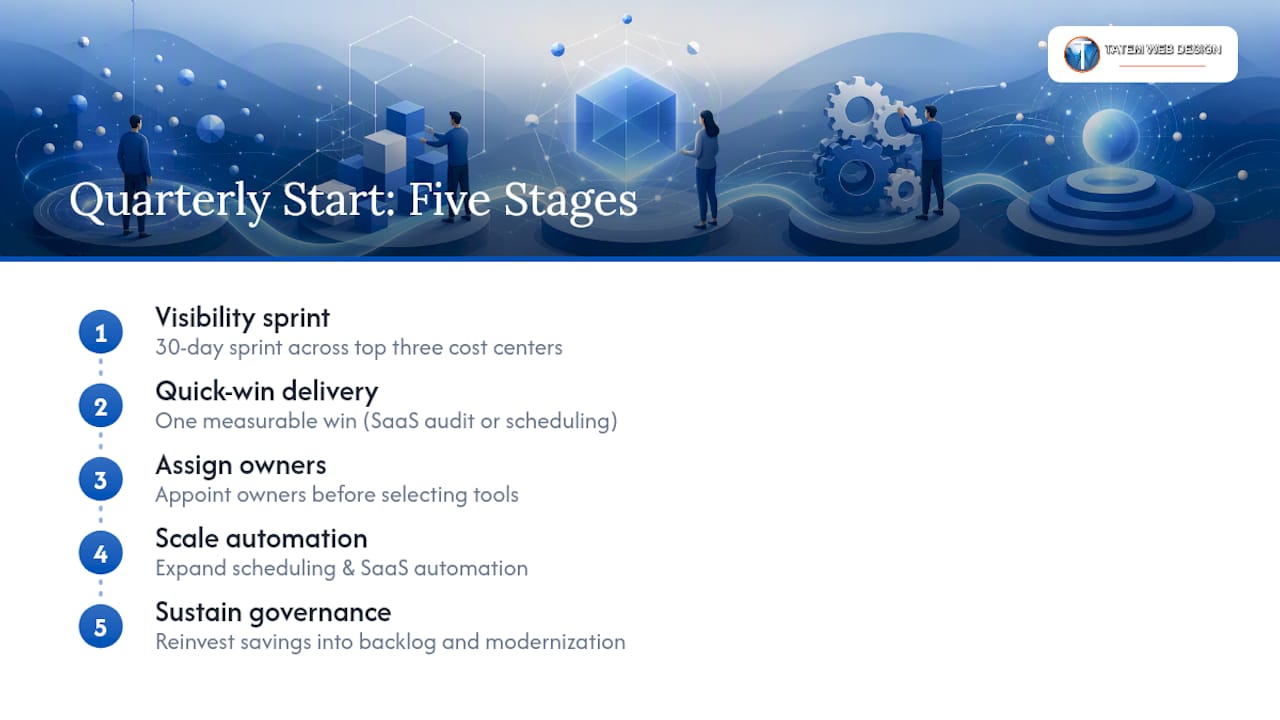
Assign owners before you pick tools. Prioritize the SaaS audit and scheduling automation first since they need the least new infrastructure to execute. Treat this as continuous work, and plan from day one to reinvest a portion of every dollar saved into a value-creation backlog: automation, data platforms, or the modernization projects that keep getting bumped for “urgent” tickets.
How a Technology Partner Accelerates Your Cost-Saving Roadmap
Executing the five-stage framework internally takes time most IT teams don’t have alongside their daily ticket load. Tatemweb works with Florida businesses to accelerate the parts of this playbook that eat the most calendar time: standing up monitoring and visibility tooling, automating non-production shutdown schedules, running SaaS consolidation audits, and verifying backup integrity with real restore testing rather than assumptions.
If your organization is carrying redundant software licenses or hasn’t tested a backup restore in over a year, that’s the fastest place to start. Tatemweb’s AI security enhancements cover backup verification and threat monitoring, while AI for business consulting helps you identify where harvested savings can fund automation that pays for itself within a year. Organizations that want a third-party review of cloud spend before committing internal resources can also look at Cost Beacon, a pay-on-savings audit service worth considering alongside any internal effort.
Call 772-224-8118 to schedule an initial consultation, or visit Tatemweb to see how a Florida-based partner can help you turn IT savings into a funded roadmap for growth instead of a one-time budget line.
Sources
- Successfully manage IT spend in business | Oliver Wyman
- CIOs: Focus cost optimization on funding growth, not cutting costs | Gartner
- Why Business Capabilities Are Your Secret Weapon For IT Cost Optimization | Forrester
- IT cost optimization: Key principles and framework | CloudZero
- IT cost optimization framework and strategies | IBM
FAQ
What Is the Difference Between IT Cost Reduction and IT Cost Optimization?
Cost reduction is a one-time cut, often across the board. Cost optimization is continuous and value-focused, eliminating waste while protecting or growing revenue-driving capability.
How Much Can Businesses Typically Save With IT Cost Optimization?
A value-first approach can save an estimated 10% to 30% of IT spend while improving operational outcomes, not just cutting the budget.
What Is FinOps and Why Does It Matter for Cost Savings?
FinOps is the practice of bringing engineering, finance, and business teams together to manage cloud spend collaboratively. It underpins the visibility to governance cycle that sustains savings over time.
How Quickly Can a Business See Results From IT Cost-Saving Tactics?
Quick wins like non-production scheduling or SaaS license cleanup can show measurable savings within two to four weeks, while commitment optimization for cloud compute takes 60 to 90 days.
Can a Partner Like Tatemweb Help With SaaS Audits and Backup Verification?
Yes. Tatemweb helps Florida businesses run SaaS consolidation audits, automate cost monitoring, and verify backup integrity as part of a broader AI-driven cost and security strategy.
Recommended
Tatem Web Design
26+ YearsWeb Design & SEO Specialist · Tatem Web Design
Matt Tatem has been designing websites professionally since 1999, making Tatem Web Design one of Florida's longest-running web agencies. Based in Stuart, FL, he specializes in WordPress, local SEO, Shopify e-commerce, and cybersecurity consulting for small businesses.

Rank in ChatGPT in 90 Days With a Practitioner Led Checklist
Follow a practitioner led 90 day plan to get cited by ChatGPT: allow OAI-SearchBot, publish short answer capsules with schema, and track Bing AI Performance.

AI SEO Content Playbook: 16 GEO Signals for Agencies & Teams
A practical playbook mapping the GEO-16 signals to hands-on editorial workflows, review controls, and metrics. For agencies and in-house teams scaling AI...

Copy Ready Local Schema Markup for SMBs + Google Validation
Copy ready JSON-LD examples and Google validation steps for SMBs' local schema markup. Audit, implement, and verify each location page with confidence.