
Local Business Digital Marketing Guide for Small Businesses
The eight highest-impact moves for local visibility are these, in order: claim and fully optimize your Google Business Profile, lock down consistent NAP (name, address, phone) across every listing, collect and respond to reviews, build dedicated local landing pages, fix core on-page SEO, run one small paid test, submit to priority local directories, and set a measurement baseline in GA4. Do those eight in the next three days and you will outrank most competitors who are still winging it.
This isn’t a theoretical framework. It’s the sequence Tatemweb runs with Florida service businesses, retailers, and professional practices before touching a single ad dollar. A documented digital marketing plan forces you to prioritize channels and budget instead of guessing, and that discipline is what separates businesses that grow steadily from ones that burn cash on tactics with no measurement attached.
The 8-step checklist:
- Claim, verify, and completely fill out your Google Business Profile
- Audit and correct NAP consistency across your website, GBP, and top directories
- Send review requests to your last 20 customers using a simple template
- Publish one local landing page for your primary service and city
- Fix mobile speed, title tags, and H1s on your five most important pages
- Run a modest Google Ads or Local Service Ads test for two weeks
- Submit your business to Yelp, Facebook, and two industry-specific directories
- Install GA4 and set up call tracking so you have a “before” baseline
Prioritize by business type: retail storefronts should start with GBP photos, products, and local inventory ads since foot traffic depends on visual proof. Service businesses (plumbers, dentists, attorneys) should prioritize reviews and Local Service Ads because trust drives the phone call. Multi-location brands should fix NAP consistency first, since one wrong address across 15 listings quietly kills rankings everywhere.
Pro Tip: Block two hours this week, not eight hours next month. GBP optimization alone takes about 45 minutes and often produces the fastest visible change in your call volume.
Schedule the GBP claim and NAP audit today. Everything else on this local business digital marketing guide builds from those two fixes.
Key Takeaways
Local visibility improves fastest when a business fixes Google Business Profile and NAP consistency before investing in content, paid ads, or new tools.
| Point | Details |
|---|---|
| Start with GBP | A complete, verified Google Business Profile produces the fastest measurable lift in calls and direction requests. |
| Fix NAP everywhere | Inconsistent name, address, or phone details across directories quietly undermine every other marketing effort. |
| Reviews drive both rankings and trust | Recent, responded-to reviews affect visibility and directly influence whether a searcher calls. |
| Measure revenue signals, not vanity metrics | Track calls, bookings, and direction requests in GA4 rather than raw traffic or impressions. |
| Bring in an agency once complexity grows | Tatemweb builds AI-powered websites and manages local SEO, GBP, and paid ads for Florida small businesses once DIY hits its limits. |
Table of Contents
- The 8-Step Local Digital Marketing Action Plan and 90-Day Timeline
- Which Website Fixes Matter Most for Local SEO?
- How Do I Optimize My Google Business Profile?
- How Do I Get More Reviews and Handle Negative Ones?
- What Local Content and Social Posts Actually Drive Business?
- Where Should I Spend on Local Paid Advertising?
- What KPIs Should a Local Business Track Every Month?
- How Long Does Local Marketing Take to Show Results?
- How Does an Agency Actually Execute a 90-Day Local Marketing Plan?
- What I’ve Learned Delivering Local Marketing Plans to Small Businesses
- When Should You Bring In Professional Help?
- Sources
- FAQ
The 8-Step Local Digital Marketing Action Plan and 90-Day Timeline
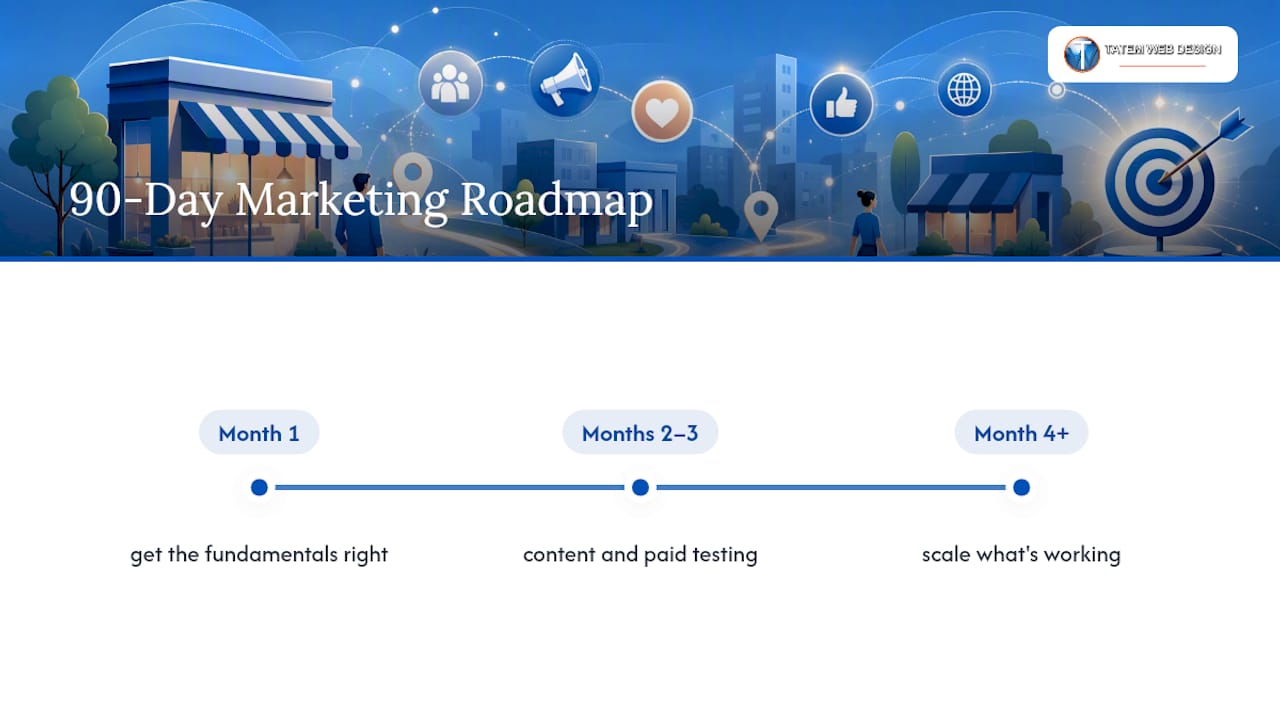
Most local businesses fail at digital marketing not because they lack good ideas, but because they try to do everything at once with no sequence and no owner assigned to each task. A 90-day roadmap fixes that. Small-business digital marketing frameworks consistently point to the same pattern: get the fundamentals right in month one, layer in content and paid testing in months two and three, then scale what’s working from month four onward.
Month 1: Fix the foundation
Your first 30 days are entirely about fixing what’s broken, not adding anything new. Claim your Google Business Profile, correct NAP across your top ten directories, install GA4, fix mobile speed issues, and launch your first review request campaign. This month produces almost no new traffic. It produces the plumbing that lets every later effort actually convert.

Months 2 to 3: Build content and test paid channels
Once the foundation holds, publish two to four local landing pages, start a light content cadence (one blog post every two weeks), and run a controlled test on one paid channel. This is also when local schema markup and citation building pay off, since search engines now have a clean, consistent business record to trust.
Months 4 to 6: Scale what’s converting
By month four, your data tells you where to put money. If Local Service Ads are producing $40 leads and organic search is producing $12 leads, you shift budget accordingly. This phase is about doubling down, not experimenting further.

| Task | Owner | Estimated Hours | Typical Timing |
|---|---|---|---|
| GBP claim and optimization | Owner or marketing lead | 3 to 5 hours | Week 1 |
| NAP audit across directories | Marketing lead or contractor | 4 to 6 hours | Week 1 to 2 |
| Review request campaign setup | Owner | 2 hours | Week 2 |
| Local landing page (per page) | Contractor or agency | 6 hours | Month 2 |
| Paid ad test setup and monitoring | Agency or marketing lead | 4 hours setup, 2 hours/week | Month 2 to 3 |
| GA4 and call tracking install | Contractor or agency | 3 to 4 hours | Week 1 |
Sample budgets by tier:
- Starter ($500 to $1,000/month): DIY GBP management, one local landing page per quarter, $200 to $300 in paid ad testing, no dedicated agency retainer.
- Growth ($1,500 to $3,000/month): Contractor-managed SEO, monthly content, $500 to $1,000 in paid ads across Google and Meta, basic email marketing.
- Scale ($3,500+/month): Full agency management, weekly content and GBP posts, $1,500+ in paid ads, AI-assisted chatbot and lead capture, ongoing citation building.
Prioritization matrix: if your goal is foot traffic, put your first dollars into GBP photos, local inventory, and Local Service Ads. If your goal is bookings or appointments, prioritize reviews and a conversion-optimized service page with click-to-call. If your goal is repeat customers, email marketing and a loyalty-style GBP post cadence matter more than new-customer ad spend.
Pro Tip #1: *Use an AI drafting tool to generate your first round of GBP posts and meta descriptions, then edit them for local specifics like street names and landmark references. AI speeds up drafting local SEO content but needs human editing to sound genuinely local needs human editing to sound genuinely local.
Pro Tip #2: Batch your review requests. Send them every Friday for the week’s completed jobs instead of reacting one at a time. Consistency produces a steadier review velocity than sporadic asks.
Pro Tip #3: Before hiring anyone, read through a straightforward ROI framework for small-business marketing spend so you know what a reasonable cost-per-lead looks like for your industry before you sign a contract.
Which Website Fixes Matter Most for Local SEO?
Site fundamentals come first because no amount of content or advertising fixes a website that loads slowly or confuses mobile visitors. Google’s local algorithm and human searchers judge you the same way: is this fast, clear, and easy to act on from a phone?
Technical checklist:
- Mobile responsiveness confirmed on an actual phone, not just a browser resize
- Core Web Vitals scores checked in Google Search Console
- HTTPS active sitewide, not just on the homepage
- Clean, crawlable URL structure (yoursite.com/plumbing-stuart-fl, not a string of parameters)
- No broken internal links or orphaned service pages
Local landing pages need real substance, not a template with the city name swapped out. Aim for 400 to 600 words minimum per page, covering the specific service, the neighborhoods you serve, pricing ranges where appropriate, and at least one local reference point (a landmark, a specific zip code, a nearby business district). Local SEO fundamentals consistently show that pages built around genuine local specificity outperform generic service pages with a city name pasted in.
Schema markup gives search engines structured proof of what you are and where you operate. Add LocalBusiness schema sitewide with your NAP, hours, and service area. Add Service schema on each service page describing exactly what’s offered. Add FAQ schema on pages where you answer three or more common customer questions, since that markup often earns featured snippet placement.
| Element | Example Pattern |
|---|---|
| Title tag | Emergency Plumber in Stuart, FL |
| Meta description | Fast, licensed plumbing repair in Stuart and Martin County. Call now for same-day service. |
| H1 | Stuart, Florida Emergency Plumbing Services |
| CTA placement | Above the fold and repeated after the service description |
For conversion optimization, put your phone number in the header as a tap-to-call link, not buried in a footer. A visitor searching “plumber near me” on their phone should be able to call you within one thumb tap of landing on your page.
Pro Tip: Run your top three service pages through Google’s PageSpeed Insights this week. A one-second delay in mobile load time can be the difference between a call and a bounce, especially for service categories where the customer is comparing three businesses in the same search session.
How Do I Optimize My Google Business Profile?
Google Business Profile is often the single highest-impact channel available to a local business, and it costs nothing to use. For many search queries with local intent, GBP results appear before organic listings even load, which means an incomplete profile is turning away customers who never see your website at all.
- Claim and verify your listing through Google’s verification process (postcard, phone, or instant verification depending on your business category).
- Fill every available field: business description, all applicable categories, services list, attributes (wheelchair accessible, women owned, etc.), and complete hours including holiday hours.
- Upload photos weekly during your first two months. Include your storefront, team, completed work, and interior shots. Profiles with recent photos tend to earn more clicks than static ones.
- Set up a booking or appointment link if your business type supports it, since that removes a full step from the customer’s path to contact.
- Post weekly using GBP’s post feature, covering offers, updates, or completed jobs.
Directory and citation checklist:
- Yelp (claim and respond to every review)
- Facebook Business Page with matching NAP
- Industry-specific directories (Avvo for attorneys, Healthgrades for medical practices, chamber of commerce listings for general SMBs)
- Apple Maps and Bing Places, which are often ignored but still drive navigation traffic
Our Google My Business optimization guide walks through the verification process and category selection in more depth if you’re claiming a profile for the first time.
Check GBP Insights monthly. Watch for shifts in call clicks, direction requests, and photo views. A sudden drop usually points to a category change, a suspended listing, or a competitor gaining review velocity in your area.
How Do I Get More Reviews and Handle Negative Ones?
Review volume, recency, and how you respond all materially affect both your local rankings and whether a searcher picks up the phone. A business with three reviews from 2023 loses to a competitor with 40 reviews from the last six months, even if the older business is objectively better.
Review request templates:
- Email: “Thanks for choosing us, [Name]. If you have 60 seconds, a quick Google review helps other [city] residents find us. [Link]”
- SMS: “Hi [Name], thanks for your business today! Mind leaving a quick review? [Link]”
- In-person: Hand a card with a QR code linking directly to your review page as the technician or staff member leaves.
Response guidance:
- Positive reviews: thank the customer by name and mention the specific service, since that reinforces keywords naturally.
- Neutral reviews: acknowledge the feedback and invite a direct conversation offline.
- Negative reviews: respond within 24 to 48 hours, stay factual, avoid arguing publicly, and offer a resolution path.
Dos and don’ts: do ask every satisfied customer, do time requests within 24 hours of service completion. Don’t offer discounts in exchange for reviews, since that violates most platform policies, and don’t ignore a negative review hoping it disappears. Silence reads as confirmation to anyone else reading it.
Pro Tip: Keep a simple crisis checklist on hand: respond fast, take detailed complaints offline, never delete a legitimate negative review (it looks worse if discovered later), and monitor mentions weekly so nothing sits unanswered for a week.
What Local Content and Social Posts Actually Drive Business?
Prioritize content that answers a transactional local question over generic industry blog posts nobody’s searching for. “How much does a water heater replacement cost in Stuart, FL” beats “The History of Plumbing” every time, because it matches actual search intent.
Local content ideas:
- Service explainer pages with realistic pricing ranges
- Neighborhood or district guides relevant to your service area
- Event-based posts tied to local happenings (hurricane prep for a roofer, holiday hours for retail)
- Before-and-after project posts with location tags
- Seasonal service reminders tied to Florida’s specific climate patterns
Social and cadence:
- Post to GBP weekly, at minimum
- Publish two to four blog posts per month if you’re in growth mode, one per month if you’re in maintenance mode
- Share completed jobs or customer wins on Facebook and Instagram with location tags
Amplification: repurpose one blog post into three social posts, a GBP post, and an email newsletter segment instead of writing fresh content for each channel. Partner with adjacent local businesses for cross-promotion (a landscaper and a pool service sharing referrals), and put a small paid boost, often $20 to $50, behind whichever organic post performs best in the first 48 hours. Our content marketing guide for small business covers a full editorial calendar template if you want to plan a quarter at once.
Where Should I Spend on Local Paid Advertising?
Paid ads buy immediate visibility while your organic and GBP presence build over the following months. If you need calls this week, paid is the lever. If you’re building for the next two years, organic and reviews are the lever.
| Channel | Best For | Typical Setup Time |
|---|---|---|
| Google Search Ads | High-intent keyword searches (“emergency electrician near me”) | 1 to 2 days |
| Performance Max | Broader reach across Search, Display, YouTube, and Maps | 2 to 3 days |
| Local Service Ads | Pay-per-lead model for home services, legal, and some medical categories | 3 to 5 days (requires background check) |
| Meta Ads | Visual services, retail, and community-based targeting | 1 to 2 days |
Budget examples: a service business testing paid for the first time can start with $300 to $500 per month split between Search and Local Service Ads. A retailer with a physical storefront often sees better early returns from Meta ads targeting a five-mile radius with visual product or in-store promotions.
Campaign checklist:
- Set geo-targeting to your actual service radius, not the whole metro area
- Write ad copy that matches the landing page it points to
- Confirm the landing page loads fast and has a single clear call to action
- Track every lead source with call tracking and UTM parameters so you know which channel actually produced the call
Set up conversion actions for calls, form fills, and direction requests before you spend a single dollar, so cost per lead is measurable from day one rather than guessed at retroactively.
What KPIs Should a Local Business Track Every Month?
Track the handful of metrics that actually connect to revenue: calls, bookings, direction requests, and form submissions. Everything else, like raw impressions or page views, is useful context but shouldn’t drive your budget decisions.
KPI by channel:
- GBP: calls, direction requests, website clicks (tracked in GBP Insights)
- SEO: organic rankings for target keywords, organic traffic, and time on page (tracked in Google Search Console and GA4)
- Ads: cost per lead, click-through rate, and return on ad spend
- Social: engagement rate and click-throughs to your site
- Email: open rate and click rate on offers
| Tool | Primary Use |
|---|---|
| GA4 | Website traffic, conversion tracking, channel attribution |
| Google Search Console | Organic keyword rankings and indexing issues |
| GBP Insights | Calls, direction requests, and photo engagement |
| Call tracking software | Attributing phone calls to specific marketing channels |
Set up GA4 with a defined conversion event for every form and phone click before you launch any new campaign. Growth in online retail and digital shopping behavior shows more of your customers researching and even transacting online before ever calling, so your GA4 setup needs to capture that path, not just the final phone call.
Reporting cadence: review KPIs monthly, adjusting ad spend and content priorities based on which channel produced the cheapest, highest-quality leads. Quarterly, step back and ask whether your channel mix still matches your actual business goals.
How Long Does Local Marketing Take to Show Results?
GBP produces the fastest visible wins, often within two to four weeks of full optimization. SEO compounds slowly and typically needs three to six months before rankings shift meaningfully. Content and reviews build authority over six months to a year, and paid ads produce leads immediately but stop the moment you stop paying.
Typical time-to-impact windows:
- GBP optimization: 2 to 4 weeks for call and direction request increases
- Paid ads: immediate, but requires ongoing spend to sustain
- On-page SEO and local landing pages: 2 to 4 months
- Review velocity and reputation: 3 to 6 months of consistent asking
Budget ranges by tier: Starter runs $500 to $1,000 per month and covers the basics. Growth runs $1,500 to $3,000 per month and adds consistent content and paid testing. Scale runs $3,500 and up, layering in full agency management and AI-assisted tools across every channel.
GBP frequently produces the most immediate leads of any channel available to a local business. This is exactly why it sits first in this local business digital marketing guide’s priority order. Invest there first regardless of your tier, then layer in paid and organic based on how fast you need results.
How Does an Agency Actually Execute a 90-Day Local Marketing Plan?
A structured onboarding followed by a focused 90-day sprint tends to deliver measurable lifts faster than an ad hoc approach, because every task has an owner and a deadline instead of competing for attention on someone’s side project list.
Sample onboarding timeline:
- Week 1: Audit current GBP, website, NAP consistency, and existing review profile.
- Week 2: Fix technical site issues, install GA4 and call tracking, correct citation inconsistencies.
- Weeks 3 to 4: Launch review request campaign, publish first local landing page, begin GBP posting cadence.
- Months 2 to 3: Layer in one paid channel test, expand content, monitor and adjust based on GA4 data.
| Responsibility | Owner |
|---|---|
| GBP and directory optimization | Agency |
| NAP audit and correction | Agency with owner sign-off |
| Content approval | Business owner |
| Paid ad management | Agency |
| Monthly reporting | Agency, reviewed with owner |
Expect measurable movement in calls and direction requests within the first month, followed by organic ranking improvements over the following quarter. A regulated business, a medical practice or a licensed contractor, adds a compliance layer to this timeline, since content and claims need review against industry-specific advertising rules before publishing. Our portfolio work for regulated local businesses shows how that compliance layer fits into a standard build without slowing the timeline significantly. Tatemweb’s own local SEO work in Stuart, Florida follows this same sequence with regional businesses across multiple industries.
What I’ve Learned Delivering Local Marketing Plans to Small Businesses
Fix NAP and GBP before buying a single tool. I’ve watched business owners sign up for expensive automation platforms while their address was still wrong on three directories, and no software fixes that kind of foundational gap.
Measure calls, not clicks. A campaign with a mediocre click-through rate that produces five phone calls a week beats a campaign with a great click-through rate and zero calls. Clicks feel good on a dashboard. Calls pay the bills.
Don’t outsource everything on day one. Owners who stay involved in reviewing GBP posts and approving content catch tone problems agencies miss, since nobody understands a local customer base better than the person who’s served them for years. Outsource the technical and repetitive work: citation building, schema markup, ad management. Keep judgment calls close.
The biggest time waste I see is chasing a trending platform before the basics are solid. A business with an incomplete GBP profile does not need a TikTok strategy. It needs its address fixed first.
When Should You Bring In Professional Help?
DIY works well for the first 30 to 60 days: claiming GBP, fixing NAP, and sending review requests are all things an owner can handle without technical skill. Once you’re juggling a paid ad campaign, local landing pages, schema markup, and monthly reporting at the same time, that’s usually the point where a professional team starts paying for itself in saved hours and fewer costly mistakes.
Tatemweb builds AI-powered websites with local SEO fundamentals baked in from the first line of code, rather than bolted on afterward. That means your service pages, schema markup, and GBP alignment launch correctly the first time instead of getting patched together over months. Our local SEO, Google Business Profile management, paid ad setup, and GA4 reporting cover every step in this local business digital marketing guide, with a Florida-based team that already understands your regulatory and regional context.
If you want a second opinion on where your local marketing stands right now, request a short audit through our AI website design services page, or call 772-224-8118 to talk through your specific situation. There’s no long sales process. Just a straightforward look at what’s working, what’s not, and what to fix first.
Sources
For deeper implementation detail beyond this local business digital marketing guide, these sources are worth bookmarking:
- U.S. Census Bureau — E‑commerce data
- Digital Marketing Basics - Small Business Help Topics (SBDCNet)
- How to build a digital marketing plan (Harvard Business School Online blog)
FAQ
What Is the Fastest Way to Improve Local Visibility?
Claiming and fully optimizing your Google Business Profile typically produces the fastest measurable increase in calls and direction requests, often within two to four weeks.
How Much Should a Small Business Budget for Digital Marketing?
Budgets typically range from a few hundred to several thousand dollars per month, depending on the level of service and paid advertising included.
How Many Reviews Does a Local Business Need to Rank Well?
There’s no fixed number, but recent review volume and response rate matter more than total count, so consistent monthly requests outperform a one-time push for dozens of reviews.
Should I Use Google Ads or Local Service Ads First?
Local Service Ads work best for home services, legal, and select medical categories on a pay-per-lead model, while Google Search Ads suit businesses wanting more control over keyword targeting and ad copy.
Can Tatemweb Help With Both Website Design and Local SEO?
Yes. Tatemweb builds AI-powered websites for Florida small businesses with local SEO, schema markup, and GBP alignment integrated from the start, along with ongoing paid ad and reporting support.
Recommended
Tatem Web Design
26+ YearsWeb Design & SEO Specialist · Tatem Web Design
Matt Tatem has been designing websites professionally since 1999, making Tatem Web Design one of Florida's longest-running web agencies. Based in Stuart, FL, he specializes in WordPress, local SEO, Shopify e-commerce, and cybersecurity consulting for small businesses.

Rank in ChatGPT in 90 Days With a Practitioner Led Checklist
Follow a practitioner led 90 day plan to get cited by ChatGPT: allow OAI-SearchBot, publish short answer capsules with schema, and track Bing AI Performance.

AI SEO Content Playbook: 16 GEO Signals for Agencies & Teams
A practical playbook mapping the GEO-16 signals to hands-on editorial workflows, review controls, and metrics. For agencies and in-house teams scaling AI...

Copy Ready Local Schema Markup for SMBs + Google Validation
Copy ready JSON-LD examples and Google validation steps for SMBs' local schema markup. Audit, implement, and verify each location page with confidence.