
Invest in Digital Marketing: ROI Guide for SMBs
Small and medium businesses that invest in digital marketing consistently outperform those that rely on word-of-mouth alone. The core reason is simple: digital channels let you reach buyers at the exact moment they are searching for what you sell, then measure every dollar’s impact with precision that traditional advertising never offered.
The strongest reasons to invest, at a glance:
- Measurable ROI — track cost per lead, conversion rate, and revenue directly tied to spend
- Targeted reach — serve ads and content to buyers by location, intent, and behavior
- Cost efficiency — email marketing and SEO cost far less per lead than outbound tactics
- Improved conversions — optimized landing pages and retargeting lift close rates
- Brand credibility — consistent online presence builds trust before the first call
- Compounding returns — SEO and content keep generating leads long after you publish
Businesses with a documented marketing plan are significantly more likely to report marketing success, and many small businesses plan to increase their marketing budgets. The gap between planned and unplanned marketing is not marginal.
Quick action: Within the next 48 hours, set up one conversion goal in Google Analytics 4 (a form submission or phone call), then run a $100 Google Ads test targeting one high-intent keyword. That single experiment will tell you more about your market than months of guessing.
Table of Contents
- Why invest in digital marketing? The core benefits for SMBs
- 1. You reach buyers when they are actively searching
- 2. Your spend is fully measurable
- 3. Email marketing delivers outsized returns
- 4. Content and SEO compound over time
- 5. You can target with surgical precision
- 6. Digital marketing builds brand credibility
- 7. AI tools are now improving SMB marketing efficiency
- 8. Digital marketing is increasingly visible in AI search results
- How digital marketing delivers measurable ROI
- What to expect: realistic timelines and budget ranges
- How to prioritize channels for your business model
- Digital marketing levels the playing field for small businesses
- Key Takeaways
- The real priority most SMBs miss
- Tatemweb helps Florida SMBs build marketing that actually converts
- Useful sources
- FAQ
Why invest in digital marketing? The core benefits for SMBs
Digital marketing is the umbrella term for paid and organic online channels: search ads, SEO, email, social media, and content. For small and medium businesses, these channels share one critical advantage over print, radio, or direct mail: you can see exactly what worked and cut what did not.

1. You reach buyers when they are actively searching
Paid search and local SEO put your business in front of people who already have buying intent. A plumber in Stuart, Florida running a Google Ads campaign for “emergency pipe repair” reaches a homeowner mid-crisis, not a general audience that may or may not need plumbing in the next year. That precision is what makes digital advertising so efficient for businesses with limited budgets.
2. Your spend is fully measurable
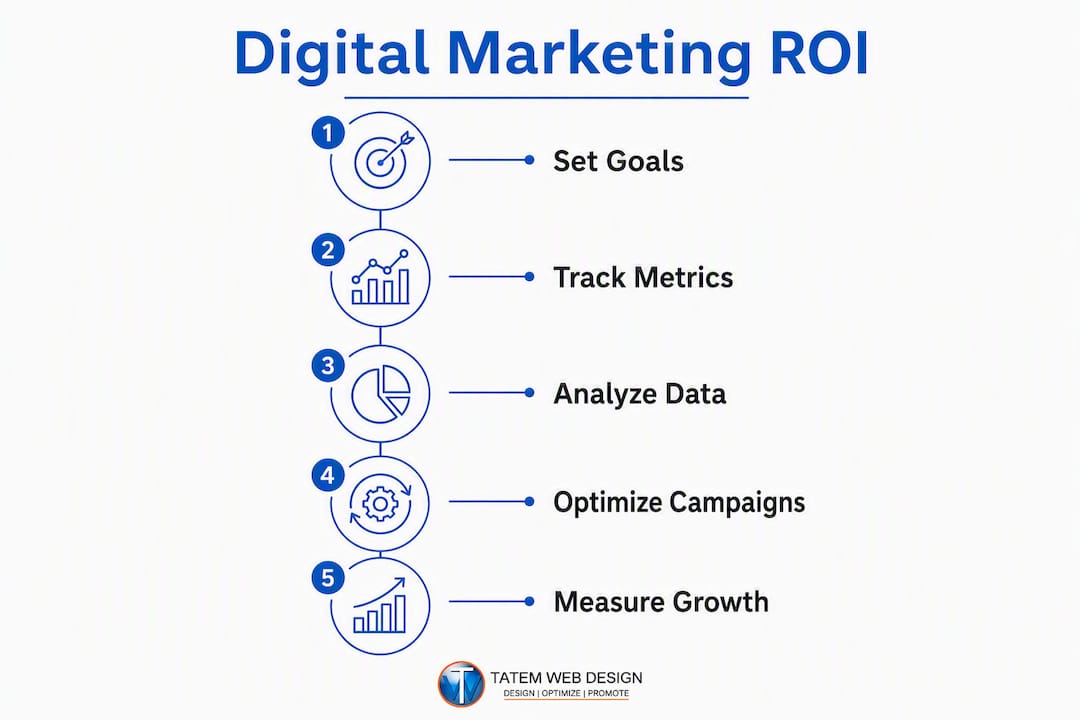
Every click, form fill, and phone call can be tracked back to a specific ad, keyword, or page. That attribution capability is what separates digital from traditional media. You know your cost per acquisition (CPA) within weeks, not quarters, and you can reallocate budget toward what is working before you waste money on what is not.
3. Email marketing delivers outsized returns
Email marketing delivers $36–$42 for every $1 spent and is widely recognized as one of the highest-ROI channels available to most SMBs. A local dental practice sending appointment reminders and seasonal promotions to a list of 2,000 patients spends almost nothing per send and keeps the schedule full. Pair that with an AI-driven automation sequence and the revenue compounds without additional labor.
4. Content and SEO compound over time
Content marketing produces substantially more leads at a lower cost compared to outbound tactics. The catch is patience: a well-optimized blog post or service page keeps generating organic traffic for years, while a paid ad stops the moment you stop funding it. For SMBs with a 12-month horizon, SEO is one of the strongest long-term investments in the mix.
5. You can target with surgical precision
Digital channels let you define your audience by ZIP code, job title, device, past website behavior, and purchase intent. A law firm in Martin County can run Facebook ads exclusively to homeowners aged 35–65 within a 15-mile radius. That kind of targeting was unavailable to small businesses before digital advertising, and it is why smaller firms can now compete directly with regional chains.
6. Digital marketing builds brand credibility
Buyers research online before they call. A business with a professional website, active Google Business Profile, and consistent social presence signals legitimacy. Digital branding is not just aesthetics — it is the first filter a prospect applies before deciding whether to contact you at all.
7. AI tools are now improving SMB marketing efficiency
AI adoption among small business marketers has crossed the majority threshold, and the practical benefits are real: AI tools reduce waste in paid campaigns, personalize email sequences automatically, and surface content gaps faster than manual audits. For a business owner wearing multiple hats, that efficiency gain is the difference between a marketing program that runs and one that stalls.
8. Digital marketing is increasingly visible in AI search results
Buyers are no longer just using Google. They are asking ChatGPT, Perplexity, and Google’s AI Overviews for recommendations. Visibility in AI-generated answers is now as important as classic search ranking, and content structured with clear proof points and specific answers gets cited by those platforms. An SMB that invests in structured, evidence-based content today is building discoverability for the way buyers will search tomorrow.
How digital marketing delivers measurable ROI
The metrics that matter for an SMB are not vanity numbers. Impressions and follower counts tell you almost nothing about revenue. These six KPIs do:
- Website traffic (by source) — shows which channels are actually sending visitors
- Lead volume — form fills, calls, and chat inquiries attributed to each channel
- Conversion rate — percentage of visitors who take a desired action
- Cost per acquisition (CPA/CAC) — total spend divided by new customers acquired
- Customer lifetime value (LTV) — average revenue per customer over the relationship
- Return on ad spend (ROAS) — revenue generated per dollar of paid media
| KPI | What it measures | How to calculate | When to act |
|---|---|---|---|
| Conversion rate | Visitors who become leads or buyers | Conversions ÷ sessions × 100 | Below 2% for most service pages |
| CPA/CAC | Cost to acquire one customer | Total spend ÷ new customers | When CPA exceeds LTV ÷ 3 |
| ROAS | Revenue per ad dollar | Revenue from ads ÷ ad spend | Below 3:1 for most SMB campaigns |
| Email open rate | List engagement | Opens ÷ delivered × 100 | Below 20% signals list or subject line issues |
Attribution for SMBs does not need to be complex. Start with last-click attribution in Google Analytics 4 to understand which channel closes the deal, then layer in UTM parameters on every campaign link so you can trace leads from first touch to sale. First-party data (your own email list and CRM) is the most reliable signal you own, especially as third-party cookies continue to phase out.
Pro Tip: The most common attribution mistake SMBs make is judging a channel by last click alone. A prospect might find you through a blog post, return via a Google Ad, and convert through email. Set up a simple multi-touch view in GA4 before you cut any channel based on last-click data.
Performance depends more on the clarity of your offer and landing page than on budget size. Many campaigns fail because the ad is good but the page it sends traffic to is generic. Fix the page before you scale the spend.
What to expect: realistic timelines and budget ranges
Setting the right expectations is what keeps SMBs from abandoning a strategy before it works.
Short-term (0–30 days): Paid search and social ads can generate leads within days of launch. This window is for testing, not scaling. Run narrow, intent-driven campaigns with a modest budget to collect data on which offers and audiences convert.

Medium-term (30–90 days): Email sequences, retargeting, and landing page optimization start compounding. You should see measurable improvement in conversion rate and CPA. SEO begins to show early movement in rankings for lower-competition keywords.
Long-term (90–180+ days): SEO and content marketing hit their stride. Organic traffic grows, cost per lead drops, and the channels you tested in month one are now optimized with real data. This is where the ROI gap between digital and traditional marketing becomes undeniable.
Starter budget guidance for small businesses:
- Conservative ($500–$1,000/month): — Focus on local SEO, Google Business Profile optimization, and one email sequence. Minimal paid spend, maximum organic leverage.
72% of total small business marketing budgets are now allocated to digital channels, which reflects where buyers spend their attention. The businesses still splitting budget between print and digital are paying twice to reach half the audience.
How to prioritize channels for your business model
Not every channel deserves equal attention. The right starting point depends on your sales cycle, transaction size, and how quickly you need leads.
Decision rules:
- High-intent, fast sales cycle (e.g., emergency services, local retail): Start with Google Ads and local SEO. Buyers are searching now.
- Longer sales cycle, higher ticket (e.g., professional services, B2B): Email nurture sequences and content marketing build trust over weeks. Pair with retargeting.
- Repeat purchase or subscription model: Email automation is your highest-ROI channel. Invest there first.
- Visual or lifestyle product: Social media and video marketing drive discovery and engagement before the purchase decision.
A practical 30/60/90-day plan:
- Days 1–30: Set up analytics, define one conversion goal, launch a narrow paid search test ($300–$500), and publish two optimized service pages. Read the data daily.
- Days 31–60: Scale the ad groups that produced leads, pause what did not, start a basic email sequence for new leads, and publish two blog posts targeting long-tail keywords.
- Days 61–90: Optimize landing pages based on conversion data, add retargeting to your paid campaigns, and review organic ranking movement. Begin planning a content marketing strategy for the next quarter.
Pro Tip: Before you hire help or increase budget, check whether your website’s landing pages are actually converting visitors. A $2,000/month ad budget sent to a slow, unclear page is money spent on traffic, not leads.
For most SMBs, the right time to bring in agency help is when you have validated at least one channel with your own testing and need to scale faster than your internal bandwidth allows.
Digital marketing levels the playing field for small businesses
Targeted, intent-driven digital strategies let smaller firms compete on impact rather than scale. A local accounting firm with a $2,000/month digital budget, a well-optimized Google Business Profile, and a strong email list can consistently outrank and out-convert a regional chain that spends ten times as much on broad, untargeted advertising.
The practical mechanism is specificity. A large competitor running national campaigns cannot afford to customize messaging for every local market. You can. A dentist in Port St. Lucie running ads specifically for “same-day crowns near me” with a landing page that answers every objection a nervous patient has will convert at a rate no generic campaign can match.
Treating early marketing spend as an investment in learning rather than a direct revenue event is the mindset shift that separates businesses that build sustainable digital programs from those that run one campaign, see mixed results, and quit. The data from your first 30 days of paid search is worth more than the leads it generates, because it tells you exactly what your buyers respond to.
Pro Tip: Start building your email list from day one, even before you run a single paid campaign. Every visitor who gives you their email is a first-party data asset you own permanently, regardless of what happens to ad platform algorithms or costs.
Key Takeaways
Businesses with a marketing plan are significantly more likely to report success, and email marketing delivers one of the clearest ROI advantages among digital channels.
| Point | Details |
|---|---|
| Plan before you spend | Businesses with a documented marketing plan are 6.7x more likely to report success. |
| Email is the highest-ROI channel | Email marketing returns $36–$42 for every $1 spent — start building your list immediately. |
| Content and SEO compound | Content marketing generates 3x more leads at 62% lower cost than outbound; results build over 90–180 days. |
| Fix the page before scaling ads | Offer clarity and landing page quality determine campaign performance more than budget size. |
| Tatemweb as your growth partner | Tatemweb provides AI website design, local SEO, email automation, and paid media setup for Florida SMBs. |
The real priority most SMBs miss
Most business owners ask the wrong first question. They want to know which channel to use before they know what they are trying to measure. The result is a scattered spend across three platforms with no clear signal from any of them.
The businesses that see the fastest returns from digital marketing share one habit: they define one conversion goal, run one focused test, and read the data before adding complexity. That discipline is harder than it sounds when you are also running a business, but it is the only thing that separates a marketing program that compounds from one that just costs money.
There is also a structural issue that rarely gets discussed honestly. Many SMBs underinvest in their website while overspending on ads. A $3,000/month Google Ads budget driving traffic to a five-year-old website with no clear call to action is a predictable waste. The website is the conversion engine. Ads are just the fuel. Getting that order right is the single most common early win Tatemweb sees with new clients.
The other thing worth saying plainly: AI tools have genuinely changed the math for small businesses. Automated email sequences, AI-assisted content creation, and smart bidding in paid platforms have reduced the labor cost of running a real marketing program. The barrier to entry is lower than it has ever been. The businesses that move now build a data advantage that gets harder to close over time.
Tatemweb helps Florida SMBs build marketing that actually converts
If you have read this far and you are still running your business on referrals and a website that has not been updated since 2021, the gap between where you are and where your competitors are going is widening every month.
Tatemweb is a full-service digital agency based in Stuart, Florida, with over 26 years of experience building marketing programs that produce measurable results for small and medium businesses. The services that move the needle fastest for most clients: AI-powered website design that converts visitors into leads, AI email automation that nurtures prospects without manual effort, AI chatbots and lead capture that work around the clock, and local SEO that gets you found before your competitors.
Engagements range from project-based website builds to monthly retainer marketing programs, so you can start at the level your budget supports and scale as results come in. Call Tatemweb directly at 772-224-8118 or visit the digital marketing services page to schedule a consultation and get a clear picture of where your biggest growth opportunity is right now.
Useful sources
- Digital Marketing for Small Business (Bank of America Business) — Practical guidance on how SMBs can compete using targeted digital strategies.
- Small Business Marketing Guide (Forbes Advisor) — Strategic framing for treating early marketing spend as a learning investment.
- Tatemweb Digital Marketing Agency (Stuart, FL) — Full-service digital marketing and AI integration services for Florida SMBs.
FAQ
Is it worth investing in digital marketing for a small business?
Yes. Businesses with a documented marketing plan are 6.7x more likely to report success, and channels like email and SEO deliver returns that outperform most traditional advertising at a fraction of the cost.
What are five key advantages of digital marketing?
The five strongest advantages are measurable ROI, precise audience targeting, lower cost per lead compared to outbound tactics, compounding returns from SEO and content, and the ability to build brand credibility at scale without a large advertising budget.
How long does it take to see results from digital marketing?
Paid search can generate leads within days; email and retargeting show measurable improvement within 30–90 days; SEO and content marketing typically produce significant organic traffic growth in the 90–180 day window.
How much should a small business spend on digital marketing?
A conservative starting point is $500–$1,000 per month focused on local SEO and email, scaling to $1,500–$3,000 per month once you have validated at least one channel. Tatemweb offers project-based and retainer options sized for SMB budgets.
Why do so many digital marketing campaigns fail?
Most failures trace back to unclear offers and weak landing pages, not insufficient ad spend. Performance is determined more by offer clarity and page experience than by budget size, so fixing the conversion path before scaling spend is the highest-leverage move.
Recommended
Tatem Web Design
26+ YearsWeb Design & SEO Specialist · Tatem Web Design
Matt Tatem has been designing websites professionally since 1999, making Tatem Web Design one of Florida's longest-running web agencies. Based in Stuart, FL, he specializes in WordPress, local SEO, Shopify e-commerce, and cybersecurity consulting for small businesses.
What a CMMC Level 2 Assessment Requires and How to Prepare
Prepare for your CMMC Level 2 assessment by understanding requirements, assessment paths, and mapping your Controlled Unclassified Information.
A Data Retention Policy Is Your Rulebook for Keeping and Deleting Data
Establishing a clear data retention policy helps manage data risk, ensuring compliance and effective data management for your organization.
Law Firm Local SEO: A Practical Playbook for More Local Clients
Unlock more local clients for your law firm with effective local SEO strategies. Optimize your Google Business Profile and boost your visibility!