
Cut PCI Work to a Few Hours: Reach SAQ A for Small Businesses
If your business processes, stores, or transmits cardholder data, you must follow PCI DSS. For most small merchants, the fastest route to compliance is outsourcing card handling to a validated third party so you can self-attest with the shortest questionnaire, SAQ A. Your first move: call your acquirer today and get your merchant level and required SAQ in writing.
TL;DR:
- Small businesses outsourcing their payment processing to validated third parties can often qualify for SAQ A, greatly simplifying PCI compliance.
- Achieving compliance generally requires mapping payment flows, reducing data scope, implementing baseline security controls, and completing the appropriate SAQ annually.
- The cost and duration of PCI compliance vary from low-cost, quick SAQ A submissions to weeks-long, expensive processes if your systems handle cardholder data directly.
- Most small merchants can self-attest without a QSA unless their systems interact directly with their own servers or they’ve experienced a breach.
- Using payment options like Square or hosted checkout solutions can help lower compliance scope but do not automatically make your entire store PCI compliant.
Table of Contents
- What Is PCI Compliance for Small Business, and Who Needs It?
- SAQs, ASVs, and QSAs: Choosing the Right Validation Path
- The 12 PCI DSS Requirements, Translated for Small Business
- How to Achieve PCI Compliance: A Step-by-Step Plan
- What PCI Compliance Actually Costs and How Long It Takes
- What I’ve Learned Advising Small Businesses on PCI
- How Tatemweb Helps You Get PCI-Ready Without the Guesswork
- Where to Verify PCI Requirements and Find Official Forms
- Sources
- FAQ
What Is PCI Compliance for Small Business, and Who Needs It?
The Payment Card Industry Data Security Standard (PCI DSS) is a set of baseline technical and operational requirements built to protect cardholder data. It applies to every merchant, regardless of size, that stores, processes, or transmits cardholder information, according to the PCI Security Standards Council. There’s no small-business exemption. A dentist’s office running three card swipes a day carries the same underlying obligation as a regional retail chain, though the paperwork required to prove it looks very different.
Cardholder data covers two categories: the Primary Account Number (PAN) and sensitive authentication data (SAD) like the CVV or magnetic stripe contents. If your business touches that data through a countertop terminal, an online store, a phone order, or even a paper order form you scan later, that channel is in scope.
Your validation burden depends on your merchant level, set by your card brand transaction volume:
- Level 1: Very high transaction volume or any merchant that has suffered a breach. Requires a Qualified Security Assessor (QSA) audit.
- Level 2: High transaction volume, typically requiring a Self-Assessment Questionnaire, sometimes an on-site review depending on the brand.
- Level 3: Moderate transaction volume e-commerce merchants. Typically self-assessment territory.
- Level 4: Low transaction volumes, covering the overwhelming majority of small businesses.
Confirm your level directly with your acquiring bank or payment processor, and get the answer in an email or letter, not a phone call you can’t reference later.
SAQs, ASVs, and QSAs: Choosing the Right Validation Path
Level 4 merchants can typically self-attest, and the questionnaire you use depends entirely on how payment data flows through your business. SAQ A applies if you’ve fully outsourced card capture to a validated third party and your systems never touch cardholder data directly. SAQ A-EP fits e-commerce merchants whose website influences the payment page even if a third party processes the transaction. SAQ B-IP covers standalone, PTS-approved terminals with an IP connection but no electronic cardholder data storage. SAQ C applies to payment applications connected to the internet. SAQ D is the long form, required when none of the simpler categories fit, or when card data touches your own systems directly.
A few practical mappings:
- A boutique using Square or a similar hosted card reader with no data storage: SAQ A or B-IP.
- A WooCommerce store using a hosted checkout redirect: SAQ A.
- A service business capturing card numbers manually over the phone into a spreadsheet: likely SAQ D, and a serious red flag on its own.
If any internet-facing system touches your payment environment, you also need quarterly external scans from an Approved Scanning Vendor (ASV), with the signed report attached to your SAQ submission, per PCI DSS documentation. Most processors bundle ASV scanning into their service packages, so ask for it in writing before assuming you need to shop separately. A QSA is only mandatory for Level 1 merchants or after a breach investigation; almost no small business needs one to start.
Once you’ve completed your SAQ, request an Attestation of Compliance (AOC) and a responsibility matrix from every payment vendor you use. That matrix spells out exactly which controls the vendor covers and which ones remain yours.
The 12 PCI DSS Requirements, Translated for Small Business
The standard is organized into twelve requirements. Most sound like they belong in an enterprise IT department, but each one has a small-business-sized version.
- Install and maintain network security controls. Check that your router and point-of-sale network use a firewall, not a default open configuration.
- Apply secure configurations. Change every default password on routers, terminals, and POS software the day you install them.
- Protect stored account data. Best practice: don’t store PAN at all. If you don’t have it, you can’t lose it.
- Protect data with strong cryptography during transmission. Confirm your website and payment page run TLS 1.2 or higher.
- Protect systems from malware. Keep endpoint protection active on any device that touches payment data.
- Develop and maintain secure systems. Apply security patches, especially critical ones, within 30 days under PCI DSS v4.0.1’s stricter timeline.
- Restrict access by business need. Not every employee needs access to the POS admin panel.
- Identify users and authenticate access. This is where multi-factor authentication (MFA) enters, now a firm requirement for any access to the cardholder data environment under v4.0.1.
- Restrict physical access to cardholder data. Lock the drawer where paper receipts sit.
- Log and monitor all access to system components. Retain logs for review, not just storage.
- Test security systems regularly. This is where your quarterly ASV scans live.
- Support information security with organizational policies. Write down your rules, even a one-page version, and train staff on them.
Hosted payment pages, tokenization, and Point-to-Point Encryption (P2PE) shift many of these burdens onto your provider. But requirements 7, 8, 10, and 12 almost always stay with you no matter how much you outsource. PCI DSS v4.0.1 also now requires merchants to inventory and monitor scripts running on payment pages, a direct response to card-skimming malware injected through third-party JavaScript.
Non-compliance carries a real financial cost. Processors commonly charge recurring monthly non-compliance fees, and a breach discovered while you’re non-compliant can trigger far larger fines and forensic investigation costs, according to payment industry guidance.
How to Achieve PCI Compliance: A Step-by-Step Plan
Compliance breaks down into a repeatable sequence, not a one-time scramble.
- Confirm your merchant level and SAQ with your acquirer, in writing. This single document determines everything that follows.
- Map every payment flow. Walk through how a customer’s card number moves, whether swiped, typed, phoned in, or entered online, and note every system it passes through.
- Reduce scope aggressively. Hosted payment pages, tokenization, and P2PE terminals push the heaviest compliance burden onto your provider instead of you. Service businesses that take card numbers by phone can add DTMF masking or tokenized capture to drop out of the heavier questionnaires entirely.
- Implement baseline controls. MFA on admin accounts, unique strong passwords, basic network segmentation between payment systems and general office Wi-Fi, and TLS 1.2 or higher across your site.
- Schedule your ASV scans. Fix anything flagged before your quarterly deadline, and keep every report on file.
- Complete your SAQ honestly and submit the AOC to your acquirer. Guessing “yes” on a control you haven’t verified creates liability, not compliance.
- Maintain the program year-round. Quarterly scans, annual SAQ renewal, ongoing staff training, and a one-page incident response plan you can actually follow under pressure.
Pro Tip: Before you touch a single technical control, get your written merchant level and SAQ type from your acquirer. Every other step depends on knowing which questionnaire you’re actually filling out.
Industry guides consistently reduce this process to the same five moves: assess scope, reduce it, secure what remains, complete the SAQ, and maintain it continuously, according to CompTIA’s small-business breakdown. If you run a WooCommerce store, confirm your host and payment gateway configuration meet these baseline controls before you assume WooCommerce PCI DSS obligations are fully handled for you. Whether WooCommerce is PCI compliant out of the box depends entirely on whether you’re using a hosted checkout or processing card data on your own server.
What PCI Compliance Actually Costs and How Long It Takes
The most common mistakes are predictable: storing PAN in email or spreadsheets, assuming your payment provider covers every requirement automatically, leaving default passwords active on terminals, and never checking what scripts run on your checkout page.
Costs and timelines vary sharply by SAQ type:
- SAQ A (fully outsourced checkout): often free to low-cost, completed in a few hours once payment flows are mapped.
- SAQ B-IP (standalone IP terminal): modest cost, usually a day or two of setup and documentation.
- SAQ D (data touches your own systems): the highest cost and longest timeline, sometimes weeks, and often the point where hiring outside help makes sense.
Completing your SAQ and submitting the AOC promptly typically stops recurring monthly non-compliance fees from your acquirer, according to Brookside Payments’ small-merchant guidance. The fastest way to cut both cost and time is scope reduction: the less your systems touch cardholder data, the shorter your questionnaire and the smaller your bill.
What I’ve Learned Advising Small Businesses on PCI
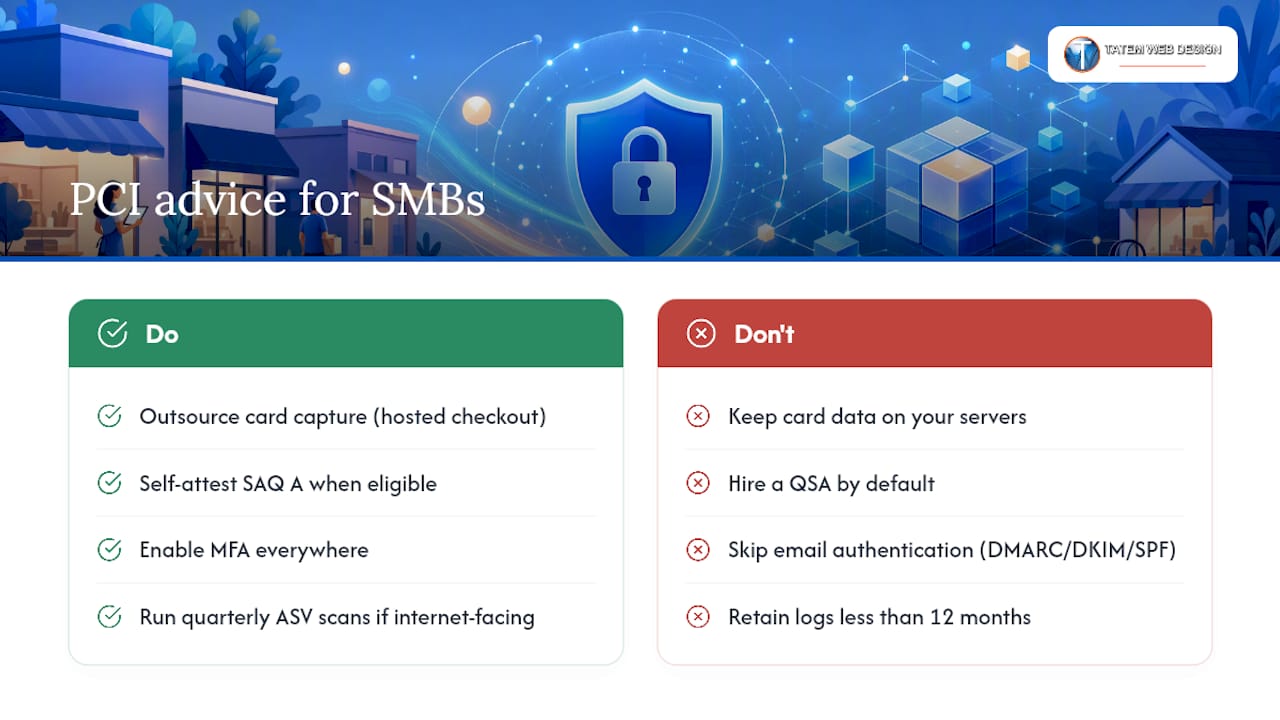
Most small business owners overcomplicate this. They imagine PCI compliance as a security audit requiring a consultant on retainer, when the real leverage move is architectural: outsource card capture entirely and your compliance burden collapses to SAQ A. I recommend a QSA only when card data genuinely touches your own servers, when you’ve had a prior breach, or when your acquirer explicitly requires it. Everyone else can self-attest.
The minimum-viable security stack I tell clients to build regardless of SAQ type: MFA everywhere, quarterly ASV scans if you have internet-facing systems, email authentication (DMARC, DKIM, SPF), twelve months of log retention, and a one-page incident response plan. One retail client cut their questionnaire from SAQ D to SAQ A in under a month simply by switching to a hosted checkout, no server migration required.
— Matt
How Tatemweb Helps You Get PCI-Ready Without the Guesswork
You can find services that bundle website hardening, PCI documentation help, and ongoing security monitoring together with site maintenance from your web team.
Our AI cybersecurity services cover scope assessment, ASV scan coordination, SAQ walk-throughs, and script monitoring for payment pages, so you’re not piecing together five vendors to answer one questionnaire. If your site runs on WooCommerce or another open-source CMS, we also handle the underlying hardening work that keeps your checkout inside the lowest-scope SAQ category possible. Such engagements often begin with a scope review of your payment flows, followed by a prioritized fix list and documentation suitable for your acquirer.
We also offer staff training so your employees stop being the weakest link in an otherwise solid setup. Call 772-224-8118 or visit our AI security enhancements page to schedule a PCI readiness consultation and get a clear picture of exactly what your business needs before your next SAQ deadline.
Where to Verify PCI Requirements and Find Official Forms
- PCI SSC merchant resources: official SAQs, ASV and QSA directories, and merchant guidance.
- PCI DSS standard documentation: full requirement text and scanning rules.
- Small business PCI DSS 4.0.1 guide: plain-language breakdown of new MFA and patching rules.
- Cybersecurity compliance guide for SMBs: broader framework context beyond PCI alone.
Sources
- Merchant Resources - PCI Security Standards Council
- 5 Simple Ways to Become PCI-DSS Compliant | CompTIA
- PCI Data Security Standard (PCI DSS) - PCI Security Standards Council
- PCI DSS 4.0: What Small Merchants Must Do Now
FAQ
Does a Small Business Need to Be PCI Compliant?
Yes. Any business that stores, processes, or transmits cardholder data must meet PCI DSS requirements, regardless of transaction volume or company size.
Can I Do PCI Compliance Myself?
Most small merchants at Level 4 can self-attest using the appropriate SAQ without hiring a QSA, especially if you’ve outsourced payment capture to a validated third party.
Do I Need to Be PCI Compliant if I Use Square?
Yes, though your burden is much lighter. Using a validated processor like Square typically qualifies you for SAQ A or SAQ B-IP, since the provider handles most of the technical requirements.
Do I Really Need PCI Compliance?
It’s not optional. Skipping it risks recurring non-compliance fees from your acquirer and much larger fines if a breach happens while you’re unvalidated.
Is WooCommerce PCI Compliant?
WooCommerce itself isn’t automatically PCI compliant. Compliance depends on whether you use a hosted checkout or PCI-validated gateway versus processing card data directly on your own server.
Recommended
Tatem Web Design
26+ YearsWeb Design & SEO Specialist · Tatem Web Design
Matt Tatem has been designing websites professionally since 1999, making Tatem Web Design one of Florida's longest-running web agencies. Based in Stuart, FL, he specializes in WordPress, local SEO, Shopify e-commerce, and cybersecurity consulting for small businesses.

Rank in ChatGPT in 90 Days With a Practitioner Led Checklist
Follow a practitioner led 90 day plan to get cited by ChatGPT: allow OAI-SearchBot, publish short answer capsules with schema, and track Bing AI Performance.

AI SEO Content Playbook: 16 GEO Signals for Agencies & Teams
A practical playbook mapping the GEO-16 signals to hands-on editorial workflows, review controls, and metrics. For agencies and in-house teams scaling AI...

Copy Ready Local Schema Markup for SMBs + Google Validation
Copy ready JSON-LD examples and Google validation steps for SMBs' local schema markup. Audit, implement, and verify each location page with confidence.