
Real Estate Website Guide for Florida Agents in 2026
A real estate website guide is the definitive playbook for Florida agents and brokers who want to turn their online presence into a lead-generating machine. Your website is not a digital business card. It is your top-performing salesperson, working around the clock to attract buyers, capture leads, and build trust before you ever pick up the phone. 97% of home buyers search online during their property hunt, and 64% of those buyers are millennials who expect fast, mobile-friendly experiences. Florida’s competitive markets, from Miami to Stuart to Naples, demand more than a pretty homepage. You need a site built on the right features, technical performance, and legal compliance to win.
What are the essential features every Florida real estate website must include?
The foundation of any effective real estate site is IDX/MLS integration. IDX, which stands for Internet Data Exchange, pulls live listing data directly from your local MLS into your website. Frictionless IDX integration with saved searches, automated alerts, and local market filters keeps buyers engaged and signals relevance to Google. Without it, visitors leave your site to find listings elsewhere, and you lose the lead entirely.
Florida agents also carry specific legal obligations that must appear on every page. Brokerage logos must be prominently visible on landing pages, and Fair Housing statements along with license numbers are legally required in footers. Skipping these disclosures risks penalties and IDX feed revocation from your MLS. Compliance is not optional. It protects your license and your business.
Beyond listings and compliance, your site needs these core components to perform:
- Smart property search filters. Let buyers filter by price, bedrooms, square footage, school district, and neighborhood. Saved search alerts that email buyers when new listings match their criteria keep your site sticky.
- Instant lead capture forms. Place contact forms on every listing page, your agent bio, and neighborhood pages. Short forms with three fields or fewer convert at higher rates than long ones.
- SMS and email notification triggers. Lead conversion rates increase 8x when agents respond within the first five minutes of form submission. Your site must fire instant alerts the moment a lead comes in.
- Booking calendar integration. Let prospects schedule showings or consultations directly on your site. Removing friction from the first meeting accelerates the sales cycle.
- Cookie consent and privacy management. Comprehensive consent management systems with cookie banners, preference centers, and Global Privacy Control (GPC) support are required to meet 2026 regulatory expectations. This applies to every lead form and tracking pixel on your site.
Pro Tip: Set up your lead capture forms to sync directly with a CRM like HubSpot or Follow Up Boss. Automated follow-up sequences start the moment a lead submits their information, so no prospect falls through the cracks while you are showing homes.
The table below summarizes the must-have features and their primary purpose for Florida real estate sites:
| Feature | Primary Purpose |
|---|---|
| IDX/MLS integration | Display live, accurate listings from local MLS feeds |
| Brokerage logo and disclosures | Meet Florida legal and MLS compliance requirements |
| Smart search with saved alerts | Keep buyers returning and engaged with your listings |
| Instant lead capture with CRM sync | Capture and respond to leads before competitors do |
| Cookie consent management | Satisfy 2026 privacy regulations and protect user data |
How to optimize your real estate website’s mobile design for maximum conversions
70% of real estate buyer traffic is mobile in 2026. That single number should drive every design decision you make. If your site loads slowly or displays poorly on a phone, you are losing seven out of ten potential clients before they see a single listing.

Google’s Core Web Vitals set the technical benchmarks your site must hit. Largest Contentful Paint (LCP) measures how fast your main content loads. The target is under 1.5 seconds for top pages and under 2.5 seconds for listing pages. Cumulative Layout Shift (CLS) measures visual stability. A CLS score above 0.1 means elements are jumping around as the page loads, which frustrates users and tanks your Google rankings. Website speed directly affects your lead conversion rate and revenue.
Follow these steps to build a mobile experience that converts:
- Choose mobile-first responsive design. Design for the smallest screen first, then scale up. This forces you to prioritize the most important content and eliminates bloated desktop layouts that break on phones.
- Use CSS aspect-ratio and skeleton loaders. CSS aspect-ratio and skeleton loading prevent layout shifts by reserving space for images before they load. This directly improves your CLS score and makes the page feel faster.
- Implement lazy loading for listing photos. Load images only when they enter the viewport. A listing page with 30 photos does not need to load all of them at once. Lazy loading cuts initial page weight dramatically.
- Size touch targets correctly. Buttons and links must be at least 44x44 pixels on mobile. Tiny tap targets cause mis-clicks and frustration, which drives users away.
- Add a sticky contact bar. A fixed bar at the bottom of the screen with a call button and a “Schedule Showing” link keeps the conversion action visible at all times, no matter how far a user scrolls.
- Use swipeable photo galleries on listings. Mobile users expect to swipe through photos the same way they swipe through social media. Tap-to-advance galleries feel clunky and outdated on a phone.
- Optimize your mobile search filters. Dropdown menus and multi-step filters that work on desktop often fail on mobile. Use accordion-style filters that collapse cleanly and respond to touch.
Pro Tip: Run your site through Google PageSpeed Insights every month. The tool gives you a mobile score and a specific list of fixes ranked by impact. Prioritize the top three recommendations each month and your Core Web Vitals will improve steadily.
Mobile-first design is the baseline expectation in 2026, not a premium feature. Agents who treat it as optional are handing leads to competitors who do not.
Step-by-step guide to creating and launching your Florida real estate website
Building a real estate site from scratch feels complex, but the process becomes manageable when you break it into clear phases. Here is the sequence that works for Florida agents and brokers.
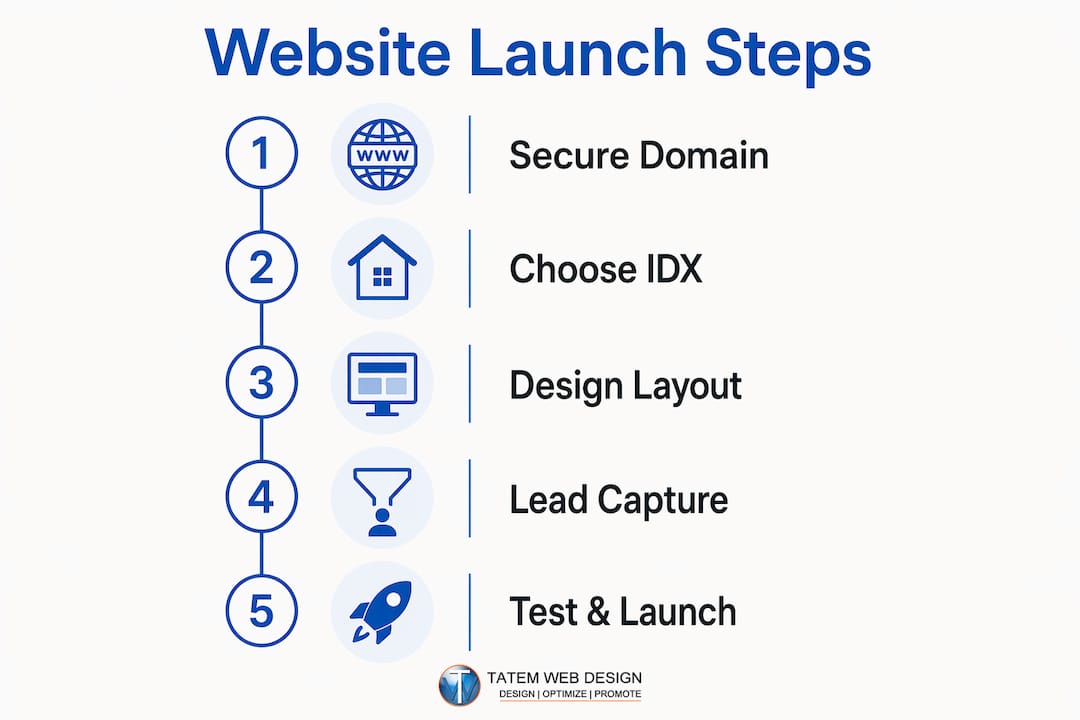
Step 1: Secure your domain and hosting. Choose a domain that includes your name or market area, such as yourname.com or stuartflhomes.com. Use a hosting provider that offers fast server response times and a content delivery network (CDN). Slow hosting is the single most common cause of poor Core Web Vitals scores.
Step 2: Select your IDX/MLS integration method. Florida has multiple MLS boards, including Stellar MLS, which covers most of the state. Confirm your IDX provider is approved by your specific MLS board before you build. Some providers offer WordPress plugins, while others use iFrame embeds. Plugin-based IDX is better for SEO because the content lives on your domain.
Step 3: Design your layout with clear navigation. Your main navigation should include Listings, Neighborhoods, About, and Contact at minimum. Buyers should reach a property search from any page in two clicks or fewer. Florida real estate web design that follows clear navigational flow keeps visitors on site longer and reduces bounce rates.
Step 4: Build your core pages. Every Florida real estate site needs these pages:
| Page | What to Include |
|---|---|
| Agent bio | Professional photo, credentials, local market expertise, and a contact form |
| Neighborhood pages | Local stats, school info, lifestyle content, and embedded listing search |
| Listings | IDX-powered search with filters, map view, and saved search option |
| Contact | Phone, email, booking calendar, and a short lead capture form |
| Home valuation | Instant estimate tool or a form to request a comparative market analysis |
Step 5: Configure lead capture and CRM notifications. Connect every form to your CRM. Set up SMS and email alerts so you receive a notification the instant a lead submits. Instant lead notification systems via SMS and email APIs multiply conversion rates by enabling rapid agent follow-up. Speed is the competitive advantage here.
Step 6: Test before you launch. Run Google PageSpeed Insights on your homepage and a sample listing page. Check every form on a real mobile device, not just a browser simulator. Confirm all disclosures appear in the footer and that your brokerage logo is visible on the homepage. Test your booking calendar end-to-end by submitting a real appointment request.
Hyper-local neighborhood pages targeting specific communities outperform broad keyword strategies in both SEO rankings and lead quality. Build one page per neighborhood you serve, and update it with fresh market data quarterly.
Common mistakes that hurt Florida real estate websites
Most real estate website problems fall into a predictable set of categories. Knowing them in advance saves you time, money, and lost leads.
- Slow load speeds. Users form opinions of business sites in 0.05 seconds. A slow site signals an unprofessional operation to affluent buyers before they read a single word. Compress images, minify CSS and JavaScript, and use a CDN.
- Hidden or missing brokerage branding. Florida MLS rules and state law require your brokerage name and logo to appear prominently. Hiding them to look like an independent agent is a compliance violation that can cost you your IDX feed.
- Non-compliant lead forms. Contact forms that collect personal data without a privacy policy link or consent checkbox violate 2026 privacy regulations. Lead generation must evolve beyond simple contact forms to privacy-compliant consent models and instant agent notifications.
- Poor touch targets and layout instability. Buttons that are too small and images that shift as the page loads destroy the mobile experience. Fix these with proper CSS sizing and skeleton loaders.
- Delayed lead notifications. If your CRM sends a lead digest email once a day, you are losing business. Set up real-time SMS alerts so you can respond within five minutes.
- No analytics setup. Without Google Analytics 4 and Google Search Console connected, you cannot see where visitors drop off or which pages drive the most leads. Set these up before launch, not after.
“The agents who win online are not the ones with the most beautiful websites. They are the ones whose sites load fast, capture leads instantly, and follow up before the competition even knows a prospect exists. Every technical shortcut you take costs you a client.”
What I have learned building real estate sites in Florida
After years of working with Florida agents and brokers on their digital presence, one pattern stands out above everything else. The agents who own their domain and their platform control their business. Agents who rely entirely on third-party portal profiles are renting their audience. The moment that platform changes its algorithm or its pricing, their lead flow disappears.
Hyper-local content is the most underused advantage in Florida real estate SEO. A page dedicated to Hobe Sound waterfront properties or Stuart historic district homes will outrank a generic “Florida homes for sale” page every time. Buyers searching for specific neighborhoods are further along in their decision process and convert at much higher rates. Build those pages first.
Mobile conversions are a technical problem, not a design problem. I have seen beautifully designed sites that converted terribly because their LCP was 4 seconds on a phone. Fixing Core Web Vitals is not glamorous work, but it is the highest-return improvement most agents can make. Check your essential website features against current benchmarks at least twice a year.
Compliance and branding are not bureaucratic annoyances. They are the foundation of trust. A buyer who sees a properly branded, professionally disclosed site feels more confident about the agent behind it. That confidence converts. Treat your disclosures as a signal of professionalism, not a legal checkbox.
— Matt
Tatemweb’s AI-powered web design for Florida real estate professionals
Florida real estate agents who want a site that performs from day one work with Tatemweb. Based in Stuart, Florida, Tatemweb builds AI-powered real estate websites that include IDX integration, mobile-first design, and instant lead capture automation built in from the start.
Tatemweb’s team handles brokerage branding compliance, Core Web Vitals optimization, and AI chatbot and lead capture setup so your site works the moment it goes live. Their AI email marketing integration keeps leads warm automatically, so no prospect goes cold while you are in the field. Call Tatemweb directly at 772-224-8118 to schedule a consultation and see what a properly built Florida real estate site can do for your business.
FAQ
What is the most important feature of a real estate website?
IDX/MLS integration is the most critical feature. It displays live listings directly on your site, keeps buyers engaged, and signals local market relevance to search engines.
How fast should a real estate website load on mobile?
Target a Largest Contentful Paint (LCP) of under 1.5 seconds for top pages and under 2.5 seconds for listing pages. These benchmarks align with Google’s Core Web Vitals standards for 2026.
What disclosures are legally required on a Florida real estate website?
Florida agents must display their brokerage logo prominently on landing pages and include Fair Housing statements and license numbers in the footer. Missing these can result in MLS penalties or IDX feed revocation.
How quickly should I respond to website leads?
Respond within five minutes. Lead conversion rates increase 8x when agents contact new leads within the first five minutes of form submission, making instant SMS and email alerts non-negotiable.
Do I need a privacy policy on my real estate website?
Yes. Any site that collects personal data through contact or lead forms must include a privacy policy, a cookie consent banner, and a preference center to meet 2026 regulatory requirements.
Key Takeaways
A Florida real estate website converts visitors into clients only when IDX integration, mobile performance, instant lead capture, and legal compliance work together from the start.
| Point | Details |
|---|---|
| IDX integration is non-negotiable | Live MLS listings on your domain keep buyers engaged and improve local SEO rankings. |
| Mobile performance drives conversions | Hit LCP under 2.5 seconds and CLS under 0.1 to capture the 70% of buyers on mobile. |
| Lead speed determines win rate | Respond within five minutes of form submission to achieve up to 8x higher conversion rates. |
| Compliance protects your license | Display brokerage logos, Fair Housing statements, and license numbers on every page. |
| Hyper-local pages outperform broad keywords | Neighborhood-specific pages attract higher-intent buyers and rank faster in Florida markets. |
Recommended
Tatem Web Design
26+ YearsWeb Design & SEO Specialist · Tatem Web Design
Matt Tatem has been designing websites professionally since 1999, making Tatem Web Design one of Florida's longest-running web agencies. Based in Stuart, FL, he specializes in WordPress, local SEO, Shopify e-commerce, and cybersecurity consulting for small businesses.

Rank in ChatGPT in 90 Days With a Practitioner Led Checklist
Follow a practitioner led 90 day plan to get cited by ChatGPT: allow OAI-SearchBot, publish short answer capsules with schema, and track Bing AI Performance.

AI SEO Content Playbook: 16 GEO Signals for Agencies & Teams
A practical playbook mapping the GEO-16 signals to hands-on editorial workflows, review controls, and metrics. For agencies and in-house teams scaling AI...

Copy Ready Local Schema Markup for SMBs + Google Validation
Copy ready JSON-LD examples and Google validation steps for SMBs' local schema markup. Audit, implement, and verify each location page with confidence.