
The Role of Digital Agencies in Business Growth: 2026 Guide
Digital agencies exist to do one thing: grow your business through measurable online performance. They manage the channels, tools, and strategies that drive traffic, generate leads, and convert visitors into paying customers. Digital channels now account for the majority share of total marketing spend, according to Gartner’s 2025 research, which tells you exactly where the competition is playing. If your business is not showing up and performing in those channels, you are already behind.
The role of digital agencies spans far more than running ads or posting on social media. A full-service agency brings together technical SEO experts, paid media managers, content strategists, conversion rate optimization specialists, and data analysts under one roof. You get an entire marketing department without the overhead of hiring, training, and managing each person individually.
Here is what that means practically for a business owner:
- Traffic generation through SEO, paid search, and social media advertising
- Lead capture and conversion via landing pages, email sequences, and AI chatbots
- Brand visibility through content marketing, video, and social media management
- Performance tracking with analytics dashboards, KPI reporting, and campaign optimization
- Technical infrastructure including web development, hosting, and cybersecurity compliance
Tatemweb, based in Stuart, Florida, with over 26 years of experience, is one example of a full-service agency that combines all of these functions with AI-powered tools built specifically for local business growth.

What core services do digital agencies actually deliver?
The functions of digital agencies fall into a few distinct categories, each tied directly to a measurable business outcome. Understanding what each service does helps you evaluate whether an agency’s offering matches your actual growth needs.
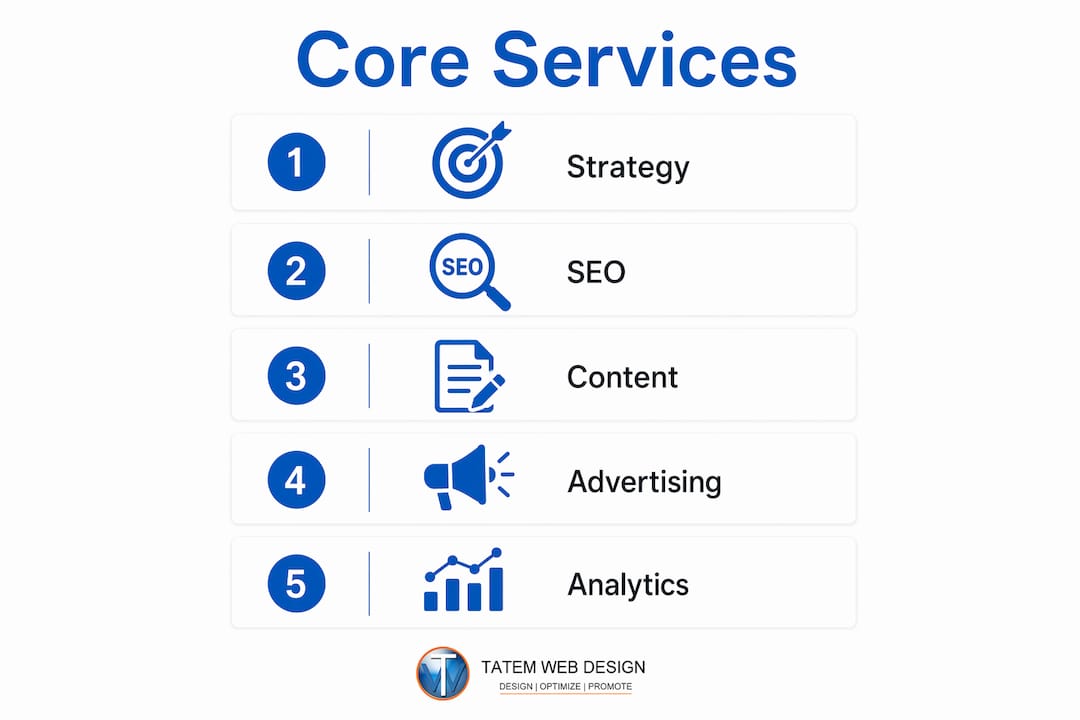
Agencies provide a full department of specialists rather than a single generalist, which is the structural advantage most business owners underestimate. Here is a breakdown of the core services:
- Search engine optimization (SEO): Technical audits, keyword strategy, on-page optimization, and link building to improve organic search rankings and drive qualified traffic
- Pay-per-click advertising (PPC): Paid campaigns on Google, Meta, and other platforms, managed for maximum return on ad spend (ROAS)
- Content marketing: Blog posts, landing pages, video scripts, and email copy that attract and nurture prospects through the buying journey; content strategies for small businesses are a core agency deliverable
- Social media management: Platform strategy, content calendars, community engagement, and paid social campaigns
- Web design and development: Building and maintaining websites optimized for speed, user experience, and conversion
- Email marketing: Automated sequences, newsletters, and behavioral triggers that keep your audience engaged
- Analytics and reporting: Tracking KPIs like customer acquisition cost (CAC), customer lifetime value (CLV), and conversion rates, not just vanity metrics like page views
- Conversion rate optimization (CRO): Testing headlines, layouts, and calls to action to improve the percentage of visitors who take action
- Local SEO: Managing your Google Business Profile, local citations, and geo-targeted campaigns for location-based businesses
Each of these services connects back to a specific business goal. An agency’s job is not to run campaigns in isolation but to coordinate them into a single strategy that moves the needle on revenue.
How do different types of digital agencies compare?
Not every agency is built the same way, and choosing the wrong type is one of the most common and costly mistakes business owners make; for guidance, see this resource on come scegliere la web agency giusta a Bari. The distinctions matter because they determine what outcomes you can realistically expect.
Full-service digital agencies handle everything from web development and SEO to paid advertising and content production. They are the best fit for small to midsize businesses that need an entire marketing function built from the ground up. You get one team, one strategy, and one point of accountability.

Boutique and niche specialist agencies go deep on one or two disciplines, such as technical SEO or conversion rate optimization. If you already have a solid marketing foundation and need expert help in a specific area, a boutique agency delivers focused attention that a larger shop might not.
Digital marketing agencies are performance-focused, driving traffic, leads, and conversions through SEO, paid ads, and content marketing. Their measurement framework centers on ROAS, cost per lead (CPL), and conversion rates.
Digital creative agencies start from the same digital foundation but layer in brand strategy, creative concepting, and production. They are the right call when your brand needs to be built or refreshed alongside your performance channels, because they treat brand and performance as one conversation rather than two separate tracks.
Digital ad agencies specialize specifically in paid advertising, managing and optimizing campaigns across platforms like Google Ads, Meta, and programmatic networks. They are a strong fit when your brand is established and you need to scale paid acquisition efficiently.
Here is a quick comparison to guide your decision:
| Agency Type | Primary Focus | Best For |
|---|---|---|
| Full-service digital agency | All channels, strategy to execution | SMBs needing a complete marketing department |
| Boutique/niche specialist | Deep expertise in one area | Businesses with a gap in a specific discipline |
| Digital marketing agency | Performance metrics: SEO, PPC, content | Scaling an established brand’s digital presence |
| Digital creative agency | Brand strategy plus performance | Launching, refreshing, or repositioning a brand |
| Digital ad agency | Paid advertising campaigns | Maximizing paid acquisition at scale |
Why do businesses benefit from hiring a digital agency?
The benefits of hiring a digital agency go well beyond convenience. The real case for outsourcing is built on access, efficiency, and the kind of objective decision-making that is nearly impossible to maintain when you are too close to your own business.
Agencies give you access to advanced tools like AI-driven analytics platforms, automation software, and programmatic advertising systems that most small businesses cannot afford to license individually. The full suite of necessary software, from enterprise SEO tools to CRM integrations, can easily cost over $10,000 per year for a single in-house person. An agency absorbs that cost and delivers the insight.
Cost efficiency is the other side of that equation. Outsourcing to an agency eliminates overhead tied to salaries, benefits, training, and recruitment. For small to midsize businesses, this means accessing a team of specialists for roughly the same investment as one mid-level in-house hire.
Beyond cost, the strategic advantages are where agencies really separate themselves:
- Objectivity: An agency looks at your data without emotional attachment. If your favorite landing page has a poor conversion rate, they will say so and fix it.
- Scalability: You can ramp campaigns up for a product launch or peak season without hiring and firing staff.
- Fresh perspective: A third party sees your business the way your customers do, which often surfaces opportunities your internal team has stopped noticing.
- Transparent reporting: Good agencies track CLV, CAC, and conversion rates, not just impressions. You see exactly what your investment is producing.
- Focus: With marketing handled, you get your time back to run the business, develop products, and serve customers.
Stat to know: Monthly retainers for digital marketing agencies commonly range from $2,500 to $15,000 for small to midsize businesses, depending on scope, industry, and agency expertise.
How do you choose the right digital agency for your business?
Choosing a digital agency is one of the most consequential decisions a business owner makes. The wrong choice costs you time, money, and market position. The right one accelerates everything.
Start with clarity on what you actually need. If your website is underperforming, you need web development and SEO. If leads are coming in but not converting, you need CRO and email automation. Matching your specific gap to an agency’s core strength is the first filter. A resource like this agency selection guide walks through the evaluation criteria in practical terms.
Look for flexible engagement terms, transparent reporting, and case studies relevant to your industry. An agency that cannot show you results in a comparable business context is asking you to fund their learning curve.
Here are the key selection criteria to apply:
- Services alignment: Does the agency offer exactly what your business needs, not a padded bundle of services you will never use?
- Proven track record: Ask for case studies with specific metrics, industry context, and conversion data, not just traffic increases.
- Communication clarity: Will you have a dedicated account manager? How often do you receive reports? What does the reporting actually show?
- Cultural fit: You will work closely with this team. Their values, communication style, and pace need to match yours.
- Contract terms: Avoid agencies requiring 12-month lock-ins before they have demonstrated value. Look for 30-day or 90-day exit options.
- Specialization match: A local service business in Florida needs a local SEO specialist, not a global e-commerce PPC firm.
Red flags to watch for: vague performance promises, generic case studies without industry or budget context, and agencies that lead with deliverables rather than outcomes.
Pro Tip: Ask any agency candidate how their PPC team coordinates with your sales team to handle lead flow. The answer reveals whether they think in silos or in systems.
Why do agencies outperform in-house teams through pattern recognition?
The single most underappreciated advantage of working with a digital agency is what practitioners call pattern recognition. An agency team is not just learning from your campaigns. They are simultaneously running campaigns across dozens of clients in different industries, and that cross-pollination of data accelerates their decision-making in ways an in-house team simply cannot replicate.
When an agency sees a particular ad format underperform across three different e-commerce clients in the same quarter, they know not to test it on your account. When they identify a content structure that consistently drives qualified leads in the legal sector, they apply that learning to your law firm’s blog before you even ask. This is the difference between experience and expertise.
The practical impact shows up in a few specific ways:
- Faster optimization cycles: Agencies identify what is not working sooner because they have seen the pattern before.
- Competitive intelligence: They can audit your top competitors’ keyword strategies, content gaps, and ad spend patterns, and build a plan to outrank them from day one.
- Error prevention: Costly mistakes, like targeting the wrong audience segment or bidding on high-volume keywords with low purchase intent, get caught before the budget is spent.
- Cross-industry application: Tactics proven in one vertical often transfer to another. A conversion strategy that works for a dental practice may work equally well for a law firm.
Pro Tip: When you onboard a new agency, ask them to walk you through a competitor audit before the first campaign launches. The insights they surface in that audit reveal both their analytical depth and the specific opportunities your business has been missing.
Agencies also reduce the risk tied to employee turnover. When a key in-house marketer leaves, institutional knowledge walks out the door. An agency’s team structure means your campaigns keep running, your strategy stays intact, and you are not starting over with a new hire.
What trends are shaping digital agencies in 2026?
The agency model is changing faster in 2026 than at any point in the past decade. AI is the primary driver, and the agencies that have built AI into their core workflows are producing results that manual processes cannot match.
AI-powered tools now handle content generation, SEO audits, ad creative testing, and lead capture autonomously. Agencies using these tools can launch campaigns faster, test more variables simultaneously, and deliver reporting that updates in real time rather than monthly. For business owners, this means shorter time-to-results and more granular data on what is actually driving revenue.
A few trends worth tracking:
- AI-generated content at scale: Agencies are using large language models to produce SEO content, email sequences, and ad copy at a pace that would have required three times the staff two years ago.
- AI chatbots and lead capture: Automated chat tools now qualify leads, book appointments, and answer customer questions around the clock without human intervention.
- Hyper-local targeting: Geo-fencing and local SEO have become primary growth levers for service-based businesses, especially in competitive markets like South Florida.
- First-party data strategy: With third-party cookies largely phased out, agencies are building email lists, CRM integrations, and owned audience channels as the foundation of long-term marketing performance.
- Performance-plus-brand integration: The gap between performance marketing and brand building is closing. Agencies that can run paid campaigns and produce brand-coherent creative from the same strategic foundation are winning more business.
Tatemweb’s AI-powered services reflect exactly this direction, combining AI website design, AI chatbots, local SEO, and cybersecurity compliance into one integrated offering for Florida businesses.
What challenges come with working with a digital agency, and how do you handle them?
Working with a digital agency is not without friction. Knowing the common challenges in advance puts you in a position to address them before they cost you time or money.
Misaligned expectations are the most frequent source of frustration. An agency may define success as increased traffic while you define it as closed sales. Fix this at the start by agreeing on specific KPIs, reporting cadence, and what “good” looks like at 30, 60, and 90 days.
Communication gaps happen when there is no clear point of contact or when reporting is infrequent and vague. Require a dedicated account manager, weekly or biweekly check-ins, and reports that show conversion data alongside traffic metrics.
Loss of control is a real concern, particularly for business owners who have managed their own marketing. The solution is not to micromanage but to stay involved at the strategy level. Review campaign briefs before launch, approve messaging, and hold monthly strategy reviews.
Slow onboarding can delay results by weeks. Prepare a thorough brief before the agency starts: your brand guidelines, past campaign data, customer personas, and competitive context. Agencies that receive a complete brief on day one move faster and make fewer assumptions. Resources like buyer persona development can help you prepare that brief effectively.
Vendor lock-in is a structural risk with agencies that require long contracts before proving value. Negotiate shorter initial terms with performance benchmarks built in.
How much do digital agencies charge, and what pricing models exist?
Agency pricing varies widely, and understanding the models helps you budget accurately and avoid surprises.
Monthly retainers for small to midsize businesses typically vary widely, depending on the scope of services, the agency’s expertise level, and your industry’s competitive intensity. A retainer covers ongoing work across multiple channels and is the most common model for businesses that need continuous marketing support.
Project-based fees apply to defined deliverables like a website redesign, a brand audit, or a one-time SEO overhaul. This model works well when you have a specific need and a fixed budget.
Performance-based pricing ties a portion of the agency’s fee to results, such as a percentage of ad spend managed or a fee per qualified lead generated. This model aligns incentives but requires clear definitions of what counts as a result.
Hourly consulting is less common for ongoing work but useful for audits, strategy sessions, or specialized technical work like HIPAA compliance consulting or CMMC Level 2 assessments.
A few factors that push pricing higher: competitive industries like legal, healthcare, and real estate; multi-channel campaigns requiring coordination across SEO, PPC, and social; and custom AI integrations or cybersecurity compliance work. Agencies that offer AI-built websites or advanced automation tools may charge a premium, but the speed and performance gains typically justify the investment.
When evaluating cost, compare the total against what you would spend hiring, training, and equipping an in-house team. For most small to midsize businesses, the agency model delivers more capability at lower total cost.
Work with Tatemweb to put your digital presence to work
Tatemweb has spent over 26 years helping Florida businesses grow through web design, digital marketing, and AI-powered business solutions. From AI website design and local SEO to AI chatbots, lead capture tools, and cybersecurity compliance, Tatemweb builds and manages the digital infrastructure that drives real business results. Call 772-224-8118 to schedule a consultation and find out exactly what your business is leaving on the table.
Key Takeaways
Digital agencies deliver the most value when you match their specific capabilities to your actual business gaps, from performance marketing and AI tools to brand strategy and compliance.
| Point | Details |
|---|---|
| Digital spend is dominant | Digital channels account for 61.1% of total marketing spend, making agency expertise a practical necessity. |
| Agencies replace entire departments | You get technical SEO, PPC, content, and CRO specialists without hiring each role individually. |
| Pricing ranges widely | Monthly retainers for SMBs commonly vary widely depending on scope and expertise. |
| Pattern recognition accelerates results | Agencies apply cross-client learnings to prevent costly mistakes and optimize campaigns faster. |
| Agency type must match your need | Full-service agencies suit SMBs building from scratch; niche specialists fit businesses with a targeted gap. |
FAQ
What is the role of a digital agency?
A digital agency manages your online marketing channels, including SEO, paid advertising, content, and web development, to drive traffic, generate leads, and convert visitors into customers. Their core function is measurable business growth through digital performance.
What is a digital services agency?
A digital services agency is a broader term for a company that provides web-based business solutions, which can include digital marketing, web design, software development, cybersecurity, and AI integration, depending on the agency’s scope.
What is the difference between a digital agency and a creative agency?
A digital marketing agency focuses on performance metrics like ROAS, CPL, and conversion rates through channels like SEO and paid ads. A creative agency specializes in brand strategy, graphic design, and visual production, and typically does not offer web development or performance marketing.
How much does a digital agency typically cost?
Monthly retainers for small to midsize businesses commonly range from $2,500 to $15,000, with pricing driven by service scope, industry competition, and agency expertise level.
When should a business hire a digital agency?
Hire a digital agency when your internal team lacks the specialized skills to compete in your market, when growth has stalled despite marketing effort, or when you need to scale campaigns faster than your current resources allow.
Recommended
Tatem Web Design
26+ YearsWeb Design & SEO Specialist · Tatem Web Design
Matt Tatem has been designing websites professionally since 1999, making Tatem Web Design one of Florida's longest-running web agencies. Based in Stuart, FL, he specializes in WordPress, local SEO, Shopify e-commerce, and cybersecurity consulting for small businesses.

Rank in ChatGPT in 90 Days With a Practitioner Led Checklist
Follow a practitioner led 90 day plan to get cited by ChatGPT: allow OAI-SearchBot, publish short answer capsules with schema, and track Bing AI Performance.

AI SEO Content Playbook: 16 GEO Signals for Agencies & Teams
A practical playbook mapping the GEO-16 signals to hands-on editorial workflows, review controls, and metrics. For agencies and in-house teams scaling AI...

Copy Ready Local Schema Markup for SMBs + Google Validation
Copy ready JSON-LD examples and Google validation steps for SMBs' local schema markup. Audit, implement, and verify each location page with confidence.