
Choosing a Web Agency That Drives Real Results
Most small business owners approach hiring a web agency the same way they’d order a logo from a freelancer — show me what it looks like, tell me the price, and let’s move on. That mindset costs businesses more money than almost any other digital mistake. A web agency worth your investment isn’t a vendor that delivers a pretty website. It’s a strategic partner that translates your business goals into a digital asset that generates leads, protects customer data, and keeps performing months after launch. This guide gives you the framework to find one that actually delivers.
Table of Contents
- Key takeaways
- What a modern web agency actually does
- How to choose the right web agency
- What to expect from professional website design services
- Leveraging digital marketing and security together
- My honest take on what SMBs get wrong
- How Tatemweb can help your business grow
- FAQ
Key takeaways
| Point | Details |
|---|---|
| Agencies do more than design | A professional web agency covers SEO, security, performance, and digital marketing, not just visual design. |
| Budget beyond the build | Factor in ongoing maintenance, content updates, and marketing costs to realize long-term ROI. |
| Vet with a discovery phase | Request a prototype or discovery engagement before committing to a full project. |
| Demand measurable KPIs | Track leads, conversions, and Core Web Vitals to evaluate agency performance objectively. |
| AI is changing the standard | Agencies integrating AI tools for security, SEO, and content now deliver faster and more competitive results. |
What a modern web agency actually does
There is a persistent misconception that hiring a web agency means hiring someone to make your website look better. The reality is far more expansive. A professional web agency serves as a strategic business advisor, translating commercial objectives into digital products that are usable, accessible, and fast.
Think about what that actually means in practice. When a dental practice in Stuart, Florida wants more appointment bookings, the agency’s job isn’t to design a nice homepage. It’s to map the patient journey from search query to confirmed appointment, identify friction points, and build a system that converts. That requires expertise across several disciplines working together.
Here is what a full-service web agency should bring to the table:
- SEO strategy: Clean site architecture, semantic HTML, internal linking, and redirect management to protect rankings during any site migration or redesign.
- UX and UI design: User experience decisions grounded in how your specific audience behaves, not personal aesthetic preferences.
- Performance optimization: Core Web Vitals standards guiding image formats, lazy loading, and caching to keep pages fast.
- Security protocols: Vulnerability assessments, SSL configuration, access controls, and a governance plan for ongoing hardening.
- Content strategy: Editorial planning, keyword mapping, and copywriting that speaks to your buyers rather than to search engines in isolation.
- Digital marketing integration: Connecting your website to paid search, social campaigns, and email automation so every channel reinforces the others.
The best agencies also establish measurable KPIs tied directly to business outcomes. Marketing-qualified leads, conversion rates by page, and cost per acquisition are the numbers that matter. Not page views.
Pro Tip: Ask any agency you interview to show you a before-and-after performance report from a past client. If they cannot produce one, they are likely not tracking the metrics that matter to your business.
Cross-functional teams working together daily — rather than designers handing off to developers who hand off to marketers — reduce errors and produce websites that are easier to maintain. When you are evaluating agencies, ask how their internal teams are structured. The answer tells you a lot about the quality of what they will deliver.
How to choose the right web agency
Picking the wrong agency is expensive. Not just in dollars paid upfront, but in lost time, missed leads, and the cost of fixing a poor build six months later. Here is a structured process for making a confident decision.

1. Define your goals before making any calls. Be specific. “We want more website traffic” is not a goal. “We want to increase inbound leads from organic search by 30% in six months” is. Agencies can only give you an accurate scope and proposal when they understand what success looks like for your business.
2. Set a realistic budget that includes the full lifecycle. Most SMBs budget for the build and forget everything else. Ongoing maintenance, SEO, and marketing are not optional extras. They are the difference between a website that grows your business and one that depreciates from the day it launches. A managed website maintenance plan is not overhead. It is protection for your investment.
3. Review portfolios with a critical eye. Anyone can show you a website that looks good in a screenshot. Dig deeper. Ask about the measurable outcomes the project delivered. Look for work in your industry or in industries with similar conversion challenges. A law firm’s website and a dental practice’s website have different goals, different compliance considerations, and different user behaviors.
4. Ask about process, governance, and constraints. Agencies that are transparent about trade-offs regarding timelines, legacy system limitations, and compliance requirements are the ones worth trusting. If an agency promises everything with no caveats, that is a red flag, not a selling point.
5. Request a discovery or prototype phase. Before you commit to a full build, a well-structured discovery engagement helps both sides align on scope, uncover hidden constraints, and produce a prototype you can evaluate objectively. Professional builds can be completed in as little as four weeks once scope is clear. Discovery is what makes that possible.
Here is a quick comparison of what separates a transactional agency from a strategic partner:
| Factor | Transactional agency | Strategic partner |
|---|---|---|
| Project scope | Design and launch only | Design, launch, optimize, and grow |
| KPIs tracked | Page views, bounce rate | Leads, conversions, revenue impact |
| Communication style | Updates only at milestones | Regular reporting and strategic reviews |
| Security approach | Basic SSL setup | Ongoing governance and compliance |
| Post-launch support | Optional add-on | Built into the engagement |
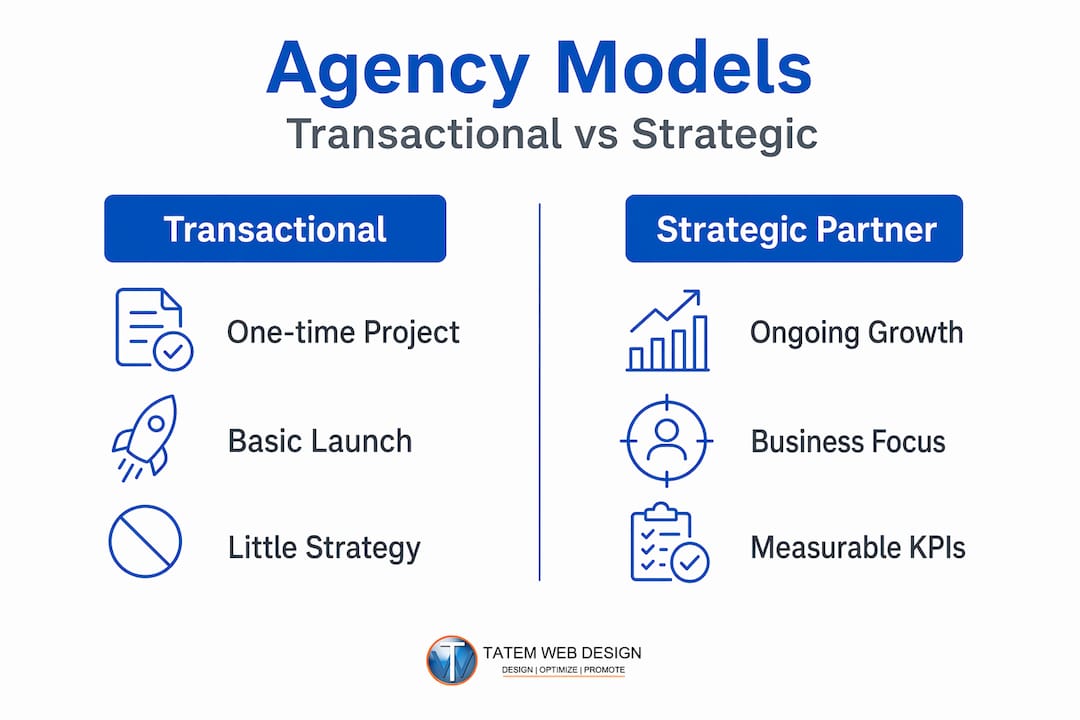
The agencies worth working with treat your website as a living business asset. The ones to avoid treat it as a deliverable they can invoice and forget.
What to expect from professional website design services
Once you have selected an agency, you need to know what a quality website build actually includes. Understanding these standards helps you hold your agency accountable and recognize whether you are getting full value.
Here are the core components that any reputable web design service should deliver:
- Mobile-first design: Accessibility following WCAG 2.2 AA guidelines is not just a legal safeguard. It expands your reach to users with disabilities and improves SEO performance simultaneously.
- SEO-embedded architecture: Clean architecture with semantic HTML, structured headings, and proper redirect management should be standard practice, not optional upgrades.
- Performance budgets: Every page should be built against defined performance targets. Fast pages convert better, rank higher, and reduce bounce rates. This is not debatable.
- Security governance: Your agency should deliver a post-launch governance plan that includes automated checks for vulnerabilities, software updates, and security hardening. Not just a one-time setup.
- CMS fit and team training: Whether you use WordPress, Joomla, or Drupal, your team should be trained to manage content without breaking anything. Governance and training on CMS workflows are what protect your SEO rankings after the agency steps back.
A well-designed responsive web design process also accounts for the way different industries present information. A real estate agency needs property search functionality and neighborhood content. A healthcare provider needs HIPAA-compliant forms and clear patient pathways. Off-the-shelf templates rarely handle these requirements without significant custom work.
Pro Tip: Before your site launches, ask your agency for a documented performance benchmark showing your Core Web Vitals scores and a security audit report. These two documents give you a baseline you can measure future performance against.
The website design services you invest in should deliver a site that performs well on day one and continues to perform with regular optimization. Anything less is not a finished product. It is a starting point that will cost you more to maintain than a properly built site would have cost upfront.
Leveraging digital marketing and security together
A well-built website with no promotion is like opening a store and not telling anyone where it is. The agencies that deliver the best long-term ROI for SMBs are the ones that treat digital marketing and security as core parts of the service, not optional bolt-ons.
Here is how those services layer together to protect and grow your business:
-
Search engine optimization (SEO) and content: Ongoing SEO is not a one-time setup. Search algorithms change, competitors publish new content, and your own site’s authority decays without regular updates. Agencies that build content calendars and track keyword rankings as part of their ongoing engagement will consistently outperform those that treat SEO as a launch activity.
-
Pay-per-click (PPC) advertising: Organic search takes time to build. PPC gives you immediate visibility while your SEO compounds. The key is having an agency that connects ad spend to actual revenue data, not just click counts.
-
Social media management: For most SMBs, social media serves two functions: brand credibility and remarketing. Visitors who see your brand on social channels after visiting your website convert at significantly higher rates than cold traffic.
-
Security enhancements and compliance: Data breaches are not just a large enterprise problem. SMBs are frequently targeted precisely because their defenses tend to be weaker. An agency with genuine cybersecurity expertise will implement firewalls, perform regular vulnerability scans, manage software updates, and help you meet compliance requirements for your industry. Healthcare practices need HIPAA compliance. Any business handling payment data needs PCI standards. These are not optional.
-
AI-driven tools for marketing and security: AI-driven marketing and security solutions are becoming genuine differentiators for agencies serving SMBs. AI-powered chatbots handle lead capture around the clock. Automated content tools accelerate publishing schedules. AI security monitoring catches anomalies before they become breaches. Businesses that adopt these tools through a capable agency gain a real competitive advantage.
Updating your website content regularly also plays a direct role in maintaining search visibility and user engagement. Static sites lose ground over time. The agencies that build update workflows into their client relationships are the ones whose clients see compounding results.
My honest take on what SMBs get wrong
I’ve worked with dozens of small and medium-sized businesses over the years, and the pattern I see most often is this: business owners spend more time evaluating the color palette than the governance plan. They ask about the font choices and forget to ask who is responsible for security updates six months after launch.
The agencies that have the most satisfied long-term clients are not always the ones with the prettiest portfolios. They are the ones that ask hard questions upfront, build in clear responsibilities, and treat the post-launch period as part of the project rather than the end of it.
I’ve also seen businesses over-invest in features and under-invest in training. A custom web design with 12 unique page templates and three API integrations sounds impressive until your team can’t update a blog post without breaking the layout. Ongoing governance plans and proper CMS training are where long-term ROI actually lives, not in the launch-day demo.
One more thing worth saying plainly: budget conversations are uncomfortable, but they are necessary. The agencies that let you discover hidden costs after a contract is signed are not partners. If an agency cannot give you a clear picture of what ongoing maintenance, SEO, and marketing will cost upfront, treat that as a serious warning sign. Setting a clear budget and understanding your full cost structure from day one is the single most practical thing you can do before signing anything.
The best partnerships I’ve seen share one thing in common: both sides show up to every review with business data, not just website metrics. When the conversation stays focused on revenue, leads, and real business outcomes, the relationship produces results. When it drifts into design opinions and vanity metrics, it tends to drift apart.
— Matt
How Tatemweb can help your business grow
If you are an SMB in Florida looking for a web agency that works the way this article describes, Tatemweb has been delivering exactly that for over 26 years. Their team builds AI-optimized websites tailored to your industry, with SEO, performance, and security built into the architecture from the start, not layered on after launch.
Tatemweb’s service portfolio covers every stage of your digital presence. From AI-powered cybersecurity solutions and compliance consulting for healthcare and legal clients, to AI email marketing automation that keeps your leads engaged without adding to your team’s workload. Their full digital marketing services include local SEO, PPC management, AI chatbot implementation, and content creation built to convert.
What makes them different from a typical web design shop is the depth of their ongoing support. They don’t hand off a finished site and disappear. They build governance plans, train your team, and continue optimizing your site as your business grows. Call Tatemweb directly at 772-224-8118 to schedule a consultation and learn how AI-integrated solutions can give your business a measurable edge.
FAQ
What does a web agency do beyond building websites?
A full-service web agency provides SEO strategy, UX design, performance optimization, security governance, content creation, and digital marketing, all working together to grow your business. The best agencies track KPIs tied directly to revenue, not just traffic.
How much should I budget for a web agency partnership?
Your budget should cover the initial build plus ongoing costs for maintenance, SEO, and marketing. Treating the website launch as a final expense rather than the beginning of an investment is the most common reason SMBs fail to see ROI from their agency relationship.
How do I know if a web agency is the right fit for my business?
Review their portfolio for work in your industry or with similar conversion goals, ask for documented performance outcomes from past projects, and request a discovery phase before committing to a full build. Agencies that are transparent about trade-offs and costs upfront are the ones worth trusting.
Why is website security part of what a web agency should handle?
Security vulnerabilities in your website expose customer data, damage your reputation, and create legal liability. A professional web agency should deliver ongoing governance including automated security checks, software updates, and compliance support, particularly for industries like healthcare, legal, and e-commerce.
How long does it take to build a professional website?
With a clear scope established during discovery, professional website builds can be completed in approximately four weeks. Rushing this process without proper planning typically leads to scope creep, missed requirements, and post-launch fixes that cost more than doing it right the first time.
Recommended
Tatem Web Design
26+ YearsWeb Design & SEO Specialist · Tatem Web Design
Matt Tatem has been designing websites professionally since 1999, making Tatem Web Design one of Florida's longest-running web agencies. Based in Stuart, FL, he specializes in WordPress, local SEO, Shopify e-commerce, and cybersecurity consulting for small businesses.

Rank in ChatGPT in 90 Days With a Practitioner Led Checklist
Follow a practitioner led 90 day plan to get cited by ChatGPT: allow OAI-SearchBot, publish short answer capsules with schema, and track Bing AI Performance.

AI SEO Content Playbook: 16 GEO Signals for Agencies & Teams
A practical playbook mapping the GEO-16 signals to hands-on editorial workflows, review controls, and metrics. For agencies and in-house teams scaling AI...

Copy Ready Local Schema Markup for SMBs + Google Validation
Copy ready JSON-LD examples and Google validation steps for SMBs' local schema markup. Audit, implement, and verify each location page with confidence.