
Role of Ecommerce Stores in Florida SMB Growth
An ecommerce store is a digital storefront where businesses sell products or services online, giving customers 24/7 access while giving you direct control over pricing, branding, and customer data. The role of ecommerce stores in modern business has moved well beyond simple order processing. Today, platforms like Shopify, WooCommerce, and BigCommerce function as full sales and marketing engines. 93.5% of global internet users purchased products online as of early 2026. That number means your customers are already buying online. The question is whether they are buying from you.
What is the role of ecommerce stores for Florida SMBs?
The role of ecommerce stores, known in the industry as digital commerce platforms, is to extend your business reach beyond physical and geographic limits. A brick-and-mortar shop in Stuart, Florida serves customers who can drive to your door. An ecommerce store serves anyone in Florida, across the U.S., or around the world. That shift in reach is the single biggest structural advantage online retail offers small and medium-sized businesses.
For Florida SMBs specifically, this matters because the state’s economy is highly seasonal and tourism-driven. A marine supply shop in Fort Lauderdale, a dental products retailer in Tampa, or a real estate services firm in Miami all face the same challenge: local foot traffic fluctuates. An ecommerce store creates a revenue channel that does not depend on who walks through your door this week.

The importance of e-commerce also shows up in how it changes the competitive playing field. A small business with a well-built online store can compete directly with larger regional or national brands on product pages, search rankings, and customer experience. That was not possible with physical retail alone.
What are the key benefits of online stores for small businesses?
The benefits of online stores fall into three categories: cost reduction, operational flexibility, and brand control. Understanding each one helps you decide where to invest first.
Cost reduction compared to physical retail
Ecommerce eliminates fixed costs like rent, utilities, and large in-store staffing. Those savings are not trivial. A retail storefront in Palm Beach County can cost $3,000 to $8,000 per month in rent alone, before utilities, insurance, and staff. An ecommerce store shifts that spending toward technology and marketing, where every dollar is trackable and adjustable. Lower operational costs also allow you to price more competitively and reinvest savings into growth.
| Cost Category | Physical Store | Ecommerce Store |
|---|---|---|
| Monthly rent | $3,000–$8,000+ | $0 |
| Utilities | $500–$1,500/month | Minimal hosting fees |
| Staffing | Full-time floor staff required | Automated checkout, minimal support |
| Marketing reach | Local/regional | State, national, or global |
| Operating hours | Fixed (typically 8–10 hrs/day) | 24/7 automated sales |
Operational flexibility and scaling
Ecommerce enables SMBs to scale quickly by launching new products or entering new markets without physical constraints. A Florida landscaping supply company can add a new product line overnight. A healthcare products retailer can test a new category with zero shelf space risk. This flexibility is simply not available in traditional retail.
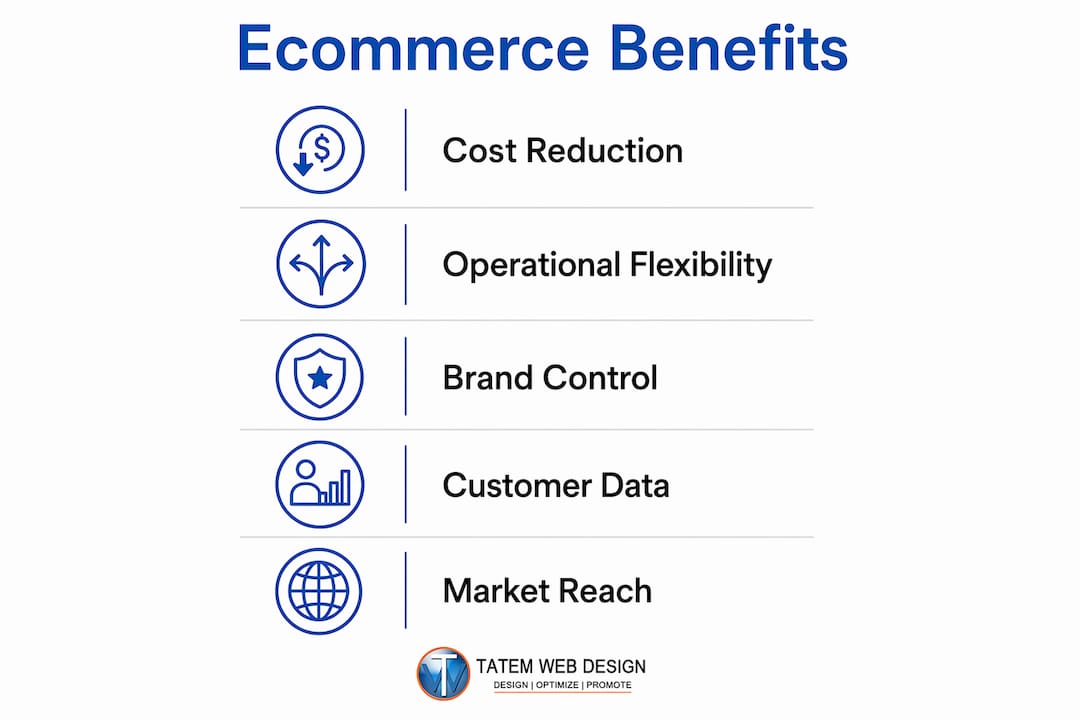
Brand control and customer data ownership
Ecommerce stores allow businesses to own their customer data and brand experience directly. When you sell through Amazon or Etsy, those platforms own the customer relationship. When you sell through your own store, you own the email list, the purchase history, and the ability to remarket. That data ownership is the foundation of long-term business independence.
Pro Tip: If you currently sell on third-party marketplaces, treat them as acquisition channels, not your primary store. Drive customers from those platforms to your own ecommerce site where you capture their data and control the relationship.
How do ecommerce stores impact consumer buying behavior?
How e-commerce changes retail is most visible in what customers now expect from every buying experience. Convenience is no longer a differentiator. It is the baseline. Shoppers expect to browse at midnight, compare products in seconds, and check out in under two minutes. If your store does not deliver that, they leave.
Online stores offer 24/7 access and remove geographic limits on sales. That availability directly shapes buying behavior. Customers who would never drive 45 minutes to your store will happily browse your product catalog at 10 p.m. on a Tuesday. The impact of online shopping on purchase frequency is real: removing friction from the buying process increases the number of transactions per customer per year.
Trust is the second major factor in consumer behavior online. Security and clear policies build consumer trust in ecommerce. Specifically, shoppers look for three things before completing a purchase:
- Secure payment processing (SSL certificates, recognized payment gateways like Stripe or PayPal)
- Transparent return policies written in plain language, not buried in fine print
- Responsive customer support through live chat, email, or phone
When those three elements are present, conversion rates improve and cart abandonment drops. When they are missing, even a well-designed store loses sales.
Personalization is the third driver of consumer behavior. Ecommerce platforms like WooCommerce and Shopify allow you to show returning customers relevant products based on past purchases. A customer who bought a kayak paddle from your Florida outdoor gear store should see kayak accessories on their next visit, not generic homepage banners. That kind of targeted experience builds loyalty faster than any loyalty card program.
Pro Tip: Add a live chat widget to your product pages. Studies consistently show that customers who engage with live chat convert at a higher rate than those who do not. Tools like Tidio or Intercom integrate directly with WooCommerce and Shopify.
What role does data play in ecommerce stores?
Ecommerce data is one of the most valuable assets a Florida SMB can own, and most businesses are not using it well. Every visit, click, add-to-cart action, and completed purchase generates information about what your customers want, when they want it, and how much they will pay. Customer interactions on ecommerce platforms generate granular behavior data that guides both product development and marketing strategy.
Here is how to put that data to work in four structured steps:
-
Track behavior with Google Analytics 4. Set up GA4 on your ecommerce store to monitor product page views, funnel drop-off points, and session sources. Understanding Google Analytics 4 for your business is the starting point for turning raw traffic data into sales decisions.
-
Segment your customer list by purchase history. Customers who bought once are different from repeat buyers. Treat them differently in your email campaigns. Repeat buyers respond to loyalty offers. First-time buyers need reassurance and social proof.
-
Integrate your inventory system with your store. Backend integration between inventory and ecommerce prevents overselling and protects customer trust. A customer who orders a product that is actually out of stock will not return. Platforms like Zoho Commerce and WooCommerce both support real-time inventory sync.
-
Connect your CRM to your ecommerce platform. A CRM like HubSpot or Zoho CRM linked to your store lets you see the full customer journey from first visit to repeat purchase. That visibility is what separates businesses that grow recurring revenue from those that constantly chase new customers.
| Data Type | What It Tells You | How to Use It |
|---|---|---|
| Page views per product | Which products attract interest | Prioritize in ads and SEO |
| Cart abandonment rate | Where buyers drop off | Trigger recovery emails |
| Repeat purchase rate | Customer loyalty level | Build loyalty campaigns |
| Traffic source | Where buyers come from | Allocate marketing budget |
| Average order value | Spending patterns | Create bundle offers |
Data collected by ecommerce stores only drives results when you actively use it for targeted marketing and customer segmentation. Collecting data without acting on it is the most common missed opportunity among Florida SMBs with online stores.
Pro Tip: Set up automated abandoned cart emails using Klaviyo or Mailchimp. Recovering even 10–15% of abandoned carts can add thousands of dollars in monthly revenue without spending a dollar on new traffic. Read more on abandoned cart recovery to see how it works in practice.
How do ecommerce stores boost online visibility in Florida?
Online visibility is not automatic. An ecommerce store only generates sales if customers can find it. Ecommerce SEO and product page optimization are the primary tools for improving search rankings and driving qualified traffic to your store.
For Florida SMBs, local SEO combined with ecommerce product optimization creates a powerful advantage. A plumbing supply company in Jacksonville that ranks on page one of Google for “commercial plumbing supplies Jacksonville” will capture buyers who are ready to purchase, not just browsing. That intent-driven traffic converts at a much higher rate than social media traffic.
The role of digital marketplaces like Google Shopping, Amazon, and Facebook Shops is to supplement your own store’s visibility, not replace it. Use those channels to attract new customers, then convert them to your own store where you control the relationship. Ecommerce for Florida SMBs requires a strategy that combines your own store with smart use of external platforms.
Practical visibility tactics that Florida businesses use effectively include:
- Product page SEO: Write unique title tags and meta descriptions for every product. Use keywords your Florida customers actually search for, including city and regional terms.
- Google Business Profile integration: Link your ecommerce store to your Google Business Profile so local searches surface your products directly.
- Email marketing automation: AI email marketing tools send targeted campaigns based on customer behavior, keeping your store top of mind between purchases.
- Social proof on product pages: Display verified reviews prominently. Florida consumers, like buyers everywhere, trust peer reviews more than brand claims.
- Site speed optimization: Google ranks faster sites higher. A one-second delay in page load time reduces conversions measurably. Use tools like Google PageSpeed Insights to identify and fix performance issues.
Pro Tip: Focus your first 90 days of ecommerce SEO on your top 10 best-selling products. Rank those pages well before spreading effort across your entire catalog. Depth beats breadth in early-stage ecommerce SEO.
Key Takeaways
Ecommerce stores give Florida SMBs a direct, data-driven sales channel that reduces fixed costs, builds customer relationships, and creates measurable competitive advantage in local and national markets.
| Point | Details |
|---|---|
| Cost advantage is real | Ecommerce eliminates rent and utilities, freeing budget for marketing and growth. |
| Data ownership drives revenue | Own your customer data through your store, not through third-party marketplaces. |
| Trust determines conversion | Secure payments, clear return policies, and live support directly increase sales. |
| SEO is your visibility engine | Product page optimization and local SEO bring high-intent Florida buyers to your store. |
| Backend integration prevents failure | Connecting inventory and CRM to your store stops overselling and builds repeat business. |
What I have learned after 26 years of ecommerce in Florida
Florida businesses have a specific challenge that most national ecommerce guides ignore: the market here is fragmented. You have retirees in Naples who prefer phone orders, tech-savvy professionals in Miami who expect a frictionless mobile checkout, and seasonal tourists in the Keys who buy once and never return. A single ecommerce template does not serve all of them.
The businesses I have seen succeed in Florida ecommerce share one trait: they treat their store as a living system, not a one-time project. They update product pages regularly, act on their analytics monthly, and test new offers constantly. The ones that struggle built a store, launched it, and then waited for sales to appear.
The other mistake I see repeatedly is over-reliance on marketplaces. Selling on Amazon or Etsy feels safe because the traffic is already there. But you are renting that audience. The moment Amazon changes its algorithm or a competitor undercuts your price by a dollar, your revenue disappears. Your own store, built on a platform like WooCommerce with proper SEO and email marketing, is an asset you own. That distinction matters more than most business owners realize until it is too late.
My honest advice: start with ecommerce advantages for small businesses as your framework, build your store on a platform you control, and invest in the data infrastructure from day one. The businesses that win in Florida ecommerce over the next three years will be the ones that own their customer relationships today.
— Matt
How Tatemweb builds ecommerce stores that perform for Florida businesses
Florida SMBs need more than a template store. They need a store built for search visibility, customer trust, and data-driven growth from the ground up.
Tatemweb has spent over 26 years building ecommerce solutions for Florida businesses across industries including healthcare, marine, real estate, legal, and professional services. Their custom ecommerce web design combines WooCommerce, AI-driven content creation, and built-in SEO optimization to deliver stores that rank and convert. Every store includes AI chatbot integration for lead capture, automated email marketing setup, and backend inventory management. If you are ready to build a store that works as hard as you do, call Tatemweb directly at 772-224-8118 or explore their AI services for Florida businesses to see what is possible.
FAQ
What is the primary role of an ecommerce store?
An ecommerce store serves as a digital sales channel that gives businesses 24/7 reach beyond local markets while generating customer data for targeted marketing and repeat sales.
How do ecommerce stores reduce costs for small businesses?
Ecommerce eliminates fixed overhead like rent, utilities, and large in-store staffing, shifting spending to technology and marketing where results are measurable and adjustable.
Why is customer data important in ecommerce?
Customer data from your own store reveals buying behavior, preferences, and purchase frequency, allowing you to run targeted campaigns that drive recurring revenue instead of constantly chasing new customers.
How can Florida SMBs improve ecommerce visibility?
Product page SEO, Google Business Profile integration, and local keyword targeting are the most direct ways Florida businesses improve search rankings and attract high-intent buyers to their online stores.
What separates a successful ecommerce store from one that fails?
Successful stores integrate inventory management, CRM, and email automation from launch, act on analytics monthly, and own their customer relationships rather than depending entirely on third-party marketplaces.
Recommended
- E-commerce web development: A complete guide for Florida SMBs | Tatem Web Design
- Role of UX in web development: A guide for Florida SMBs | Tatem Web Design
- Advantages of Ecommerce Websites for Small Businesses | Tatem Web Design
- AI web solutions for Florida SMBs: industry, compliance, growth | Tatem Web Design
Tatem Web Design
26+ YearsWeb Design & SEO Specialist · Tatem Web Design
Matt Tatem has been designing websites professionally since 1999, making Tatem Web Design one of Florida's longest-running web agencies. Based in Stuart, FL, he specializes in WordPress, local SEO, Shopify e-commerce, and cybersecurity consulting for small businesses.
What a CMMC Level 2 Assessment Requires and How to Prepare
Prepare for your CMMC Level 2 assessment by understanding requirements, assessment paths, and mapping your Controlled Unclassified Information.
A Data Retention Policy Is Your Rulebook for Keeping and Deleting Data
Establishing a clear data retention policy helps manage data risk, ensuring compliance and effective data management for your organization.

Law Firm Local SEO: A Practical Playbook for More Local Clients
Unlock more local clients for your law firm with effective local SEO strategies. Optimize your Google Business Profile and boost your visibility!