
Role of UX in web development: A guide for Florida SMBs

Most Florida business owners think UX (user experience) is about picking fonts and color palettes. It is not. The role of ux in web development reaches far deeper, directly shaping your Google rankings, conversion rates, and whether first-time visitors ever come back. If your website loads slowly, confuses visitors, or buries your contact information, you are not just losing sales. You are losing search position too. This guide breaks down exactly how UX works inside web development, why it matters now more than ever in 2026, and what your Florida business can do about it starting today.
Table of Contents
- Why UX matters in web development for Florida SMBs
- Understanding the user experience: More than just design
- Early UX integration: Saving costs and boosting ROI
- How UX influences SEO and online visibility
- Practical UX strategies for SMB websites in Florida
- Why small businesses in Florida must rethink UX as a growth engine, not just aesthetics
- Enhance your Florida business with AI-powered UX and web development solutions
- Frequently asked questions
Key Takeaways
| Point | Details |
|---|---|
| UX impacts SEO | User experience directly influences Google rankings and search visibility through key engagement metrics. |
| Early UX saves money | Integrating UX design during the early project stages prevents costly fixes and boosts ROI. |
| Core UX principles focus | Small businesses benefit most from clarity, consistency, and mobile-first design to enhance usability. |
| UX drives conversions | Improved UX increases conversion rates by reducing friction and enhancing trust. |
| Measure UX to grow | Tying UX efforts to measurable outcomes secures buy-in and ongoing investment. |
Why UX matters in web development for Florida SMBs
The phrase “user experience” sounds abstract until you see the numbers behind it. UX signals now influence rankings in a measurable, documented way. Sites with Interaction to Next Paint (INP) scores above 200ms saw average ranking drops of 0.8 positions as of Q1 2026, while sites above 500ms on competitive queries dropped 2 to 4 full positions. That is not a rounding error. That is the difference between page one and page two.
INP measures how fast your site visually responds after a user clicks something. Think of it as the digital equivalent of a store employee acknowledging a customer. If the response takes too long, people leave. And Google notices they left.
“88% of users will not return to a website after a bad experience, and 70.19% of shopping carts were abandoned in 2024 primarily due to poor usability and friction in the checkout process.”
The user experience benefits of getting this right are not optional extras. They are core business outcomes. Consider what these UX failures cost you directly:
- Lost revenue from cart abandonment. More than 7 in 10 potential buyers stop before completing a purchase, often because the checkout is confusing or asks for too much too soon.
- Permanent visitor loss. Nearly 9 in 10 users who have a bad experience will not give you a second chance. They find a competitor instead.
- Lower organic search rankings. Google’s algorithms reward websites that keep users engaged and penalize those that push them away.
- Reduced trust in your brand. Florida consumers, whether they are hiring a local dentist or a marine contractor, judge credibility within seconds of landing on your site.
Understanding the UX design principles that drive these outcomes is the first step. Good UX reduces bounce rates, holds attention longer, and directly feeds the behavioral signals that search engines use to rank you higher.

Understanding the user experience: More than just design
Many business owners confuse UX with visual design. That confusion costs them. UX design covers all touchpoints from interaction design to onboarding and ongoing support. It is the practice of creating products that are useful, usable, accessible, and genuinely satisfying to interact with. The visual layer is just one piece.
Here is a cleaner way to think about it: UX defines how a product works, including user research, information architecture, and usability testing, while UI (user interface) defines how it looks. You can have a beautiful website that fails completely because users cannot find what they need. You can also have a plain website that converts at 8% because the flow is logical and frictionless.
The UX and UI distinction matters enormously when you are investing in a new site or a redesign. Core UX principles that every Florida SMB website must address include:
- Usability. Can visitors find what they need in three clicks or fewer? Does your navigation make sense to someone who has never visited before?
- Accessibility. Can someone using a screen reader or a low-contrast display still navigate your site? Accessibility is both a legal consideration and a UX one.
- Clarity. Within five seconds of landing on your homepage, does a new visitor know exactly who you are, what you offer, and what to do next?
- Consistency. Do your buttons, fonts, and colors behave the same way across every page? Inconsistency creates friction and erodes trust.
- Research and testing. Effective UX is not guesswork. It uses heatmaps, session recordings, user interviews, and A/B tests to understand actual behavior.
Think of a Florida dental practice that redesigned its appointment booking page. By removing three unnecessary form fields and adding a simple progress indicator, bookings increased by 31% without changing a single line of marketing copy. The product did not change. The experience of using it did.
Early UX integration: Saving costs and boosting ROI
Here is a fact that should change how you budget for web development: fixing a usability problem after development is complete costs roughly 100 times more than catching it during the design phase. That is not a slight increase. It is the difference between a $50 fix and a $5,000 rebuild.
Most Florida SMBs approach web development by building first and testing later. When something does not work, they call a developer to patch it. Each patch adds cost, delays launch, and often introduces new inconsistencies. Early UX integration flips that cycle entirely.
“Design-led companies deliver 228% higher returns to shareholders compared to industry peers.”
That statistic applies directly to how your business approaches its website. When UX research informs the design before a single line of code is written, you build something that actually works for your users from day one. Here is a practical process that captures those savings:
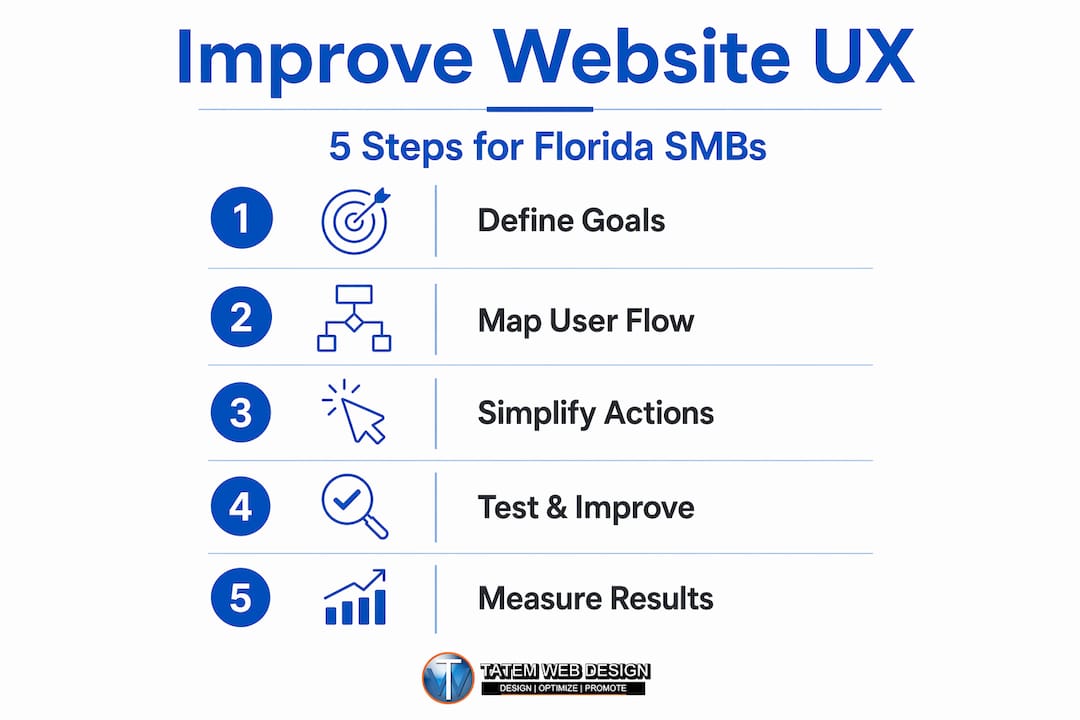
- Define user personas before wireframing. Know exactly who is visiting your site, what they want, and what would stop them from converting. A Florida real estate agency serves very different users than a Stuart-based accounting firm.
- Create wireframes and low-fidelity prototypes. Test the basic structure before committing to full design. This is where most usability problems surface cheaply.
- Conduct usability testing with real users. Five to eight users will reveal the majority of critical problems. This does not need to be expensive or time-consuming.
- Build from validated designs. Developers work from designs that have already been tested and refined, eliminating costly mid-project pivots.
- Measure and iterate post-launch. UX work does not end at launch. Tracking behavior over the first 90 days surfaces issues that testing could not predict.
The professional website design guide for Florida businesses reinforces this exact approach. Skipping these steps does not save time. It guarantees more expensive problems later.
Pro Tip: Before your next website project begins, map out the three most important actions you want visitors to take. Every UX decision should be measured against whether it helps or hurts those three goals.
How UX influences SEO and online visibility
The relationship between UX and SEO used to be indirect. In 2026, it is direct and measurable. Google evaluates UX signals such as dwell time, pogo-sticking (when users click your link then immediately return to search results), scroll depth, and rage clicks to build a composite quality score that influences where you rank.
Here is what that means practically. If users land on your plumbing services page in Fort Lauderdale and leave within 8 seconds, Google registers that as a low-quality result for that search query. Do it enough times and your ranking drops. Fix the UX on that page and the opposite happens.
| UX factor | Poor UX outcome | Strong UX outcome |
|---|---|---|
| Page load speed | High bounce rate, ranking drop | Lower bounce, higher dwell time |
| Mobile layout | Users pinch to zoom, immediate exit | Smooth navigation, longer sessions |
| Clear CTAs | Confusion, no conversions | Direct path to contact or purchase |
| Internal linking | Dead ends, user frustration | Deeper exploration, more page views |
| Checkout friction | Cart abandonment above 70% | Higher completed transactions |
Mobile UX deserves special attention here because more than 60% of web traffic now comes from mobile devices. If your site is not built mobile-first with responsive design, you are failing the majority of your visitors before they even read your headline.
Key behaviors that signal poor UX to Google’s AI-driven algorithms in 2026:
- Pogo-sticking. Users click your link, see a cluttered or irrelevant page, and hit the back button in seconds.
- Low scroll depth. Users do not scroll past the fold, suggesting your above-the-fold content does not earn further attention.
- Rage clicks. Repeated rapid clicks on elements that do not respond, indicating broken or confusing functionality.
- Short session duration. Especially damaging on service pages where you want users to read, explore, and convert.
The benefits of responsive design extend well beyond aesthetics. A site built for mobile first performs better in search, retains visitors longer, and converts more of them into leads.
Pro Tip: Use Google Search Console’s Core Web Vitals report to identify which pages have INP, LCP (Largest Contentful Paint), or CLS (Cumulative Layout Shift) issues. Fix the worst offenders first on your highest-traffic pages.
Practical UX strategies for SMB websites in Florida
Small businesses achieve significant gains by focusing on core usability principles such as clarity, consistency, and mobile-first responsiveness. These are often more impactful than adding complex features. A Florida HVAC company does not need an animated homepage. It needs visitors to find the “Request a Quote” button in under three seconds on a phone screen.
Here are the most high-impact UX strategies your business can apply right now:
- Lead with clarity, not creativity. Your homepage headline should answer “what do you do and who do you do it for” immediately. “Stuart’s most trusted family dentist” beats “Your smile, our passion” every time.
- Design navigation for strangers. Your internal team knows your site structure. Your first-time visitor does not. Limit main navigation to five to seven items, label them plainly, and keep dropdowns shallow.
- Build mobile-first, not mobile-adjusted. Start every design on the smallest screen and scale up. A mobile-first approach ensures your site works for the majority of your traffic, not just desktop users.
- Use large, obvious touch targets. On mobile, buttons smaller than 44 pixels are frustration points. Every link and button should be easy to tap with a thumb, not a stylus.
- Cut checkout to the minimum. Each additional field in a form or checkout reduces completion rates. Ask only for what you absolutely need. Offer a guest checkout option. Show progress bars. Display total costs including tax and shipping before the final step.
- Keep UI elements consistent. If your primary button is blue on the homepage, it should be blue everywhere. If your font is a specific size for body text, never break that rule. Consistency reduces the cognitive effort visitors spend trying to understand your site.
The path to improving user experience is not always about adding more. Often it is about removing friction, simplifying choices, and trusting that clarity converts better than complexity.
Why small businesses in Florida must rethink UX as a growth engine, not just aesthetics
We have spent 26 years watching Florida businesses treat their websites like digital brochures. Print it once, leave it alone, come back when something breaks. That model worked in 2005. In 2026, it is quietly killing your business.
Here is the shift that matters: UX maturity is moving from a cultural aspiration to a data-driven discipline. Businesses that connect design decisions to measurable outcomes earn larger budgets and stronger stakeholder buy-in. Which means the businesses that treat UX as a living system are pulling away from those that treat it as a one-time project.
The uncomfortable truth we see repeatedly with Florida SMBs is this: companies will spend thousands on Google Ads to drive traffic to a website that hemorrhages visitors within seconds. The math on that investment never works. You cannot advertise your way out of a broken user experience. The traffic arrives, hits a wall of friction, and leaves. Your ad spend burns.
What changes when you treat UX design principles as a growth system? You start measuring the right things. Bounce rate on key landing pages. Session duration by traffic source. Conversion rate on service inquiry forms. Cart abandonment by device type. Each of those metrics tells you something specific about where your experience breaks and what fixing it is worth.
A small plumbing company in Palm Beach Gardens made a single UX change: they added a visible phone number in the header and replaced their homepage’s wall of text with a simple three-step “how we work” section. Leads from organic search increased by 40% in 90 days. No new ad spend. No SEO campaign. Just clearer communication.
AI integration is accelerating this even further. AI tools now allow businesses to personalize UX dynamically, showing different content and pathways to different visitor segments in real time. Combined with AI chatbots that capture leads at any hour, the gap between businesses with intentional UX and those without is widening fast. SMBs that act now have a window to build that advantage before it closes.
Enhance your Florida business with AI-powered UX and web development solutions
Your website is either working for you or against you. There is no neutral ground. At Tatem Web Design, we have helped Florida businesses across real estate, healthcare, legal, marine, and dozens of other industries build websites that are fast, clear, and built to convert from day one.
Our team combines over 26 years of web development expertise with the latest AI tools to deliver AI website design that goes well beyond aesthetics. We build custom e-commerce web design with UX-optimized checkout flows, AI chatbot integration for round-the-clock lead capture, and local SEO strategies built directly into your site architecture. Our AI web and marketing services give Florida SMBs a measurable edge in search rankings and user engagement. Ready to stop losing visitors and start turning them into customers? Call us directly at 772-224-8118 to schedule your consultation.
Frequently asked questions
What exactly does UX mean in web development?
UX, or user experience, refers to how users interact with a website including its usability, accessibility, and overall satisfaction, which goes far beyond visual design. As defined in current practice, UX covers all touchpoints from the first click to post-purchase support.
How does poor UX affect my website’s Google ranking?
Poor UX causes high bounce rates, pogo-sticking, and low engagement, all signals Google uses to lower your ranking. Google evaluates UX signals like dwell time and rage clicks to build a composite quality score that directly affects search position.
Can small Florida businesses benefit from UX improvements?
Yes, and often dramatically. Small businesses achieve significant gains by focusing on clarity, mobile responsiveness, and intuitive navigation without needing large budgets or enterprise-level complexity.
When should UX be integrated into a web development project?
UX should be integrated before any code is written, during the design and planning phase. Fixing usability problems post-launch costs roughly 100 times more than addressing them during design, making early integration the smartest investment you can make.
How quickly can I see results from UX improvements?
Most businesses see measurable impact within 60 to 90 days after a redesign or UX update launches. Longer-term benefits such as improved customer retention and higher lifetime value typically stabilize over 3 to 6 months.
Recommended
- E-commerce web development: A complete guide for Florida SMBs | Tatem Web Design
- Improve user experience in web design for business growth | Tatem Web Design
- Professional website design: An expert guide for Florida businesses | Tatem Web Design
- Responsive web design benefits: boost visibility and engagement | Tatem Web Design
Tatem Web Design
26+ YearsWeb Design & SEO Specialist · Tatem Web Design
Matt Tatem has been designing websites professionally since 1999, making Tatem Web Design one of Florida's longest-running web agencies. Based in Stuart, FL, he specializes in WordPress, local SEO, Shopify e-commerce, and cybersecurity consulting for small businesses.

Rank in ChatGPT in 90 Days With a Practitioner Led Checklist
Follow a practitioner led 90 day plan to get cited by ChatGPT: allow OAI-SearchBot, publish short answer capsules with schema, and track Bing AI Performance.

AI SEO Content Playbook: 16 GEO Signals for Agencies & Teams
A practical playbook mapping the GEO-16 signals to hands-on editorial workflows, review controls, and metrics. For agencies and in-house teams scaling AI...

Copy Ready Local Schema Markup for SMBs + Google Validation
Copy ready JSON-LD examples and Google validation steps for SMBs' local schema markup. Audit, implement, and verify each location page with confidence.