
ADA Compliance for U.S. Businesses: 2026 Guide
ADA compliance is the mandatory provision of equal access and effective communication for people with disabilities, covering physical facilities, digital content, and service delivery under U.S. federal law. The Americans with Disabilities Act applies to most businesses open to the public, all state and local government entities, and employers with 15 or more employees. Meeting these obligations is not optional. Violations expose your organization to federal lawsuits, DOJ investigations, and reputational damage that no business can afford. This guide breaks down what ADA compliance actually requires in 2026, covering physical access, digital standards, and the communication rules that most business owners overlook entirely.
What ADA compliance requires for physical access
Physical accessibility under the ADA is governed by the ADA Standards for Accessible Design, which apply to new construction and any alterations made to existing facilities. If you build a new location or renovate a restroom, parking area, or entrance, those spaces must meet the full technical specifications in the Standards. No exceptions.
For existing facilities that have not been altered, the obligation is different but still binding. Readily achievable barrier removal means you must eliminate access barriers when doing so is easily accomplishable without significant difficulty or expense. This is a sliding scale. A large retail chain is expected to remove more barriers than a small independent restaurant, because the standard is calibrated to your resources. The DOJ encourages phased remediation triggered by audits rather than waiting for a renovation project to force your hand.

ADA Title III obligations for businesses open to the public include reasonable modifications to policies and practices, allowing service animals in all areas open to customers, and providing accessible routes to goods and services. A medical office that requires patients to use stairs when a ramp is feasible is in violation. A hotel that refuses a guest’s service dog is in violation. These are not edge cases. They are the most common sources of ADA complaints filed against private businesses each year.
Common physical barriers that qualify for readily achievable removal include:
- Inaccessible parking spaces lacking proper signage or dimensions
- Entrances without accessible routes or automatic door openers
- Restrooms with insufficient turning radius or inaccessible fixtures
- Service counters too high for wheelchair users
- Aisles too narrow for mobility device passage
Pro Tip: Conduct a formal barrier removal audit before your next fiscal year budget cycle. Prioritize fixes that affect the path of travel from parking to the primary service area first. This sequence aligns with DOJ guidance and demonstrates good-faith compliance effort if a complaint is ever filed.
How does ADA compliance apply to websites and digital content?
Digital accessibility is now a core component of ADA compliance, not a future concern. The Department of Justice has established that WCAG 2.1 Level AA is the technical standard for websites and mobile apps operated by state and local government entities under Title II. For private businesses under Title III, courts and the DOJ consistently apply WCAG 2.1 Level AA as the benchmark in enforcement actions and settlements.
The compliance timeline differs depending on your organization type. Public entities serving populations of 50,000 or more face a deadline of April 2027. Smaller public entities and special districts have until April 2028 under the DOJ Interim Final Rule. Private businesses have no single federal deadline, but the volume of ADA web accessibility lawsuits filed annually makes delay a genuine financial risk.
The core digital accessibility practices required under ADA guidance include:
- Alt text on all meaningful images so screen readers can describe visual content
- Captions and transcripts for all video and audio content
- Keyboard navigation that allows users to access all functions without a mouse
- Sufficient color contrast between text and background (minimum 4.5:1 ratio for normal text)
- Labeled form fields so assistive technologies can identify input requirements
- Descriptive link text that makes sense out of context, not “click here”
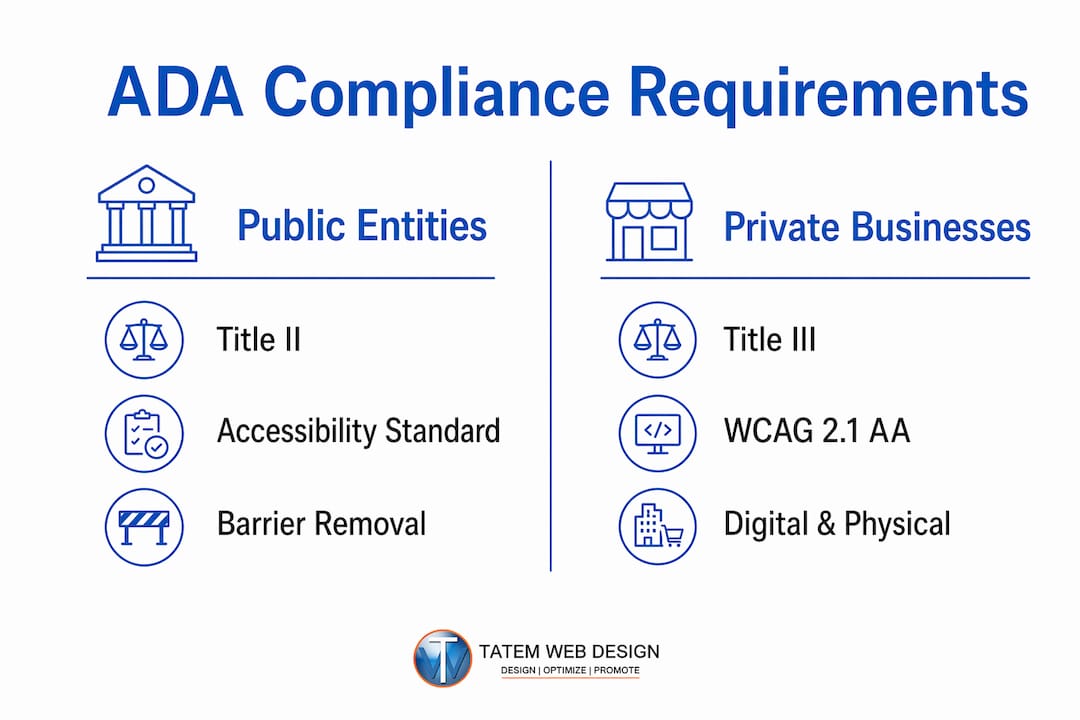
The following table summarizes key differences in digital compliance requirements between public entities and private businesses:
| Requirement | Public entities (Title II) | Private businesses (Title III) |
|---|---|---|
| Governing standard | WCAG 2.1 Level AA (mandatory) | WCAG 2.1 Level AA (de facto standard) |
| Federal deadline | April 2027 or April 2028 | No single federal deadline |
| Enforcement authority | DOJ, private lawsuits | Private lawsuits, DOJ investigations |
| Mobile app coverage | Explicitly required | Applies under general nondiscrimination |
Pro Tip: Embed accessibility requirements into your web development workflow from the start. Retrofitting an inaccessible site costs three to five times more than building it correctly the first time. Treat WCAG 2.1 Level AA criteria as acceptance criteria in every sprint or design review.
For Florida businesses, the Florida SMB compliance guide from Tatemweb covers both physical and digital requirements in a format built specifically for professional service firms operating in the state.
What does effective communication mean under the ADA?
Effective communication under ADA Titles II and III requires that your organization communicate as effectively with people who have disabilities as it does with everyone else. This is not a vague aspiration. It is a specific legal obligation with defined tools and documented exceptions.
The ADA requires businesses and government entities to provide auxiliary aids and services when needed for effective communication. The type of aid required depends on the nature, length, complexity, and context of the communication. A brief transaction at a retail counter may require only written notes. A legal consultation, a medical appointment, or a government hearing may require a qualified sign language interpreter or real-time captioning.
The most common auxiliary aids and services include:
- Qualified sign language interpreters for in-person or video interactions
- Real-time captioning (CART) for meetings, presentations, and events
- Assistive listening devices for individuals with partial hearing loss
- Written materials in accessible formats such as large print, Braille, or electronic text
- Video Remote Interpreting (VRI) for situations where an in-person interpreter is unavailable
Two legal exceptions limit this obligation. First, if providing a specific auxiliary aid would impose an undue burden, meaning significant difficulty or expense relative to your organization’s resources, you may offer an alternative that still provides effective communication. Second, if the aid would fundamentally alter the nature of your service, it is not required. Both exceptions require documented evaluation. A business that claims undue burden without written analysis of its financial resources is unlikely to prevail in a complaint proceeding.
Effective communication decisions are highly contextual and must prioritize the individual’s preferred auxiliary aid, with reasonable exceptions. This means you ask the person with a disability what works for them. You do not decide for them. A deaf customer who requests a qualified interpreter for a complex financial transaction is not asking for a preference. They are asserting a legal right.
How can businesses implement and maintain ADA compliance effectively?
Sustainable ADA compliance is a governance function, not a one-time project. Ongoing audits, remediation, and staff training are required to prevent the reintroduction of barriers as your facilities, website, and services evolve. Businesses that treat compliance as a checkbox exercise typically face repeat violations within 18 to 24 months of their initial remediation effort.
The most effective implementation approach combines physical and digital compliance into a single governance workflow. Here is how to structure it:
- Assign an accessibility coordinator. This person owns the compliance calendar, manages audit findings, and serves as the point of contact for accommodation requests. In smaller organizations, this can be a part-time responsibility added to an existing operations or HR role.
- Conduct annual accessibility audits. Physical audits should walk the path of travel from parking through every customer-facing space. Digital audits should combine automated scanning tools with manual testing by users of assistive technologies. Automated tools alone catch roughly 30 to 40 percent of WCAG failures.
- Embed accessibility in your web development lifecycle. Semantic markup, proper labels, and keyboard navigation must be built into every new page, feature, and content update. The W3C Web Accessibility Initiative provides free developer guidance that your team can use as a technical reference.
- Train customer-facing staff. Employees who interact with customers need to know how to respond to accommodation requests, how to operate assistive listening devices, and how to connect customers with your accessibility coordinator.
- Create a public accessibility feedback channel. A dedicated email address or web form for accessibility concerns gives customers a direct path to resolution and demonstrates good-faith compliance effort.
The comparison below shows the primary implementation steps for physical and digital compliance side by side:
| Implementation step | Physical compliance | Digital compliance |
|---|---|---|
| Baseline assessment | Barrier removal audit of facilities | Automated and manual WCAG audit |
| Remediation priority | Path of travel, then service areas | Navigation, forms, media, documents |
| Ongoing governance | Annual physical inspection | Continuous monitoring and sprint reviews |
| Staff training | Accommodation requests, service animals | Accessible content creation, alt text |
| Documentation | Barrier removal log, undue burden analysis | Audit reports, remediation tracking |
Pro Tip: Use tools like axe DevTools, WAVE, or Deque’s browser extensions for initial digital audits. Follow up with manual keyboard-only testing and a screen reader walkthrough using NVDA or VoiceOver. Automated tools are fast but incomplete. Manual testing catches the failures that matter most to real users.
Compliance trends favor auditable, standard-based implementation like WCAG 2.1 Level AA over case-by-case accessibility judgments. This means documenting your decisions, your audit findings, and your remediation timelines. If a complaint is filed, that paper trail is your best defense and your clearest evidence of good faith.
For a deeper look at embedding accessibility into your design process, the website accessibility guide from Tatemweb covers practical approaches from initial design through ongoing maintenance.
Key takeaways
ADA compliance requires a continuous, documented commitment to equal access across physical facilities, digital content, and communication, anchored to WCAG 2.1 Level AA for websites and the ADA Standards for Accessible Design for physical spaces.
| Point | Details |
|---|---|
| Physical access obligations | Remove readily achievable barriers now; do not wait for renovations to trigger compliance. |
| Digital standard | WCAG 2.1 Level AA is the enforceable benchmark for websites and mobile apps under both Title II and Title III. |
| Effective communication | Ask individuals with disabilities what auxiliary aid they need; document any exceptions claimed. |
| Compliance as governance | Annual audits, staff training, and a feedback channel are required to sustain compliance over time. |
| Documentation matters | Written audit logs and remediation records are your primary defense in any complaint or lawsuit. |
Why most businesses get ADA compliance wrong
After working with businesses across healthcare, legal, real estate, and professional services for over two decades, I have seen the same pattern repeat itself. A business owner receives a demand letter or a lawsuit notice, panics, hires someone to fix the most visible problems, and then considers the matter closed. Six months later, a new website update reintroduces three of the barriers that were just remediated. The cycle starts again.
The fundamental error is treating ADA compliance as a destination rather than a standard operating procedure. Accessibility is not a state you achieve and then maintain passively. Your website changes. Your staff turns over. Your facilities age. Each of those changes creates new risk if you do not have a governance structure that catches problems before they become complaints.
What I have found actually works is this: organizations that assign a named individual to own accessibility, budget for annual audits, and include accessibility criteria in every web project brief sustain compliance far more effectively than those that rely on periodic remediation campaigns. The cost difference is significant. Proactive governance costs a fraction of what reactive remediation and legal defense cost.
The other thing I want to push back on is the idea that ADA compliance is purely a legal burden. Businesses that invest in accessibility consistently report broader benefits: better SEO performance because accessible sites have cleaner semantic structure, higher customer satisfaction among older adults who benefit from the same features designed for people with disabilities, and stronger brand reputation in communities where inclusivity matters to purchasing decisions. Compliance and competitive advantage are not mutually exclusive. For most businesses, they point in the same direction.
— Matt
How Tatemweb builds ADA-compliant websites for Florida businesses
ADA compliance on your website is not something you can bolt on after launch and expect it to hold. Tatemweb builds AI-powered accessible websites with WCAG 2.1 Level AA standards embedded from the first line of code, not added as an afterthought. Every site includes proper semantic markup, keyboard navigation, color contrast validation, and accessible form labeling by default. For Florida businesses in healthcare, legal, real estate, and professional services, Tatemweb also provides ongoing compliance support to keep your digital presence protected as your site evolves. Call Tatemweb directly at 772-224-8118 to schedule a consultation and find out exactly where your website stands today.
FAQ
What is ADA compliance for businesses?
ADA compliance is the legal requirement for businesses and public entities to provide equal access and effective communication to individuals with disabilities, covering physical facilities, websites, and service delivery under the Americans with Disabilities Act.
Does ADA compliance apply to my business website?
Yes. Courts and the DOJ apply WCAG 2.1 Level AA as the standard for private business websites under Title III, and the DOJ has explicitly required it for government websites under Title II, with deadlines of April 2027 or 2028.
What is a readily achievable barrier removal?
Readily achievable barrier removal means eliminating physical access barriers in existing facilities when doing so is easily accomplishable without significant difficulty or expense, assessed against your organization’s available resources.
How do I conduct a website accessibility audit?
Start with automated scanning tools like axe DevTools or WAVE to identify common WCAG failures, then follow up with manual keyboard-only testing and a screen reader walkthrough using NVDA or VoiceOver, since automated tools catch only 30 to 40 percent of real accessibility issues.
What auxiliary aids does the ADA require for effective communication?
The ADA requires businesses to provide auxiliary aids such as qualified sign language interpreters, real-time captioning, assistive listening devices, and accessible document formats, with the specific aid determined by the nature and complexity of the communication and the individual’s preference.
Recommended
Tatem Web Design
26+ YearsWeb Design & SEO Specialist · Tatem Web Design
Matt Tatem has been designing websites professionally since 1999, making Tatem Web Design one of Florida's longest-running web agencies. Based in Stuart, FL, he specializes in WordPress, local SEO, Shopify e-commerce, and cybersecurity consulting for small businesses.

Rank in ChatGPT in 90 Days With a Practitioner Led Checklist
Follow a practitioner led 90 day plan to get cited by ChatGPT: allow OAI-SearchBot, publish short answer capsules with schema, and track Bing AI Performance.

AI SEO Content Playbook: 16 GEO Signals for Agencies & Teams
A practical playbook mapping the GEO-16 signals to hands-on editorial workflows, review controls, and metrics. For agencies and in-house teams scaling AI...

Copy Ready Local Schema Markup for SMBs + Google Validation
Copy ready JSON-LD examples and Google validation steps for SMBs' local schema markup. Audit, implement, and verify each location page with confidence.