
AI Security for SMEs: What You Need to Know in 2026
AI security is defined as the dual practice of protecting artificial intelligence systems from attack and deploying AI-powered tools to strengthen an organization’s overall cybersecurity defenses. For small and medium-sized enterprises, this distinction matters more than most realize. The industry standard term is “AI security,” but practitioners also call it artificial intelligence cybersecurity when referring specifically to using AI as a defense mechanism. Solutions like Google AI Threat Defense, the AWS AI Security Framework, and guidance from the UK National Cyber Security Centre (NCSC) now give SMEs access to the same frameworks that enterprise security teams use. The question is no longer whether AI security applies to your business. It is how quickly you can put it to work.
What are the unique security risks associated with AI systems?
AI systems introduce a threat surface that traditional firewalls and antivirus tools were never designed to address. AI-specific vulnerabilities include prompt injection, data and model poisoning, supply chain compromise, and excessive AI agent permissions. Each of these can compromise a business without triggering a single traditional security alert.
Prompt injection occurs when an attacker embeds malicious instructions inside user input that an AI model then executes as if they were legitimate commands. A customer service chatbot, for example, could be manipulated into leaking internal data or bypassing access controls simply through a crafted message. This attack type has no equivalent in classic SQL injection defenses.

Data and model poisoning is subtler and more dangerous over time. An attacker corrupts the training data or fine-tuning inputs that an AI model learns from, causing the model to produce biased, incorrect, or malicious outputs at scale. For a healthcare practice using AI to flag billing anomalies, a poisoned model could silently approve fraudulent claims for months.
Supply chain compromise targets the third-party libraries, pre-trained models, and AI APIs that most SMEs rely on rather than building from scratch. If a vendor’s model is compromised before it reaches your environment, your security controls downstream may never catch it. Praetorian’s research maps these threat types to concrete program elements, including adversarial testing, secure training pipelines, and AI-specific incident response plans.
Beyond these vectors, AI agent memory and context represent an emerging attack surface that most IT teams have not yet addressed. Protecting AI systems requires memory defense, cryptographic provenance, and trust-gated retrieval to prevent context poisoning, where an attacker manipulates what an AI agent “remembers” between sessions to alter its future behavior.
- Prompt injection: Malicious instructions embedded in user input that hijack AI model behavior
- Data and model poisoning: Corrupted training data that causes AI to produce harmful outputs over time
- Supply chain compromise: Infected third-party models or libraries introduced before deployment
- Excessive agent permissions: AI agents granted broader system access than their task requires, creating lateral movement risk
- Model theft: Adversaries extract proprietary model weights through repeated API queries, stealing your competitive asset
Pro Tip: Treat your AI systems as a distinct threat surface with their own security controls, separate from your network perimeter and endpoint defenses. A vulnerability in your AI layer will not appear in a standard penetration test unless you specifically scope for it.
How do leading frameworks and providers recommend securing AI systems?
The most credible guidance on machine learning protection comes from three sources that SMEs can apply directly: the UK NCSC, AWS, and Google. Each approaches the problem from a different angle, and together they form a practical blueprint.
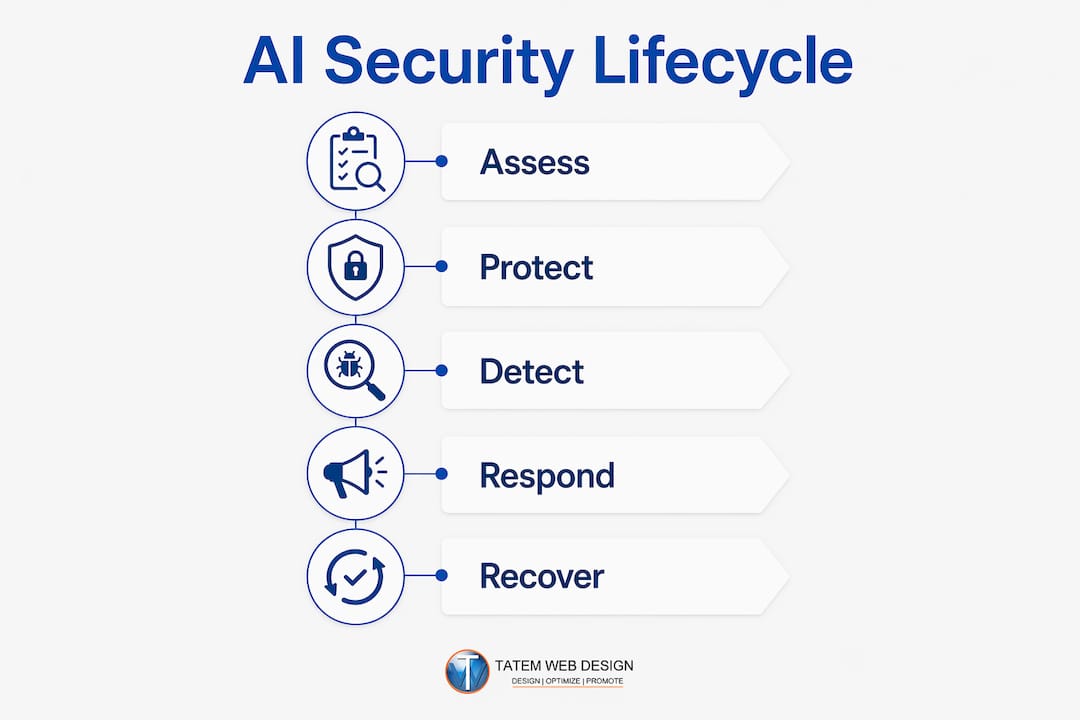
The UK NCSC’s 2026 principles establish the foundational rule: AI security is a continuous lifecycle concern, not a development checklist. Security must be embedded from the moment you select a model through deployment, monitoring, and eventual retirement. This matters because AI systems evolve. A model that was safe at launch can become vulnerable as its training data ages or as adversaries discover new attack patterns against it.
The AWS AI Security Framework organizes controls across three layers and three phases. The three layers are infrastructure security, identity and data security, and AI application security. The three phases move from foundational controls (the basics every organization must have) through enhanced controls (for organizations with growing AI use) to advanced controls (for mature AI security programs). This phased structure is particularly useful for SMEs because it tells you exactly where to start without demanding enterprise-level resources on day one.
Google AI Threat Defense takes a different approach by combining Gemini reasoning, Wiz risk prioritization, and Mandiant threat intelligence into a continuous detection and remediation system. The platform operates at machine speed, which matters because AI-powered attacks move faster than human analysts can manually track. Google’s approach demonstrates that AI threat detection is now a prerequisite for defending against AI-powered adversaries.
The table below compares how each framework addresses the AI security lifecycle:
| Framework | Lifecycle approach | Primary layers covered | Best suited for |
|---|---|---|---|
| UK NCSC ML Principles | Continuous security from design to retirement | Model development, deployment, monitoring | Organizations building or fine-tuning their own AI models |
| AWS AI Security Framework | Phased adoption from foundational to advanced | Infrastructure, identity/data, AI application | SMEs scaling AI use incrementally with cloud infrastructure |
| Google AI Threat Defense | Continuous automated detection and remediation | Threat intelligence, risk prioritization, response | Organizations needing machine-speed defense against AI-powered threats |
All three frameworks share one non-negotiable recommendation: threat modeling and red teaming must happen before production deployment, not after. Waiting until your AI system is live to test its security is the equivalent of stress-testing a bridge after opening it to traffic.
Pro Tip: Follow the AWS zero-trust guidance and assign each AI agent its own scoped credentials with the minimum permissions required for its specific task. Shared credentials across agents are one of the most common and most preventable sources of excessive permission risk.
How can SMEs effectively implement AI security practices and tools?
Translating framework guidance into action is where most SME IT teams stall. The frameworks are comprehensive, but your team has finite time and budget. The sequence below is designed for organizations that are adopting AI tools now and need to secure them without a dedicated security research team.
-
Establish identity and access controls on day one. Before any AI agent touches production data, assign it a unique identity with scoped credentials. This single step prevents the excessive permission risk that makes AI agent compromises so damaging. Use your existing identity provider, whether that is Microsoft Entra ID, Okta, or AWS IAM, and extend it to cover AI workloads.
-
Deploy continuous monitoring for your AI layer. Tools like Google AI Threat Defense and Cycode’s AI security platform provide automated scanning that flags anomalies in model behavior, unusual API call patterns, and potential data exfiltration. Manual log review cannot keep pace with the volume of events that AI systems generate.
-
Run adversarial testing before every major model update. This does not require a red team on staff. Services from firms like Praetorian offer AI-specific penetration testing that covers prompt injection, model extraction attempts, and training data integrity. Schedule this the same way you schedule network penetration tests.
-
Update your incident response plan to cover AI-specific scenarios. Your existing plan likely covers ransomware and phishing. Add playbooks for model poisoning, prompt injection incidents, and AI agent credential compromise. Define who has authority to take an AI system offline and what the rollback procedure looks like.
-
Embed governance and human oversight from the start. Human oversight remains essential to validate AI detections and authorize remediation actions. Build workflows where AI-generated security findings create investigation tasks for your team, but patching authority stays with a named human. This prevents both oversight gaps and automation errors.
-
Train your workforce on AI-specific risks. Staff who understand prompt injection and model theft are less likely to inadvertently expose your AI systems through careless use. Workforce readiness is a control layer that no technical tool can replace.
For Florida businesses in healthcare, legal, or financial services, compliance requirements add another dimension. HIPAA, PCI, and CMMC frameworks are beginning to address AI-specific controls, and getting ahead of those requirements now reduces remediation costs later. Tatemweb’s AI cybersecurity consulting can help you map your current AI use against these emerging compliance obligations.
What measurable impact does AI security deliver for organizations?
The business case for investing in AI security is no longer theoretical. Organizations that use AI extensively in security reduce average breach costs by up to $1.9 million and shorten breach lifecycles by approximately 80 days, according to a 2026 World Economic Forum report. That $1.9 million figure represents direct financial exposure: legal costs, regulatory fines, customer notification, and lost business. For an SME, a breach of that magnitude is often existential.
“Organizations that leverage AI extensively in security reduce average breach costs by up to $1.9 million and shorten breach lifecycles by about 80 days.” — World Economic Forum, 2026
The 80-day reduction in breach lifecycle is equally significant. The longer an attacker remains undetected inside your systems, the more data they exfiltrate and the more systems they compromise. Automated AI threat detection closes that window faster than any human-staffed security operations center can at SME budget levels.
AI security also delivers competitive advantages that go beyond breach prevention. Organizations with mature AI security programs can deploy new AI tools faster because they have a tested framework for evaluating and onboarding them safely. That speed advantage compounds over time. Competitors who skip security controls face slower deployment cycles as they deal with incidents and remediation.
The WEF data also reinforces a critical point: AI improves cybersecurity as strategic augmentation, not as a replacement for human judgment. The organizations that saw the largest gains combined AI tools with tested use cases, clear governance structures, and human oversight at decision points. Buying an AI security tool and letting it run autonomously without review does not produce these results. Pairing it with accountable human processes does.
For SMEs without a full security operations team, this means your IT manager or a managed security service provider becomes the human layer that validates and acts on AI-generated findings. The AI handles the volume. The human handles the judgment calls.
Key takeaways
AI security requires both protecting your AI systems from attack and using AI-powered tools to detect and respond to threats faster than human teams can manage alone.
| Point | Details |
|---|---|
| AI threats are distinct | Prompt injection, model poisoning, and agent permission abuse require controls beyond traditional cybersecurity tools. |
| Lifecycle security is mandatory | UK NCSC and AWS both confirm that security must be continuous from model design through retirement, not a one-time setup. |
| Start with identity controls | Assign scoped credentials to every AI agent on day one to prevent the most common source of excessive permission risk. |
| AI security cuts breach costs | WEF data shows organizations using AI in security reduce breach costs by up to $1.9 million and shorten breach timelines by 80 days. |
| Human oversight is non-negotiable | AI-generated findings should trigger human investigation tasks; patching authority must remain with accountable people, not automated systems. |
Why I think most SMEs are securing the wrong thing first
After working with Florida businesses across healthcare, legal, and professional services for years, I keep seeing the same pattern. A business owner invests in a new AI tool, asks IT to “make sure it’s secure,” and IT installs an SSL certificate and calls it done. That is not AI security. That is website security applied to an AI problem.
The uncomfortable truth is that most SMEs are securing the container while leaving the contents completely exposed. Your AI agent might sit behind a perfectly configured firewall and still be vulnerable to a prompt injection attack that extracts client data through the chat interface. Your AI-powered billing system might pass every network security audit and still produce fraudulent outputs because someone poisoned its training data six months ago.
What I have found actually works is treating your AI systems the way you treat your most sensitive database: with named ownership, access logs, regular audits, and a clear incident response plan. The AWS AI Security Framework gives you the language to have that conversation with your IT team or vendor without needing a PhD in machine learning. The NCSC principles give you the governance backbone. Google AI Threat Defense shows you what automated detection looks like at scale.
The organizations I see getting this right are not the ones with the biggest budgets. They are the ones that started with identity controls, built monitoring before they needed it, and kept a human in the loop on every remediation decision. Incremental adoption with a scalable framework beats a rushed, all-at-once deployment every time. Start with one AI system, secure it properly, and use that as your template for everything that follows.
— Matt
How Tatemweb helps Florida SMEs build real AI security
If you are a Florida business owner or IT manager who has read this far, you already understand that AI security is not optional. The question is where to start without wasting time or budget on controls that do not fit your actual risk profile.
Tatemweb’s AI security enhancement services are built specifically for SMEs in Florida’s healthcare, legal, real estate, and professional services sectors. The team at Tatemweb handles AI agent setup with proper identity controls, continuous monitoring configuration, compliance mapping for HIPAA and PCI, and workforce training on AI-specific threats. You get a security posture that matches your scale, not an enterprise framework that overwhelms your team. For businesses ready to take the next step, explore Tatemweb’s cybersecurity services or call 772-224-8118 to schedule a consultation.
FAQ
What is AI security and why does it matter for SMEs?
AI security is the practice of protecting AI systems from attack while also using AI-powered tools to detect and respond to cyber threats faster. SMEs that adopt AI tools without addressing AI-specific risks expose themselves to prompt injection, model poisoning, and agent permission abuse that traditional security controls cannot catch.
How does AI prevent cyber attacks compared to traditional security tools?
AI threat detection systems like Google AI Threat Defense operate at machine speed, continuously scanning for anomalies and correlating signals across multiple data sources simultaneously. Traditional tools rely on signature-based detection that misses novel attack patterns, while AI-powered systems identify behavioral deviations in real time.
What is the biggest AI security risk for small businesses?
Excessive AI agent permissions represent the most common and most preventable risk for SMEs. When AI agents share credentials or receive broader system access than their task requires, a single compromised agent can move laterally across your entire environment.
Do I need a dedicated security team to implement AI security?
No. Frameworks like the AWS AI Security Framework are designed for phased adoption, starting with foundational controls that a small IT team or managed service provider can implement. The key is pairing automated AI monitoring tools with a human who has clear authority to act on the findings.
How much can AI security reduce breach costs for my business?
According to the World Economic Forum’s 2026 report, organizations that use AI extensively in security reduce average breach costs by up to $1.9 million and shorten breach lifecycles by approximately 80 days. These gains require combining AI tools with tested use cases and human governance, not just deploying automation alone.
Recommended
Tatem Web Design
26+ YearsWeb Design & SEO Specialist · Tatem Web Design
Matt Tatem has been designing websites professionally since 1999, making Tatem Web Design one of Florida's longest-running web agencies. Based in Stuart, FL, he specializes in WordPress, local SEO, Shopify e-commerce, and cybersecurity consulting for small businesses.

Rank in ChatGPT in 90 Days With a Practitioner Led Checklist
Follow a practitioner led 90 day plan to get cited by ChatGPT: allow OAI-SearchBot, publish short answer capsules with schema, and track Bing AI Performance.

AI SEO Content Playbook: 16 GEO Signals for Agencies & Teams
A practical playbook mapping the GEO-16 signals to hands-on editorial workflows, review controls, and metrics. For agencies and in-house teams scaling AI...

Copy Ready Local Schema Markup for SMBs + Google Validation
Copy ready JSON-LD examples and Google validation steps for SMBs' local schema markup. Audit, implement, and verify each location page with confidence.