
Why updating website content boosts SEO and engagement
One Florida grass sod supplier saw a +937% surge in sessions after a focused content update strategy. That number sounds extreme, but it reflects a pattern we see repeatedly: businesses that treat their website as a living document consistently outperform those that let it sit unchanged for months or years. Many Florida SMB owners assume that publishing new pages is the only way to grow search visibility. The truth is that refreshing what you already have, done strategically, can be just as powerful. This article walks you through the mechanics of content freshness, how it builds trust with both search engines and real customers, the right update schedule for your business, and a practical framework to execute it all without wasting time.
Table of Contents
- How content freshness drives SEO success
- User experience: How updated content builds trust and engagement
- Benchmarks: How often should Florida SMBs update content?
- Practical frameworks: How to prioritize and execute content updates
- The uncomfortable truth about content updates: Quality vs. freshness in the Florida market
- Enhance your website’s results with expert content updates
- Frequently asked questions
Key Takeaways
| Point | Details |
|---|---|
| Freshness boosts SEO | Regular content updates tell search engines your site is active and relevant, raising rankings. |
| Build trust with updates | Up-to-date websites look credible and increase customer engagement for Florida SMBs. |
| Substantial changes matter most | Major content refreshes drive significant traffic, while minor tweaks have minimal impact. |
| Prioritize vital pages | Audit and update high-traffic or declining pages first for best results. |
| Balance new and refreshed content | Combine strategic updates with new material to maximize online visibility and conversions. |
How content freshness drives SEO success
Building on the surge in site visits from updated content, let’s examine the mechanics behind how search engines reward freshness.
Google does not treat all web pages equally when deciding what to rank. One of the signals it uses is how recently a page was meaningfully updated. This matters more than most business owners realize. A page that was accurate two years ago may now contain outdated pricing, old regulations, or irrelevant examples, and Google’s algorithms are designed to detect exactly that kind of staleness.
The concept behind this is called Query Deserves Freshness, or QDF. Google’s QDF algorithm boosts recently updated pages for time-sensitive searches, such as local service queries, seasonal topics, and anything tied to current events or changing conditions. For Florida businesses, this is especially relevant. Searches like “best HVAC contractor near Stuart” or “hurricane prep services Florida” carry a strong freshness signal. If your competitor updated their service page last month and yours hasn’t changed in 18 months, they have a measurable advantage.
Fresh content improves SEO rankings by signaling to Google that your site is active, authoritative, and worth crawling more frequently. When Googlebot visits your site and finds new or revised content, it indexes those changes faster. That means your updated information reaches search results sooner, which directly impacts your visibility for local queries.
Here is a quick comparison of how active versus stale websites tend to perform across key SEO metrics:
| SEO factor | Active website (regular updates) | Stale website (no updates) |
|---|---|---|
| Crawl frequency | High | Low |
| Ranking for time-sensitive queries | Strong | Weak |
| Domain authority signals | Improving | Flat or declining |
| Featured snippet eligibility | Higher | Lower |
| Local pack visibility | Competitive | Disadvantaged |
Beyond rankings, consistent updates also support your keyword research for SEO strategy. When you refresh content, you have the opportunity to incorporate new search terms your customers are actually using right now, not the terms that were popular when you first built the page.
The practical benefits of regular content updates include:
- Higher crawl rate: Search engines revisit active sites more often, picking up changes quickly.
- Improved relevance scores: Updated pages better match current user intent.
- More internal linking opportunities: Fresh content creates natural anchors to other pages on your site.
- Stronger topical authority: Consistently updated content signals that you are a current expert in your field.
- Better local SEO performance: Florida-specific updates, like mentioning current local regulations or seasonal services, reinforce geographic relevance.
Professional content writing services can help you build a sustainable update schedule that keeps your pages competitive without pulling you away from running your business.
“Search engines reward websites that demonstrate ongoing expertise and relevance. For local businesses, consistent updates are one of the most cost-effective ways to maintain and grow rankings.”
The bottom line: your website’s age is not what Google cares about. What it cares about is whether your content is still the best answer to the question being asked today. Regular, meaningful updates are how you stay in that position.
User experience: How updated content builds trust and engagement
While search engines notice content freshness, your customers also react strongly to how current and relevant your website appears.
Think about the last time you visited a business website and saw a blog post from four years ago at the top of the page, or a “current promotions” section listing an offer that expired in 2022. You probably questioned whether that business was still active, let alone worth calling. Your customers do the same thing when they land on your site.
75% of consumers judge a business’s credibility by its website design and content currency. Updated sites improve trust immediately. For Florida SMBs competing in markets like real estate, marine services, healthcare, or legal services, that trust signal can be the difference between a phone call and a click to a competitor.

Regularly updated content also reduces bounce rates, which is the percentage of visitors who leave your site after viewing only one page. When visitors find timely, relevant information, they stay longer, click through to other pages, and are more likely to convert into leads or customers. A well-maintained website keeps visitors engaged by answering current questions, not questions from two years ago.
Florida-specific content updates are particularly effective for local engagement. Consider these examples:
- A roofing company that updates its service pages with hurricane season preparation tips each spring sees higher engagement from homeowners actively searching for storm-ready contractors.
- A restaurant in Stuart that refreshes its menu and event listings monthly gives locals a reason to return to the site regularly.
- A healthcare provider that updates its FAQ page with current insurance accepted and new telehealth options reduces phone inquiries and builds immediate credibility.
- A marine services business that posts seasonal maintenance checklists aligned with Florida’s boating calendar keeps boat owners coming back.
Pro Tip: Pair your content updates with your Google My Business optimization efforts. When you update your website, post a corresponding update on your Google Business Profile. This double signal reinforces your local relevance to both search engines and potential customers.
Updated content also supports your link building strategies because other websites are more likely to link to current, accurate resources. An outdated page rarely earns new backlinks, while a freshly updated guide or resource page becomes a natural reference point.
“Customers who find current, accurate information on your website are significantly more likely to contact you. Outdated content doesn’t just hurt SEO. It actively erodes the trust you’ve worked hard to build.”
The engagement benefits of updated content are not abstract. They show up in real metrics: longer session durations, lower bounce rates, more pages visited per session, and higher conversion rates. For Florida SMBs, these numbers translate directly into more leads and more revenue.
Benchmarks: How often should Florida SMBs update content?
With trust and engagement hinging on current information, it’s essential to know how often you should revise each part of your website.
Not all pages need the same update frequency. Treating your homepage the same as a deep-archive blog post is inefficient. The key is matching your update schedule to the nature of each page and the competitive landscape of your specific Florida market.
Page-one content is updated on average every 730 days, and updates of 500 or more words yield a +43% traffic increase. That is a significant return for a few hours of focused work. But the timing and depth of updates matter as much as the frequency.
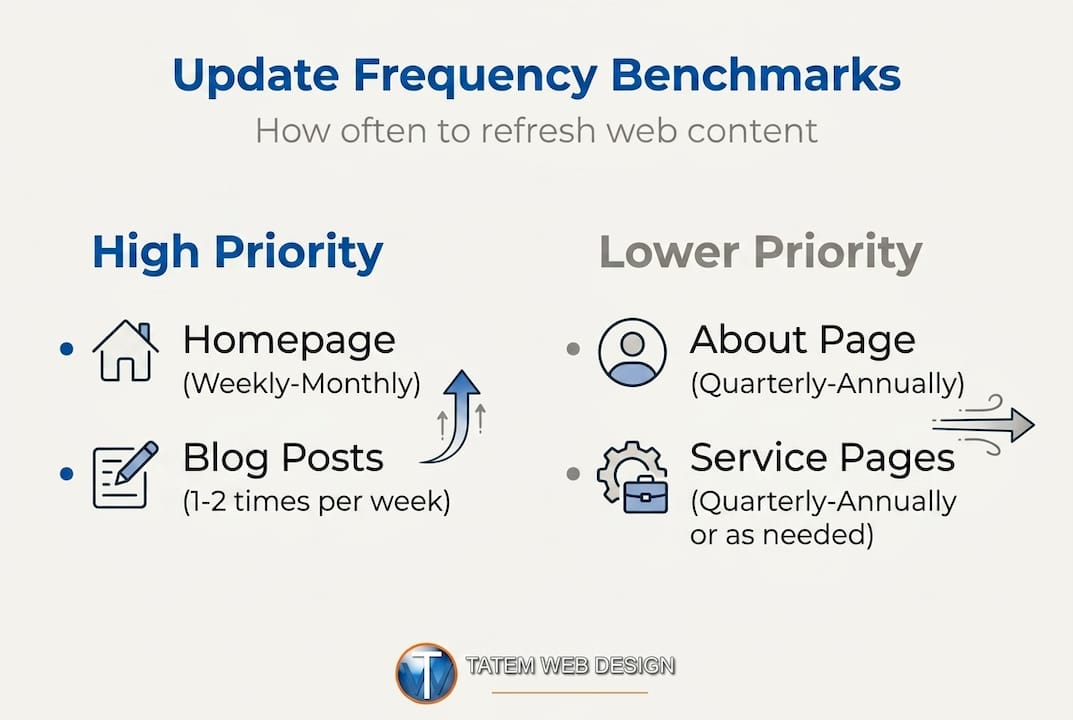
Here are the recommended update benchmarks for Florida SMBs:
| Content type | Recommended update frequency | Priority trigger |
|---|---|---|
| Homepage | Monthly or as needed | New services, promotions, seasonal messaging |
| Service pages | Every 12 to 18 months | Pricing changes, new offerings, local regulation updates |
| Blog posts | Every 6 to 12 months | Declining traffic, outdated statistics, new industry data |
| FAQ pages | Quarterly | New customer questions, policy changes |
| About/team pages | As needed | Staff changes, new certifications, awards |
| Location pages | Quarterly | Local events, community involvement, seasonal relevance |
A Florida HVAC company that committed to regular content updates saw 102% traffic growth and reached top-10 rankings in a competitive local market. That result came from a structured update strategy, not a website rebuild.
Here is a numbered framework to apply these benchmarks practically:
- Audit your top 10 traffic pages using Google Analytics and Search Console every quarter.
- Flag pages with declining click-through rates or falling average positions as immediate update priorities.
- Schedule blog refreshes for posts older than 12 months that still rank on pages two or three.
- Update service pages whenever you change pricing, add a service, or when local regulations shift.
- Revisit your homepage at the start of each Florida season to align messaging with customer needs.
Pro Tip: Don’t confuse activity with results. Changing a date or swapping one word is not a content update. Substantial changes, meaning new sections, updated statistics, added examples, or restructured information, are what drive measurable gains. Explore content freshness strategies to understand what Google actually rewards.
Our web design blog covers additional tactics specific to Florida industries, and the team at Tatem Web Design has spent over 26 years helping local businesses build update strategies that actually move the needle.
Practical frameworks: How to prioritize and execute content updates
Now that you know what works, let’s break down step-by-step processes to help Florida business owners maximize website performance through regular updates.
Knowing you should update content is one thing. Knowing exactly which pages to touch, what to change, and how to measure the results is where most SMB owners get stuck. Here is a clear, repeatable process.
Step 1: Run a content audit
Start with Google Analytics and Google Search Console. Look for pages that once drove traffic but have seen a decline over the past three to six months. These are your highest-priority targets. Prioritize high-traffic and declining pages using these tools before touching anything else.
Step 2: Categorize by update type
Not every page needs the same kind of work. Sort your pages into three buckets:
- Refresh: Pages with good structure but outdated statistics, old examples, or missing recent information.
- Expand: Pages that rank but are too thin, under 600 words, and could benefit from added sections.
- Restructure: Pages with high bounce rates that need a new format, clearer headings, or better calls to action.
Step 3: Execute substantial updates
Minor edits are ineffective; only substantial changes boost traffic by +43%. This means adding new data, incorporating current Florida-specific examples, updating statistics with 2025 or 2026 figures, and improving the overall depth of the page. Do not just change the publish date and call it done.
Step 4: Optimize for local relevance
Every update is an opportunity to strengthen your local SEO for Florida. Mention specific cities, reference local events or regulations, and use geographic terms your Florida customers actually search for.
Step 5: Track and iterate
After updating, monitor the page in Search Console for four to six weeks. Watch for changes in average position, impressions, and click-through rate. If results improve, apply the same approach to the next priority page.
Pro Tip: Use a simple spreadsheet to track every page you update, the date of the update, what you changed, and the traffic metrics before and after. This creates a feedback loop that sharpens your strategy over time. For a broader view of content marketing for SMBs, Semrush’s content marketing guide offers solid benchmarks to compare against.
Your website maintenance services partner can handle the execution side of this framework, freeing you to focus on the strategic decisions.
Avoid these common pitfalls:
- Updating only the blog while ignoring high-value service pages.
- Making cosmetic changes and expecting ranking improvements.
- Updating content without checking whether target keywords have shifted.
- Ignoring mobile formatting when adding new content sections.
The uncomfortable truth about content updates: Quality vs. freshness in the Florida market
With a practical roadmap established, it’s time to examine the deeper reality most experts gloss over when advising SMBs in Florida.
Here is what we have seen after 26 years of working with Florida businesses: freshness is not a magic switch. Business owners sometimes hear “update your content regularly” and interpret that as permission to publish anything, just to show activity. That approach can actually hurt you.
Quality and relevance are primary signals for Google, not just freshness. AI-driven search and Google’s Helpful Content system are specifically designed to penalize superficial updates. If you refresh a page by padding it with filler sentences or recycling the same information in different words, you are not fooling anyone, including the algorithm.
The Florida SMB market is competitive. In industries like real estate, legal services, and healthcare, your competitors are investing in quality content. A shallow update to a service page will not outrank a competitor who has genuinely answered the questions your customers are asking.
Our honest advice: do fewer updates, but make each one count. A single well-researched, substantially improved page will outperform five quick touch-ups every time. Test this yourself. Pick your highest-traffic declining page, invest two to three hours in a real overhaul, and track the results over 60 days. The data will tell you more than any general benchmark can.
Freshness matters most when it is paired with genuine improvement. Use your local SEO strategies as the foundation, and let quality be the standard every update is measured against.
Enhance your website’s results with expert content updates
Having explored the actionable steps and pitfalls for SMBs, here’s how you can take your website’s content update strategy to the next level.
Consistent, high-quality content updates are one of the highest-return investments a Florida SMB can make in its online presence. But executing them well takes time, expertise, and a clear strategy. That’s exactly what we bring to the table at Tatem Web Design.
Whether you need a WordPress website design built for easy ongoing updates, a full suite of website services that include content writing and SEO, or an ecommerce website design that stays competitive in Florida’s fast-moving retail market, we have the tools and experience to deliver results. Our AI-powered content and SEO solutions help you stay ahead without adding hours to your workload. Contact Tatem Web Design today to build a content update strategy that drives real, measurable growth for your Florida business.
Frequently asked questions
How often should Florida businesses update their website content?
Update your homepage monthly if conditions change, blog posts every 6 to 12 months, and service pages every 12 to 18 months, prioritizing any page showing a traffic decline in your analytics data.
Does updating website content really improve SEO rankings?
Yes, fresh and substantial content signals ongoing activity and authority to search engines, which directly improves rankings for local Florida queries where freshness is a strong ranking factor.
Should I update all website pages, or just focus on high-traffic content?
Focus first on high-traffic or declining pages; prioritize strategically using Search Console data, and only revisit evergreen pages when their underlying data or information becomes outdated.
Is it better to add new content or refresh old pages for Florida SMBs?
A balanced approach works best; substantial refreshes drive traffic gains on existing pages, while new content expands your visibility by targeting additional queries your customers are searching for.
Can minor tweaks like date changes improve SEO?
No; only substantial updates that add new data, insights, or expanded sections create measurable traffic improvements of +43% or more, while minor edits have no significant impact on rankings.
Recommended
- AI Content Creation Services Florida | AI Copywriting | Tatem Web Design
- Website Content Writing Services - Professional Copywriting | Tatem Web Design
- AI SEO Optimization Services Florida | AI-Powered SEO | Tatem Web Design
- AI SEO Optimization in 2025: How Machine Learning Is Changing Search Rankings for Florida Businesses | Tatem Web Design
- Engaging — Positive Ikigai Word | Meaning & Profession (What You Can Be Paid For) Connection | Ikigain
Tatem Web Design
26+ YearsWeb Design & SEO Specialist · Tatem Web Design
Matt Tatem has been designing websites professionally since 1999, making Tatem Web Design one of Florida's longest-running web agencies. Based in Stuart, FL, he specializes in WordPress, local SEO, Shopify e-commerce, and cybersecurity consulting for small businesses.

Rank in ChatGPT in 90 Days With a Practitioner Led Checklist
Follow a practitioner led 90 day plan to get cited by ChatGPT: allow OAI-SearchBot, publish short answer capsules with schema, and track Bing AI Performance.

AI SEO Content Playbook: 16 GEO Signals for Agencies & Teams
A practical playbook mapping the GEO-16 signals to hands-on editorial workflows, review controls, and metrics. For agencies and in-house teams scaling AI...

Copy Ready Local Schema Markup for SMBs + Google Validation
Copy ready JSON-LD examples and Google validation steps for SMBs' local schema markup. Audit, implement, and verify each location page with confidence.