
Designing healthcare websites for engagement and compliance
Florida healthcare practices lose real revenue every day to websites that frustrate patients before they ever pick up the phone. A clunky booking flow, a missing accessibility feature, or a form that leaks private data can cost you new patients and expose your practice to serious legal risk. High-performing healthcare sites convert 5 to 8 percent of visitors into booked appointments, generate 70 percent more inquiries, and keep patients engaged for over two and a half minutes per session. This guide walks you through a proven, repeatable process to build or rework your practice’s website so it delivers measurable results and stays on the right side of every relevant regulation.
Table of Contents
- Clarifying your website goals and regulatory requirements
- Gathering insight from patients and stakeholders
- Designing effective patient journeys: From landing to booked appointment
- Testing, measuring, and optimizing your healthcare site
- What most healthcare sites get wrong—and what actually works in Florida
- How Tatem Web Design helps Florida healthcare practices thrive online
- Frequently asked questions
Key Takeaways
| Point | Details |
|---|---|
| Patient-centric design | Interviewing patients and staff leads to websites that increase engagement and bookings. |
| Compliance is critical | Address HIPAA, ADA, and Florida-specific regulations before designing your site. |
| Measure real results | Track conversions, session times, and feedback to assess and optimize performance. |
| Iterate for success | Continuous testing and improvements give you the edge over generic, one-size-fits-all sites. |
Clarifying your website goals and regulatory requirements
Now that you see how critical website performance is, step one is clarifying what your practice needs and must comply with before a single page is designed.
Most Florida healthcare administrators make the mistake of jumping straight to visuals. They pick colors, upload a logo, and wonder why patients still call the front desk to ask basic questions. The real starting point is a clear, written list of what your website must accomplish and what rules it must follow.
Start by defining your primary goals. Every decision you make later should trace back to these objectives:
- Attract new patients from local Florida search results
- Allow patients to book, request, or confirm appointments online
- Publish accurate service information, provider bios, and office hours
- Collect patient reviews and build your practice’s online reputation
- Support existing patients with portal access or secure messaging
Once goals are documented, you need to address the regulatory layer. Florida healthcare websites must satisfy three overlapping frameworks. HIPAA (the Health Insurance Portability and Accountability Act) governs how you collect, store, and transmit any protected health information, including data gathered through web forms. ADA (the Americans with Disabilities Act) requires that your site be accessible to users with visual, auditory, or motor disabilities, which typically means following WCAG 2.1 guidelines for color contrast, keyboard navigation, and screen reader compatibility. Florida also enforces its own patient privacy statutes that can impose additional penalties beyond federal law.
| Regulatory area | What it covers | Risk if ignored |
|---|---|---|
| HIPAA compliance | Patient data, online forms, secure messaging | Federal fines, lawsuits |
| ADA/WCAG 2.1 | Accessibility for users with disabilities | Civil litigation, OCR complaints |
| Florida patient privacy | State-level data handling rules | State fines, license risk |
| SSL/data encryption | Secure data transmission on all pages | Data breaches, lost patient trust |
High usability boosts satisfaction by 90 percent, which means investing in improving healthcare site UX is not optional. It directly affects whether patients stay, book, and return.
Pro Tip: Bring your front office manager, your billing coordinator, and at least one provider into the goal-setting conversation before you brief any web designer. These three roles will surface practical requirements that administrators often overlook, such as insurance verification links, after-hours messaging, and telehealth entry points.
Involve your compliance officer or healthcare attorney at this stage as well. Catching a regulatory gap before design begins costs far less than retrofitting a live site or defending a complaint.
Gathering insight from patients and stakeholders
With requirements clear, input from real users reveals what will actually work online. You can document every regulation perfectly and still build a site that patients abandon in under thirty seconds because the navigation makes no sense to them.
Patient interviews and surveys are the foundation of sound information architecture. Ask patients directly: What did you search for before calling us? What frustrated you on our current site? What information do you wish you could find faster? Even five to ten structured interviews will surface patterns that no amount of internal guessing can match.
Questions to ask patients during discovery:
- How did you find our practice online?
- What information did you look for first?
- Did anything make you hesitate to book an appointment?
- Did you try to use our website on your phone?
- What would make scheduling easier for you?
Staff interviews are equally important. Receptionists know exactly which questions patients ask repeatedly, which usually means that information is buried or missing on the site. Nurses can identify clinical information gaps. Providers often know which conditions or services drive the most new patient inquiries. Collect all of this input before wireframing a single page.
| Input source | What they reveal | How to use it |
|---|---|---|
| Patient interviews | Navigation pain points, missing info | Restructure menus and landing pages |
| Patient surveys | Booking preferences, trust signals | Prioritize features like reviews and bios |
| Front desk staff | FAQ topics, friction in scheduling | Add FAQ pages, simplify booking forms |
| Providers | High-value services to highlight | Build dedicated service pages with SEO |
| Compliance team | Data handling requirements | Define form fields and security protocols |
Translate these insights into a clear site map before you write a single line of code. A well-structured healthcare website design in FL is built around how patients actually think, not how your internal departments are organized. Patients search for “knee pain specialist near Stuart” not “Department of Orthopedic Services.” Your navigation should reflect that reality.
One practical method is card sorting, where you write each page or topic on an index card and ask five to ten patients to group them logically. The results often surprise administrators and lead to dramatically simpler, more intuitive menus.
Designing effective patient journeys: From landing to booked appointment
Once you’ve captured what patients and staff actually need, it’s time to turn those insights into user-friendly digital journeys. A patient journey is simply the sequence of steps a visitor takes from arriving on your site to completing a meaningful action, like booking an appointment or submitting a contact form.

The most critical path to design is this one: landing page → provider search → appointment booking. Every extra click, every confusing label, and every slow-loading page in that sequence costs you a conversion. High-performing sites convert 5 to 8 percent of visitors to bookings. Most Florida practice sites convert far less because the journey is broken somewhere.
Here is a practical, numbered approach to mapping and building that journey:
- Identify your three to five most important patient actions. Booking an appointment, finding a provider, requesting a referral, accessing the patient portal, and contacting the office cover most practices.
- Sketch the flow on paper first. Draw boxes for each page and arrows showing how patients move between them. Identify where patients might get confused or give up.
- Minimize the number of clicks. A patient should be able to start booking from any page on your site in two clicks or fewer. Put your “Book Now” button in the header, not buried in a contact page.
- Write clear, action-oriented calls to action. “Schedule Your Visit” outperforms “Contact Us” every time. Be specific about what happens when someone clicks.
- Simplify every form. Ask only for what you absolutely need at the booking stage. You can collect additional clinical information after the appointment is confirmed.
- Test the entire flow on a smartphone. Over 60 percent of healthcare searches happen on mobile devices. If your booking form is hard to complete on a phone, you are losing patients daily.
“A website that makes booking feel effortless communicates that your practice values patients’ time before they ever walk through the door.”
The medical practice web features that drive the most engagement are provider profile pages with photos and credentials, online scheduling tools that sync with your practice management system, and patient testimonials placed close to calls to action. These three elements together build trust and reduce hesitation at the decision point.
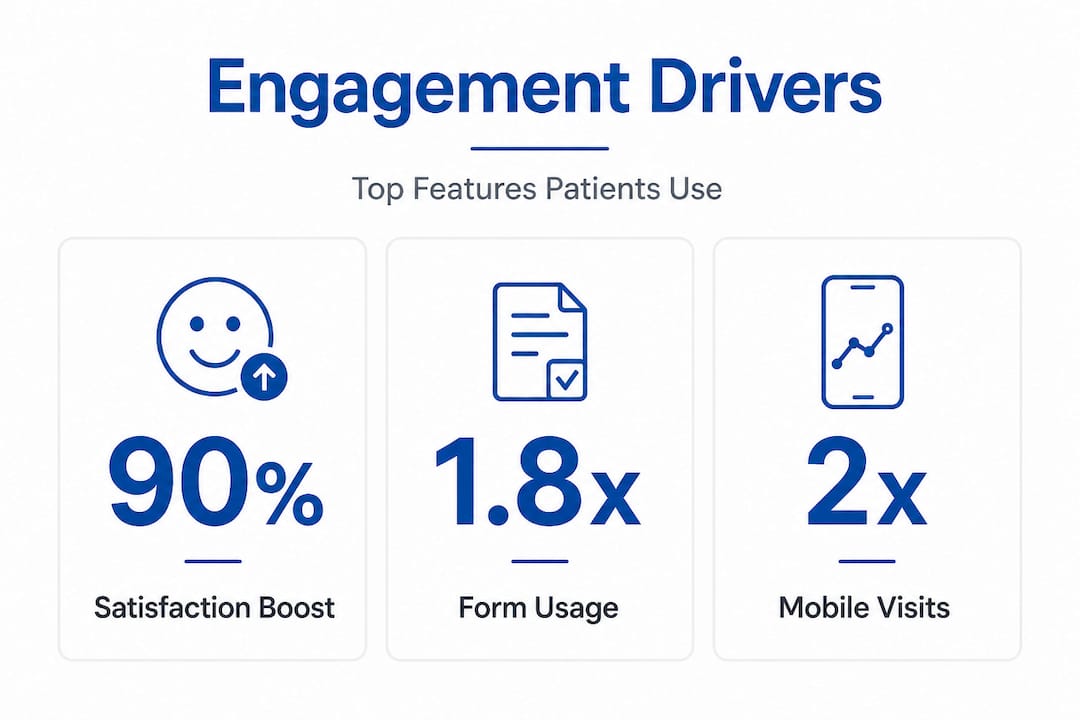
Responsive design for healthcare is not a bonus feature. It is a baseline requirement. Google ranks mobile-friendly sites higher in local search results, which directly affects how many new patients find your practice in the first place.
Pro Tip: Run a five-second test with a few real patients. Show them your homepage for five seconds, then ask what the site is about and what they should do next. If they cannot answer both questions confidently, your messaging and calls to action need work.
Testing, measuring, and optimizing your healthcare site
With your site’s patient journeys implemented, ongoing testing and improvement will maximize your impact. Launching a redesigned site is not the finish line. It is the starting point for a continuous cycle of measurement and refinement.
The core metrics every Florida practice should track:
| Metric | What it measures | Target benchmark |
|---|---|---|
| Conversion rate | Visitors who book or inquire | 5 to 8 percent |
| Average session duration | Time patients spend on site | Over 2.5 minutes |
| Bounce rate | Visitors who leave after one page | Below 55 percent |
| Mobile traffic share | Percentage using smartphones | Track monthly trend |
| Form completion rate | Patients who finish booking forms | Above 70 percent |
Measuring task completion and engagement gives you objective data to replace guesswork. Google Analytics 4 is free and tracks all of these metrics. Pair it with a heat mapping tool like Microsoft Clarity, also free, to see exactly where patients click, scroll, and abandon your pages.
Here is a practical testing and optimization cycle to run quarterly:
- Recruit three to five real patients to complete key tasks on your site while you observe. Watch for hesitation, wrong clicks, and moments of confusion.
- Review your analytics data for the previous 90 days. Identify pages with high bounce rates or low time on page as candidates for revision.
- Check compliance status. Regulations change. Review your HIPAA forms, ADA accessibility, and Florida-specific requirements at least twice per year.
- Run A/B tests on your most important calls to action. Test button text, placement, and color on your booking page to find what converts best.
- Collect patient feedback actively. A short post-visit survey asking “How easy was it to book your appointment online?” generates actionable data over time.
Current web design trends in healthcare are moving toward AI-powered chat tools that can answer common patient questions at any hour, automated appointment reminders, and personalized content based on the services a patient has previously viewed. These tools are no longer reserved for large hospital systems. They are accessible and affordable for Florida practices of any size.
Pro Tip: Set a recurring calendar reminder every 90 days to review your site’s top five pages in Google Analytics. This single habit will surface problems early and keep your site performing at a high level without requiring a full redesign every year.
Measuring user experience is an ongoing discipline, not a one-time audit. The practices that consistently outperform their competitors online treat their website like a living asset, not a static brochure.
What most healthcare sites get wrong—and what actually works in Florida
Here is an honest perspective that most web design articles will not give you: copying what large hospital systems do is one of the most common and costly mistakes Florida practice owners make.
Large hospital websites are built by committees, approved by legal teams, and optimized for brand awareness across entire regions. They are not designed to convert a new patient in Stuart or Vero Beach who found you through a Google search at 9 p.m. on a Tuesday. When smaller practices try to replicate that approach, they end up with bloated sites that take too long to load, navigation that requires a map to understand, and content that sounds like it was written for a board presentation rather than a nervous patient.
What actually works for Florida practices is almost the opposite. Smaller, focused sites with clear messaging, fast load times, and a direct path to booking consistently outperform elaborate multi-page systems. We have seen practices cut their bounce rates by 30 percent simply by removing clutter from their homepage and making the booking button impossible to miss.
Florida’s patient population is also genuinely diverse. Retirees from the northeast, Spanish-speaking families, seasonal residents, and year-round locals all use healthcare websites differently and expect different things. A one-size-fits-all template built for a suburban Chicago practice will not resonate with a patient in Palm Beach County or Martin County. Florida web design inspiration shows how locally-informed design choices, from imagery to language to service emphasis, make a measurable difference in how patients respond.
The practices that win online are the ones that listen first, build second, and test constantly. They treat their website as a patient experience tool, not a marketing expense. That mindset shift is what separates a site that generates 20 new patient inquiries a month from one that generates two.
How Tatem Web Design helps Florida healthcare practices thrive online
If you’re ready to elevate your practice’s website, the right partnership makes all the difference. At Tatem Web Design, we have spent over 26 years building secure, high-performing websites for Florida healthcare professionals, from solo practitioners to multi-location specialty groups.
We specialize in AI-powered healthcare web design that combines HIPAA compliance consulting, ADA accessibility, and conversion-focused patient journeys into a single, cohesive solution. Our team handles everything from initial goal-setting and patient journey mapping to ongoing optimization and regulatory updates. Explore our full range of website services for healthcare to see how we can support your practice at every stage. Whether you need a complete redesign or a targeted audit of your current site, our Florida healthcare web design team is ready to help. Call us at 772-224-8118 to schedule your consultation today.
Frequently asked questions
What features must every healthcare website include for compliance?
Every healthcare website must include HIPAA-compliant forms, accessibility features that meet WCAG 2.1 standards, SSL encryption across all pages, and secure patient communication options to protect sensitive data.
How long does it take to redesign a healthcare practice website?
A typical redesign takes four to eight weeks, depending on the volume of content, third-party integrations like scheduling software, and the speed of your internal feedback cycles.
How can a practice measure website success?
Track conversion rates and session duration alongside patient inquiries and form completion rates. High-performing healthcare sites convert 5 to 8 percent of visitors and sustain sessions over two and a half minutes.
Why interview patients during the web design process?
Patient interviews and surveys reveal the actual information patients seek and the friction points that prevent them from booking, leading to better site structure and higher appointment rates.
What makes Florida healthcare sites unique?
Florida’s combination of state-specific privacy regulations, a highly diverse patient population, and strong seasonal fluctuations in demand means that custom, locally-informed design consistently outperforms generic national templates.
Recommended
- Healthcare Website Design FL - Medical Web Development | Tatem Web Design
- Doctor Website Design FL - Medical Practice Websites | Tatem Web Design
- Dentist Website Design - Dental Practice Web Development | Tatem Web Design
- E-Commerce Website Design: Converting Visitors into Customers | Tatem Web Design
- HIPAA Compliance Software | Simplif-i
- Optimise IT in Queensland healthcare: efficiency, compliance, security - IT Start
Tatem Web Design
26+ YearsWeb Design & SEO Specialist · Tatem Web Design
Matt Tatem has been designing websites professionally since 1999, making Tatem Web Design one of Florida's longest-running web agencies. Based in Stuart, FL, he specializes in WordPress, local SEO, Shopify e-commerce, and cybersecurity consulting for small businesses.
What a CMMC Level 2 Assessment Requires and How to Prepare
Prepare for your CMMC Level 2 assessment by understanding requirements, assessment paths, and mapping your Controlled Unclassified Information.

A Data Retention Policy Is Your Rulebook for Keeping and Deleting Data
Establishing a clear data retention policy helps manage data risk, ensuring compliance and effective data management for your organization.

Law Firm Local SEO: A Practical Playbook for More Local Clients
Unlock more local clients for your law firm with effective local SEO strategies. Optimize your Google Business Profile and boost your visibility!