
Marine industry web design: Unlock visibility and compliance
Most Florida marine businesses have a website. Very few have one that actually works for them. There’s a meaningful difference between a generic site built on a template and a purpose-built digital presence designed to pull in leads from Boca Raton, Fort Lauderdale, and Stuart while keeping your business protected from ADA litigation and missed search rankings. If your site isn’t converting visitors into customers, wasn’t built with mobile-first thinking, or lacks the compliance basics that Florida courts now enforce, you’re leaving revenue on the dock.
Table of Contents
- What defines marine industry web design?
- Compliance essentials for Florida marine websites
- Driving visibility with location-focused SEO and inventory integration
- Applying growth-driven design for Florida marine businesses
- The reality most marine web design guides miss
- Level up with specialized marine web solutions
- Frequently asked questions
Key Takeaways
| Point | Details |
|---|---|
| Marine-first design matters | Websites built for marine professionals address mobile, booking, and location needs that generic sites miss. |
| Florida compliance simplified | ADA accessibility, SSL security, and privacy policies are essential for all marine sites to avoid legal risks. |
| Local SEO drives business | Optimizing for Florida-specific terms and integrating inventory supports higher search visibility and more leads. |
| Growth-driven design delivers | Launching fast and iterating based on user feedback is vital for marine industry web success. |
| Expert solutions available | Local agencies offer AI-powered tools and specialized web services to elevate marine online presence. |
What defines marine industry web design?
Having previewed why generic web design falls short, let’s break down the unique mechanics that set marine industry sites apart.
Marine industry web design is not simply a standard website with a boat photo on the homepage. It’s a purpose-built digital system designed around the way marine professionals operate and how their customers search, browse, and buy. A marina operator in Stuart, a yacht charter company in Fort Lauderdale, or a boat dealer on the Treasure Coast each has specific needs that a one-size-fits-all web template will never meet.
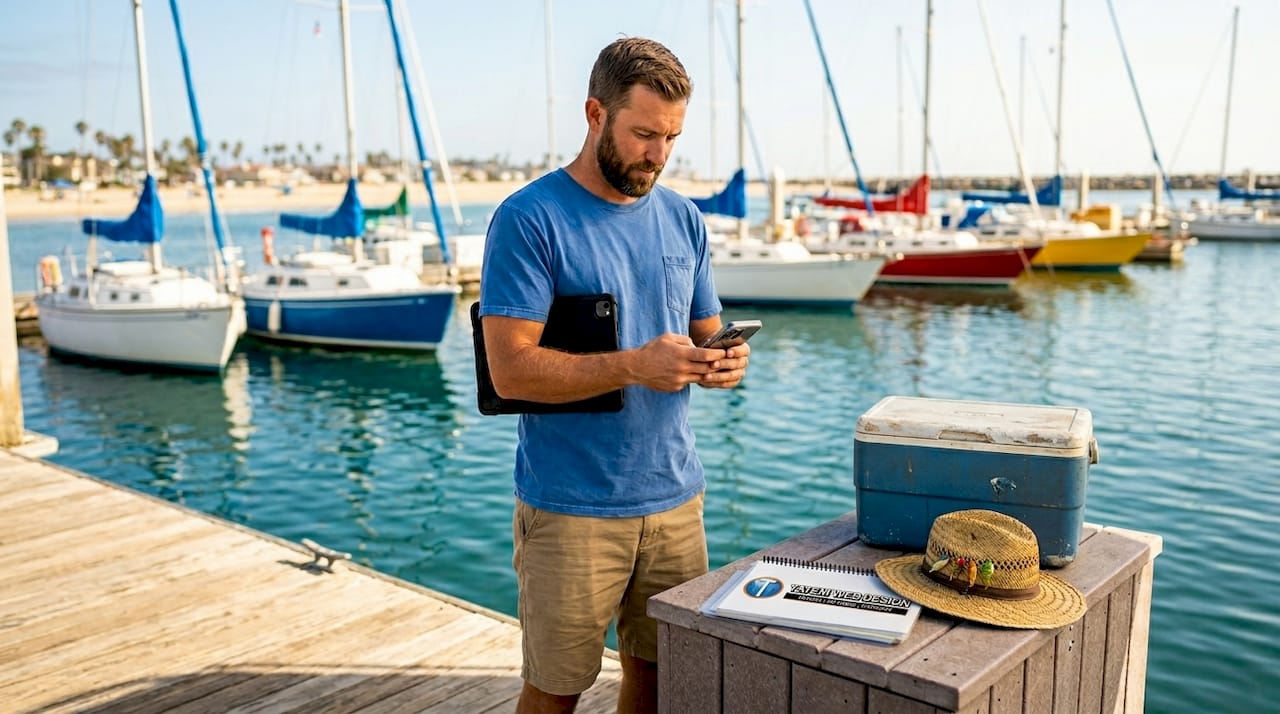
The foundation starts with responsive web design best practices built specifically for mobile users who are often browsing from a dock, a boat ramp, or even on the water. That customer searching “boat rentals near me” on a Saturday morning at 7 AM isn’t sitting at a desktop. If your site takes five seconds to load or forces pinching and zooming on a phone screen, you’ve already lost them. Speed and mobile performance are not optional features in this industry.
Marine industry website design also requires a specific set of core capabilities that generic templates simply don’t include out of the box. According to Six Marketing’s boating and marine web design framework, key mechanics include responsive and mobile-first design, fast loading for mobile users on docks and boats, SEO for location-specific searches, inventory integration, booking flows, and growth-driven design. Each of these elements plays a critical role in how customers find your business and decide to contact you.
Here’s a clear breakdown of how marine web design stacks up against generic web design:
| Feature | Generic web design | Marine industry web design |
|---|---|---|
| Mobile performance | Standard optimization | Dock/boat use optimized, fast load |
| SEO strategy | Broad keyword focus | Florida coastal city-specific terms |
| Inventory management | Not included | Boat listings, rentals, charters |
| Booking integration | Basic contact forms | Real-time booking and availability |
| Compliance | General best practices | ADA/WCAG, SSL, marine UX standards |
| Trust elements | Generic testimonials | Marine credentials, certifications |
| Design goal | General brand presence | Lead generation and conversion |
The core features every strong boat dealer website should have include:
- Mobile-first layout with fast load times under three seconds
- Inventory database integration for browsable boat listings
- Real-time booking systems for charters, rentals, and slip reservations
- Florida city-specific landing pages for local search visibility
- Trust signals including certifications, reviews, and secure payment indicators
- Clear calls to action designed for quick contact on mobile
One critical concept that separates high-performing marine sites from mediocre ones is growth-driven design, which we will cover in detail later. For now, understand that marine professionals need a site built to evolve, not a static brochure that collects digital dust. The Florida marine market moves fast, seasons shift, inventory changes, and your website must keep up.
Compliance essentials for Florida marine websites
Now that you know what sets marine web design apart, let’s focus on compliance essentials for Florida businesses.
Compliance is one of the most misunderstood topics in marine industry web design. Many business owners assume that because they operate on the water, their websites somehow fall outside the reach of standard web regulations. That assumption has cost some Florida businesses significantly. The reality is straightforward: if your site is public-facing, it must meet accessibility, security, and privacy standards, regardless of your industry.
ADA website compliance is the most pressing legal concern for Florida marine businesses. The Americans with Disabilities Act (ADA) applies to websites, and Florida courts have seen a steady rise in web accessibility lawsuits targeting small and mid-size businesses. ADA and WCAG compliance requirements for Florida public-facing sites include keyboard navigation, descriptive alt text for images, sufficient color contrast, clear link descriptions, and screen-reader compatibility. Ignoring these standards doesn’t just create ethical problems. It creates legal exposure.
Importantly, there are no web regulations specific to the marine industry in Florida. As research from Accessibility Works confirms, no marine-specific web regulations exist beyond general web standards, meaning your compliance focus should be on industry-tailored user experience and SEO rather than searching for niche maritime web laws that don’t exist. This actually simplifies your compliance roadmap considerably.
Here’s a practical compliance data table for Florida marine website operators:
| Compliance area | What to implement | Risk level if ignored |
|---|---|---|
| ADA/WCAG accessibility | Alt text, keyboard nav, color contrast | High, active litigation in Florida |
| SSL certificate | HTTPS across all pages | High, browser warnings drive users away |
| Privacy policy | Clear data collection disclosures | Medium, required for any data capture |
| Cookie consent | Banner for tracking cookies | Medium, increasing enforcement |
| Contact accuracy | Verified address, license numbers | Medium, trust and local SEO impact |
| Mobile usability | Responsive design, tap-friendly buttons | High, Google ranking factor |
Pro Tip: Run your existing site through the WebAIM Contrast Checker and Google’s PageSpeed Insights before anything else. These two free tools will expose your biggest compliance and performance gaps in under five minutes, and fixing those issues often creates an immediate improvement in both user experience and search rankings.
Beyond legal compliance, trust-building elements are what convert visitors into customers. For marine businesses specifically, this means displaying Florida marine contractor licenses, verified customer reviews, marina affiliations, and safety certifications. These signals tell a first-time visitor that your business is legitimate, experienced, and worth calling. A technically compliant site that feels cold or generic will still underperform. Compliance and trust must work together.
Quick wins you can implement today to improve your Florida marine site’s compliance standing:
- Add an SSL certificate if you haven’t already. Every page should load with HTTPS.
- Write descriptive alt text for every image, especially boat photos and gallery shots.
- Post a clear privacy policy that explains what visitor data you collect and why.
- Verify your contact information is current, accurate, and matches your Google Business Profile.
- Test keyboard navigation by pressing Tab through your entire homepage without using a mouse.
For deeper compliance guidance, reviewing expert web design compliance tips specific to Florida can save you from costly mistakes that are easy to overlook when you’re focused on running your marine business.
Driving visibility with location-focused SEO and inventory integration
With compliance covered, visibility becomes the next major concern for Florida marine operators.
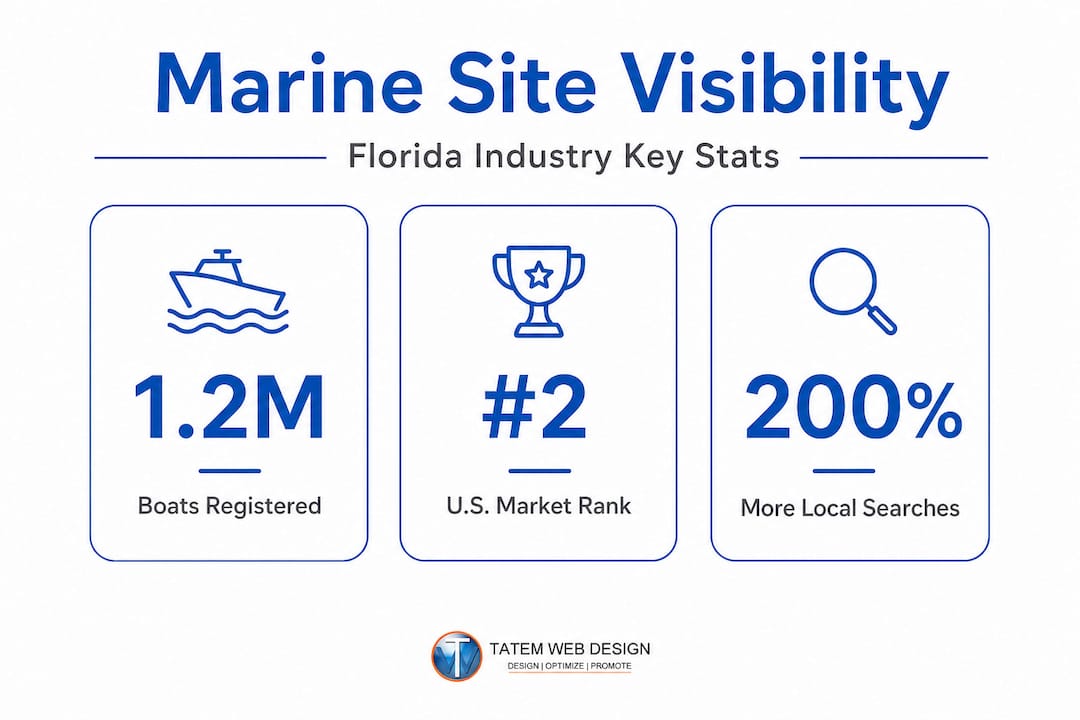
Florida is one of the most competitive marine markets in the world. With over 1.2 million registered boats in the state and a coastline that stretches more than 1,300 miles, the opportunity is enormous. But so is the competition. Getting found in search results for terms like “boat charters Fort Lauderdale” or “used boats for sale Stuart FL” requires a deliberate SEO strategy built around Florida’s specific geography and marine culture.
Florida local SEO strategies for marine businesses start with understanding how customers in different coastal cities search for your services. Someone in Miami searches differently than someone in Destin or Naples. Building location-specific content and landing pages for each market you serve is one of the most effective ways to pull in qualified traffic. Generic pages that say “we serve all of Florida” rarely rank anywhere. Specific pages built for Fort Lauderdale, Miami, Stuart, or Tampa Bay will.
As Six Marketing’s marine web design research confirms, location-specific SEO for Florida cities, inventory integration, and booking flows are among the highest-impact features you can build into a marine website. Here’s a step-by-step approach to building that visibility:
- Identify your primary service areas and create individual landing pages for each Florida city or region you serve.
- Research location-specific keywords using terms like “boat rental [city name],” “marine repair [city name],” or “yacht charter near [marina name].”
- Integrate your boat inventory into your website with searchable filters, high-quality photos, detailed specs, and pricing. Static PDF catalogs are invisible to search engines.
- Add real-time booking functionality so customers can check availability and schedule directly on your site without calling your office.
- Claim and optimize your Google Business Profile and ensure your NAP (name, address, phone number) data matches perfectly across your website and all directories.
- Build local backlinks by partnering with Florida marina associations, boating clubs, and local tourism boards to earn links back to your site.
- Embed schema markup (structured data) for your services, so Google can display rich results like star ratings, pricing, and availability directly in search.
Pro Tip: Marine businesses that use schema markup for their boat listings and charter services often see enhanced Google display results that show prices, availability, and review stars directly in search. This increases click-through rates significantly without any additional ad spend. Schema markup is free to implement and frequently overlooked by marine businesses that rely on generic web templates.
Inventory integration deserves special attention because it’s one of the most powerful lead-generation tools available to marine businesses, yet most sites handle it poorly. When a customer can browse available boats, filter by length, engine type, price, or location, and then book or inquire directly from the listing page, your conversion rate climbs dramatically. Florida marine web examples show that marine businesses with integrated inventory systems consistently outperform those relying on static image galleries or phone-only inquiries.
SEO services for marine sites that combine local keyword targeting with dynamic inventory integration create a compounding effect over time. Each new boat listing becomes an indexed page that can rank in search. Each location landing page targets a distinct audience. Each booking confirmation email can automatically request a review. These are not isolated tactics. They work together as a system.
Applying growth-driven design for Florida marine businesses
After visibility and compliance, ongoing improvement is key. Let’s look at how growth-driven design can deliver results fast for marine businesses.
Growth-driven design, commonly referred to as GDD, is a methodology that flips the traditional web design model on its head. Instead of spending months building a “perfect” website and then launching it, GDD launches a minimum viable site quickly and uses real user data to drive continuous improvements. For Florida marine businesses, this approach is particularly powerful because it means you’re live and generating leads within weeks, not months.
As the research behind marine web design confirms, growth-driven design launches a minimum viable site quickly and iterates based on user data rather than assumptions. This is especially valuable for seasonal marine businesses where missing peak season can cost tens of thousands of dollars in lost bookings.
Here’s a practical GDD process adapted for Florida marine businesses:
- Plan: Define your business goals, target customers, and the core pages your site absolutely must have. For most marine businesses, this means a homepage, service pages for each offering, an inventory or gallery section, a contact page, and at least one location-specific landing page.
- Launch: Build and deploy your starter site within four to eight weeks. This is not a half-finished site. It’s a focused, well-designed site built around your most important customer actions.
- Measure: Track user behavior using tools like Google Analytics and heat mapping software (such as Hotjar or Microsoft Clarity). Identify where visitors drop off, which pages drive calls, and what content generates the most time on site.
- Refine: Based on real data, update and expand your site continuously. Add new location pages as you enter new markets, update your inventory, test new calls to action, and improve pages that aren’t converting.
- Repeat: GDD is a cycle, not a destination. Every quarter, review your data and prioritize the next round of improvements.
South Florida web design agencies that embrace GDD for their marine clients often see dramatically faster ROI than those locked into long traditional build cycles. Consider a Fort Lauderdale boat charter company that launched a lean GDD site in six weeks during the off-season. By the time peak season arrived, they had six weeks of real user data showing that visitors were abandoning the booking page at the payment step. A quick redesign of that page before season opened led to a measurable spike in completed bookings without any change to their marketing budget.
“The businesses that win online aren’t the ones with the most expensive websites. They’re the ones that treat their website as a living asset, investing in continuous improvement based on what their actual customers are doing.” This captures the core philosophy behind growth-driven design and why modern iterative web design consistently outperforms static build-and-forget approaches.
Marine industry web design examples from successful Florida businesses consistently show one common thread: the sites that perform best were not launched as finished products. They were launched as starting points and improved over time using data.
Pro Tip: Set up Google Search Console on day one of your GDD site launch. This free tool shows you exactly which search queries are bringing visitors to your site, which pages are gaining or losing rankings, and where technical issues may be blocking your visibility. It’s the fastest way to identify quick wins in your first 30 days.
The reality most marine web design guides miss
Having explored the step-by-step frameworks, here’s a candid perspective few advisers will share.
Most marine web design guides focus on checklists. Add alt text. Get SSL. Use mobile-friendly design. Implement local SEO. These are all correct and necessary. But the guides almost never address the tension that sits at the center of every successful marine website project: the ongoing battle between compliance, user experience, and actual business results.
Here’s the uncomfortable truth we’ve seen play out with Florida marine businesses over more than two decades of hands-on work. A site can be fully ADA compliant, load in under two seconds, and rank on page one for three Florida city keywords, and still generate almost no revenue. Why? Because compliance doesn’t convert. Customer experience does.
Many marine business owners, after reading about ADA requirements and schema markup, shift their entire focus to technical correctness. They spend budget on compliance audits and ignore the fundamental question: does this site make a customer want to pick up the phone right now? Technical standards exist to ensure your site is accessible and findable. They do not exist to close deals. That work belongs to copywriting, design psychology, clear pricing, visible testimonials, and fast booking flows.
Research confirms that general web standards govern marine websites rather than any industry-specific marine web regulations, which means your real competitive edge comes from superior user experience and smarter SEO, not from finding some hidden marine compliance box to check. The businesses that dominate Florida’s coastal search results have simply done the basics better than everyone else, and kept improving.
Another hard lesson: most marine businesses treat their website like a brochure rather than a salesperson. A brochure is printed once and forgotten. Your website should be your most productive team member, working 24 hours a day to answer questions, qualify leads, and drive bookings. That only happens when you commit to ongoing iteration rather than treating launch day as the finish line.
Invest in ADA web design as your compliance baseline, but then invest equally in the experience that makes a first-time visitor choose you over the competitor two search results below you. That balance, between legal correctness and genuine appeal, is what separates Florida marine businesses that grow from those that stall.
Level up with specialized marine web solutions
Ready to take action? Here’s how you can apply these principles with expert local help.
Florida’s marine industry is too competitive to rely on generic digital tools. Tatem Web Design, based in Stuart, Florida, brings over 26 years of experience in building high-performance websites for marine professionals across the state. We specialize in creating AI website design services that combine rapid launch timelines with powerful local SEO, ADA compliance, and AI-driven lead capture tools built specifically for Florida coastal markets.
Whether you’re a boat dealer, charter operator, marina, or marine repair service, we build digital solutions that do real work for your business. Our Florida web design agency team handles everything from compliance audits and inventory integration to AI chatbots and booking automation. If your current site isn’t pulling in consistent leads, it’s time to change that. We also offer specialized ecommerce web design for marine businesses selling parts, gear, and services online. Call us directly at 772-224-8118 to schedule your consultation.
Frequently asked questions
What is marine industry web design?
It’s specialized web design tailored for marine businesses, emphasizing mobile usability, compliance, and inventory management. As key marine web design mechanics confirm, effective marine sites require responsive and mobile-first design, fast loading, SEO, inventory integration, booking flows, and growth-driven design.
Do Florida marine websites have unique legal requirements?
No, they follow general standards like ADA/WCAG accessibility, SSL security, and privacy. Research confirms no marine-specific web regulations exist in Florida beyond standard web compliance requirements.
How can marine sites improve local visibility?
By implementing Florida-focused SEO, responsive design, and integrated booking or inventory tools. Location-specific SEO targeting Florida cities like Miami and Fort Lauderdale, combined with inventory integration and booking flows, directly drives qualified local traffic.
What is growth-driven design in marine web projects?
GDD is a methodology that launches a minimum viable site quickly and then iterates based on real user data, helping marine businesses adapt fast rather than waiting months for a perfect launch that may miss peak season.
Recommended
Tatem Web Design
26+ YearsWeb Design & SEO Specialist · Tatem Web Design
Matt Tatem has been designing websites professionally since 1999, making Tatem Web Design one of Florida's longest-running web agencies. Based in Stuart, FL, he specializes in WordPress, local SEO, Shopify e-commerce, and cybersecurity consulting for small businesses.
What a CMMC Level 2 Assessment Requires and How to Prepare
Prepare for your CMMC Level 2 assessment by understanding requirements, assessment paths, and mapping your Controlled Unclassified Information.

A Data Retention Policy Is Your Rulebook for Keeping and Deleting Data
Establishing a clear data retention policy helps manage data risk, ensuring compliance and effective data management for your organization.

Law Firm Local SEO: A Practical Playbook for More Local Clients
Unlock more local clients for your law firm with effective local SEO strategies. Optimize your Google Business Profile and boost your visibility!