
The Real Role of SEO for Real Estate Agents in 2026

SEO makes your listings, neighborhood pages, and agent profile the first organic result local buyers and sellers see when they search. That single outcome drives three concrete business results: more qualified leads from people already looking to buy or sell, a lower cost-per-lead compared to paid portal placements, and stronger local brand authority that compounds over time. According to NAR, a large majority of buyers (88%) purchased through an agent, and virtually all of them started their search online. If your website is not ranking, a competitor is capturing that traffic instead.
Here is what that means in practice for you:
- More qualified leads: Organic visitors arrive with specific intent (“homes with specific features in targeted locations”), making them far more likely to convert than cold ad traffic.
- Lower cost-per-lead: Once a page ranks, it generates leads without a per-click fee. Paid portals charge you every month regardless of results.
- Local brand authority: Consistent rankings in your market build name recognition that referrals and repeat clients reinforce.
- Long-term compounding: A well-optimized page continues to attract traffic for months or years after the initial work is done.
Your single best first step: run a quick local visibility check by searching your primary service keyword on Google, then verify your Google Business Profile is claimed, complete, and active. If either is missing or weak, that is where your SEO program starts.
Table of Contents
- What does real estate SEO actually cover?
- How does SEO function as a lead-generation engine?
- Your prioritized SEO checklist for real estate
- Local SEO and Google Business Profile: what actually moves the needle
- Technical SEO for property sites: what you need to audit
- Which content types win in real estate search?
- How do you measure SEO success for real estate?
- When will you see results, and what does it cost?
- Common SEO mistakes that cost real estate agents leads
- What a professional real estate SEO engagement looks like
- Key Takeaways
- The part most agents get wrong about SEO
- Tatemweb builds real estate SEO programs that generate leads
- Useful sources
- FAQ
What does real estate SEO actually cover?
Real estate SEO, also called real estate search engine optimization, is the practice of improving your website’s visibility in organic (non-paid) search results so that buyers, sellers, and investors find you before they find anyone else. It is not the same as paying for a Zillow Premier Agent listing or running Google Ads, though those channels can complement it.
The discipline covers five interconnected areas:
- Local SEO: — Google Business Profile (GBP) management, NAP (name, address, phone) consistency across directories, neighborhood landing pages, and review velocity.
Portal vs. agent SEO: Paid portals like Zillow and Realtor.com are useful for brand exposure and listing syndication, but they own the ranking, not you. SEO on your own domain builds an asset you control. For agents and investors who want predictable, long-term lead flow, your own site’s organic visibility is the primary growth engine. Portals work best as a supplemental channel while your SEO program matures.
How does SEO function as a lead-generation engine?
SEO captures demand at every stage of the buying or selling funnel and converts it through targeted landing pages built around specific search intents. The funnel is not a straight line, but it has three recognizable stages, each with its own keyword type and conversion goal.
Awareness stage: The searcher is exploring. They type “is now a good time to buy in [city]?” or “what is the average home price in [neighborhood]?” Your content here is informational: market reports, neighborhood overviews, and FAQ pages. The conversion goal is an email capture or newsletter sign-up, not an immediate call.
Consideration stage: The searcher is comparing options. They search “best neighborhoods in [city] for families” or “top real estate agents in [county].” Here, your agent profile page, testimonials, and comparison content do the work. The conversion goal is a contact form submission or a phone call.
Transaction stage: The searcher is ready to act. They type “homes for sale in [ZIP code]” or “sell my house fast [city].” These are your highest-value pages: listing hubs, IDX search pages, and seller landing pages. The conversion goal is a booked consultation or a direct call.
Keyword-to-page mapping examples:
| Search intent | Page type | Primary conversion element |
|---|---|---|
| “homes for sale in [neighborhood]” | IDX listing hub | Click-to-call + contact form |
| “real estate agent in [city]” | Agent profile page | Booking widget or phone link |
| “[neighborhood] market report 2026” | Market report post | Email capture / PDF download |
| “how to sell my house in [city]” | Seller resource page | Free valuation CTA |
Every page needs at least one clear conversion element: a click-to-call phone number, a short contact form (name, email, message, nothing more), or a calendar booking link. Pages that rank but do not convert are a technical SEO win and a business loss.
Your prioritized SEO checklist for real estate
This is the sequence that produces results fastest, ordered by impact relative to effort. Work through it in order, or hand it to your agency as a scope document.
-
Run a discovery audit. Use Google Search Console and Google Analytics to establish your baseline: current rankings, organic traffic volume, top-performing pages, and crawl errors. If you have neither set up, that is step zero.
-
Build your keyword map. Group keywords by intent and geography. Start with your primary market: “[city] homes for sale,” “[neighborhood] real estate agent,” “[city] market report.” Use Google’s autocomplete and the “People Also Ask” boxes to find long-tail variants. For deeper local keyword research, Tatemweb’s keyword research guide walks through the full process.
-
Optimize on-page elements. For every priority page, write a unique title tag (50–60 characters, primary keyword near the front), a meta description (150–160 characters, benefit-led), and an H1 that matches search intent. Example title tag: “Homes for Sale in Stuart FL | [Your Name] Real Estate.” Example meta: “Browse current listings in Stuart, FL. [Your Name] helps buyers find the right home fast. Call 772-XXX-XXXX.”
-
Claim and complete your Google Business Profile. Select “Real Estate Agent” or “Real Estate Agency” as your primary category. Add your service areas, upload photos, and post at least once per week. This single action is the fastest path to map-pack visibility.
-
Fix technical issues. Confirm HTTPS is active, your sitemap is submitted to Search Console, and your site loads in under three seconds on mobile. Address any crawl errors flagged in Search Console before adding new content.
-
Add structured data. Implement schema.org markup for RealEstateListing and RealEstateAgent on your property and profile pages. This helps search engines understand your content and can produce rich results in the SERP.
-
Build neighborhood content. Create one dedicated page per target neighborhood or ZIP code. Each page should cover local market stats, school district notes, commute details, and lifestyle context that portals do not provide.
-
Start a link-building program. Pursue citations from local directories (Yelp, BBB, local chamber), sponsorships of community events, and links from local news coverage. These hyperlocal signals carry more weight for map-pack rankings than generic national backlinks.
-
Establish a content calendar. Publish at minimum two pieces per month: one market update (using NAR data as a source) and one neighborhood or buyer/seller resource page. Consistency matters more than volume.
Pro Tip: If your budget is limited, prioritize steps 4 (GBP), 5 (technical fixes), and 7 (neighborhood pages) first. Those three actions produce the fastest local visibility gains with the least content overhead.
Local SEO and Google Business Profile: what actually moves the needle
Local SEO is where most real estate agents win or lose the visibility battle. A buyer searching “real estate agent near me” or “homes for sale in [neighborhood]” sees a map pack before they see any organic results. If you are not in that pack, you are invisible to the highest-intent searchers.
Google Business Profile as your primary local asset
Google Business Profile is the single most important local SEO asset you control. Complete every field: business name, address, phone, website, hours, service areas, and primary category. Upload at least 10 photos, including your headshot, office exterior, and sold properties. Post weekly updates with local market news or new listings. Agents who treat GBP as a static directory listing miss the engagement signals Google uses to rank map-pack results.
Neighborhood and school-district landing pages
Each neighborhood page should answer the questions a buyer would ask before scheduling a showing: What are homes selling for right now? What schools serve this area? What is the commute like? How does this neighborhood compare to the one next door? That level of specificity is what national portals cannot replicate at scale, and it is what earns you both rankings and trust. Local SEO tactics for real estate consistently identify neighborhood content as the highest-value organic asset for agents competing against portal dominance.

NAP consistency and citation building
Your name, address, and phone number must be identical across every directory where your business appears: Google, Yelp, BBB, Realtor.com profile, local chamber, and any local news mentions. Even a minor variation (“St.” vs. “Street”) creates a trust signal conflict for Google. Audit your citations quarterly using a tool like BrightLocal or Whitespark, and prioritize local directories over generic national ones.
Review velocity
Aim for a steady stream of new reviews rather than a burst followed by silence. Ask every closed client within 48 hours of closing, while the experience is fresh. A simple text message with a direct GBP review link converts at a much higher rate than a follow-up email sent two weeks later. Responding to every review, positive or negative, signals active management to both Google and prospective clients.
Technical SEO for property sites: what you need to audit
Property websites have technical constraints that standard business sites do not. IDX feeds, large listing databases, and image-heavy pages create crawlability and performance challenges that can silently suppress your rankings even when your content is excellent.
Core technical audit checklist:
- XML sitemap: — Submit a clean sitemap to Google Search Console. Exclude low-value pages (thank-you pages, filtered search results) to focus crawl budget on your priority content.
IDX integration: the indexability problem
Most IDX solutions serve listing content in iframes or via JavaScript that search engines cannot crawl. That means thousands of property pages on your site may be invisible to Google. The fix is to either use an IDX provider that generates server-side rendered, indexable listing pages, or to supplement your IDX with manually created listing hub pages that you control and optimize. Ask your IDX vendor directly: “Are my listing pages indexable by Google?” If they cannot answer clearly, treat the answer as no.
Industry guidance for real estate SEO in 2026 consistently flags indexable listings as a top technical priority, alongside entity authority and local content depth.
Structured data for property pages
Implement schema.org markup for two key types: RealEstateListing (for individual property pages) and RealEstateAgent (for your profile and team pages). RealEstateListing markup can include price, address, number of bedrooms and bathrooms, listing status, and listing agent details. This structured data helps search engines parse your content accurately and can generate rich result features in the SERP, including price and property details displayed directly in search results.
Which content types win in real estate search?
The content assets that consistently outperform in real estate SEO share one quality: they provide information that national portals either cannot or do not bother to produce at a local level. That information gap is your competitive advantage.
High-value content types and why they work:
Neighborhood guides are the cornerstone asset. A well-built guide covers median sale prices, school ratings, walkability, local businesses, community events, and honest lifestyle context. Buyers use them to shortlist neighborhoods before they ever look at a specific listing. NAR’s generational trends data shows that different buyer cohorts prioritize different neighborhood attributes, which means you can tailor each guide to the demographic most likely to buy in that area.
Market reports position you as the local expert. Pull data from NAR’s monthly research updates, your MLS, and local economic indicators. Publish monthly or quarterly. A page titled “[City] Real Estate Market Report: [Month] 2026” ranks for high-intent searches from both buyers and sellers trying to time the market.
Buyer and seller resource pages capture mid-funnel traffic. “How to buy a home in [city]” and “what to expect when selling in [county]” pages attract searchers who are 30–90 days from a transaction. These pages convert well because the reader is actively preparing, not just browsing.
Keyword clustering and internal linking
Group your keywords into clusters around a primary topic, then build a hub-and-spoke structure. The hub page (e.g., “[City] Real Estate”) targets the broadest keyword and links out to spoke pages (individual neighborhood guides, market reports, buyer/seller resources). Each spoke page links back to the hub. This pattern concentrates link equity on your highest-priority pages and signals topical depth to Google.
A practical example: your “[Stuart FL Real Estate]” hub links to “Stuart FL Neighborhoods Guide,” “Stuart FL Market Report 2026,” and “Homes for Sale in Stuart FL.” Each of those pages links back to the hub and cross-links to the others where relevant. The result is a tightly connected content cluster that ranks for a wide range of related searches while funneling visitors toward your contact page.
Pro Tip: Use NAR’s monthly research updates as the data backbone for your market reports. Citing a primary source like NAR builds credibility with readers and adds the kind of authoritative reference that strengthens your EEAT signals with Google.
How do you measure SEO success for real estate?
Tracking the right metrics separates an SEO program that is working from one that is just producing activity. For real estate professionals, the KPIs that matter most are the ones tied directly to lead flow and revenue, not vanity metrics like raw page views.
Critical KPIs to track monthly:
- Leads from organic: — Form submissions, phone calls, and chat inquiries attributed to organic search. Set up goal tracking in Google Analytics (GA4) for every conversion point.
Recommended tools: Google Analytics 4 for traffic and conversions, Google Search Console for keyword impressions and crawl health, Google Business Profile Insights for local actions, and a dedicated local rank tracker for position monitoring.
SEO performance benchmarks
| Metric | Early stage (early months) | Growth stage (middle months) | Mature stage (later months) |
|---|---|---|---|
| Keyword rankings | Impressions rising, few page-one positions | several keywords on page one | many keywords on page one |
| Organic traffic | Baseline established | Measurable month-over-month growth | Consistent lead-generating volume |
| Leads from organic | Minimal | a handful of leads per month | a number of leads per month depending on the market |
| Estimated ROI | Negative (investment phase) | Approaching break-even (~10 months) | Positive; ~1,389% ROI at maturity |
A simple monthly reporting template: track organic sessions, leads from organic, GBP calls, top 10 ranking keywords, and one qualitative note on what changed (new content published, technical fix applied, new citations added). That five-line summary is enough to manage an SEO program intelligently.
When will you see results, and what does it cost?
Expect measurable ranking movement in 3–6 months and meaningful lead volume in 6–12 months, with the caveat that competitive markets and older domains with existing authority can shift those timelines in either direction. A brand-new domain in a competitive metro market will take longer than an established agent site in a smaller market.
Timeline and cost reference
| Phase | Timeline | Typical monthly investment | What to expect |
|---|---|---|---|
| Foundation (audit + setup) | Month 1–2 | a moderate monthly or one-time investment | GBP optimization, technical fixes, keyword map |
| Content and local build-out | Month 3–6 | a moderate monthly investment | Neighborhood pages, citations, on-page optimization |
| Growth and authority | Month 6–12 | a higher monthly investment | Rankings moving, early lead flow, link building |
| Maturity | Month 10+ | a moderate monthly investment (maintenance) | Consistent leads, break-even point in under a year |
These ranges reflect typical agency retainer pricing for a single-agent or small team program in a mid-size U.S. market. Large metro markets (Miami, Los Angeles, New York) command higher investment because keyword competition is significantly more intense.
Budgeting priorities for limited resources: If you have $1,000 per month or less, put it toward GBP optimization, two neighborhood pages, and citation cleanup. Those three activities produce the fastest local visibility gains. Add technical fixes and link building as budget allows. Avoid spreading a small budget across every tactic at once; depth on a few high-impact actions outperforms shallow effort across many.
Signals that justify higher investment: You are in a top-10 metro market, you have multiple service areas, you represent a brokerage with multiple agents, or you are targeting both buyers and investors simultaneously. Each of those scenarios multiplies the number of pages and keyword clusters you need to compete effectively.
Common SEO mistakes that cost real estate agents leads
Most real estate SEO programs underperform not because the strategy is wrong, but because a handful of recurring mistakes quietly drain results. Recognizing them early saves months of wasted effort.
Mistakes to avoid:
- Relying only on portals: Zillow and Realtor.com rank for your keywords, not you. Paying for portal placement while neglecting your own site means you are building someone else’s asset.
- Duplicate IDX pages: Unmanaged IDX feeds create hundreds of near-identical pages that dilute crawl budget and trigger duplicate content issues. Use canonical tags and limit indexation to your most valuable listing pages.
- Ignoring Google Business Profile: An unclaimed or incomplete GBP is the single fastest way to lose map-pack visibility to a competitor who spent 30 minutes on setup.
- Poor mobile performance: Google’s mobile-first indexing means a slow mobile site suppresses rankings across all devices, not just phones.
- Buying irrelevant links: A link from a generic “top 10 real estate blogs” roundup on a domain with no local relevance does almost nothing for local rankings. Prioritize links from local organizations, news outlets, and community partners.
- Publishing thin content: A neighborhood page with three sentences and a contact form is not a neighborhood guide. It will not rank, and it will not convert.
Red flags that your SEO program is failing:
- Traffic is growing but leads are flat. This usually means you are ranking for informational keywords without conversion-optimized pages.
- No improvement in map-pack visibility after 90 days of GBP work. Check for NAP inconsistencies or a suspended GBP listing.
- Review count has stalled. A static review profile signals low client engagement and can suppress local rankings over time.
Quick fixes with high impact: Add a click-to-call button above the fold on every page. Respond to every GBP review within 24 hours. Add your city and state to the title tag of every service page. These three changes take less than two hours and produce measurable results.
What a professional real estate SEO engagement looks like
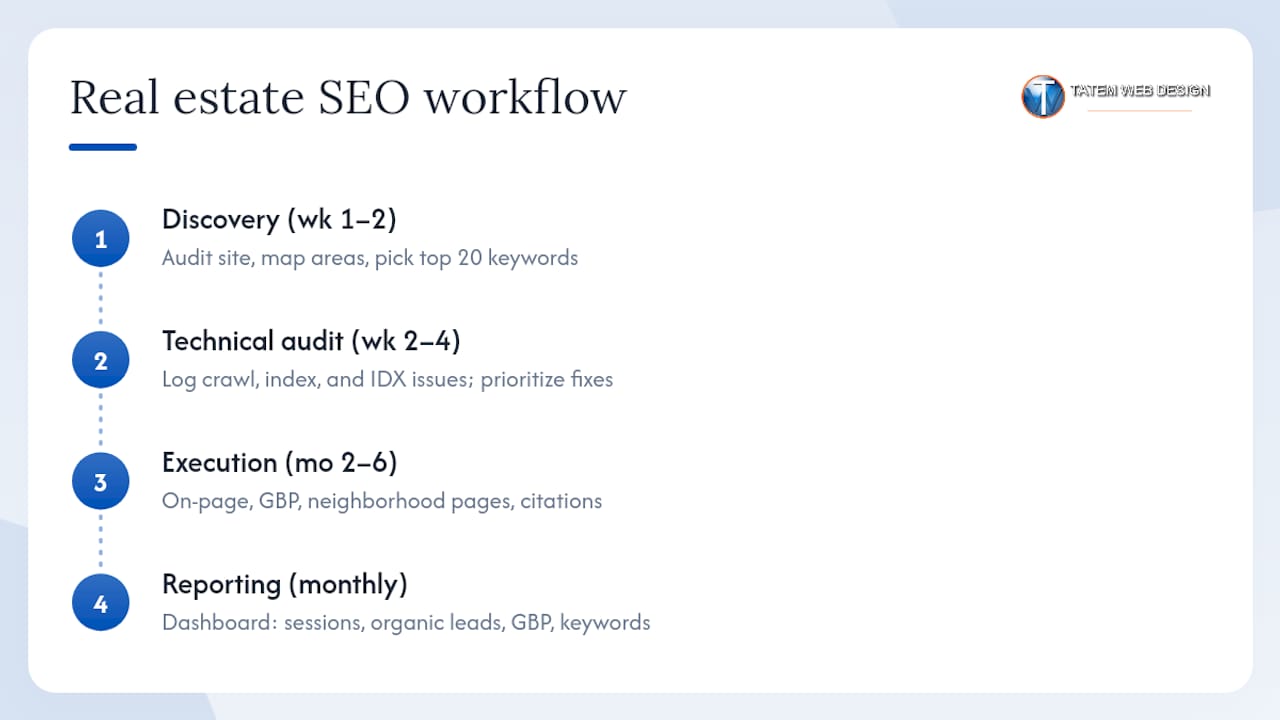
A well-run agency combines local market research, technical remediation, content production at scale, and secure hosting to produce predictable, measurable results. The workflow is sequential, not simultaneous, because each phase builds on the last.
Discovery (week 1–2): The agency audits your current site, documents existing rankings, maps your service areas, and identifies your top 20 priority keywords. This phase also includes a competitor gap analysis: which pages are your local competitors ranking for that you are not?
Technical audit and prioritization (week 2–4): Every crawl error, indexation issue, IDX problem, and speed bottleneck is documented and ranked by impact. The highest-priority fixes go first: HTTPS, sitemap, mobile speed, canonical tags on IDX pages.
Execution (month 2–6): On-page optimization, GBP setup, neighborhood page creation, citation building, and structured data implementation run in parallel. Content is produced on a calendar, with market reports and neighborhood guides published consistently.
Reporting (monthly): A clean dashboard showing organic sessions, leads from organic, GBP actions, and keyword movement. Every month includes a one-paragraph narrative explaining what changed and why.
Tatemweb brings over 26 years of web development and digital marketing experience to real estate clients, combining AI-assisted content production with technical SEO, secure cloud hosting, and compliance-aware site architecture. For real estate professionals who handle sensitive client data, that combination of SEO performance and security infrastructure is not a luxury; it is a professional standard. AI-driven website design accelerates the page creation process without sacrificing the on-page quality that rankings require.
Safe AI usage in content generation means every AI-assisted page is reviewed for factual accuracy, local specificity, and EEAT signals before publication. AI handles the structural scaffolding; a human expert adds the neighborhood nuance, market data, and agent voice that Google’s quality raters look for. That workflow produces more content, faster, without the quality shortcuts that get sites penalized.
Key Takeaways
Real estate SEO works because it places your listings and agent profile in front of buyers and sellers at the exact moment they are searching, converting high-intent organic traffic into qualified leads at a fraction of the cost of paid portals.
| Point | Details |
|---|---|
| Start with GBP and technical fixes | Claim your Google Business Profile and resolve crawl errors before adding new content. |
| Neighborhood pages are your top asset | Hyperlocal content that portals cannot replicate drives the highest-intent organic traffic. |
| Break-even arrives around month 10 | SEO ROI data shows real estate reaching about 1,389% ROI at program maturity. |
| Track leads, not just traffic | Measure form submissions, GBP calls, and goal conversion rate monthly to prove business value. |
| Tatemweb delivers the full program | Tatemweb combines AI-assisted content, local SEO, technical audits, and secure hosting for real estate clients. |
The part most agents get wrong about SEO
There is a persistent belief in real estate that SEO is a slow, passive channel you set up once and wait on. That framing leads agents to under-invest, under-maintain, and then conclude that SEO “doesn’t work” after six months of minimal effort.
The agents who see the strongest results treat SEO as an active lead-generation program, not a background task. They publish market reports consistently, respond to every review within a day, update their GBP weekly, and fix technical issues the same week they are flagged. That cadence is what separates a site that ranks from one that stagnates.
There is also a tendency to measure SEO success by keyword rankings alone. Rankings are a leading indicator, not the outcome. The outcome is a phone call from a qualified buyer or a seller who found you on Google and already trusts you before the first conversation. That trust is built by the content they read on your site, the reviews they saw on your GBP, and the neighborhood guide that answered their question better than any portal did. Rankings get them to your site. Everything else closes the gap.
For real estate investors specifically, the opportunity is even more underutilized. Most investors rely on direct mail, cold calling, or paid ads. A single well-optimized page targeting motivated sellers in a specific ZIP code can generate inbound leads that cost a fraction of what direct mail produces per response. The investors who figure this out early build a durable lead source that their competitors are not even aware of.
Tatemweb builds real estate SEO programs that generate leads
If you have read this far, you already know what needs to happen. The question is whether you have the time and technical depth to execute it yourself or whether a focused agency engagement gets you there faster.
Tatemweb is a full-service digital agency based in Stuart, Florida, with over 26 years of experience building and ranking websites for real estate professionals. The real advantage is not just SEO knowledge; it is the combination of AI-powered website design, local SEO execution, AI chatbot and lead-capture integration, and compliance-aware hosting under one roof. You get a site that ranks, loads fast, captures leads automatically, and meets the security standards your clients expect.
The engagement follows a clear sequence: a technical and local visibility audit, a prioritized action plan with realistic timelines, hands-on execution across on-page, technical, and local SEO, and monthly reporting that shows exactly what your investment is producing. No vague deliverables, no 12-month lock-in before you see results.
Call Tatemweb directly at 772-224-8118 or explore the full AI services portfolio to see how a structured SEO program can put your listings and agent profile in front of the buyers and sellers already searching in your market.
Useful sources
These primary sources are worth bookmarking. Each one serves a specific purpose in building and sustaining a real estate SEO program.
- Equity-Rich Buyers, Sellers Are Driving Today’s Housing Market
- schema.org
- Local SEO for Real Estate: 2026 Domination Guide
- SEO ROI Statistics 2026: Returns, Costs & Break-Even Time
- MONTHLY RESEARCH UPDATE
- Home Buyers and Sellers Generational Trends
- Google Business
- The Ultimate Guide to Real Estate SEO for Agents in 2026
FAQ
What is SEO in real estate?
Real estate SEO is the practice of optimizing your website, Google Business Profile, and content so that buyers and sellers find you in organic search results. It covers on-page optimization, technical site health, local signals like GBP and citations, and content assets like neighborhood guides and market reports.
Is SEO still effective for real estate in 2026?
Yes, and the ROI case is stronger than most agents realize. Resourcera’s data shows real estate SEO delivering about 1,389% ROI at program maturity, with break-even typically around 10 months. The shift toward AI-generated search summaries makes structured data and authoritative local content more important, not less.
What are the 3 C’s of SEO?
The three C’s of SEO are Content (the pages and information you publish), Code (the technical structure of your site), and Credibility (the authority signals, backlinks, and reviews that tell search engines your site is trustworthy). All three must work together for consistent rankings.
How does local SEO differ from general SEO for real estate?
Local SEO targets geographically specific searches (“homes for sale in [city]”) and relies on signals like Google Business Profile completeness, NAP consistency across directories, neighborhood landing pages, and review velocity. General SEO focuses on broader keyword rankings and domain authority. For most real estate agents, local SEO produces faster, more commercially relevant results because buyers and sellers search with location intent.
What is the 3-3-3 rule in real estate?
The 3-3-3 rule is a prospecting framework, not an SEO concept. It refers to contacting three past clients, three current prospects, and three new leads each day to maintain a consistent pipeline. From an SEO perspective, the equivalent discipline is publishing consistently, optimizing three priority pages per month, and tracking three core KPIs monthly to keep your program on track.
Recommended
Tatem Web Design
26+ YearsWeb Design & SEO Specialist · Tatem Web Design
Matt Tatem has been designing websites professionally since 1999, making Tatem Web Design one of Florida's longest-running web agencies. Based in Stuart, FL, he specializes in WordPress, local SEO, Shopify e-commerce, and cybersecurity consulting for small businesses.
What a CMMC Level 2 Assessment Requires and How to Prepare
Prepare for your CMMC Level 2 assessment by understanding requirements, assessment paths, and mapping your Controlled Unclassified Information.

A Data Retention Policy Is Your Rulebook for Keeping and Deleting Data
Establishing a clear data retention policy helps manage data risk, ensuring compliance and effective data management for your organization.

Law Firm Local SEO: A Practical Playbook for More Local Clients
Unlock more local clients for your law firm with effective local SEO strategies. Optimize your Google Business Profile and boost your visibility!