
Why Small Businesses Should Invest in Content Writing
For most small and mid-size businesses, professional content writing is the highest-return marketing investment available — not because it generates instant traffic, but because it compounds. A well-executed blog post, case study, or research report keeps generating qualified leads for years after publication. Paid ads stop the moment your budget does.
TL;DR: Yes, invest in professional content writing. Content marketing returns approximately $7.65 per $1 spent on average and generates roughly three times the leads per dollar compared with paid search over 24 months. The catch: results take 4–6 months to reach breakeven and require a documented strategy to work.
Here is what the data shows:
- SEO and visibility: Consistently published content builds organic rankings that drive traffic without ongoing ad spend.
- Lead generation: Content-educated leads close 20–30% faster than cold leads because they arrive pre-sold on your expertise.
- Authority and trust: Case studies and original research position your business as the credible choice in your market.
- Lower long-term cost-per-lead: Over a 24-month horizon, content marketing’s cost-per-lead drops well below paid search as existing assets continue to rank.
Table of Contents
- Why invest in content writing? The core business benefits
- How professional content produces traffic, leads, and revenue
- When should you hire a professional content writer?
- How to choose a content writing service that actually delivers
- Which content formats and strategies deliver the best return?
- Key Takeaways
- The part most SMBs get wrong about content investment
- Tatemweb’s content writing services for Florida businesses
- Useful sources and further reading
- FAQ
Why invest in content writing? The core business benefits
Content writing, or more precisely content marketing, is the practice of creating and distributing written assets designed to attract, educate, and convert your ideal buyers. The distinction matters: content writing without a strategy is just publishing. Content writing with a documented strategy is a revenue-generating system.
The business case breaks down into five measurable outcomes:
- Organic visibility: Each published piece targets a specific search query. Over time, a library of well-optimized articles captures traffic across the full buyer journey, from early research to final vendor selection.
- Brand awareness and authority: Buyers who encounter your content repeatedly before a purchase decision already trust you. That trust shortens sales conversations.
- Lead generation and nurturing: A blog post drives awareness; a case study moves a prospect from consideration to decision. Mapping content to buyer stages is what separates a content program from a content pile.
- Conversion support: Content that follows a conversion architecture helps content-educated leads close 20–30% faster than cold leads. That is a direct impact on sales cycle length and revenue velocity.
- Compounding asset value: Unlike a paid ad, a ranking article generates traffic for years. The cost-per-lead on a piece written 18 months ago approaches zero.
A common objection is cost. Professional content writing does carry an upfront price. But the comparison is not “content vs. free” — it is “content vs. paid ads” over a 24-month window, and content wins that comparison decisively.
Pro Tip: When budgets are tight, prioritize case studies and original research over generic blog posts. Original research returns $18.40 per $1 spent and case studies return $12.80 per $1, compared with roughly $1.40 per $1 for whitepapers. Format allocation matters as much as publishing volume.

One more point worth making: roughly 20% of content drives the majority of returns, while the rest underperforms unless supported by a documented strategy and distribution plan. Volume alone does not win. Strategic targeting does.
How professional content produces traffic, leads, and revenue
The mechanics are straightforward once you see the full chain. A content program works through three connected stages: awareness, nurture, and decision. Each stage needs different formats, and each stage produces measurable signals.
Awareness: Top-of-funnel blog posts and educational guides capture organic search traffic from buyers who are researching a problem. The KPI here is organic sessions and keyword rankings.

Nurture: Mid-funnel assets — comparison guides, how-to articles, industry reports — keep prospects engaged and build preference. Track time-on-page, return visits, and email list growth.
Decision: Bottom-of-funnel content (case studies, testimonials, ROI calculators, service pages) converts engaged readers into leads. Track form fills, demo requests, and content-attributed pipeline.
The KPIs that matter most for a CFO-friendly ROI calculation:
- Content-attributed pipeline (leads that consumed content before converting)
- Leads per asset (which pieces generate the most qualified inquiries)
- Time-to-rank (how long before a new piece reaches page one)
- Conversion rate per asset (what percentage of readers take a next step)
- Cost-per-lead from content vs. paid channels over 12 and 24 months
Timeline reality check: Most content programs run at a loss in months 1–3, reach breakeven in months 4–6, and deliver strong compounding returns in months 7–12. Top performers at 12+ months often see 400%+ ROI. The teams that abandon at month four never see the return. Set that expectation before you sign a vendor agreement.
Multi-channel distribution accelerates the curve. Combining email, LinkedIn, and SEO can produce roughly 5.1x higher conversions compared with SEO-only publishing. Publishing to your site and waiting is not a strategy; distributing every piece across email and social is.
A practical metrics checklist you can paste into a vendor brief:
- Monthly organic sessions (baseline and 90-day target)
- Number of new pieces published per month
- Keyword rankings for target terms (tracked weekly)
- Leads attributed to content (tracked in your CRM)
- Cost-per-lead from content vs. paid (calculated quarterly)
When should you hire a professional content writer?
The honest answer: sooner than most small businesses think. The longer you delay, the longer your competitors compound their content advantage.
Use this checklist to diagnose your current situation:
- Capacity: Are you or your team writing content consistently, or does it happen when someone has spare time?
- Content velocity: Are you publishing at least twice a week? Daily publishers generate 13x more leads than monthly publishers.
- Domain complexity: Does your industry require specialized knowledge (legal, medical, financial, technical) that a generalist writer cannot fake?
- Speed-to-market: Do you need to respond to industry trends or competitor moves faster than your current output allows?
- Measurement maturity: Can you currently attribute any leads or revenue to specific content assets?
If you answered “no” to three or more of these, outsourcing is the right move.
In-house vs. agency vs. freelance vs. hybrid
Each model has a real cost profile:
- In-house: Full control and institutional knowledge, but high fixed cost (salary, benefits, tools), single-point-of-failure risk if the writer leaves, and limited scale.
- Agency: Subject-matter expertise across industries, faster turnaround (some agencies deliver in 48–72 hours), and built-in strategy support. Total cost often compares favorably to in-house when you factor in tools, benefits, and management time.
- Freelance: Lower per-piece cost, but requires significant management overhead, inconsistent availability, and no strategic layer unless you provide it.
- Hybrid: An agency or senior freelancer handles strategy and high-value assets (case studies, pillar pages); in-house handles social and quick-turn content. This is the model most growing SMBs land on.
Three signals that it is time to hire now: you have missed lead quotas two quarters in a row, your publishing cadence is inconsistent, or you cannot show your CFO a single content-to-pipeline attribution. Any one of those is enough.
Plan for 2–4 hours per week of internal governance time to manage an external writer or agency effectively. That includes briefing, review, and performance check-ins. If you cannot commit that, the engagement will underperform regardless of how good the writer is.
How to choose a content writing service that actually delivers
Most SMBs hire the wrong content partner for one reason: they evaluate writing quality instead of business outcomes. A beautiful piece that ranks for nothing and converts no one is an expensive decoration.
Here is a practical vetting framework:
- Industry experience: Ask for samples in your specific vertical. A writer who covers healthcare, legal, or marine industries understands the compliance constraints and buyer language that a generalist misses.
- Portfolio relevancy: Request URLs, not PDFs. Live published pieces you can check for rankings and engagement signals are worth more than polished samples that never went live.
- Evidence of measurable outcomes: Ask directly: “Can you show me a piece you wrote that generated leads or ranked for a target keyword?” If they cannot answer that question, move on.
- SEO and research process: How do they select topics? Do they use keyword research tools? Do they build topical clusters or just respond to ad hoc requests?
- Attribution practices: How do they track and report content performance? If they do not have an answer, you will never be able to calculate ROI.
- Editorial workflow: What does the briefing, drafting, revision, and approval process look like? Vague answers here lead to missed deadlines and off-brief content.
Questions to ask every candidate:
- “Walk me through your discovery process for a new client.”
- “What is your revision policy?”
- “How do you report on content performance, and how often?”
- “Can you share a case study where content directly contributed to pipeline?”
Pricing guidance
Content writing pricing typically takes three shapes. Per-article pricing runs from a few hundred dollars for short-form pieces to several thousand for original research or long-form pillar content. Monthly retainers bundle strategy, production, and reporting into a predictable fee. Performance-based arrangements tie a portion of fees to traffic or lead outcomes.
Mid-market SMBs typically budget $1,500–$5,000 per month for a retained content program that includes strategy, production, and basic reporting. That range covers 4–8 pieces per month depending on complexity and format.
Red flags to walk away from:
- No conversion data in their portfolio
- Generic samples with no industry specificity
- No documented SEO process
- Inability to explain their briefing or editorial workflow
- Promises of page-one rankings within 30 days
Pro Tip: Ask any candidate to share a content strategy platform or planning tool they use. Teams that plan with data produce more consistent results than teams that write from intuition.
Which content formats and strategies deliver the best return?
Not all content is equal. The data on format-level ROI is clear enough to drive real budget decisions.
A documented content strategy increases the likelihood of success by 414% compared with teams that publish without one. That single variable outweighs budget size and writer headcount. Before you commission a single piece, document your strategy: target audience, buyer stages, topic clusters, publishing cadence, and distribution channels.
| Content Format | Approx. Return per $1 Spent | Best Buyer Stage |
|---|---|---|
| Original research | $18.40 | Awareness / Authority |
| Case studies | $12.80 | Consideration / Decision |
| Pillar blog posts | Varies by cadence | Awareness / Nurture |
| Whitepapers | ~$1.40 | Nurture (gated) |
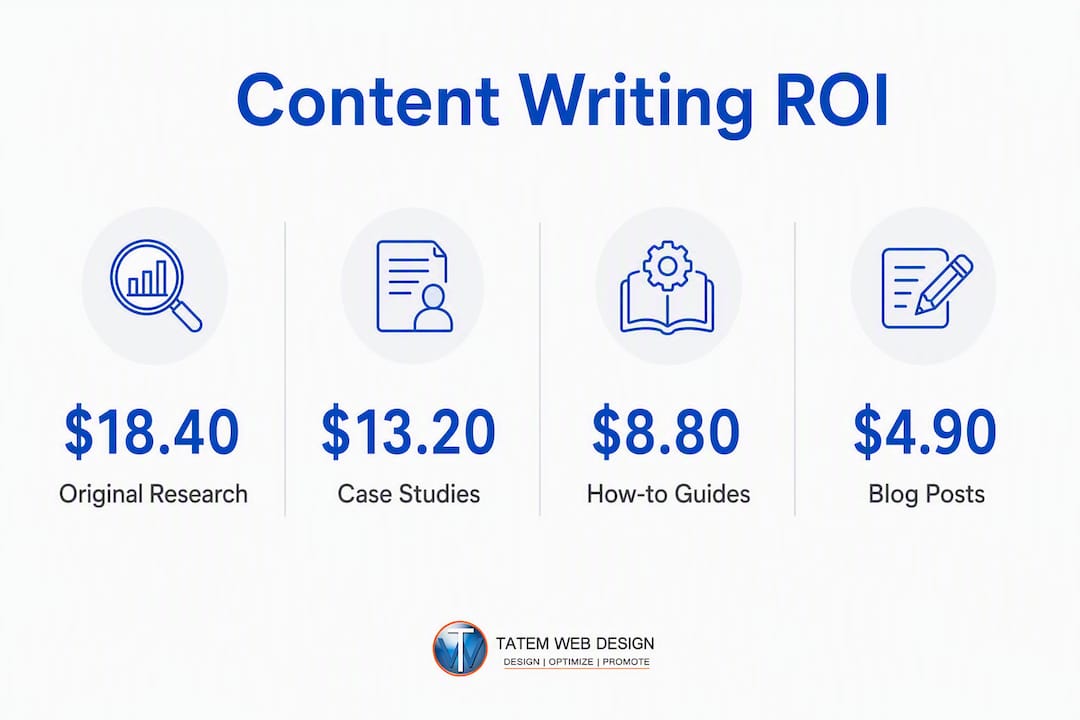
Source: Marketful B2B content marketing statistics
Publishing cadence compounds the effect. Teams that publish frequently and consistently over a sustained period see significantly higher ROI than teams with sporadic publishing. Consistency is the competitive moat most SMBs fail to build because they treat content as a campaign rather than a program.
Distribution matters as much as production. Combining email, LinkedIn, and SEO produces roughly 5.1x higher conversions than SEO-only publishing. Every piece you produce should have a distribution plan attached before the writer starts.
Pro Tip: AI-assisted production can increase your publishing volume without sacrificing editorial quality, provided a human editor reviews every piece for accuracy, brand voice, and conversion intent. Tatemweb’s AI content creation services combine AI-assisted drafting with human editorial oversight — a practical way to hit a 2x-per-week cadence without doubling your budget.
Key Takeaways
Professional content writing is a compounding business asset: SMBs that invest in a documented strategy, consistent cadence, and high-ROI formats like original research and case studies generate significantly more leads at a lower long-term cost-per-lead than paid channels alone.
| Point | Details |
|---|---|
| Document your strategy first | A documented strategy increases content success likelihood by 414% versus no strategy. |
| Expect a 4–6 month runway | Content programs typically reach breakeven in months 4–6 and strong compounding returns in months 7–12 and beyond. |
| Prioritize high-ROI formats | Original research returns $18.40 per $1 spent; case studies return $12.80 per $1. |
| Publish consistently | Teams publishing 2+ times per week for 12+ months see 4.2x higher ROI than sporadic publishers. |
| Tatemweb as your content partner | Tatemweb offers AI-assisted content writing with human editorial oversight, tailored for Florida SMBs. |
The part most SMBs get wrong about content investment
Most small businesses treat content writing as a cost line, not a capital investment. That framing is the root of almost every content program failure I have seen.
When you treat content as a cost, you cut it at the first sign of budget pressure, usually around month three, right before the compounding begins. When you treat it as a capital investment, you measure it the same way you measure any asset: what is the return over 12, 24, and 36 months? That shift in framing changes every decision that follows.
The second mistake is chasing volume over strategy. Publishing 20 generic blog posts produces less return than publishing four original research pieces targeted at your highest-value buyer segment. The bimodal distribution of content ROI makes this concrete: roughly 20% of content drives the majority of returns. The implication is not to publish less. It is to be ruthlessly strategic about what you publish and to distribute every piece aggressively across email and social.
The third mistake is hiring for writing quality alone. A writer who produces beautiful prose but cannot explain keyword clustering, buyer-stage mapping, or conversion architecture is a liability at scale. The best content partners think like marketers first and writers second. That is the profile worth paying for, and it is the profile worth waiting for if your first search does not surface it.
Tatemweb’s content writing services for Florida businesses
For Florida SMBs that want content writing paired with the strategy, SEO infrastructure, and distribution to actually generate leads, Tatemweb delivers a full-service solution without the overhead of a large agency retainer.

Tatemweb combines AI-assisted content production with human editorial oversight, local SEO expertise, and over 26 years of digital marketing experience serving Florida businesses across healthcare, legal, real estate, marine, and professional services. The result is a content program built on your specific buyer journey, not a generic template. Every piece maps to a buyer stage, targets a researched keyword, and connects to a conversion path on your site.
Ready to build a content program that compounds? Schedule a discovery call or explore Tatemweb’s AI website design and content services to see how a fully integrated digital presence accelerates your results. Call directly at 772-224-8118.
Useful sources and further reading
- Content Marketing ROI Statistics — RevenueMemo
- Website Content Writing Services — Tatemweb
- Content Marketing Strategies for Small Business — Tatemweb
- AI Content Creation for Florida Businesses — Tatemweb
- Why Content Strategy Aligns with SEO for Better Results — BlockPress
FAQ
Why do small businesses benefit from investing in content writing?
Content writing builds organic visibility, establishes authority, and generates leads at a lower long-term cost than paid advertising. Over a 24-month window, content marketing returns approximately $7.65 per $1 spent and generates roughly three times the leads per dollar compared with paid search.
What are the main benefits of professional content writing?
The core benefits are improved search rankings, stronger brand authority, faster lead conversion (content-educated leads close 20–30% faster than cold leads), and a compounding asset that generates traffic and inquiries long after publication.
Is content writing still in demand for small businesses?
Yes. Organic search remains one of the highest-converting traffic sources for SMBs, and content is the primary driver of organic rankings. Businesses that publish consistently and strategically hold a durable competitive advantage over those that rely solely on paid channels.
What are the 4 C’s of content writing?
Definitions vary across practitioners, but a widely used version covers clarity (writing that is easy to understand), conciseness (no wasted words), consistency (regular publishing cadence and brand voice), and conversion (every piece maps to a measurable buyer action). These principles apply whether you write in-house or hire a professional.
How long before content writing produces a measurable return?
Most content programs reach breakeven in months 4–6 and deliver strong compounding returns in months 7–12 and beyond. Teams that sustain a cadence of two or more posts per week for 12 or more months see 4.2x higher ROI than teams that publish sporadically.
Recommended
Tatem Web Design
26+ YearsWeb Design & SEO Specialist · Tatem Web Design
Matt Tatem has been designing websites professionally since 1999, making Tatem Web Design one of Florida's longest-running web agencies. Based in Stuart, FL, he specializes in WordPress, local SEO, Shopify e-commerce, and cybersecurity consulting for small businesses.
What a CMMC Level 2 Assessment Requires and How to Prepare
Prepare for your CMMC Level 2 assessment by understanding requirements, assessment paths, and mapping your Controlled Unclassified Information.

A Data Retention Policy Is Your Rulebook for Keeping and Deleting Data
Establishing a clear data retention policy helps manage data risk, ensuring compliance and effective data management for your organization.

Law Firm Local SEO: A Practical Playbook for More Local Clients
Unlock more local clients for your law firm with effective local SEO strategies. Optimize your Google Business Profile and boost your visibility!