
U.S. PII Compliance: Five Phase Roadmap to Prove Security for SMBs
Compliance with U.S. personal data protection rules requires organizations to maintain reasonable, risk-based security controls, a current inventory of personally identifiable information, oversight of vendors handling that data, and a tested breach response plan. The FTC enforces this baseline for most businesses, while HHS enforces HIPAA for health data and state regulators police their own privacy statutes. Your obligations shift depending on your sector and the states where your customers live. Start with the checklist below.
TL;DR:
- The compliance landscape is complex, relying on federal, sector-specific, and state laws, making risk-based controls and regular inventory updates essential.
- Enforceable controls include documented policies, encryption, multi-factor authentication, and physical security measures scaled to data sensitivity.
- Conducting a privacy threshold analysis and classifying data helps prioritize and tighten protections for highly sensitive information like health and financial data.
- A breach response plan should focus on rapid detection, evidence preservation, staged containment, and timely notification, especially given varying state and federal mandates.
- Vendor contracts and BAAs must specify data use, breach protocols, and security responsibilities to prevent liability even when outsourcing data handling.
Table of Contents
- What PII Compliance Requirements Actually Cover in the U.S.
- Which Controls Do Regulators Actually Expect?
- How Should You Map and Classify PII to Reduce Risk?
- What Should Your Breach Response Plan Cover?
- How Do You Manage Vendor and Third-Party Risk?
- A Five-Phase Checklist to Get PII Compliance Requirements Under Control
- Why the “Checklist Mentality” Around PII Compliance Requirements Misses the Point
- Where to Verify These PII Compliance Requirements Directly
- Get Compliance and a Modern Website Working Together
- Sources
- FAQ
What PII Compliance Requirements Actually Cover in the U.S.
There is no single federal law that governs every business the way the GDPR does in the European Union. Instead, you are working inside a patchwork built from federal statutes, sector rules, and state legislation, and figuring out which pieces apply to you is the first real compliance task.
The FTC Act gives the Federal Trade Commission authority to pursue companies for “unfair or deceptive” practices, and the agency has used that authority for two decades to punish weak security and broken privacy promises, even without a specific data law naming the violation. This applies to nearly every commercial business in the country, regardless of industry.
The Privacy Act of 1974 governs federal agencies and the systems of records they maintain, reinforced by OMB memoranda that require privacy threshold analyses before new data collection begins. If you contract with a federal agency, this framework likely reaches you too.
HIPAA’s Privacy and Security Rules set the standard for protected health information (PHI), a specific and heavily regulated subset of PII. Covered entities, health plans, and their business associates must follow national safeguard standards enforced by the HHS Office for Civil Rights.
GLBA governs financial institutions, and its updated Safeguards Rule now requires written information security programs with specific technical controls, not just general good intentions.
At the state level, California’s CCPA/CPRA gave consumers enforceable rights over their data, and other states have followed with their own versions, each with slightly different triggers, exemptions, and enforcement mechanisms. This state-by-state variation is exactly why U.S. compliance functions as a patchwork rather than one unified code.
Run through this quick applicability check:
- Do you process health information tied to treatment, payment, or operations? HIPAA likely applies.
- Do you offer financial products or services? GLBA’s Safeguards Rule likely applies.
- Do you contract with a federal agency or handle federal systems of records? The Privacy Act applies.
- Do you have customers or employees in California, Colorado, Virginia, or another state with a privacy statute? That state’s law applies to those residents specifically.
- Does none of the above apply? The FTC’s reasonable-security standard still applies to you.
Which Controls Do Regulators Actually Expect?
Every framework above eventually points to the same three categories of control: administrative, technical, and physical. Regulators don’t expect perfection. They expect proportionality, meaning your safeguards should scale with how sensitive your data is and how much of it you hold.
Administrative controls come first because they set the rules everything else follows: written security policies, documented employee training, access governance built on least privilege, and retention schedules that say exactly how long each data type stays on your systems.
Technical controls carry most of the weight in an audit. Encryption of PII in transit and at rest is now expected across nearly every framework, and skipping it is a common compliance gap that shows up in breach investigations. Multi-factor authentication, formal identity and access management, centralized logging, and, for larger organizations, data loss prevention or extended detection and response tools round out the technical layer.
Physical controls are easy to overlook but still matter: locked server rooms, controlled device access, and documented secure-disposal procedures for retired hardware and paper records.
Follow this order when building or auditing your program:
- Classify your data by sensitivity and assign a confidentiality impact level, following the risk model in NIST SP 800-122.
- Match control strength to that impact level. Low-impact data might need basic access controls; high-impact data (Social Security numbers, health records, financial account numbers) needs encryption, MFA, and tight logging.
- Document everything. Regulators and auditors look for written policies, access logs, penetration test results, and remediation records as proof a program actually functions.
- Test your controls periodically rather than treating them as a one-time setup.
Pro Tip: Regulators rarely expect state-of-the-art defenses. They expect a security posture proportional to your size and the sensitivity of what you hold, and they expect you to be able to prove it with documents, not promises.
How Should You Map and Classify PII to Reduce Risk?
Most compliance failures trace back to the same root cause: nobody knew exactly where the sensitive data lived. A privacy threshold analysis, or PTA, is the formal exercise that fixes that blind spot. It asks a simple set of questions: what PII do you collect, where does it live, who can access it, why do you keep it, and how long do you keep it.
Your inventory should capture, at minimum, the data element, its system of residence, its owner, its retention period, and its confidentiality impact level. Once you have that inventory, classification tells you which records need the strongest protection and which can carry lighter controls.
Minimization follows naturally from classification. If a data field serves no ongoing business or legal purpose, delete it rather than store it indefinitely. Pair this with a formal retention policy that ties every data category to a defined disposal date, with clear exceptions for records under legal hold.
Keep the inventory alive with real governance:
- Assign a named owner to every major data system, not just the IT department in general.
- Refresh the inventory on a set cadence, at least annually, and after any major system change.
- Log every new PII collection point the moment it goes live, not months later during an audit scramble.
NIST and OMB both prioritize this lifecycle approach because a control you never apply to data you never mapped is not a control at all. It is a checkbox.
What Should Your Breach Response Plan Cover?
Speed and documentation decide how a PII incident turns out. Every state and territory has its own breach-notification law, with different triggers and different notification windows, so a business operating nationally needs to track obligations state by state rather than assume one national clock. HIPAA sets its own well-known breach-notification requirements, including prompt reporting to HHS and affected individuals for significant incidents.
Newer federal reporting rules for critical infrastructure sectors are tightening timelines further, with some incident types now requiring notice to federal authorities within days rather than months, a trend regulators expect to continue.
Build your incident response plan around these five steps:
- Detect and confirm the incident, then immediately preserve logs and forensic evidence before anything gets overwritten.
- Contain the exposure, isolating affected systems without destroying evidence you will need later.
- Assess scope: which records, how many individuals, which states and regulators are triggered.
- Notify according to the shortest applicable deadline, since state and federal timelines rarely match.
- Remediate and document every step taken, because that documentation becomes your defense if regulators investigate.
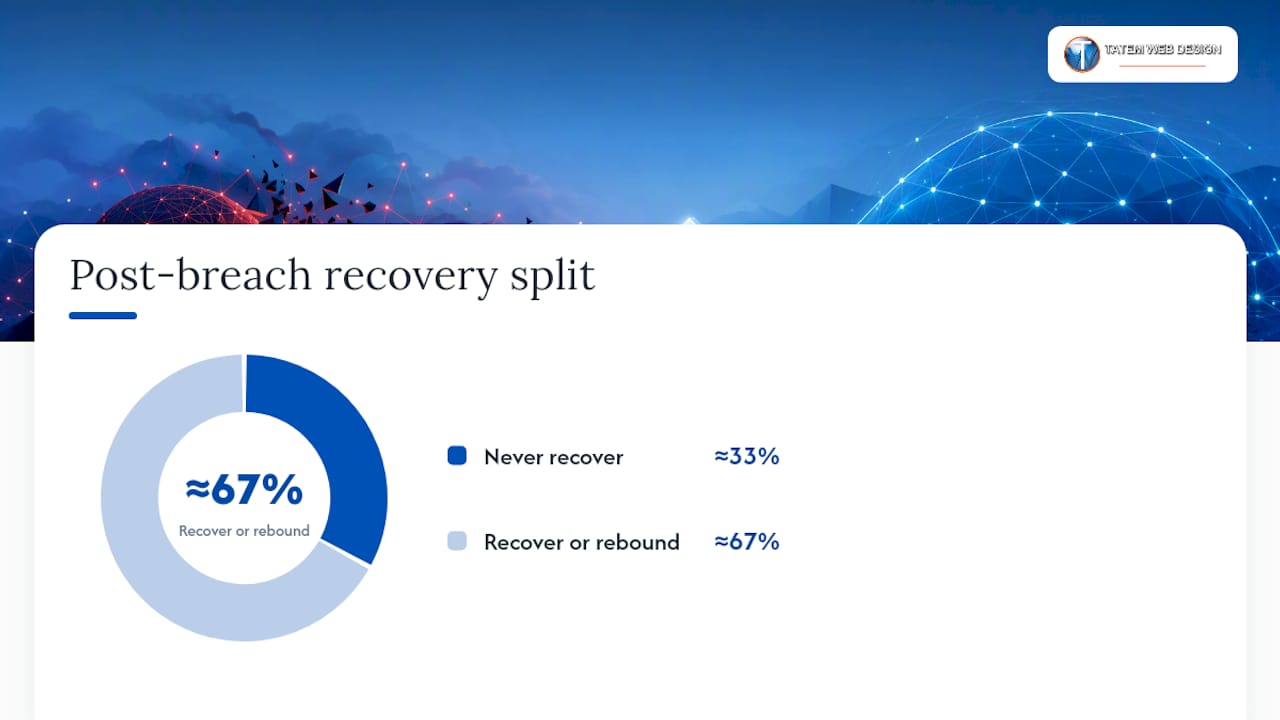
Roughly one-third of small businesses that suffer a significant breach never fully recover their footing afterward, which is less a statistic to quote and more a reason to rehearse your plan before you need it.
How Do You Manage Vendor and Third-Party Risk?
Outsourcing work doesn’t outsource liability. If a vendor mishandles PII you gave them, you typically still answer to regulators and affected individuals, which makes contract language your first line of defense.
Every vendor contract handling PII should specify permitted uses, retention limits, breach notification timelines back to you, and your right to audit their practices. For HIPAA-covered entities, a Business Associate Agreement (BAA) is not optional. It’s a specific, legally required document that must name the permitted uses of PHI, require appropriate safeguards, and obligate the vendor to report breaches, a stricter standard than a typical commercial data processing clause.
Before signing anyone on, run a basic risk assessment:
- Ask for their most recent security audit or attestation (SOC 2, penetration test summary).
- Confirm they encrypt data at rest and in transit, not just “on request.”
- Check whether they subcontract to sub-processors you haven’t vetted.
- For interconnected systems, especially in federal or defense contexts, formalize the relationship with an Interconnection Security Agreement (ISA) that spells out shared security responsibilities.
Red flags include vague answers about data location, reluctance to sign a BAA, and an unwillingness to specify breach notification timelines in writing.
A Five-Phase Checklist to Get PII Compliance Requirements Under Control
Trying to fix everything simultaneously is how compliance projects stall. Work through these phases in order, and resource-constrained teams can complete Phase 1 and 2 with existing staff in most cases.
- Discover. Run your data inventory, classify by sensitivity, and complete a privacy threshold analysis for every system touching PII.
- Protect. Apply baseline administrative and technical controls, matched to impact level, and finalize your retention schedule.
- Detect. Stand up centralized logging, periodic vulnerability scans, and scheduled monitoring reviews, even if lightweight at first.
- Respond. Write your incident response plan, draft notification templates in advance, and run at least one tabletop exercise per year.
- Govern. Lock down vendor contracts and BAAs, schedule recurring employee training, and report program status to leadership or the board on a fixed cadence.
Assign a clear owner to each phase. In smaller organizations, this often falls to a single privacy or compliance lead wearing multiple hats; larger organizations formalize the role as a Chief Privacy Officer who reports program status upward and signs off on major data decisions.
Pro Tip: Start your inventory with a narrow, high-value scope, customer-facing systems and critical infrastructure first, then expand. Trying to inventory everything on day one is the most common reason these projects never finish.
Why the “Checklist Mentality” Around PII Compliance Requirements Misses the Point
Most compliance content treats PII protection as a box-checking exercise: install encryption, write a policy, hire a vendor, done. That framing gets the order backward. The real work is building a program that keeps functioning after the initial project ends, and that means governance and ownership matter more than any individual control.
A number of web design agencies have experience working with Florida businesses on layered problems combining web development and digital marketing with cybersecurity compliance consulting for CMMC Level 2, HIPAA, PII, and PCI requirements. That combination matters because the businesses most likely to fall behind on PII compliance are the ones treating their website, their marketing systems, and their security posture as three separate projects instead of one connected system.
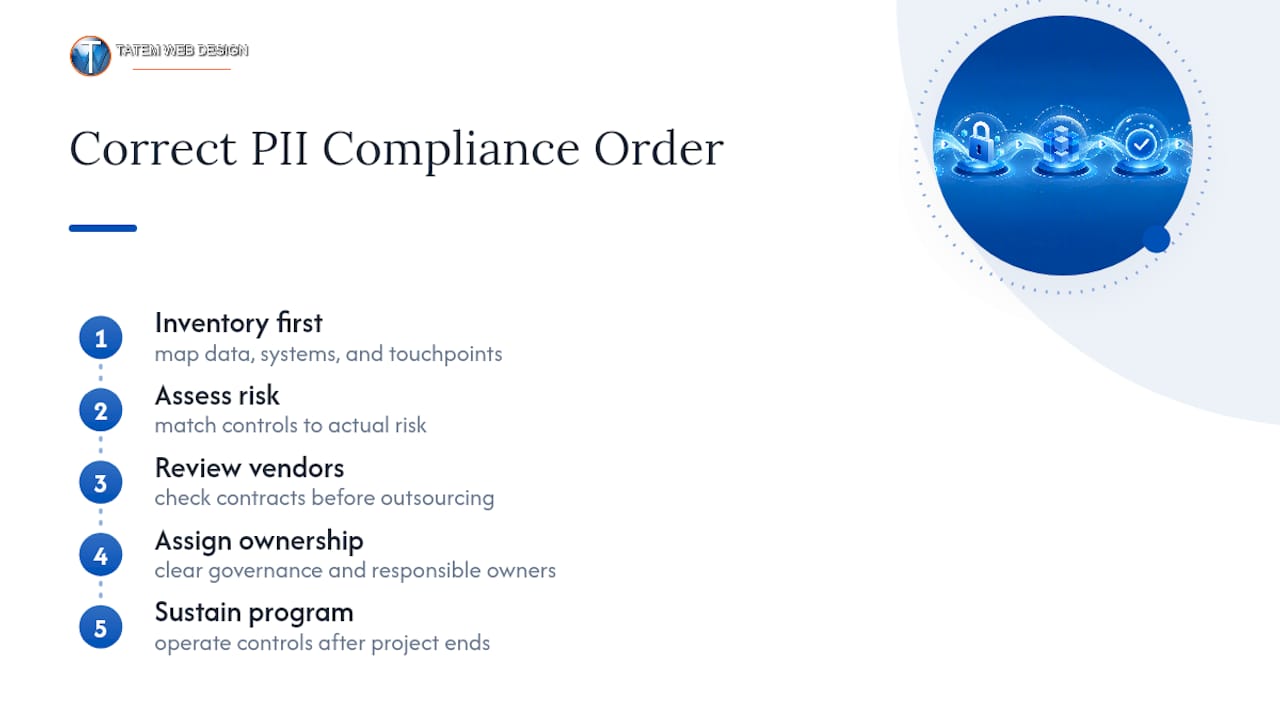
The agency’s approach starts where this article does: inventory first, controls matched to actual risk second, vendor contracts reviewed before anything gets outsourced…
Organizations weighing where to start can review Tatemweb’s AI cybersecurity compliance services for a sense of how inventory, controls, and vendor governance come together in practice.
— Matt
Where to Verify These PII Compliance Requirements Directly
Skip the secondhand summaries when you need something to cite in a policy document or defend in an investigation. Go to the primary source.
- The FTC’s privacy and security enforcement page lays out the agency’s enforcement theory and recent actions.
- NIST SP 800-122 remains the definitive federal guide to the risk-based PII lifecycle.
- HHS’s HIPAA Privacy Rule summary covers healthcare-specific obligations in full.
- The ICLG United States data protection guide tracks the state-by-state patchwork as it evolves.
Use these to draft policy language yourself, but bring in legal counsel before finalizing anything tied to breach notification deadlines or multi-state consumer rights, since the details change by jurisdiction faster than any single guide can track.
Get Compliance and a Modern Website Working Together
Most businesses treat their website rebuild and their compliance project as two separate line items, hiring a web designer for one and a compliance consultant for the other. That split usually means the new site launches with the same unmanaged PII collection forms, the same missing encryption, and the same vendor gaps the old site had. Some agencies build AI-powered websites and handle PII, HIPAA, and PCI compliance consulting under one roof, so the forms, chatbots, and ecommerce checkout your new site launches with can be reviewed against the same risk-based standards covered in this article, not bolted on afterward.

For a professional practice or growing business in Florida, that means one point of contact instead of two vendors pointing fingers when something breaks. If your current site collects customer data through contact forms, booking tools, or checkout pages, that is exactly the kind of unmanaged PII flow regulators flag first. Call Tatem Web Design at 772-224-8118 or visit the AI cybersecurity compliance services page to schedule a review of how your site handles personal data today.
Sources
- Privacy & Data Security | Federal Trade Commission
- Guide to Protecting the Confidentiality of Personally Identifiable Information (PII) — NIST SP 800-122
- Hhs
- Data protection laws and regulations 2026 | USA — ICLG
FAQ
What Are the Basic PII Compliance Requirements for a U.S. Business?
Most U.S. businesses need reasonable, risk-based security controls, a current inventory of the PII they hold, vendor oversight through contracts and BAAs where applicable, and a tested breach response plan, with specific added rules if they fall under HIPAA, GLBA, or a state privacy law.
Is There a GDPR Equivalent in the United States?
No single federal law mirrors the GDPR. The U.S. relies on a sector-and-state patchwork built from the FTC Act, HIPAA, GLBA, and state statutes like CCPA/CPRA, rather than one comprehensive privacy statute.
What Federal Law Protects PII in the United States?
No single statute covers all PII nationwide. The FTC Act provides the broadest federal backstop through its unfair-and-deceptive-practices authority, while HIPAA, GLBA, and the Privacy Act each protect specific categories of data or specific types of organizations.
What Counts as a PII Violation?
A PII violation typically means failing to provide reasonable security for sensitive data, breaking a stated privacy promise, mishandling protected health information under HIPAA, or failing to notify affected individuals and regulators within the legally required breach-notification window.
Who Enforces PII Compliance Requirements in the U.S.?
The FTC enforces general consumer privacy and security expectations, HHS’s Office for Civil Rights enforces HIPAA specifically, and individual state attorneys general or dedicated privacy agencies enforce their own state statutes.
Recommended
Tatem Web Design
26+ YearsWeb Design & SEO Specialist · Tatem Web Design
Matt Tatem has been designing websites professionally since 1999, making Tatem Web Design one of Florida's longest-running web agencies. Based in Stuart, FL, he specializes in WordPress, local SEO, Shopify e-commerce, and cybersecurity consulting for small businesses.

Rank in ChatGPT in 90 Days With a Practitioner Led Checklist
Follow a practitioner led 90 day plan to get cited by ChatGPT: allow OAI-SearchBot, publish short answer capsules with schema, and track Bing AI Performance.

AI SEO Content Playbook: 16 GEO Signals for Agencies & Teams
A practical playbook mapping the GEO-16 signals to hands-on editorial workflows, review controls, and metrics. For agencies and in-house teams scaling AI...

Copy Ready Local Schema Markup for SMBs + Google Validation
Copy ready JSON-LD examples and Google validation steps for SMBs' local schema markup. Audit, implement, and verify each location page with confidence.