
A Data Retention Policy Is Your Rulebook for Keeping and Deleting Data
A data retention policy is an enforceable, category-by-category schedule that spells out what data your organization keeps, why you keep it, and exactly when and how you delete it. It is not a vague statement of good intentions. It is a working document that assigns owners and forces decisions.
If you’re starting from zero, your first move is not writing policy language. It’s inventory. Find out what data lives where, which categories carry the highest legal or breach risk (think health records, payment data, employee files), and assign a named owner to each one before you write a single retention period.
Three anchors will shape almost everything you draft: NIST’s media sanitization guidance for how you dispose of data, HIPAA’s documentation requirements if you touch health information, and the growing list of state privacy laws that now demand you disclose retention periods in plain language.
- Inventory every repository, including backups, shadow IT tools, and AI logs
- Classify data by risk level, not just by department
- Assign one accountable owner per data category
- Set a review date before you finish the first draft
Pro Tip: Start with the three riskiest categories, health data, payment data, and employee records, rather than trying to inventory everything at once. A partial schedule that is actually enforced beats a comprehensive one still in draft six months from now.
Key Takeaways
An enforceable data retention policy pairs a five-attribute schedule with automated deletion, legal-hold overrides, and logged evidence tied to a documented legal or business reason for every category.
| Point | Details |
|---|---|
| Start with inventory | Map every repository and assign a named owner before writing retention periods. |
| Use five schedule attributes | Category, purpose, owner, period, and disposition method for every entry. |
| Apply the high-water mark | When rules conflict, retain for the longer required period and document why. |
| Automate with hold overrides | Legal holds must always take precedence over scheduled deletion jobs. |
| Keep deletion evidence | Timestamped logs proving what was deleted and under which policy line matter as much as the schedule itself. |
Table of Contents
- What Does a Data Retention Policy Actually Cover?
- What Happens When You Keep Data Too Long?
- What Should a Data Retention Policy Include?
- How Long Should You Keep Different Types of Records?
- How Do You Put a Retention Policy Into Practice?
- What Laws Govern How Long You Must Keep Data?
- How Do You Destroy Data Without Leaving a Trail Behind?
- Who Should Own Your Data Retention Program?
- What Do Auditors Check When Reviewing Retention Programs?
- Why Trust This Guidance on Retention Programs
- How Does GDPR or CCPA Change Your Retention Approach?
- How Do You Assess and Manage Retention-Related Risk?
- How Do You Communicate Retention Policy to Employees?
- The Checklist Beats the Manifesto
- Sources
- FAQ
What Does a Data Retention Policy Actually Cover?
A policy and a schedule are two different documents doing two different jobs, and confusing them is the most common mistake compliance teams make. The policy states principles: who has authority, how exceptions get approved, what “in scope” means. The schedule is the operational table. It is the actual list of data categories, retention periods, and disposition instructions that IT and records teams execute against.
Every entry in a well-built retention schedule carries five attributes: the data category, the business or regulatory purpose for keeping it, the designated owner, the retention period itself, and the disposition method (delete, archive, or anonymize). Leave any one of these five out and the entry becomes unenforceable, because nobody knows who’s responsible or what “done” looks like.
Scope is where most policies quietly fail. It’s easy to write a rule for “customer records” and forget that customer data also lives in:
- Backup snapshots taken nightly, often with their own retention clock
- Log files and system telemetry that capture PII incidentally
- AI training sets and prompt logs, which now count as a distinct data category under emerging governance frameworks
- Derived or exported data sitting in spreadsheets, CRM exports, and marketing platforms
That AI-adjacent category deserves specific attention. As more businesses feed customer data into chatbots and automation tools, prompt logs and training datasets need their own retention entries, not an assumption that they fall under “general records.”
Leaving any of these copies unaddressed defeats the whole exercise. You can delete the primary customer record and still have three backup snapshots, an export sitting in a marketing tool, and a log file holding the same PII eighteen months later. Regulators and plaintiffs’ attorneys both know to ask about copies, not just originals.

What Happens When You Keep Data Too Long?
Over-retention isn’t a passive risk, it’s an active liability that grows every day you don’t act on it. Every record you hold past its useful life is a record that can be breached, subpoenaed, or discovered in litigation. Data you deleted eighteen months ago cannot appear in a breach notification, cannot be produced in discovery, and cannot be used against you in a regulatory inquiry.
The math is straightforward once you see it laid out. Breach surface area scales with volume: more stored data means more exposure per incident. Litigation discovery costs scale the same way, because attorneys bill by the document reviewed, not by the document that matters. Fines under state privacy laws often key to whether you disclosed and followed your own stated retention periods, so a policy that exists on paper but isn’t followed can be worse than having none.
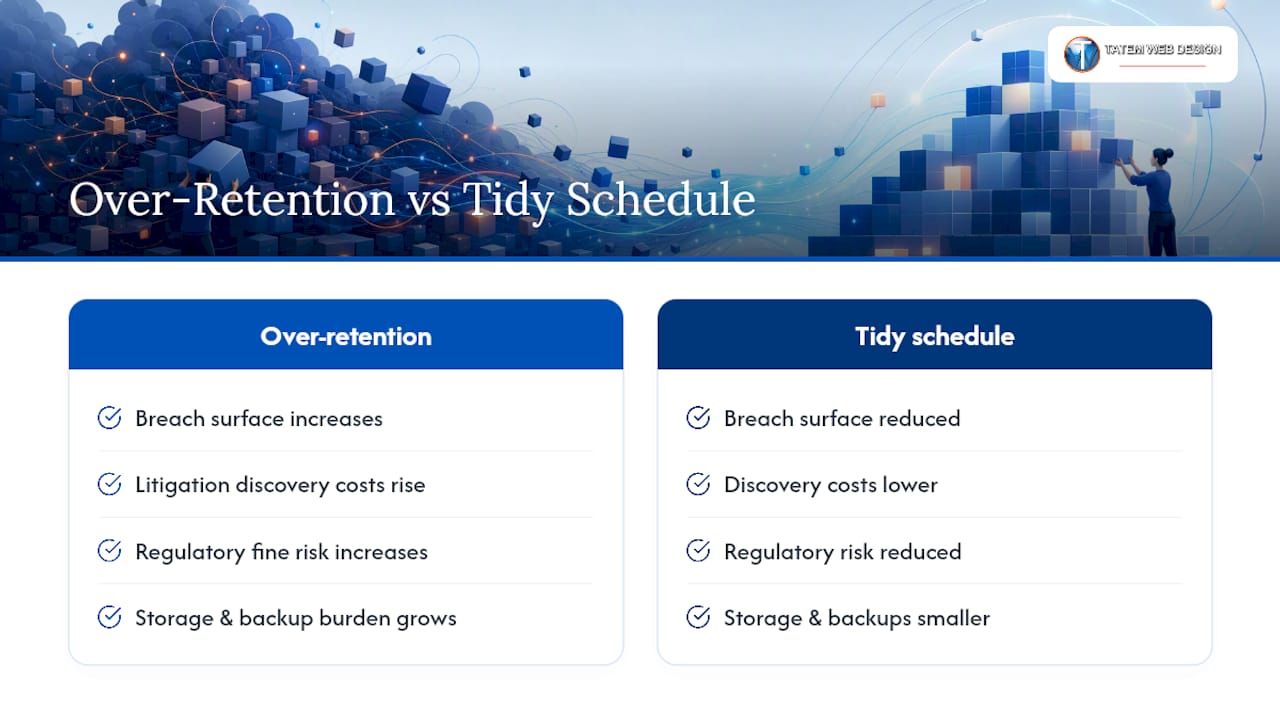
A tidy schedule flips each of those costs into a benefit. Storage costs drop when old data gets purged on schedule instead of accumulating indefinitely. Backup and recovery times improve because there’s simply less to restore. Audit readiness improves because you can point to a document and a log instead of explaining, after the fact, why records from 2019 are still sitting in a production database.
This is why the inventory step from the opening matters so much. You can’t justify a retention period, and you can’t defend one in an audit, until you know what you’re holding and why. Legal guidance on retention consistently favors the shortest period that satisfies real legal and business needs, documented at the time the decision is made, not reconstructed later when a regulator asks.
What Should a Data Retention Policy Include?
A policy that can’t be audited isn’t a policy, it’s a memo. The difference comes down to specificity. Every rule needs to be atomic, testable, and traceable to a named owner, which is what makes a governance program defensible instead of aspirational.
Here’s what belongs in the written policy document itself:
- Scope statement — which systems, business units, and data types the policy governs, including third-party processors
- The retention schedule — the operational table, described in detail below
- Legal hold procedures — how a hold gets triggered, who approves it, and how it overrides normal deletion jobs
- Destruction methods — which disposal method applies to which data class and sensitivity level
- Roles and responsibilities — named functions (not just “IT”) accountable for each stage
- Exception handling — how someone requests a deviation from the standard period, and who signs off
- Review cadence — a fixed date, not “periodically,” for revisiting the entire document
The schedule itself is where the five core attributes come alive. Take a concrete example: employee W-2 forms. Category: tax records. Purpose: IRS compliance and wage dispute defense. Owner: HR director. Period: four years from filing. Disposition: secure digital deletion following NIST SP 800-88 sanitization guidance.
That level of detail is what auditors mean when they say “prescriptive.” A line that reads “retain financial records as needed” satisfies no one. A line that reads “retain W-2 forms for four years, HR director owns disposition, delete via NIST-compliant wipe” survives scrutiny because templates and legal guides consistently emphasize that vague retention language fails in practice.
Breaking the policy into these atomic statements, one testable rule per data class, each with a named owner, is what makes the whole program auditable rather than theoretical. It also makes automation possible: a system can enforce “delete after four years” far more reliably than it can enforce “retain as needed.”
How Long Should You Keep Different Types of Records?
Retention periods vary by category, and the honest answer to “how long should data be retained” is “it depends on what regulation or business need governs that specific record.” That said, a starting point beats a blank page. Here’s a practical baseline you can adjust to your jurisdiction and industry:
- Employee records: typically retained for a period consistent with applicable state wage and hour laws
- Financial and tax records: commonly retained according to IRS audit windows and statute of limitations, often several years
- Contracts: retained for the duration of the relationship plus a period aligned with the statute of limitations for contract disputes in your jurisdiction
- PHI (protected health information): retained for at least the minimum period required under HIPAA’s documentation rule, with variations by state
- PCI (payment card data): retained only as long as business needs require, then securely purged in accordance with PCI DSS guidance
- System and access logs: retained for a period consistent with operational and security needs, often ranging from several months to a year
- Marketing and analytics data: retention periods vary and should be explicitly defined as required by applicable state privacy laws, rather than indefinite
When two rules overlap, apply the high-water mark: follow whichever requirement demands the longer period. If a contract dispute statute wants records for five years but a state tax rule wants seven, keep them seven years and document why.
Start dates matter as much as period lengths. The clock for tax records generally starts at filing, not at the transaction date. The clock for terminated-employee files starts at termination, not at hire. Get the trigger wrong and a technically correct retention period still produces the wrong deletion date. This is also where reviewing retention needs by industry pays off, since a law firm’s file-closing trigger looks nothing like a dental practice’s last-visit trigger.
How Do You Put a Retention Policy Into Practice?
Writing the document is the easy part. Operationalizing it is where most programs stall. Follow these steps roughly in order:
- Inventory every data repository and assign a named owner to each one, including cloud storage, SaaS tools, and physical files
- Design a small tiered schedule, ideally five tiers or fewer, and document the legal or business reason behind each tier
- Automate deletion jobs wherever your systems allow it, and build override logic so legal holds always take precedence
- Handle backups and archives explicitly, including a written requirement that third-party processors delete data on the same schedule you follow internally
- Generate deletion evidence, meaning timestamped logs that prove what was deleted, when, and under which policy line
- Run a test cycle before going live, train staff on their specific responsibilities, and set a fixed review date, not a vague “periodic” review
That five-tier limit isn’t arbitrary. A small set of well-enforced retention tiers tends to outperform dozens of ad-hoc categories, mostly because complexity is the enemy of enforcement. Nobody follows a 40-line schedule with contradictory rules buried in the footnotes.
Pro Tip: Build the legal-hold override before you automate deletion, not after. An automated deletion job that runs before a hold is in place can destroy evidence mid-litigation, which turns a compliance win into a spoliation problem.
Third-party processors deserve their own line item here. If a vendor stores customer data on your behalf, your retention policy is only as strong as their contractual deletion obligations. A cybersecurity consultant reviewing vendor agreements can catch gaps between what you promise customers and what your processors actually do with the data once it leaves your systems.
What Laws Govern How Long You Must Keep Data?
No single federal statute dictates a universal retention period, which is exactly why so many businesses guess wrong. Instead, obligations stack up sector by sector and state by state, and your policy has to account for every layer that applies to your organization.
HIPAA requires covered entities to retain certain documentation, including policies and procedures, for six years from creation or last effective date, whichever is later. Sarbanes-Oxley (SOX) imposes seven-year retention on audit workpapers for public companies, with criminal penalties for destruction during an active investigation. COPPA takes a different angle entirely: operators collecting children’s personal information must maintain and publish a written retention policy describing the purpose and timeframe for deletion, not just follow one internally.
State privacy laws add a disclosure layer on top of the federal patchwork. California requires businesses to post retention periods per data category directly in the privacy notice, Minnesota requires a description of retention practices, and Illinois’s Biometric Information Privacy Act (BIPA) requires a public retention schedule specifically for biometric data like fingerprints and facial scans.
The organizing principle underneath all of this: every retention decision should tie to a documented legal or business reason, not a guess. When two requirements conflict, retain for the longer of the two periods rather than trying to split the difference.
For media sanitization, NIST guidance is the reference point regulators expect you to cite when explaining how “deleted” data actually became unrecoverable.
How Do You Destroy Data Without Leaving a Trail Behind?
“Delete” means different things depending on what’s at stake, and picking the wrong method for the sensitivity level is a common audit finding.
- Logical delete: marks a record as removed in the application, but the underlying data often persists in the database. Fast, but insufficient alone for regulated data.
- Secure wipe: overwrites storage media so the original data can’t be recovered by standard forensic tools. This is where NIST SP 800-88 sanitization standards apply directly.
- Cryptographic erasure: destroys the encryption key rather than the data itself, rendering encrypted data unreadable almost instantly. Efficient for cloud environments where physical access isn’t possible.
- Physical destruction: shredding or degaussing hard drives, still the gold standard for end-of-life hardware carrying highly sensitive data.
Deletion evidence is what turns “we deleted it” into a defensible claim. That means a timestamped log entry showing what was deleted, the policy line that authorized it, and confirmation the job completed. KPMG’s framework treats these logs as first-class evidence, not an afterthought.
Special cases need explicit handling: backups often lag behind primary deletion by weeks, exports living in spreadsheets rarely get purged automatically, and processor contracts need deletion clauses with verification rights, not just a promise.
Who Should Own Your Data Retention Program?
Retention only works when specific people, not departments, own specific pieces of it. Vague accountability produces vague enforcement.
- Data owner (department head or process owner): decides business justification for retention periods within their function
- Legal counsel: manages litigation holds, approves exceptions, and interprets ambiguous regulatory language
- IT/security lead: implements automated deletion, secure disposal, and backup handling
- Records manager: maintains the master schedule, tracks review dates, and coordinates between owners
- Procurement: builds deletion and audit-rights clauses into every vendor contract before signature, not after a breach
Exception workflows need a paper trail. If someone wants to keep a record past its scheduled deletion date, that request should route through the data owner and legal, with the reason documented at the time, not reconstructed months later.
Procurement deserves special attention because it’s where most gaps get created silently. Every new vendor contract touching customer or employee data should require the processor to delete data on your schedule, provide deletion confirmation on request, and flow down the same obligations to any subprocessors they use.
What Do Auditors Check When Reviewing Retention Programs?
Auditors don’t take your word for it. They want to see the schedule itself, deletion logs proving disposal actually happened, a legal hold register showing active and released holds, records of approved exceptions, and results from your last test cycle.
Track a small set of metrics to know whether the program is actually working, not just documented:
- Percentage of data categories with a current, assigned owner — anything below 100% is a gap waiting to surface in an audit
- Average time between scheduled deletion date and actual deletion — a growing lag signals automation is falling behind
- Number of exception requests per quarter — a spike often means the schedule itself needs revisiting, not just more exceptions
- Legal hold response time — how fast a hold gets applied once litigation is reasonably anticipated
Review the entire policy on a fixed annual cadence at minimum, and trigger an off-cycle review whenever a new regulation takes effect, you enter a new state market, or you adopt a new data category like an AI tool that generates its own logs.
Why Trust This Guidance on Retention Programs
Retention programs fail most often not from bad intentions but from treating the policy as a document instead of an operating system. That distinction shapes everything in this guide, from the five-attribute schedule structure to the emphasis on deletion evidence as proof, not paperwork.
Tatemweb brings this operational lens to the compliance consulting work it does for Florida businesses, including:
- HIPAA compliance consulting for healthcare practices handling PHI retention and disposal
- CMMC Level 2 and PII/PCI compliance consulting for businesses under federal or payment-card obligations
- Cybersecurity implementation that pairs retention policy with the technical controls needed to enforce it
If you’re building or auditing a retention program and want a second set of eyes on the schedule, a consultation is a low-friction way to start that conversation.
How Does GDPR or CCPA Change Your Retention Approach?
Even businesses that never sell to a European customer often touch GDPR indirectly, because vendors, partners, or SaaS platforms downstream may apply GDPR-style rules across their entire user base regardless of location. GDPR’s storage limitation principle requires that personal data be kept “no longer than necessary” for its stated purpose, which is a stricter default than most U.S. sector laws impose.
The CCPA, and its expanded successor the CPRA, pushes California businesses toward the same discipline domestically. Consumers have a right to know how long a business intends to retain their data, and vague answers like “as long as necessary” increasingly fail to satisfy the disclosure bar regulators expect.
The practical effect on your schedule is real: instead of writing one retention period per category, you may need two, one for California or GDPR-covered individuals and one for everyone else, unless you decide it’s simpler to apply the stricter period across the board. Many businesses choose that simpler path once they calculate the operational cost of running two parallel schedules.
Cross-border data transfer adds another wrinkle if any vendor or subsidiary moves data outside the U.S., since transfer mechanisms and retention obligations can differ by destination country. If your organization has any international footprint, that’s a conversation for legal counsel, not a default assumption baked into the schedule.
How Do You Assess and Manage Retention-Related Risk?
Retention risk isn’t static, it shifts as your data volume grows, your vendor list expands, and new regulations take effect. Treating a risk assessment as a one-time exercise is how programs quietly become obsolete.
A useful assessment starts by scoring each data category on two axes: sensitivity (what happens if it leaks) and volume (how much you’re accumulating and how fast). High-sensitivity, high-volume categories, health records processed at scale, for instance, deserve the tightest schedule and the most frequent review. Low-sensitivity, low-volume categories can tolerate a longer review cycle.
Breach exposure calculations should factor in retained data directly. Every additional year of customer records held past business necessity is additional exposure in a breach scenario, and that exposure compounds when the data sits in multiple copies (backups, exports, logs) rather than a single controlled location.
Vendor risk belongs in the same assessment. A processor holding your customer data on a retention schedule you don’t control, or can’t verify, is a risk multiplier regardless of how strong your internal program looks on paper.
How Do You Communicate Retention Policy to Employees?
A policy that lives in a compliance folder nobody reads doesn’t reduce risk, it just creates a false sense of coverage. Employees who handle customer data day to day need to know the specific rules that apply to their role, not the full 20-page document.
Effective training breaks the policy into role-specific pieces. HR staff need to know employee record periods and termination triggers. Sales and marketing need to know how long lead and campaign data can sit before deletion. IT and support staff need to know how legal holds work and who to contact if litigation is reasonably anticipated.

Training should happen at onboarding and repeat at least annually, with a shorter refresher whenever the schedule itself changes. Documentation of who completed training, and when, matters here too, since auditors increasingly ask for training records alongside the schedule and deletion logs.
The Checklist Beats the Manifesto
Most retention advice online reads like a legal treatise when it should read like an operations manual. That’s the gap this guide tries to close: a policy document earns nothing on its own. What earns trust with regulators and courts is a schedule that’s actually followed, deletion jobs that actually run, and logs that actually prove it.
The conventional wisdom oversells comprehensiveness and undersells enforcement. A 60-category schedule that nobody maintains is worse than a five-tier schedule that runs on autopilot with a working legal-hold override. Complexity looks thorough in a board presentation and fails completely the moment an auditor asks for the deletion log behind category 47.
If you’re starting today, prioritize in this order: inventory your highest-risk data first, build the legal-hold override before you automate anything, and treat the deletion log as the deliverable, not the schedule document. A policy without evidence of enforcement is just a well-organized liability waiting for someone to ask you to prove it.
— Matt
Sources
- § 312.10 Data retention and deletion requirements. | Electronic Code of Federal Regulations
- Foundations of effective data retention and deletion — KPMG (2025)
- Data Retention Policy: What US State Privacy Laws Require and How to Build One | PrivacyLawMap
- Creating a data retention policy to meet privacy requirements — Association of Corporate Counsel (ACC)
- Data retention policy template guide — Dictiva
FAQ
What Is the 7-Year Retention Rule?
The seven-year figure is a common benchmark for financial and tax records, tied to IRS audit windows and SOX’s seven-year requirement for public company audit workpapers, but it’s not a universal legal standard for all data types.
What Does a Good Data Retention Policy Look Like?
A good policy pairs clear scope and legal hold procedures with a schedule where every entry lists a category, purpose, owner, retention period, and disposition method, backed by deletion logs as evidence.
Does the US Have Federal Data Retention Laws?
There’s no single federal data retention law covering all data types; instead, obligations come from sector-specific rules like HIPAA, SOX, and COPPA, plus a growing patchwork of state privacy laws.
How Long Should Data Be Retained?
It depends on the data category and which law or business need governs it, with system and access logs often retained for several months to a year, and tax and audit records commonly retained for several years, with the high-water mark applied when rules overlap.
Recommended
Tatem Web Design
26+ YearsWeb Design & SEO Specialist · Tatem Web Design
Matt Tatem has been designing websites professionally since 1999, making Tatem Web Design one of Florida's longest-running web agencies. Based in Stuart, FL, he specializes in WordPress, local SEO, Shopify e-commerce, and cybersecurity consulting for small businesses.

Rank in ChatGPT in 90 Days With a Practitioner Led Checklist
Follow a practitioner led 90 day plan to get cited by ChatGPT: allow OAI-SearchBot, publish short answer capsules with schema, and track Bing AI Performance.

AI SEO Content Playbook: 16 GEO Signals for Agencies & Teams
A practical playbook mapping the GEO-16 signals to hands-on editorial workflows, review controls, and metrics. For agencies and in-house teams scaling AI...

Copy Ready Local Schema Markup for SMBs + Google Validation
Copy ready JSON-LD examples and Google validation steps for SMBs' local schema markup. Audit, implement, and verify each location page with confidence.