
What Is Ecommerce Security? A 2026 Guide for Store Owners
Ecommerce security is defined as the set of protocols, technologies, and practices that protect online stores, payment systems, and customer data from cyberattacks and fraud. The industry standard term is ecommerce security, and it sits at the intersection of PCI DSS compliance, SSL/TLS encryption, and access control. A single breach can cost a small business between $120,000 and $1.24 million in direct losses, legal fees, and customer churn. That number alone explains why understanding what is ecommerce security is not optional for any store owner processing payments online. This guide covers the threats you face, the technical controls that stop them, and the compliance standards that keep you legally protected.
What is ecommerce security and why does it matter?
Ecommerce security is a multi-layered strategy that protects every point where money and data change hands online. It covers your checkout page, your admin login, your customer database, and every third-party app connected to your store. Without it, you are not just risking a data breach. You are risking your ability to process payments at all.

The financial exposure is real and well documented. Security breaches on small-to-medium stores accumulate costs across forensic investigation, regulatory fines, legal defense, and customer refunds. Many small stores never recover from a serious incident. The reputational damage outlasts the financial hit.
Two foundational standards define the baseline for any secure ecommerce operation. PCI DSS (Payment Card Industry Data Security Standard) governs how you handle cardholder data. SSL/TLS encryption secures the data in transit between your customer’s browser and your server. Both are non-negotiable starting points, not optional upgrades.
The importance of ecommerce security also extends to customer trust. Shoppers check for the padlock icon before entering a card number. A site without HTTPS or with a lapsed certificate loses conversions before the threat actor even shows up.
What are the most common ecommerce security threats businesses face?
Ecommerce websites are disproportionately targeted by automated attacks designed for financial gain. Attackers use bots to probe thousands of sites simultaneously, looking for known vulnerabilities. The speed and scale of these attacks means a store can be compromised within minutes of a new exploit becoming public.
The most common threats you will encounter include:
- Credential stuffing. Bots use leaked username and password combinations from other breaches to try logging into your store’s admin panel or customer accounts. A successful login gives attackers access to saved payment methods and order history.
- Card testing. Attackers use stolen card numbers to place small test transactions on your checkout page. If the charge clears, they know the card is active and sell it or use it for larger fraud.
- Skimming scripts (Magecart attacks). Malicious JavaScript is injected into your checkout page, often through a compromised third-party plugin. The script silently copies card details as customers type them and sends the data to an attacker-controlled server.
- Phishing and social engineering. Attackers send fake emails impersonating your payment processor or hosting provider to steal your admin credentials. Staff members are often the target, not the store software itself.
- Session hijacking. If your session cookies are not configured correctly, an attacker can steal a valid session token and take over an authenticated user’s session without needing a password.
Pro Tip: Set up Google Search Console alerts and monitor your checkout page’s outbound network requests monthly. A new external domain appearing in your checkout scripts is a red flag for a skimming injection.
Attackers evolve constantly. A threat that did not exist six months ago may be the most active vector today. Static defenses set up once and forgotten are not sufficient. Your security posture must adapt as the threat environment shifts.
Which core technical measures form the baseline of ecommerce security?
Protecting your store starts with a defined set of technical controls. These are not advanced measures reserved for enterprise platforms. Every store owner can implement them, and most hosting environments support them by default.
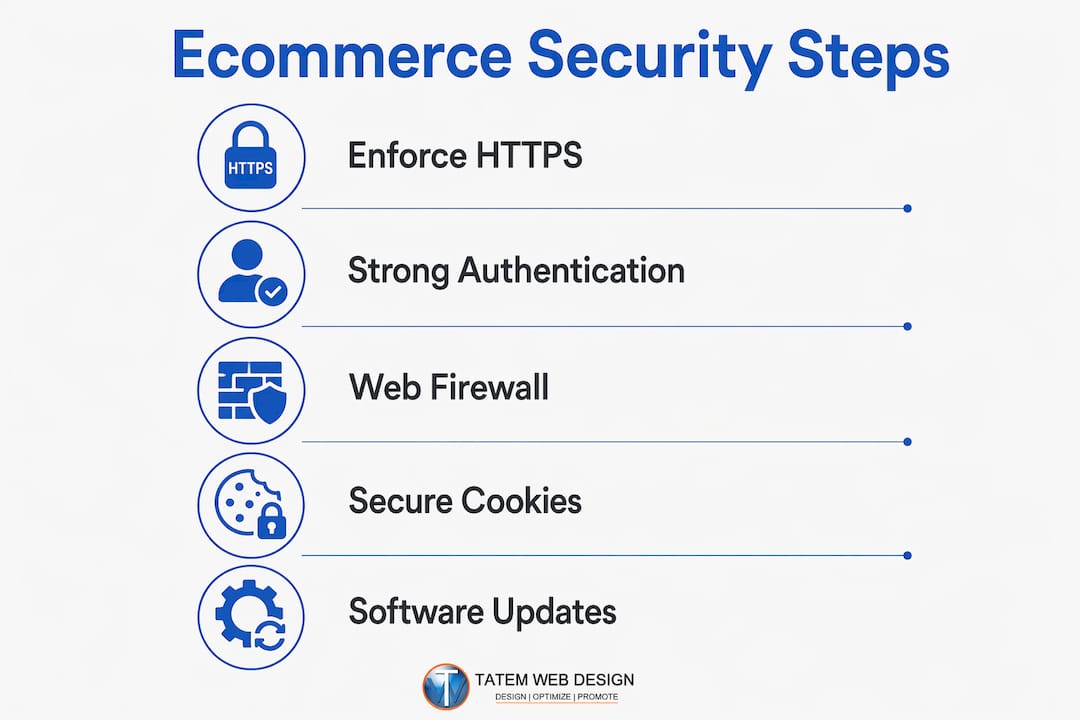
1. Enforce HTTPS with HSTS
Install a valid SSL/TLS certificate on every page of your store, not just the checkout. Then configure HTTP Strict Transport Security (HSTS). HSTS headers should be set with a minimum max-age of 31,536,000 seconds, which equals one full year. This tells browsers to refuse any non-HTTPS connection to your domain, even if a user types the address without “https://”. It closes a common downgrade attack vector.
2. Require strong authentication
Use two-factor authentication (2FA) on every admin account without exception. Require it for staff logins as well. For customer accounts, offer 2FA as an option. Strong password policies should enforce a minimum of 12 characters with mixed character types. Password reuse across accounts is the primary reason credential stuffing attacks succeed.
3. Deploy a Web Application Firewall
A Web Application Firewall (WAF) sits between your store and incoming traffic. It filters out malicious requests before they reach your application. WAFs block SQL injection attempts, cross-site scripting (XSS), and known exploit patterns. Virtual patching through WAF configurations covers plugin or theme vulnerabilities before the vendor releases an official patch. That gap between exploit discovery and patch release is when most attacks happen.
4. Secure your session cookies
Session cookie security requires setting both the HttpOnly and Secure flags on every session token. The HttpOnly flag prevents JavaScript from reading the cookie, which blocks most cross-site scripting theft attempts. The Secure flag ensures the cookie is only transmitted over HTTPS. These two settings together prevent session hijacking and admin account takeover.
5. Keep all software current
Update your platform, themes, and plugins on a regular schedule. Do not wait for automatic updates to run on their own timeline. Check for security releases weekly and apply them within 24 hours. For vulnerabilities with no patch yet available, use your WAF’s virtual patching rules as a temporary control.
Pro Tip: Create a staging environment that mirrors your live store. Test every update there before pushing it to production. This prevents a security patch from breaking your checkout flow.
The table below shows the protection each control provides and its implementation priority.
| Technical control | Threat it addresses | Priority |
|---|---|---|
| SSL/TLS with HSTS | Data interception, downgrade attacks | Critical |
| Two-factor authentication | Credential stuffing, account takeover | Critical |
| Web Application Firewall | Injections, exploits, bot traffic | High |
| HttpOnly and Secure cookie flags | Session hijacking | High |
| Regular software updates | Known vulnerability exploits | High |
Secure hosting, strong authentication, HTTPS, firewalls, and continuous monitoring together form the proven baseline that stops most real-world ecommerce attacks. Each control addresses a different attack vector, which is why removing any one of them creates a gap.
What compliance standards and operational practices support ecommerce security?
Technical controls protect your store from attacks. Compliance standards protect you from regulatory and legal consequences when something goes wrong. Both matter, and they reinforce each other.
Key compliance and operational requirements include:
- PCI DSS. PCI DSS compliance is mandatory for any business that accepts card payments. It requires network segmentation, encryption of cardholder data, access controls, and continuous monitoring. Noncompliance leads to fines, loss of payment processing ability, and reputational damage. Even if you use a third-party payment processor, you still carry compliance obligations for how data flows through your site.
- GDPR and CCPA. If you sell to customers in the European Union, GDPR applies to how you collect, store, and process personal data. If you sell to California residents, CCPA gives those customers rights over their data. Both laws require you to disclose what data you collect, secure it appropriately, and respond to data subject requests within defined timeframes.
- Third-party integration security. HTTPS encryption is foundational, but all third-party apps and API integrations must maintain equivalent security standards. A single poorly secured plugin can expose your entire customer database. Audit every integration you use and remove any that are no longer actively maintained.
- Continuous monitoring and incident response. Set up real-time alerts for failed login attempts, unusual order volumes, and unexpected file changes on your server. Have a written incident response plan that defines who does what when a breach is detected. A plan written after an attack is too late.
- Staff training. Phishing attacks target people, not software. Regular security awareness training for anyone with admin access reduces the risk of credential theft. A staff member clicking a fake invoice email can undo every technical control you have in place.
For a deeper look at how PCI DSS compliance applies to small ecommerce businesses, the requirements break down into manageable steps that most store owners can address without enterprise-level resources.
How can ecommerce owners implement a layered security approach?
Ecommerce security is an ongoing operational commitment, not a one-time setup. The most effective framework organizes your defenses into four operational layers: Prevent, Harden, Detect, and Respond.
Prevent covers the controls that stop attacks before they reach your store. This includes your WAF, bot mitigation rules, and rate limiting on your login and checkout pages. A secure payment gateway that handles card data off your server removes the most sensitive data from your attack surface entirely.
Harden covers the configuration work that reduces your exposure. HSTS, 2FA, cookie flags, and regular updates all fall here. Hardening means removing every unnecessary access point and tightening every configuration that ships with a permissive default.
Detect covers your monitoring tools. File integrity monitoring alerts you when core files change unexpectedly. Login anomaly detection flags unusual access patterns. Uptime monitoring catches site defacement or redirect injections quickly. The faster you detect an incident, the smaller the damage.
Respond covers your recovery capability. Daily offsite backups mean a ransomware attack or server failure does not destroy your business. A tested restore process means you can be back online in hours, not days. An incident response plan means your team knows exactly what steps to take without improvising under pressure.
Pro Tip: Run a quarterly security review using a published checklist. Treat it like a financial audit. Assign one person ownership of each control and document the last review date. Accountability prevents the drift that turns a secure store into a vulnerable one.
The comparison below shows how reactive and proactive security postures differ in practice.
| Security posture | Approach | Typical outcome |
|---|---|---|
| Reactive | Fix issues after they are reported or exploited | Higher breach cost, longer downtime, customer loss |
| Proactive | Monitor, patch, and audit on a defined schedule | Faster detection, lower impact, maintained customer trust |
Viewing ecommerce data protection as a continuous operational priority, rather than a project you complete once, is what separates stores that survive incidents from those that do not.
Key takeaways
Ecommerce security requires layered technical controls, active compliance with PCI DSS and privacy laws, and continuous monitoring to protect online transactions and customer data.
| Point | Details |
|---|---|
| Define your baseline | SSL/TLS, 2FA, WAF, and secure cookie flags are non-negotiable starting points for every store. |
| Know your threats | Credential stuffing, card testing, and skimming scripts are the most active automated attack types. |
| Stay compliant | PCI DSS is mandatory for card-accepting stores; GDPR and CCPA add data privacy obligations. |
| Audit third-party integrations | Every plugin and API connected to your store expands your attack surface and must be evaluated. |
| Commit to continuity | Security is an ongoing operational discipline, not a one-time configuration task. |
What I have learned after 26 years of building ecommerce sites
The most dangerous assumption I see ecommerce owners make is that their platform handles security for them. It does not. WordPress, WooCommerce, Shopify, and every other platform give you a foundation. What you build on top of that foundation is your responsibility.
I have worked with store owners who had every technical control in place and still got hit because a staff member clicked a phishing email and handed over admin credentials. The technical layer and the human layer have to work together. One without the other leaves a gap that attackers will find.
The second mistake I see constantly is treating security as a project with a completion date. You install an SSL certificate, set up 2FA, and check the box. Six months later, a plugin you forgot about has a critical vulnerability, and your WAF rules have not been updated since the initial setup. Security drifts. The only way to prevent that drift is to schedule regular reviews and assign ownership to specific people.
What actually works is the layered model described in this article, applied consistently over time. Prevent what you can. Harden what you cannot prevent. Detect what gets through. Respond fast when it does. That cycle, repeated on a defined schedule, is what keeps a store secure in 2026 and beyond. For store owners who want to go deeper on the broader strategy, the cybersecurity consultant guide covers how to think about security at the business level, not just the technical level.
— Matt
How Tatemweb builds security into every ecommerce store it creates
Tatemweb has spent over 26 years building ecommerce sites for Florida businesses across retail, healthcare, legal, and professional services. Security is not an add-on. It is built into the architecture from the first line of code.

Every AI ecommerce store Tatemweb builds includes HTTPS enforcement, WAF configuration, secure session handling, and PCI DSS-aligned payment integration from day one. For stores that need a deeper security layer, Tatemweb’s AI security enhancements apply AI-driven monitoring and threat detection to catch anomalies before they become incidents. Call Tatemweb directly at 772-224-8118 to schedule a consultation and find out how a properly secured ecommerce store protects your revenue and your customers.
FAQ
What is ecommerce security in simple terms?
Ecommerce security is the combination of technical controls, compliance standards, and operational practices that protect your online store, customer data, and payment transactions from cyberattacks and fraud.
What is the most important ecommerce security standard?
PCI DSS is the most critical compliance standard for ecommerce businesses that accept card payments. It requires encryption, network segmentation, access controls, and continuous monitoring of cardholder data environments.
How do I secure my ecommerce store against automated attacks?
Deploy a Web Application Firewall with bot mitigation rules, enable rate limiting on your login and checkout pages, and use 2FA on all admin accounts. These three controls stop the majority of automated credential stuffing and card testing attacks.
Does HTTPS alone make my ecommerce site secure?
No. HTTPS encrypts data in transit but does not protect against account takeovers, skimming scripts, or server-side vulnerabilities. A complete website security approach requires authentication controls, a WAF, and regular software updates alongside HTTPS.
How often should I review my ecommerce security setup?
Run a full security review at least once per quarter. Apply security patches within 24 hours of release. Review third-party integrations every six months and remove any plugins that are no longer actively maintained.
Recommended
Tatem Web Design
26+ YearsWeb Design & SEO Specialist · Tatem Web Design
Matt Tatem has been designing websites professionally since 1999, making Tatem Web Design one of Florida's longest-running web agencies. Based in Stuart, FL, he specializes in WordPress, local SEO, Shopify e-commerce, and cybersecurity consulting for small businesses.

Rank in ChatGPT in 90 Days With a Practitioner Led Checklist
Follow a practitioner led 90 day plan to get cited by ChatGPT: allow OAI-SearchBot, publish short answer capsules with schema, and track Bing AI Performance.

AI SEO Content Playbook: 16 GEO Signals for Agencies & Teams
A practical playbook mapping the GEO-16 signals to hands-on editorial workflows, review controls, and metrics. For agencies and in-house teams scaling AI...

Copy Ready Local Schema Markup for SMBs + Google Validation
Copy ready JSON-LD examples and Google validation steps for SMBs' local schema markup. Audit, implement, and verify each location page with confidence.