
The Role of SEO in Digital Marketing: How It Drives Growth
SEO is the foundational, long-term growth engine inside modern digital marketing. It captures high-intent demand before buyers ever encounter a paid ad, builds brand credibility through earned visibility, and compounds in value over time in ways that paid channels simply cannot replicate. The tools you will use to measure and manage it, Google Search Console, GA4 (Google Analytics 4), and Google Business Profile, are already free and waiting. The three ways SEO drives real business value are direct and worth naming upfront:
- Visibility: Your pages appear when buyers are actively searching for what you sell, putting you in front of qualified demand at zero incremental cost per click.
- Trust: Consistent organic presence signals authority to both search engines and buyers, reducing sales friction.
- Conversion: Organic visitors who arrive through a relevant search query convert at higher rates than most paid traffic sources because intent is already established.
Table of Contents
- What is the role of SEO in digital marketing?
- What are the main types of SEO you need to know?
- How does SEO integrate with your other marketing channels?
- How do you build an SEO strategy that actually scales?
- How do you measure SEO success with the right tools and KPIs?
- What does a practical SEO checklist look like for your business?
- Where is SEO headed with AI search and voice?
- Key Takeaways
- Why most businesses underestimate what SEO actually requires
- Tatemweb helps Florida businesses turn SEO into a revenue channel
- Useful sources
- FAQ
What is the role of SEO in digital marketing?
Digital marketing is the full portfolio of paid and organic channels a business uses to acquire, engage, and retain customers online. That portfolio includes paid search (Google Ads), social media, email, display advertising, content marketing, and public relations. SEO, or search engine optimization, is the discipline within that portfolio focused on earning unpaid visibility in search results and, increasingly, in AI-driven discovery surfaces like Google’s AI Overviews.
The distinction that matters most for business owners: paid channels stop delivering the moment you stop paying. SEO builds an asset. Every optimized page, earned backlink, and structured data implementation continues working after the initial investment.
| Dimension | SEO | Paid Search (SEM) |
|---|---|---|
| Time to results | 90–120 days for early signals | Immediate |
| Cost shape | Front-loaded effort, low ongoing cost per click | Continuous spend required |
| Trust signal | High (earned placement) | Lower (labeled “Ad”) |
| Best use case | Long-term demand capture, brand authority | Fast testing, promotional spikes |
| Compounding value | Yes, assets accumulate | No, stops when budget stops |
Where they overlap: keyword research, landing page quality, and conversion rate optimization benefit both channels simultaneously. An eCommerce retailer uses SEO for product discovery pages and PPC for seasonal promotions. A local law firm in Stuart, Florida uses local SEO to capture “personal injury attorney near me” queries and paid ads to dominate during a specific campaign window. A B2B software company uses SEO to capture research-stage leads reading comparison articles months before a purchase decision. According to Investopedia, improving SEO is one of the most accessible and cost-effective ways for small businesses to increase visibility and drive traffic.
What are the main types of SEO you need to know?
SEO breaks into five functional areas: technical, on-page, off-page, local, and content-format SEO. Each addresses a different layer of how search engines evaluate and rank your site.
Technical SEO
Technical SEO covers everything that affects crawlability, indexability, and page performance. Core Web Vitals, Google’s user-experience metrics measuring Largest Contentful Paint (LCP), Interaction to Next Paint (INP), and Cumulative Layout Shift (CLS), sit at the center of this work. A page that loads slowly or shifts layout unexpectedly during load will rank below a comparable page that does not, regardless of content quality.
On-page SEO
On-page work maps keywords to user intent and structures content so both readers and crawlers understand it. That means title tags, meta descriptions, header hierarchy (H1–H3), internal linking, and image alt text. The deeper discipline is intent mapping: understanding whether a query is informational, navigational, commercial, or transactional, and matching your page format to that intent. A buyer searching “best CRM for small business” wants a comparison, not a product page. Serving the wrong format costs rankings. The on-page SEO checklist from Tatemweb walks through every element in sequence.
Off-page SEO and link building
Off-page authority comes primarily from backlinks, meaning other websites linking to yours. A link from a high-authority, relevant domain signals to Google that your content is trustworthy. Brand mentions, digital PR, and guest publishing all contribute. For local businesses, link building strategies that target local directories, chambers of commerce, and industry associations carry particular weight.
Local SEO
Local SEO centers on Google Business Profile (GBP). A fully optimized GBP listing with accurate NAP (name, address, phone), categories, photos, and review responses directly influences your visibility in the local map pack. Citations, meaning consistent business listings across directories like Yelp, Angi, and industry-specific platforms, reinforce that local authority.
Content-format SEO
Video, image, and product-feed optimization are growing in importance. YouTube videos appear in Google SERPs. Product feeds structured with schema.org markup surface in Google Shopping. Structured FAQ content wins featured snippet placements. Applying structured data to these formats is the bridge between content production and SERP feature capture.
Pro Tip: Fix technical issues before scaling content. Publishing 50 new pages on a site with crawl errors or failing Core Web Vitals is like filling a leaky bucket. Audit first, then produce.
How does SEO integrate with your other marketing channels?
SEO feeds acquisition, content, and audience data into every other channel in your marketing stack. Treating it as a standalone activity leaves significant ROI on the table. Here is how the integration works in practice:
- Top organic content fuels email campaigns — A blog post that drives consistent organic traffic is already proven content. Repurpose it as a newsletter feature, a lead magnet, or an email sequence to capture subscribers who found you through search.
HubSpot’s SEO strategy guide frames this integration clearly: a unified approach that connects SEO activity to pipeline and revenue consistently outperforms siloed channel management. Neal Schaffer reinforces the point, positioning search as foundational infrastructure that captures demand before buyers know your brand exists.
How do you build an SEO strategy that actually scales?
An SEO strategy that scales rests on three pillars in priority order: technical health (crawlability and performance), content aligned to intent clusters, and authority-building through earned links and brand signals. Get the foundation right before scaling the other two.
Roadmap and timeline
| Phase | Timeframe | Primary Activities |
|---|---|---|
| Foundation | Weeks 1–4 | GA4 + Search Console setup, technical audit, critical redirects, GBP optimization |
| Early content | Months 1–3 | Keyword mapping, 6–8 priority pages targeting low-competition queries |
| Authority building | Months 3–9 | Link outreach, content hub expansion, pillar page development |
| Optimization | Months 9+ | Content refresh, conversion rate testing, scaling winning formats |
The SEO Engine’s month-by-month ROI timeline shows that early ranking signals typically appear in 90–120 days for low-competition keywords, meaningful traffic increases around months 4–6, and revenue impact often by months 6–9. Set those expectations with stakeholders before the campaign starts.
How do you measure SEO success with the right tools and KPIs?
Measure both visibility metrics and business metrics. Impressions and rankings tell you whether SEO activity is working. Organic conversions and assisted revenue tell you whether it is generating business value.
| KPI | Business Signal | Primary Tool |
|---|---|---|
| Organic impressions | Brand awareness and discoverability | Google Search Console |
| Average position | Competitive ranking health | Google Search Console |
| Organic sessions | Traffic volume from search | GA4 |
| Organic conversion rate | Lead or sale quality from search | GA4 |
| Assisted conversions | SEO’s role in multi-touch paths | GA4 (attribution reports) |
| Domain authority / backlink profile | Long-term trust and ranking potential | Moz, Ahrefs, or similar |
| Core Web Vitals scores | Page experience and ranking eligibility | Google Search Console |
Tool breakdown:
- Moz (or equivalent rank tracker): — Monitors keyword position changes over time and tracks domain authority relative to competitors.
A practical attribution example: a buyer searches “HIPAA-compliant website design Florida,” reads your blog post, leaves, sees a retargeting ad two days later, and submits a contact form. GA4’s attribution reports show that organic search assisted that conversion even though the last click was paid. Without that visibility, you would undervalue SEO’s contribution to revenue.
What does a practical SEO checklist look like for your business?
The fastest wins come from fixes that improve indexability and user experience, not from publishing more content on a broken foundation.
Week 1 (setup and triage):
- Connect GA4 and Google Search Console to your domain and verify ownership.
- Submit your XML sitemap in Search Console.
- Audit and fix critical redirects (broken 404s, redirect chains).
- Claim and fully complete your Google Business Profile.
Month 1 (content and on-page):
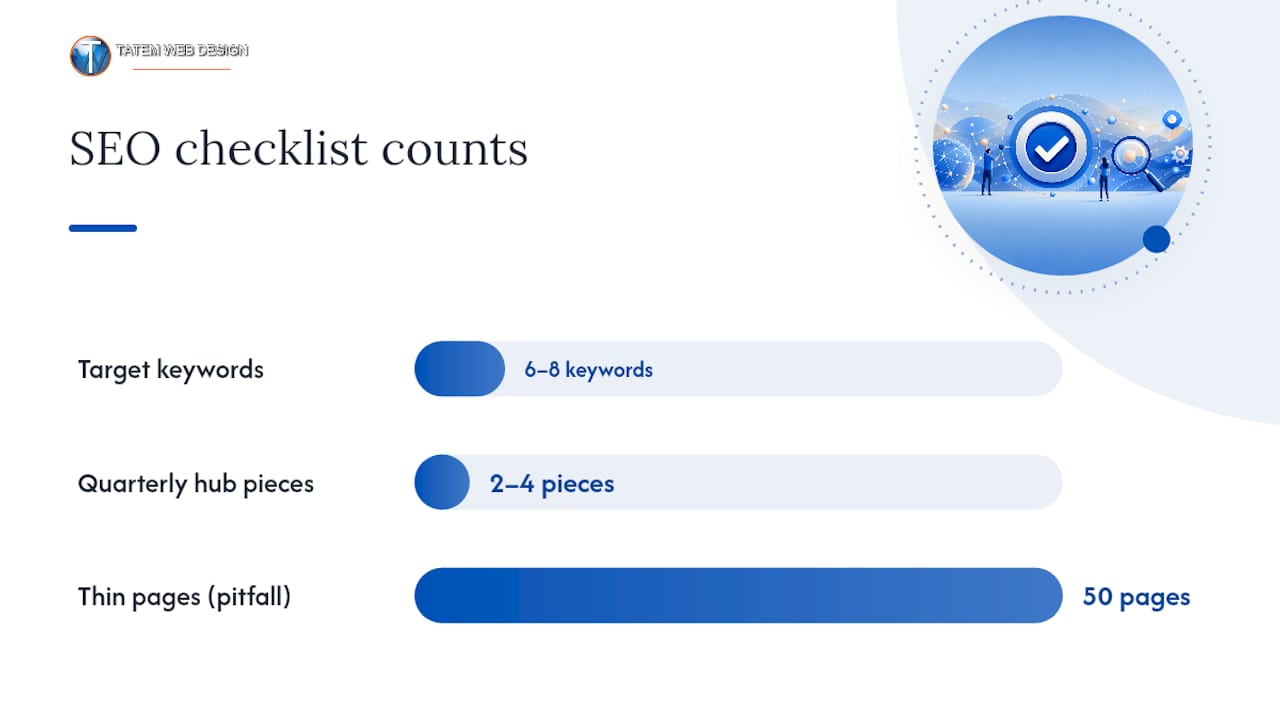
- Map your top 6–8 target keywords to specific pages using a keyword-to-URL matrix.
- Audit title tags and meta descriptions for those pages; rewrite any that are missing, duplicated, or over 60 characters.
- Fix any pages blocked in robots.txt that should be indexed.
- Add schema.org markup to your homepage, service pages, and any FAQ content.
Quarter 1 (authority and expansion):
- Launch a link outreach campaign targeting local directories, industry associations, and relevant publications.
- Publish two to four content hub pieces targeting informational queries in your niche.
- A/B test meta title variants using Search Console click-through-rate data.
- Schedule a quarterly content audit to refresh pages with declining traffic.
One pitfall that derails more SMB SEO programs than any other: thin content published at scale. Fifty pages with 200 words each signal low quality to Google and dilute your site’s overall authority. Prioritize depth on fewer pages over breadth on many, and address technical debt before adding new content. The step-by-step SEO optimization guide from Tatemweb covers the full audit-to-execution sequence.
Where is SEO headed with AI search and voice?
Prioritize structured answers, data verifiability, and topical depth to remain visible as AI-driven SERPs reshape how buyers discover businesses.
The trends reshaping search right now:
- AI Overviews and zero-click growth: Google’s AI-generated answer blocks are appearing for a growing share of queries. Search Engine Journal’s analysis of the AI search era recommends structuring content with answer-first paragraphs, named entities, and inline citations to increase citability. Incremys notes that impressions and share-of-voice are now as important as click counts in any forward-looking measurement framework.
- Voice search: Conversational, question-based queries are growing as smart speakers and mobile voice assistants become standard. Content structured around natural-language questions and concise answers performs better in voice results. Tatemweb’s voice search optimization guide covers the specific formatting adjustments that help.
- Core Web Vitals as a ranking floor: Google treats CWV scores as a baseline quality signal. Sites that fail LCP, INP, or CLS thresholds face a structural ranking disadvantage regardless of content quality.
- First-party data as a competitive asset: As third-party cookies phase out, businesses that collect and use their own customer data for content strategy and audience targeting hold a durable advantage.
The practical priority list: publish unique, primary-source data your competitors cannot replicate, structure every page with clear heading hierarchies and list-based answer blocks, and maintain technical health as a non-negotiable baseline.
Key Takeaways
SEO is the only digital marketing channel that builds compounding organic assets, captures high-intent demand at zero incremental cost per click, and feeds measurable business outcomes across every other channel in your stack.
| Point | Details |
|---|---|
| SEO compounds over time | Organic assets accumulate value; early ranking signals appear in 90–120 days, revenue impact often by months 6–9. |
| Technical health comes first | Fix crawl errors, Core Web Vitals, and indexability before scaling content production. |
| Measure business outcomes | Track organic conversions and assisted revenue in GA4, not just rankings or sessions. |
| Integration multiplies ROI | Sharing keyword and conversion data across SEO, PPC, and email reduces wasted spend and accelerates learning. |
| Tatemweb accelerates the process | Tatemweb’s AI-powered local SEO and website design services give Florida SMBs a faster path from audit to measurable organic growth. |
Why most businesses underestimate what SEO actually requires
The conventional wisdom says SEO is a content game. Publish more, rank higher. That framing is not wrong, but it is dangerously incomplete, and it is why so many small businesses invest in blog posts for six months and see nothing.
What actually moves the needle is the sequence. Technical health first, always. A site with crawl errors, slow load times, or duplicate content issues will not rank well no matter how good the writing is. The businesses that see compounding returns from SEO are the ones that treated it as infrastructure before they treated it as a content calendar.
The second thing most businesses underestimate is the integration requirement. SEO data, specifically which queries drive conversions, which pages hold attention, and which topics generate links, is some of the most valuable intelligence a marketing team can have. When that data stays siloed in a Search Console account that nobody checks, the whole organization loses. The businesses winning in organic search in 2026 are the ones feeding that data into paid campaigns, email sequences, and product decisions.
The third underestimation is time. Ninety to 120 days to early signals is not a failure. It is how the channel works. The businesses that quit at month three are the ones that never experienced the compounding phase, where a single well-optimized page drives leads for years without additional spend.
Tatemweb helps Florida businesses turn SEO into a revenue channel
If your business is not capturing organic search traffic from your local market, you are leaving qualified leads to competitors who are. Tatemweb has spent over 26 years helping Florida businesses build the kind of digital presence that generates consistent, measurable growth, and the agency’s AI-powered approach compresses the timeline significantly.
Three ways Tatemweb delivers results for SMBs:
- AI-powered website design that is built SEO-ready from day one, with structured data, Core Web Vitals compliance, and intent-mapped content architecture included in every build.
- Local SEO services covering Google Business Profile optimization, citation building, and keyword targeting for Florida markets, so your business appears when nearby buyers are searching.
- AI email marketing integration that repurposes your top organic content into automated email sequences, turning search traffic into a nurture pipeline.
Call Tatemweb directly at 772-224-8118 or visit tatemweb.com/ai-services to request a free consultation and find out exactly where your site stands today.
Useful sources
- Google Developers — Webmaster guidelines
- HubSpot Blog — How to create an SEO strategy
- Investopedia — SEO for small businesses
- Neal Schaffer — Digital marketing strategy (SEO as discovery engine)
- Search Engine Journal — Integrated search brief and AI search era
- The SEO Engine — Benefits and month-by-month ROI timeline for small business
- Incremys — SEO in digital marketing: The 2026 guide
- LivePlan Blog — SEO benefits for small businesses
FAQ
What is the role of SEO in digital marketing?
SEO captures high-intent organic demand within the broader digital marketing mix, building compounding visibility and credibility that paid channels cannot replicate. It feeds audience and keyword data into every other channel, from PPC to email, making the entire marketing stack more efficient.
How long does SEO take to show results for a small business?
Early ranking signals typically appear in 90–120 days for low-competition keywords, with meaningful traffic increases around months 4–6 and revenue impact often by months 6–9.
Which tools do you need to measure SEO performance?
GA4 and Google Search Console are the minimum viable setup, covering organic sessions, conversions, rankings, and index health. Moz or a comparable rank tracker adds competitive position monitoring, and a crawl tool like Screaming Frog handles technical audits.
How does local SEO differ from general SEO?
Local SEO prioritizes visibility in geographically relevant searches, centering on Google Business Profile optimization, consistent NAP citations across directories, and location-specific keyword targeting. General SEO focuses on organic rankings without a geographic constraint.
Can Tatemweb handle both SEO and website design together?
Yes. Tatemweb builds AI-powered websites that are SEO-ready from launch, with structured data, Core Web Vitals compliance, and intent-mapped content architecture built in, then supports ongoing local SEO and digital marketing services for Florida businesses.
Recommended
Tatem Web Design
26+ YearsWeb Design & SEO Specialist · Tatem Web Design
Matt Tatem has been designing websites professionally since 1999, making Tatem Web Design one of Florida's longest-running web agencies. Based in Stuart, FL, he specializes in WordPress, local SEO, Shopify e-commerce, and cybersecurity consulting for small businesses.
What a CMMC Level 2 Assessment Requires and How to Prepare
Prepare for your CMMC Level 2 assessment by understanding requirements, assessment paths, and mapping your Controlled Unclassified Information.

A Data Retention Policy Is Your Rulebook for Keeping and Deleting Data
Establishing a clear data retention policy helps manage data risk, ensuring compliance and effective data management for your organization.
Law Firm Local SEO: A Practical Playbook for More Local Clients
Unlock more local clients for your law firm with effective local SEO strategies. Optimize your Google Business Profile and boost your visibility!