
The Role of Industry-Specific Website Design for Growth
Your website is working for you or against you. There is no neutral. The role of industry-specific website design goes far beyond picking colors and fonts that match your logo. It determines whether a procurement manager trusts your manufacturing company enough to request a quote, whether a patient feels confident booking with your medical practice, or whether a legal prospect calls your firm or clicks to a competitor. Generic templates distribute the same structural logic across wildly different buyer journeys, and that mismatch costs businesses real revenue every day. This article unpacks what industry-specific web design actually means, why it measurably outperforms one-size-fits-all approaches, and how you can use it to build a site that functions as your best salesperson around the clock.
Table of Contents
- Key takeaways
- The role of industry-specific website design explained
- Benefits of custom website design vs. templates
- Site architecture and technical SEO for industry sites
- Lead qualification through smart UX design
- How design strategy connects to long-term business outcomes
- My honest take on why businesses get this wrong
- Build a site that works as hard as you do
- FAQ
Key takeaways
| Point | Details |
|---|---|
| Beyond aesthetics | Industry-specific design means functional alignment with your buyers’ decision process, not just visual branding. |
| Conversion advantage | Custom-designed websites generate 20 to 40% higher conversion rates than template-based alternatives. |
| Architecture matters | Structuring site content around industry topics like processes, materials, and certifications directly improves SEO and user trust. |
| Lead quality over volume | Forms optimized for your industry with 4 to 6 fields consistently outperform long generic forms at capturing qualified prospects. |
| AI changes the math | AI-assisted development now cuts custom site build time by 30 to 50%, making bespoke design accessible for businesses of all sizes. |
The role of industry-specific website design explained
Most business owners think of web design as a visual exercise. You pick a theme, drop in some photos, write a few paragraphs, and publish. That mindset works fine if you are selling commodity products where price is the only decision factor. For almost every other business, it leaves serious money on the table.
What is industry-specific web design, exactly? It is the practice of building a website where every structural and functional decision reflects how your specific buyers make purchasing decisions. That includes the information they need at each stage of consideration, the trust signals that carry weight in your sector, the forms and calls-to-action that match their workflow, and the content architecture that answers the questions they are actually asking before they ever contact you.
A healthcare website needs visible HIPAA compliance signals, appointment booking tools, and content that reduces patient anxiety. A law firm website needs attorney credibility markers, clear practice area breakdowns, and contact options that respect client confidentiality. A manufacturing supplier site needs detailed technical specification pages, RFQ paths, and certification documentation. None of these are interchangeable. When you drop any of these businesses onto a generic template, the disconnect between what the site offers and what the buyer needs creates friction. Friction kills conversions.
Here is where industry-specific design creates a structural advantage:
- Buyer journey alignment: Content and navigation mirror how your customers actually research and decide, not how a generic template assumes they do.
- Trust signal specificity: Credentials, certifications, case studies, and compliance badges are placed where your specific buyers look for reassurance.
- Functional tool integration: Industry-relevant tools like appointment schedulers, RFQ calculators, or compliance checklists are built in, not bolted on as afterthoughts.
- Content depth: Pages address the real questions buyers in your sector ask, which reduces the sales cycle and improves lead quality.
- Competitive differentiation: B2B service websites that integrate offline expertise into purposeful design consistently outperform competitors still using standard business templates.
The importance of industry-specific web design becomes clearest when you look at sectors with long sales cycles and high-value transactions. In those environments, a website is not just a marketing tool. It is the first substantive interaction a prospect has with your expertise, and it either confirms their confidence or erodes it.
Benefits of custom website design vs. templates
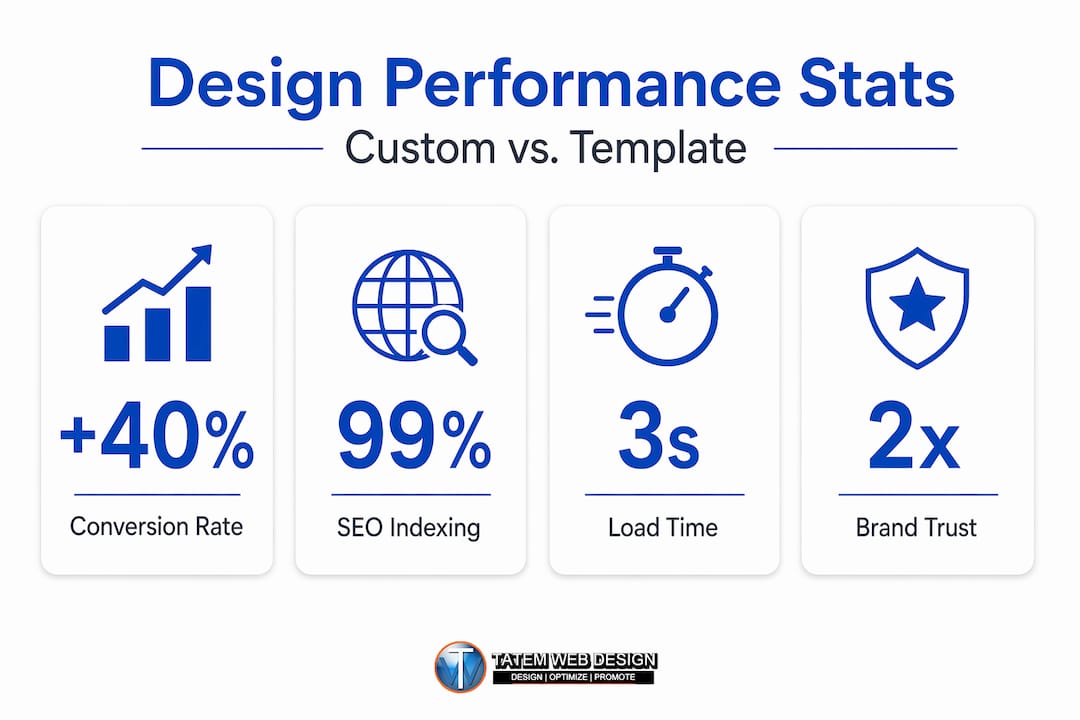
Numbers make the case better than theory. Bespoke web design yields 20 to 40% higher conversion rates than template-based sites across comparable traffic volumes. To translate that into business terms: if your site currently converts at 2% and custom design lifts that to 3.5%, the revenue impact on 5,000 monthly visits compounds fast, especially in professional services or B2B where a single client may be worth thousands of dollars annually.

The benefits of custom website design extend across four distinct dimensions that generic templates simply cannot replicate at scale.
| Dimension | Generic template | Industry-specific custom design |
|---|---|---|
| Conversion rate | Average 1 to 2% across mixed traffic | 20 to 40% uplift through aligned UX |
| SEO performance | Limited technical control, shared code bloat | Clean code, schema markup, crawl budget control |
| Lead quality | High volume, low relevance | Lower volume, higher intent and fit |
| Brand credibility | Same design as thousands of other sites | Unique visual identity reinforcing sector authority |
SEO performance deserves special attention here. Industry-specific design gives your development team full control over technical SEO elements: schema markup, canonical tags, URL structure, and Core Web Vitals optimization. Templates often carry legacy code, unnecessary plugins, and page-weight issues that drag down performance scores. In sectors where buyers search with highly specific technical queries, that performance gap translates directly into ranking gaps.
Pro Tip: If you are evaluating your current site’s competitive position, pull your Core Web Vitals report in Google Search Console and compare your Largest Contentful Paint score against the 2.5-second threshold. Most template-built sites in professional services fail this benchmark, giving custom-built competitors a measurable ranking advantage.
Brand differentiation carries real weight in credibility-sensitive industries. When a prospective patient compares three medical practices online, or a legal client evaluates two law firms, the site that feels specifically designed for them builds trust that a recycled template cannot. AI-assisted development now cuts custom build times by 30 to 50%, meaning the cost gap between templates and bespoke sites has narrowed significantly, making the switch a more accessible decision for growing businesses.
Site architecture and technical SEO for industry sites
Getting the structure of an industry-specific site right is where most businesses stumble. They think about pages individually instead of thinking about the site as an interconnected information system.
For complex industries like manufacturing, engineering, or heavy industrial services, the most effective model is a four-hub shallow architecture. This means organizing your content into four primary clusters: processes, materials, applications, and certifications. Each hub becomes a topical authority center that search engines understand and buyers can navigate intuitively. This four-hub structure improves procurement intent ranking while making it easier for field engineers and procurement managers to find exactly what they need without digging through irrelevant pages.
The “shallow” part matters as much as the structure itself. Keeping your site to three depth levels maximum means that any page is reachable in three clicks from the homepage. Search engine crawlers spend crawl budget more efficiently on shallow sites, and buyers do not abandon the journey because navigation became too complex.
| Technical element | Purpose | Industry impact |
|---|---|---|
| Schema markup | Communicates page type and content to search engines | Critical for service, product, and event pages |
| Canonical tags | Prevents duplicate content penalties | High value for product catalogs and service variations |
| Core Web Vitals | Measures real user page experience | Directly tied to Google ranking and bounce rate |
| Mobile optimization | Ensures usability on field and mobile devices | Essential for contractors, medical staff, field buyers |
| Crawl budget control | Ensures search engines index priority pages | Valuable for large industrial catalogs |
Technical SEO practices like schema markup and clean URL architecture are not optional extras for industry sites. They are the reason your product or service pages outrank competitors for the specific queries your buyers actually use.
Speed is another non-negotiable. Sites that load within three seconds retain significantly more users. Beyond three seconds, over 30% of prospective buyers leave before the page finishes loading. For industrial buyers checking supplier specs on a mobile device in the field, or a patient trying to book an appointment during a lunch break, a slow site is a lost opportunity. Responsive web design built around performance from the ground up, rather than patched onto a template after the fact, is the only way to consistently meet that threshold.
Lead qualification through smart UX design
Getting traffic to your industry-specific site is only half the equation. Converting that traffic into qualified leads requires deliberate design decisions at the point of contact.
The most effective approach for complex industries is the self-serve RFQ path. Instead of presenting buyers with a long, intimidating form, you stage the qualification process. Here is how it works:
- Initial contact form (4 to 6 fields maximum): Capture name, company, email, phone, project type, and timeline. Nothing more. Manufacturers who implement 4 to 6 field forms see significantly better conversion than those using exhaustive intake questionnaires on the first touch.
- Automated follow-up sequence: Once the initial form submits, a pre-built email or AI chatbot sequence asks the deeper qualification questions: budget range, technical specifications, compliance requirements.
- Gated content as a mid-funnel qualifier: Offer spec sheets, case studies, or compliance documentation in exchange for additional details. Buyers who engage with gated content are demonstrating intent, making them far higher quality leads.
- Progressive profiling: As buyers return to your site, track their behavior and surface relevant content that deepens engagement without requiring repeated form fills.
- Clear decision-stage CTAs: Place different calls-to-action based on where a buyer is in their journey. Early-stage visitors get educational content downloads. Late-stage visitors get “Request a Quote” or “Schedule a Consultation” prominently placed.
Pro Tip: Place your primary call-to-action above the fold and repeat it once in the middle of the page and once at the bottom. Studies on professional services sites consistently show that repeated CTA placement increases form completions without feeling aggressive, because each placement catches a different reading pattern.
Content strategy within the site matters just as much as form design. Industry-specific pages that answer fit and risk questions early, such as “Does your firm have experience with HIPAA-compliant projects?” or “What certifications does your manufacturing process meet?” do the heavy lifting of qualification before a prospect ever fills out a form. This reduces the volume of unqualified inquiries and increases the percentage of leads that are genuinely ready to buy. For healthcare website design, this means addressing compliance, patient privacy, and clinical trust on every key page.
How design strategy connects to long-term business outcomes
The importance of industry-specific web design becomes most visible when you measure the right things. Most business owners track rankings. Rankings are a leading indicator, not the result. The real metrics that tell you whether your site is working are: qualified lead volume, lead-to-proposal conversion rate, average deal size from web-sourced leads, and time-to-close for prospects who entered through the site.
Connecting SEO strategy to business KPIs rather than ranking positions alone is what separates a site that performs from one that simply exists. An industry-specific site built with this measurement mindset tracks buyer signals: which service pages they visited, what content they downloaded, how long they spent on pricing or certification pages. That data informs sales conversations and marketing decisions in ways that raw traffic numbers never can.
The ROI case for tailored website design strategies is straightforward. A site that converts even marginally better over a three to five year period pays back its design investment many times over. As your business scales or your market positioning evolves, your industry-specific site can be updated in sections without a full rebuild, because the architecture was built with intention rather than inherited from a template. That flexibility protects your investment and keeps your site aligned with where your business is going, not just where it started.
My honest take on why businesses get this wrong
I’ve seen hundreds of businesses make the same mistake: they treat their website like a business card. Get it done, get it online, move on. What I’ve learned over years of working with business owners across industries is that the companies growing fastest treat their site like a living sales asset, and they invest in it accordingly.
The uncomfortable truth is that most business owners don’t invest in industry-focused site development because they underestimate how much it affects buyer perception. They see a template that looks professional and assume that’s enough. It isn’t. A prospect who lands on a generic template for a law firm, a medical practice, or an engineering company immediately, even subconsciously, registers that nothing about this site was built specifically for them. That gap between expectation and experience erodes trust before a single word is read.
My advice: don’t wait until your site is embarrassing to upgrade it. Upgrade it when you want to move upmarket, when you’re entering a new service area, or when you notice your conversion rate stagnating despite solid traffic. Budget and business stage matter, of course. A brand-new practice with limited capital might start with a well-structured WordPress build that has clean architecture and solid content. But the moment you have traction, invest in design that reflects the sophistication of your actual service. AI tools have genuinely changed the economics here. What once cost $25,000 and took six months can now be built at a fraction of that cost and time. The barrier to a custom, industry-specific site is lower than it has ever been. There is no longer a good argument for settling.
— Matt
Build a site that works as hard as you do
If this article gave you a clear picture of where your current site falls short, the next logical step is working with a team that specializes in exactly this kind of industry-aligned design.
Tatemweb has spent over 26 years building websites for businesses across healthcare, legal, manufacturing, real estate, marine, and professional services throughout Florida and beyond. Their AI website design service combines the precision of industry-specific architecture with the speed and efficiency of modern AI tools, delivering custom sites in record time without sacrificing the technical SEO and conversion performance your business needs. Whether you need a custom e-commerce solution or a lead-generating professional service site, Tatemweb builds it with your buyers in mind from the first wireframe to the final page. You can also explore their AI chatbot and lead capture tools to keep your site working around the clock. Call Tatemweb directly at 772-224-8118 to schedule a consultation and find out what a properly designed industry-specific site can do for your revenue.
FAQ
What is industry-specific website design?
Industry-specific website design is the practice of building a website where structure, content, and functionality are tailored to the buyer journey, trust signals, and conversion needs of a specific sector. It goes beyond visual branding to include technical architecture, lead capture design, and SEO strategy aligned with how your buyers actually make decisions.
How does industry-specific design improve conversion rates?
Custom industry-aligned websites generate 20 to 40% higher conversion rates than generic templates by matching site structure and content to the specific decision criteria and trust signals buyers in that sector respond to.
How many form fields should an industry website use?
For most industries, especially manufacturing and professional services, 4 to 6 form fields on the initial contact form produces the best conversion results. Deeper qualification questions are collected in follow-up sequences after the first contact is made.
Does custom website design improve SEO?
Yes. Custom sites provide full control over technical SEO elements including schema markup, crawl budget, canonical tags, and page speed. These factors directly influence ranking performance in competitive industry search queries, particularly in regulated or complex sectors where generic templates cannot compete technically.
When should a business invest in industry-specific web design?
The right time is when you want to move upmarket, enter a new service area, or when traffic is strong but conversions are flat. AI-assisted development has reduced both cost and timelines significantly, making custom industry-specific design a viable option for businesses at earlier growth stages than ever before.
Recommended
- Industry website design examples to inspire your Florida business | Tatem Web Design
- Niche website design: Custom solutions for Florida SMBs | Tatem Web Design
- Technology Website Design FL - Tech Company Websites | Tatem Web Design
- Marine Industry Website Design - Boating Business Websites | Tatem Web Design
Tatem Web Design
26+ YearsWeb Design & SEO Specialist · Tatem Web Design
Matt Tatem has been designing websites professionally since 1999, making Tatem Web Design one of Florida's longest-running web agencies. Based in Stuart, FL, he specializes in WordPress, local SEO, Shopify e-commerce, and cybersecurity consulting for small businesses.

Rank in ChatGPT in 90 Days With a Practitioner Led Checklist
Follow a practitioner led 90 day plan to get cited by ChatGPT: allow OAI-SearchBot, publish short answer capsules with schema, and track Bing AI Performance.

AI SEO Content Playbook: 16 GEO Signals for Agencies & Teams
A practical playbook mapping the GEO-16 signals to hands-on editorial workflows, review controls, and metrics. For agencies and in-house teams scaling AI...

Copy Ready Local Schema Markup for SMBs + Google Validation
Copy ready JSON-LD examples and Google validation steps for SMBs' local schema markup. Audit, implement, and verify each location page with confidence.