
What Is User Experience Design? A Business Guide
User experience design is defined as the process of shaping every aspect of how people interact with a product or service to make that interaction intuitive, efficient, and satisfying. Known in the industry as UX design, this discipline goes far beyond visual aesthetics. It is a research-driven practice with direct, measurable impact on conversion rates, customer retention, and support costs. The data is clear: every $1 invested in UX returns an average of $100, a 9,900% ROI. For Florida businesses and individuals building digital products, understanding what UX design truly involves is the first step toward building something people actually want to use.
What does user experience design involve?
UX design is a systematic, iterative process that solves user problems rather than a focus on self-expression or visuals. It covers the full arc of how a person discovers, uses, and feels about a product. The discipline pulls together research, structure, interaction, and testing into a repeatable workflow.

Core components of UX design
The practice rests on five interconnected components:
- User research: Interviews, surveys, and behavioral analysis that reveal what users need, expect, and struggle with.
- Information architecture: Organizing content and features so users can find what they need without confusion.
- Interaction design: Defining how users move through a product, including button behavior, transitions, and feedback states.
- Usability testing: Observing real users complete tasks to identify friction points before launch.
- Visual design: Applying color, typography, and layout to reinforce clarity and build trust.
Each component feeds the next. Research informs architecture, architecture shapes interaction, and testing validates all of it.
User interface vs. user experience
The user interface (UI) is the visual layer: buttons, icons, screens, and color palettes. User experience is the broader discipline that determines whether those elements serve the user’s goals. UI is one output of UX work, not a synonym for it. A product can look polished and still frustrate users if the underlying structure is poorly designed. The role of UX in web design extends well beyond what users see to how they think, feel, and act.
The UX design process explained
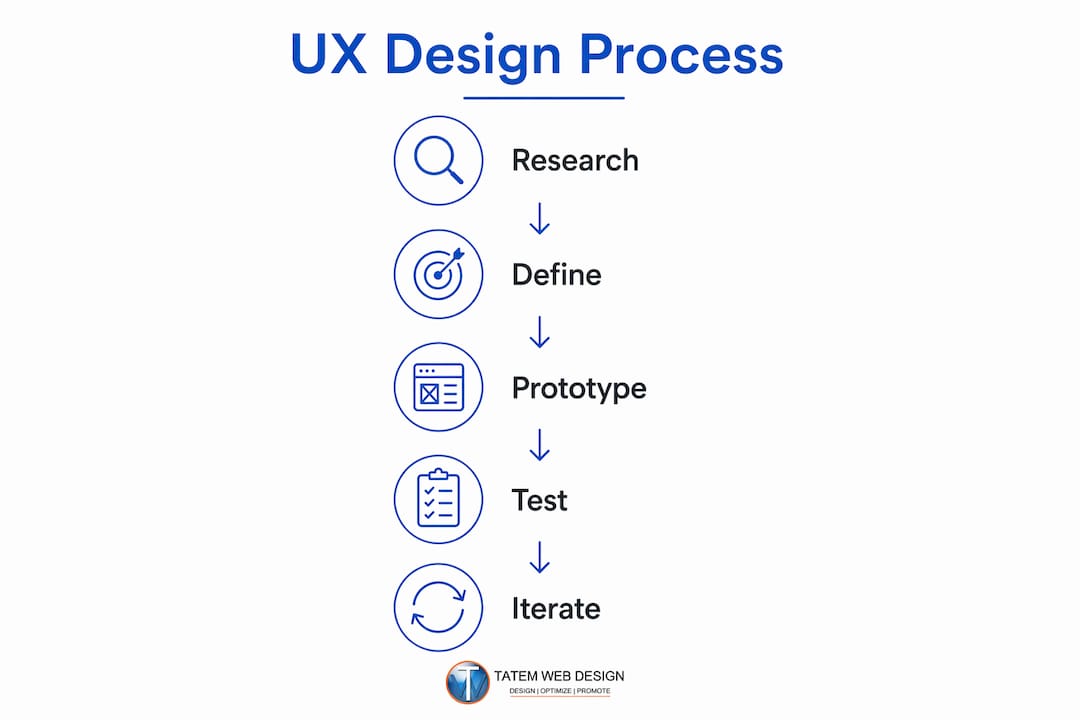
UX design follows an iterative cycle, not a linear path. Teams move through research, define the problem, prototype solutions, test with users, and refine based on findings. That cycle repeats throughout the product lifecycle. Products that treat UX as a one-time launch task consistently underperform compared to those that embed testing and iteration into ongoing development.
Pro Tip: Run usability tests early, even with rough wireframes. Fixing design problems in the research phase costs $1. The same fix during development costs $10, and post-launch it costs $100.
Why is UX design crucial for business success?
UX design is a direct driver of revenue, retention, and operational efficiency. The business case is not theoretical. The numbers show a consistent pattern across industries.
Well-optimized UX can improve conversion rates by up to 400% and reduce support tickets by 30%. Those two outcomes alone represent significant cost savings and revenue gains for any business running a website or digital product.
“Business leaders often misunderstand UX as mere aesthetics. It is a data-driven engine for business survival and growth. Companies that treat design as decoration consistently lose to those that treat it as a system.”
Customer retention is equally at stake. 88% of users will not return to a website or app after a single bad experience. That statistic means one poor interaction can permanently remove a potential customer from your pipeline.
The cost of ignoring UX
Poor UX generates hidden costs that compound over time. High churn rates, increased support volume, and low conversion all trace back to friction in the user experience. A confusing checkout flow, a slow-loading page, or a navigation structure that buries key information all push users away. 47% of users expect a page to load in two seconds or less, and delays directly reduce conversions. Speed is not a technical detail. It is a UX requirement.
UX business impact at a glance
| UX Factor | Business Impact |
|---|---|
| $1 UX investment | Average $100 return (9,900% ROI) |
| Optimized UX | Up to 400% improvement in conversion rates |
| Poor UX | 88% of users will not return after one bad experience |
| Page load delay | 20% reduction in conversions per delay |
| Reduced support tickets | Up to 30% decrease with better UX |
Pro Tip: Track UX impact through three core metrics: task completion rate, time on task, and support ticket volume. A drop in support tickets after a redesign is one of the clearest signals that UX improvements are working.
What are the principles and best practices of effective UX design?
Effective UX design follows principles grounded in how people think and make decisions. These are not stylistic preferences. They are behavioral realities that determine whether a product succeeds or fails.
Psychological principles that shape design
Two cognitive principles directly affect how users interact with digital products.
Hick’s Law states that the more options a person faces, the longer it takes them to decide. Menus with 12 items slow users down compared to menus with 5. The practical rule is to reduce choices at every decision point. The Goal Gradient Effect shows that users complete tasks faster when they perceive they are close to the finish line. Progress indicators, step counts, and visual checkpoints all trigger this effect and reduce abandonment.
First impressions also carry enormous weight. Users form an opinion about a website’s visual appeal in as little as 50 milliseconds. That judgment shapes whether they trust the product before reading a single word.
Core UX design principles
The principles of user experience that consistently produce strong results include:
- Simplicity: Remove every element that does not serve a user goal. Complexity is a UX failure, not a feature.
- Accessibility: Design for users with visual, motor, and cognitive differences. WCAG 2.1 guidelines provide the standard framework.
- Consistency: Use the same patterns, labels, and behaviors throughout a product. Inconsistency forces users to relearn the interface at every step.
- Usability: Every feature must be learnable, efficient, and error-tolerant. If users make the same mistake repeatedly, the design is at fault.
- Responsive design: A product must work correctly across all screen sizes. Mobile users represent a majority of web traffic in most industries.
Best practices for UX design
Strong UX execution comes down to a set of repeatable practices:
- Conduct user research before writing a single line of code or designing a single screen.
- Build low-fidelity prototypes and test them with real users before investing in high-fidelity design.
- Prioritize clear navigation with no more than three clicks to any core feature.
- Write interface copy in plain language. Avoid jargon in labels, error messages, and instructions.
- Test for performance. Page speed is a UX metric, not just a technical one.
- Iterate based on data. Every redesign should be driven by user behavior, not internal opinion.
How to implement UX design effectively in your organization
Implementing UX design well requires embedding it into your workflow from the start, not adding it as a final review step. The sequence matters as much as the methods.
-
Start with discovery. Before designing anything, conduct at least five user interviews to understand the core problems your product must solve. Small-scale usability testing with as few as five users uncovers most high-impact usability issues cost-effectively. This is the most efficient risk reduction available to any product team.
-
Map the user journey. Document every step a user takes from first contact to task completion. Identify where they drop off, where they hesitate, and where they succeed. This map becomes the foundation for every design decision.
-
Build and test in low fidelity first. Sketch wireframes or use basic prototyping tools before committing to visual design. Test these rough versions with real users. The goal is to find problems while they are cheap to fix.
-
Integrate accessibility from day one. Retrofitting accessibility after launch is expensive and often incomplete. Apply WCAG 2.1 standards during the design phase, not after.
-
Establish baseline metrics before launch. Measure task completion rate, bounce rate, and support ticket volume before any redesign. Without a baseline, you cannot prove improvement.
-
Run continuous testing cycles post-launch. UX maturity is a long-term capability, not a one-time project. Schedule quarterly usability reviews and treat user feedback as a permanent input into your product roadmap.
-
Connect UX decisions to business outcomes. Every UX change should map to a measurable goal: lower bounce rate, higher conversion, fewer support calls. This framing builds internal support for ongoing UX investment.
A practical example: a Florida healthcare provider redesigned their patient portal intake form by reducing the number of fields from 22 to 9, based on user testing. Appointment completions increased significantly, and support calls about form errors dropped. The fix took two weeks. The testing that identified the problem took two days. That ratio reflects the real value of improving website user experience before problems compound.
Key Takeaways
Effective UX design is the single highest-ROI investment a business can make in its digital product, returning measurable gains in conversion, retention, and support efficiency when applied systematically.
| Point | Details |
|---|---|
| UX design definition | UX design shapes every interaction a user has with a product to make it intuitive and satisfying. |
| Business ROI | Every $1 invested in UX returns an average of $100 through conversions and reduced support costs. |
| Cost of poor UX | 88% of users will not return after one bad experience, making first impressions critical. |
| Early testing saves money | Fixing design problems in the research phase costs $1 versus $100 post-launch. |
| Continuous iteration | UX maturity requires embedding research and testing into ongoing workflows, not just at launch. |
UX design is not a department. It’s a discipline.
After working with businesses across Florida for years, the pattern I see most often is this: companies invest in a website redesign, launch it, and then treat UX as finished. Six months later, they are wondering why conversions are flat and support tickets are climbing.
The uncomfortable truth is that most businesses treat UX as a visual problem when it is actually a behavioral one. A new color scheme does not fix a confusing checkout flow. A new logo does not help a user who cannot find your contact page. The businesses that get real results from UX are the ones that start with research, test before they build, and keep testing after they launch.
The 1-10-100 rule is the most persuasive argument I know for early UX investment. A problem caught in research costs $1 to fix. The same problem caught after launch costs $100. That math should end every internal debate about whether to budget for user testing.
The other misconception I encounter regularly is that UX is only relevant for large companies with dedicated design teams. That is wrong. A five-person usability test with real users costs almost nothing and reveals the majority of critical issues. Small businesses in Florida have the same access to these methods as enterprise teams. The difference is whether they choose to use them.
UX design is not a luxury or a finishing touch. It is the foundation that determines whether your product earns trust, drives conversions, and keeps customers coming back. Build it in from the start, measure it consistently, and treat it as a permanent part of how you operate.
— Matt
Tatemweb’s AI-driven approach to UX-focused web design
Great UX does not happen by accident. It requires the right process, the right tools, and experience building products that perform under real-world conditions.
Tatemweb brings over 26 years of web design experience to every project, now combined with AI-powered design systems that build faster, test smarter, and deliver measurable results. Their AI website design services apply UX principles from the first wireframe to final launch, with built-in SEO, performance optimization, and conversion-focused structure. Florida businesses across healthcare, legal, real estate, and professional services have used Tatemweb’s process to reduce bounce rates, increase leads, and cut support overhead. Call Tatemweb directly at 772-224-8118 to schedule a consultation and see what a properly designed user experience can do for your business.
FAQ
What is the user experience definition in simple terms?
User experience is the overall feeling a person has when using a product or service, shaped by how easy, efficient, and satisfying that interaction is.
What does UX design involve day to day?
UX design involves user research, information architecture, prototyping, usability testing, and iterative refinement based on real user behavior and data.
How does user interface differ from user experience?
The user interface is the visual layer of a product. User experience is the broader discipline that determines whether the entire interaction serves the user’s goals effectively.
What is the ROI of investing in UX design?
Every $1 invested in UX returns an average of $100, primarily through higher conversion rates, improved retention, and reduced customer support costs.
How many users do you need for effective usability testing?
Testing with as few as five users uncovers the majority of high-impact usability problems, making small-scale testing a cost-effective standard practice for any product team.
Recommended
Tatem Web Design
26+ YearsWeb Design & SEO Specialist · Tatem Web Design
Matt Tatem has been designing websites professionally since 1999, making Tatem Web Design one of Florida's longest-running web agencies. Based in Stuart, FL, he specializes in WordPress, local SEO, Shopify e-commerce, and cybersecurity consulting for small businesses.

Rank in ChatGPT in 90 Days With a Practitioner Led Checklist
Follow a practitioner led 90 day plan to get cited by ChatGPT: allow OAI-SearchBot, publish short answer capsules with schema, and track Bing AI Performance.

AI SEO Content Playbook: 16 GEO Signals for Agencies & Teams
A practical playbook mapping the GEO-16 signals to hands-on editorial workflows, review controls, and metrics. For agencies and in-house teams scaling AI...

Copy Ready Local Schema Markup for SMBs + Google Validation
Copy ready JSON-LD examples and Google validation steps for SMBs' local schema markup. Audit, implement, and verify each location page with confidence.