
AI Consultant for SMEs: Your 2026 Hiring Guide
An AI consultant is an external expert who designs, advises on, and deploys artificial intelligence solutions to help businesses operate more efficiently and compete more effectively. The role spans everything from a single strategy call to full end-to-end model training and production deployment. For small and medium-sized enterprises in Florida and across the U.S., working with the right AI consulting partner is no longer a luxury reserved for enterprise budgets. It is a practical decision that determines whether your AI investments produce measurable returns or expensive prototypes that never ship.
What does an AI consultant actually do?
An AI consultant provides a broad range of services, from conference-call guidance on AI strategy to hands-on model training, vendor evaluation, risk management, and production deployment. That breadth is what separates a true artificial intelligence advisor from a software vendor who simply sells you a tool and walks away. The consultant’s job is to understand your business goals first, then identify where AI creates real leverage.
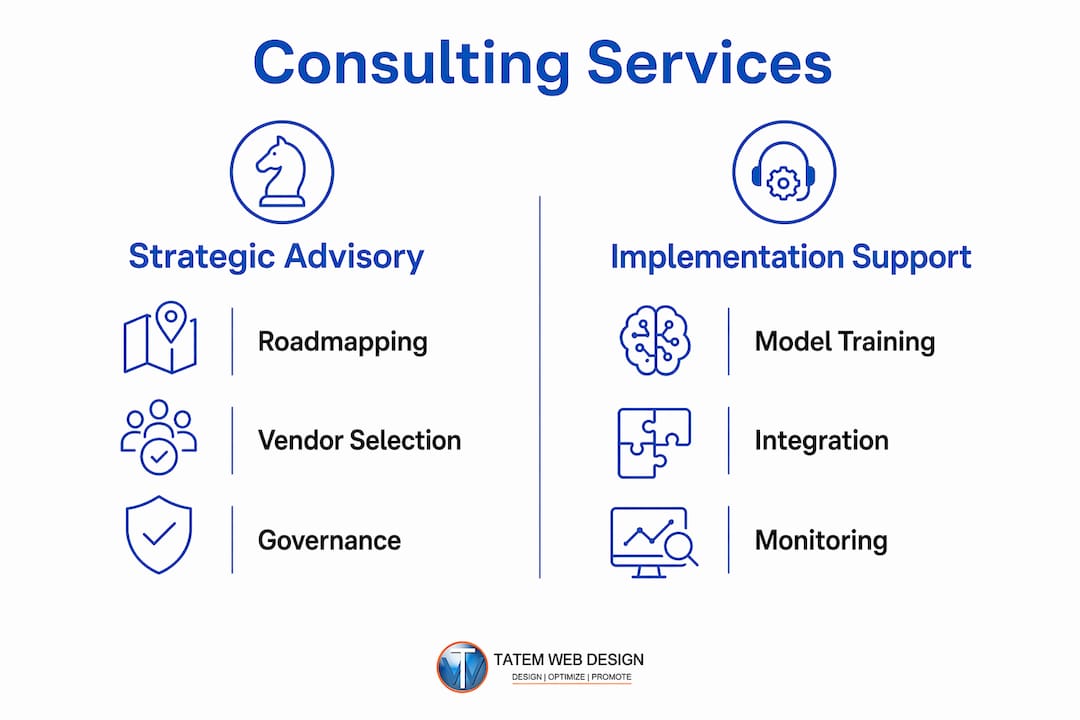
Most engagements fall into one of three categories. Strategic advisory focuses on roadmapping, vendor selection, and governance policy. Implementation consulting covers the technical build: data pipelines, model configuration, integration with existing systems, and testing. Decision consulting, a more specialized model, produces a single defensible recommendation for an executive-level AI decision within a defined timeframe. Each model serves a different stage of business maturity.

The strategic oversight component is what most business owners underestimate. Selecting the right AI tool is only 20% of the work. The remaining 80% involves change management, staff training, compliance alignment, and ongoing performance monitoring. A qualified machine learning consultant handles all of it, not just the technology layer.
Pro Tip: Ask any prospective AI consultant to describe a project where their recommendation was to not implement AI. If they cannot answer that question, they are selling technology, not strategy.
What types of AI consulting services fit different business needs?
Understanding the service spectrum helps you match the engagement model to your actual situation rather than paying for more than you need.
- Strategic advisory: Typically runs four to twelve weeks. The consultant audits your current operations, identifies AI opportunities, and delivers a prioritized roadmap. This is the right starting point if you have not yet deployed any AI tools.
- Decision consulting: Defined by AI decision consultant practitioners as brief, focused engagements of two to six weeks that produce a single, defensible recommendation for a specific executive decision. Think “should we build or buy a customer service AI?” rather than a broad transformation plan.
- Implementation consulting: The consultant manages the technical build from data preparation through deployment. Engagements typically run three to nine months depending on complexity.
- Fractional Chief AI Officer (CAIO): A part-time AI strategy expert embedded in your leadership team on a retainer basis. This model suits SMEs that need ongoing AI governance without the cost of a full-time hire.
- Retainer and monitoring support: Ongoing advisory after deployment to manage model drift, compliance updates, and performance optimization.
Choosing the right model depends on two factors: where you are in your AI journey and what decision you need to make next. A healthcare practice in Stuart, Florida, evaluating AI-assisted patient intake needs a different engagement than a marine equipment retailer building a product recommendation engine.
Pro Tip: Before signing any consulting contract, define the deliverable in writing. “AI strategy” is not a deliverable. “A prioritized 90-day AI implementation roadmap with vendor shortlist and cost estimates” is.
How does the NIST AI Risk Management Framework guide SMEs?
The NIST AI Risk Management Framework (AI RMF 1.0), published in January 2023, is the most practical governance tool available to SMEs deploying AI. It is voluntary, technology-agnostic, and sector-neutral, which means it applies equally to a Florida law firm using contract review AI and a dental practice using diagnostic imaging tools.
The framework organizes AI risk management into four functions:
| Function | Core Purpose | SME Application |
|---|---|---|
| Govern | Establish accountability, policies, and culture | Assign an AI owner; document acceptable use policies |
| Map | Identify AI risks and context | Catalog all AI tools in use; assess data sensitivity |
| Measure | Assess and analyze risks quantitatively | Set performance benchmarks; track model accuracy over time |
| Manage | Respond to and mitigate identified risks | Create incident response plans; define rollback procedures |
Governance must come first. Without clear accountability structures and documented policies, the mapping, measurement, and management activities have no anchor. SMEs that skip governance and jump straight to deployment consistently face compliance gaps and operational failures when something goes wrong.
The NIST AI RMF also aligns with ISO 42001 (AI management systems) and ISO 27001 (information security), which matters if your business serves government clients or operates in regulated industries. Applying the framework does not require a dedicated compliance team. A qualified AI strategy expert can implement the core governance layer in a matter of weeks using existing staff and documentation tools.
Pro Tip: Start with the Govern function by creating a one-page AI policy that defines who approves new AI tools, what data they can access, and who is responsible when something goes wrong. This single document prevents the majority of SME AI governance failures.
What should SMEs consider when evaluating AI vendors?
Vendor selection is where most SMEs make their most expensive mistakes. A polished demo and a favorable pricing sheet are not due diligence. A structured evaluation process protects you from operational failures, data breaches, and compliance liability.
A practical vendor assessment follows this sequence:
- Define your requirements first. Document the specific business problem, data types involved, integration requirements, and compliance obligations before contacting any vendor.
- Apply a structured rubric. A 30-question due diligence checklist covering security posture, data handling, legal terms, and compliance evidence takes approximately 45 to 90 minutes per medium-risk tool. Use pass/fail scoring to eliminate non-compliant vendors quickly.
- Request compliance evidence. SOC 2 Type II reports, penetration test results, and data processing agreements are the minimum acceptable evidence for any AI tool handling customer or employee data.
- Check operational reliability. Review uptime SLAs, incident history, and support response times. An AI tool that goes offline during business hours costs you more than its subscription fee.
- Evaluate exit terms. Confirm you can export your data in a standard format and terminate the contract without punitive fees. Vendor lock-in is a real operational risk.
The goal is to shortlist three to five vendors that meet your baseline requirements, then evaluate them on fit and cost. Treating vendor evaluation as a procurement risk rather than a purchasing formality is the mindset shift that separates well-governed AI deployments from expensive mistakes.
A comparison of two common evaluation approaches illustrates the difference in outcomes:
| Approach | Time Investment | Risk Level | Outcome |
|---|---|---|---|
| Demo-based selection | 2 to 4 hours | High | Frequent compliance gaps and integration failures |
| Structured rubric evaluation | 45 to 90 minutes per vendor | Low | Defensible selection with documented evidence |
The structured approach actually takes less total time when you factor in the cost of reversing a poor vendor decision.
What compliance obligations do SMEs carry when deploying AI?
Regulatory compliance is not something you can delegate entirely to your AI vendor. The EU AI Act, which mandates compliance for high-risk AI systems starting August 2, 2026, applies to both providers and deployers. If your business uses AI tools that process employee data, make credit decisions, or influence access to services, you may carry direct compliance obligations regardless of where the vendor is headquartered.
The key obligations SMEs need to understand:
- Role identification: Your business may function as a provider, a deployer, or both depending on the AI system. Overlapping roles across different AI tools make compliance complex but manageable through structured inventory.
- Fundamental Rights Impact Assessments (FRIAs): Required for deployers of certain high-risk AI systems before deployment. This is not optional, and vendor compliance certifications do not substitute for your own assessment.
- Recordkeeping and incident reporting: Deployers must maintain logs of AI system use and report significant incidents to relevant authorities within defined timeframes.
- Human oversight requirements: High-risk AI systems must have a human in the loop who can intervene, override, or shut down the system. Automating this away is a compliance violation, not an efficiency gain.
- Vendor compliance claims are not your compliance. Buying third-party AI tools does not transfer your legal obligations to the vendor. You remain responsible for oversight, monitoring, and recordkeeping.
For SMEs operating in the U.S. without direct EU market exposure, the EU AI Act still matters as a governance benchmark. Many U.S. state-level AI regulations are modeled on similar risk-tiered frameworks. Building compliance habits now positions your business ahead of domestic regulatory changes that are already in progress.
How can SMEs successfully operationalize AI projects?
The gap between a working AI prototype and a governed production system is where most SME AI projects fail. Underestimating monitoring needs is the most common cause. A model that performs well in testing can degrade significantly in production as data patterns shift, user behavior changes, or upstream data sources are modified.
Successful operationalization requires attention to several areas that often get deprioritized during the excitement of a successful pilot:
- Production monitoring: Define what “good performance” looks like before you go live. Set thresholds for accuracy, latency, and error rates that trigger human review.
- Incident response and rollback: Document the steps to disable or revert an AI system if it produces harmful or inaccurate outputs. This plan should exist before deployment, not after an incident.
- IT and business alignment: The team that built the model and the team that uses it must agree on success metrics, escalation paths, and maintenance responsibilities.
- Change management and training: Staff who interact with AI outputs need training on when to trust the system and when to override it. This is especially true in healthcare, legal, and financial services contexts.
- Scalability planning: An AI tool that works for 50 customer interactions per day may require significant infrastructure changes to handle 5,000. Address this before you need it.
An experienced AI integration consultant adds the most value at this stage. The technical build is often the easy part. Governing the system, training the team, and maintaining performance over time requires sustained expertise that most SMEs do not have in-house.
Pro Tip: Treat the NIST AI RMF’s Map and Measure functions as your production readiness checklist. If you cannot answer “what risks does this system carry?” and “how will we know if it stops working correctly?” you are not ready to deploy.
Key takeaways
Effective AI consulting for SMEs requires matching the right engagement model to your business stage, governing AI risk with structured frameworks, and maintaining compliance obligations that vendors cannot carry for you.
| Point | Details |
|---|---|
| Match the engagement model | Choose advisory, decision, implementation, or fractional CAIO based on your current AI maturity. |
| Govern before you deploy | Establish accountability policies using the NIST AI RMF Govern function before any AI tool goes live. |
| Vendor claims are not compliance | Conduct structured due diligence with SOC 2 evidence and pass/fail rubrics; your obligations remain yours. |
| Monitor production systems | Define performance thresholds and incident response plans before deployment, not after problems appear. |
| EU AI Act applies broadly | High-risk AI deployers carry direct compliance obligations starting August 2026, regardless of vendor location. |
What I have learned from watching SMEs hire AI consultants
The single biggest mistake I see SMEs make when hiring an AI consultant is selecting someone based on familiarity with a specific platform rather than depth of AI experience. A consultant who only knows how to configure ChatGPT plugins or build basic OpenAI API wrappers is a product specialist, not a strategic advisor. The distinction matters enormously when your business needs a solution that actually fits your data, your workflows, and your compliance environment.
The technology-agnostic approach is the clearest signal of a credible consultant. If the first recommendation you receive is a specific vendor before anyone has audited your operations, that is a red flag. Real AI strategy expertise starts with understanding your business problem and works backward to the technology. Vendor-neutral consultants have no incentive to recommend the wrong tool.
I have also watched SMEs get burned by the prototype trap. A consultant delivers a polished demo that impresses the leadership team, collects the project fee, and disappears. Six months later, the prototype is sitting unused because no one planned for integration, monitoring, or staff training. The measure of a good AI engagement is not whether the demo worked. It is whether the system is running in production, improving over time, and being used by the people it was built for.
The best AI consulting relationships I have seen share one characteristic: the consultant treats measurable business outcomes as the only valid success metric. Not model accuracy in isolation. Not the number of features delivered. Revenue impact, time saved, error rates reduced, customer satisfaction improved. If your consultant cannot connect their work to those numbers, you are paying for activity, not results.
— Matt
Ready to explore AI consulting for your Florida business?
If you are a business owner in Florida evaluating AI solutions for the first time or looking to scale what you have already started, Tatemweb brings over 26 years of digital expertise to every engagement. From AI website design to AI agent implementation using tools like NemoClaw and Perplexity Computer, the team at Tatem Web Design builds solutions that are secure, SEO-optimized, and built for your specific industry.
Tatemweb serves real estate professionals, healthcare providers, legal firms, marine businesses, and dozens of other sectors across Stuart and the broader Florida market. Whether you need AI chatbots, AI-powered lead capture, or a full AI business integration strategy, the team is ready to help you move from idea to production. Call Tatem Web Design directly at 772-224-8118 to schedule your consultation.
FAQ
What is an AI consultant?
An AI consultant is an external expert who advises businesses on AI strategy, vendor selection, risk management, and implementation. Engagements range from brief decision-focused advisory to full end-to-end model deployment.
How much does AI consulting cost for a small business?
Costs vary by engagement type. Decision consulting engagements typically run two to six weeks at project rates, while fractional Chief AI Officer retainers are priced monthly. Implementation projects are scoped individually based on complexity and duration.
Do SMEs need to comply with the EU AI Act?
If your business deploys AI tools that qualify as high-risk under the EU AI Act, compliance obligations apply starting August 2, 2026, regardless of your location. Deployers retain direct responsibilities for oversight, recordkeeping, and incident reporting even when using third-party AI tools.
What is the NIST AI RMF and why does it matter for SMEs?
The NIST AI Risk Management Framework (AI RMF 1.0) is a voluntary, sector-agnostic framework that organizes AI governance into four functions: Govern, Map, Measure, and Manage. SMEs use it to build structured, auditable AI governance without requiring a dedicated compliance team.
How do I know if an AI consultant is qualified?
Look for demonstrated experience across multiple industries and AI technologies, a technology-agnostic approach to vendor selection, and the ability to connect AI recommendations to specific business outcomes. Ask for case studies where the consultant recommended against an AI solution.
Recommended
Tatem Web Design
26+ YearsWeb Design & SEO Specialist · Tatem Web Design
Matt Tatem has been designing websites professionally since 1999, making Tatem Web Design one of Florida's longest-running web agencies. Based in Stuart, FL, he specializes in WordPress, local SEO, Shopify e-commerce, and cybersecurity consulting for small businesses.

Rank in ChatGPT in 90 Days With a Practitioner Led Checklist
Follow a practitioner led 90 day plan to get cited by ChatGPT: allow OAI-SearchBot, publish short answer capsules with schema, and track Bing AI Performance.

AI SEO Content Playbook: 16 GEO Signals for Agencies & Teams
A practical playbook mapping the GEO-16 signals to hands-on editorial workflows, review controls, and metrics. For agencies and in-house teams scaling AI...

Copy Ready Local Schema Markup for SMBs + Google Validation
Copy ready JSON-LD examples and Google validation steps for SMBs' local schema markup. Audit, implement, and verify each location page with confidence.