
What Is a Website Audit? Your 2026 Business Guide

A website audit is a systematic health check of your site’s technical SEO, content quality, user experience, and security to identify every issue costing you traffic and conversions. Think of it as a full physical exam for your business’s most important digital asset. The audit process covers everything from broken links and slow load times to keyword gaps and security vulnerabilities. Tools like Google Search Console, SEMrush, and HubSpot Website Grader make this process measurable and repeatable. HubSpot recommends running a full audit at least every six months to stay competitive in your market.
What is a website audit and what does it cover?
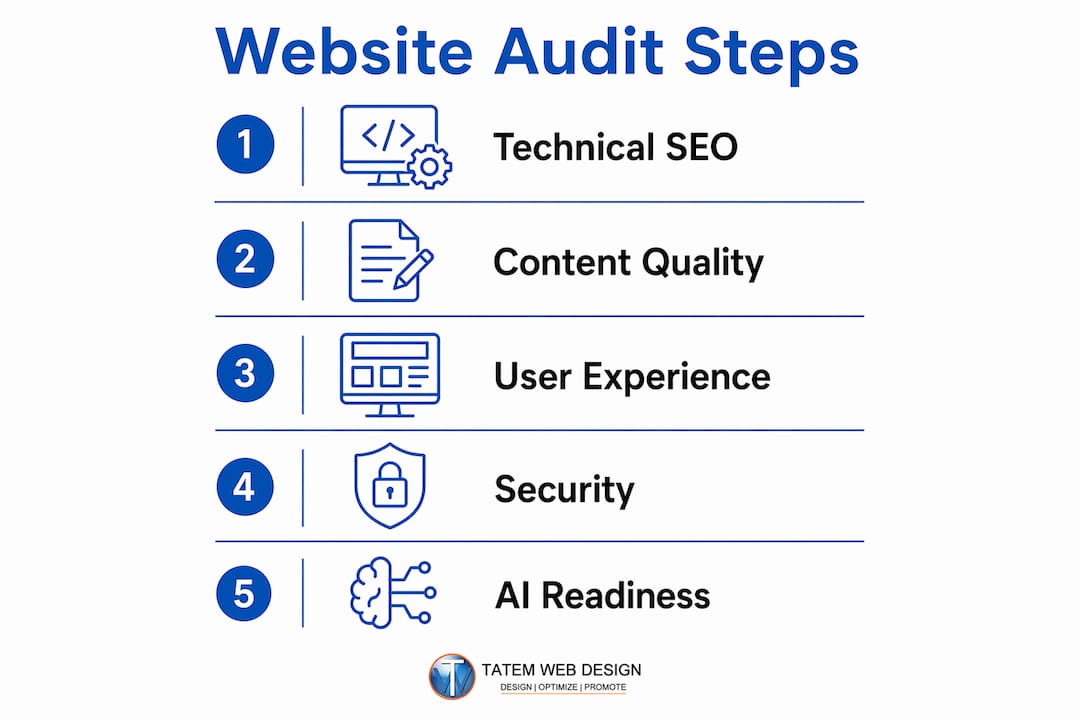
A website audit is a structured review of your site across five core dimensions: technical SEO, content quality, user experience (UX), security, and AI readiness. Each dimension affects how well your site performs in search results and how confidently visitors engage with it. Skipping even one area leaves blind spots that quietly drain your leads and revenue.
The technical SEO layer checks whether search engines can crawl and index your pages correctly. This includes reviewing your sitemap, robots.txt file, redirect chains, duplicate content, and page speed. Google Search Console surfaces crawl errors and indexing problems that are invisible to the naked eye.

Content quality evaluation goes beyond checking for typos. It asks whether each page answers a real user question, uses relevant keywords naturally, and earns the trust of both readers and search engines. A page that ranks, but fails to convert, is just as much a problem as a page that never ranks at all.
The security and UX layers are often underestimated. A site with an expired SSL certificate or confusing navigation loses visitor trust within seconds. Modern audits now ask whether AI systems, search engines, and human visitors can all interpret and trust your site fast enough to act on it. That shift from simple crawlability to trust signals is what separates a 2026 audit from the checklist-style audits of five years ago.
What does the 2026 website audit process involve?
The current audit process runs 9–12 defined steps, and the scope varies by site size. Small sites under 100 pages can be completed in a single session, while larger sites require a phased approach spread across days or weeks. Here is how a standard audit unfolds:
- Define scope and goals. Decide whether you are auditing the full site or a specific section. Align the audit goals with your business objectives, such as increasing leads, improving rankings, or reducing bounce rates.
- Gather baseline data. Pull traffic reports from Google Analytics, crawl the site with SEMrush or SE Ranking, and export performance data from Google Search Console. The initial phase is purely data collection. Analysis comes later once you have the full picture.
- Run technical SEO checks. Review crawlability, indexability, site speed, Core Web Vitals scores, mobile responsiveness, and internal linking structure.
- Assess content quality. Identify thin pages, duplicate content, missing meta descriptions, and keyword cannibalization. Flag pages that rank but convert poorly.
- Check AI readiness. Verify that JavaScript renders correctly, structured data (schema markup) is in place, and content is written in a way that AI-powered search engines can interpret and surface. This dimension is now critical for visibility in AI-driven search results.
- Evaluate UX and navigation. Test page layouts on mobile and desktop, review call-to-action placement, and check for user experience friction points that push visitors away before they convert.
- Review security. Confirm SSL certificates are valid, check for outdated plugins or CMS versions, and scan for known vulnerabilities.
- Build a prioritized action plan. Organize findings into a 30-60-90 day roadmap. Fix critical technical errors first, then content gaps, then longer-term UX improvements.
Pro Tip: Run your Core Web Vitals check in Google Search Console before touching any other tool. Core Web Vitals failures are Google’s most direct signal that your site is underperforming, and fixing them often produces the fastest ranking gains.
| Audit phase | Primary tool | What it reveals |
|---|---|---|
| Technical SEO crawl | SEMrush, SE Ranking | Broken links, redirect errors, duplicate pages |
| Performance check | Google Search Console | Core Web Vitals, indexing issues, mobile usability |
| Content analysis | HubSpot Website Grader | Thin content, missing metadata, keyword gaps |
| Security scan | SSL checker, CMS audit | Expired certificates, outdated plugins, vulnerabilities |
| AI readiness review | Structured data validator | Schema errors, JavaScript rendering failures |
How does a website audit differ from an SEO audit?
A website audit is broader than an SEO audit. An SEO audit focuses specifically on ranking factors: keyword usage, backlink profile, on-page optimization, and search visibility. A full website audit includes all of that plus UX, content strategy, security, accessibility, and AI readiness. Combining both approaches produces the most complete picture of your site’s health.
Here is how the two audits compare side by side:
| Focus area | Website audit | SEO audit |
|---|---|---|
| Technical health | Yes (full scope) | Yes (crawl and index only) |
| Content quality | Yes | Partially |
| User experience | Yes | No |
| Security | Yes | No |
| Backlinks and rankings | Partially | Yes (full scope) |
| AI readiness | Yes | Rarely |
| Accessibility | Yes | No |
The practical difference matters for business owners. If your site ranks well but visitors leave without buying, an SEO audit alone will not find the problem. The UX and content layers of a full website audit will. Conversely, if your traffic has dropped sharply, the SEO audit’s backlink and ranking analysis will pinpoint the cause faster.
The key insight is that neither audit replaces the other. Running both in sequence, starting with the full website audit and following up with a deep SEO audit, gives you the data to fix what is broken and build on what is working. For service businesses in Florida, this combination is especially valuable because local search visibility and client trust both depend on getting every layer right.
Why is website audit important for your business?
Regular audits support data-driven decisions and prevent the slow, invisible losses that come from broken links, slow load times, and security gaps. Most business owners treat their website as a static brochure. An audit treats it as a performance tool and measures it accordingly.
The benefits of a website audit fall into four clear categories:
- Organic traffic recovery. Crawl errors, duplicate content, and poor Core Web Vitals scores all suppress rankings. Fixing them restores traffic you are already losing without knowing it.
- Conversion rate improvement. Audits surface UX problems like confusing navigation, slow checkout flows, and missing calls to action. Each fix directly increases the percentage of visitors who become leads or customers.
- Security and compliance. An outdated WordPress plugin or an expired SSL certificate can expose your business to data breaches. Audits catch these before they become expensive incidents. Tatemweb’s AI website security services address exactly these vulnerabilities.
- Competitive intelligence. Auditing your site alongside your competitors’ keyword gaps and backlink profiles shows you exactly where to invest next.
Audit frequency matters as much as audit quality. HubSpot’s guidance is clear: every six months is the minimum for businesses in competitive markets. Florida businesses in healthcare, legal, and real estate face especially fast-moving search environments where a six-month gap can mean significant ranking losses. Pairing your audit schedule with a website maintenance plan keeps your site performing between full audits.
Pro Tip: Set a calendar reminder for your next audit the day you finish the current one. Businesses that schedule audits in advance are far more consistent than those who audit reactively after a traffic drop.
How to conduct a website audit: practical steps for business owners
The audit process starts with data, not fixes. Having accurate, comprehensive data is the foundation for every confident improvement you make afterward. Jumping to fixes before completing data collection is the most common mistake business owners make.
Follow these steps to run a practical, results-focused audit:
- Set up your tools. Connect Google Search Console and Google Analytics to your site if you have not already. Both are free and provide the baseline performance data every audit needs.
- Run a full site crawl. Use SEMrush or SE Ranking to crawl your site and export a list of all pages, errors, and warnings. This gives you the raw inventory of everything that needs attention.
- Score your site with HubSpot Website Grader. This free tool gives you an overall performance score and flags specific issues in performance, SEO, mobile responsiveness, and security. It is a fast way to identify your highest-priority problems.
- Analyze your content. Review your top 20 pages by traffic. Ask whether each page has a clear purpose, a target keyword, a compelling headline, and a visible call to action. Pages that rank but convert below your site average need a content refresh.
- Check your SEO optimization steps. Confirm that title tags, meta descriptions, header tags, and image alt text are complete and accurate across all key pages.
- Prioritize your findings. Sort issues into three buckets: critical (fix within 30 days), important (fix within 60 days), and planned improvements (fix within 90 days). Critical issues include crawl errors, security vulnerabilities, and Core Web Vitals failures.
- Document and track. Record every finding in a shared spreadsheet with a status column. This turns your audit into an ongoing performance record rather than a one-time snapshot.
Pro Tip: Do not try to fix everything at once. Businesses that address their top five critical issues first consistently see faster ranking improvements than those who spread effort across dozens of minor fixes simultaneously.
The benefits of website optimization compound over time. Each audit cycle builds on the last, and the data you collect becomes more valuable as your baseline improves.
Key Takeaways
A website audit is the most direct way to identify what is costing your business traffic, leads, and revenue, and it requires covering technical SEO, content quality, UX, security, and AI readiness together to produce results.
| Point | Details |
|---|---|
| Audit every six months | HubSpot recommends biannual audits to stay competitive in fast-moving markets. |
| Start with data, not fixes | Collect all crawl and analytics data before making any changes to your site. |
| Website audit vs. SEO audit | A full website audit covers UX, security, and AI readiness that an SEO audit misses. |
| AI readiness is now required | Structured data and JavaScript rendering checks are critical for AI-powered search visibility. |
| Prioritize with a 30-60-90 plan | Sort findings into critical, important, and planned buckets to fix the highest-impact issues first. |
Why I think most business owners are auditing the wrong thing
After working with Florida businesses across healthcare, legal, real estate, and marine industries, I have seen the same pattern repeat: the business owner runs a quick SEO check, fixes a few meta descriptions, and calls it done. That approach misses the point entirely.
The audits that actually move the needle are the ones that ask harder questions. Can an AI-powered search engine interpret your content well enough to surface it in a featured answer? Does your site load fast enough on a mobile connection in a parking lot? Does a first-time visitor understand what you do and what to do next within five seconds? These are trust questions, not just technical questions.
The shift I have seen in 2026 is that technical SEO, AI readiness, and UX are no longer separate conversations. They are one conversation. A site that passes a crawl check but fails on structured data and confusing navigation is still losing business every day.
The other mistake I see constantly is treating the audit as a one-time project. The businesses that grow consistently are the ones that audit on a schedule, track their findings over time, and treat each audit cycle as a feedback loop. Your site is not a finished product. It is a living system, and the audit is how you keep it healthy.
If you are a business owner who has never run a full audit, start with Google Search Console and HubSpot Website Grader today. You will find problems you did not know existed, and fixing them will produce results faster than almost any other marketing investment you can make.
— Matt
Tatemweb’s AI-powered website audit and design services
Your audit findings are only as valuable as the action you take on them. Tatemweb has spent over 26 years helping Florida businesses in healthcare, legal, real estate, and professional services turn audit results into measurable performance gains.
Tatemweb’s AI website design services are built to address exactly what audits uncover: slow load times, weak content structure, security gaps, and poor AI readiness. The team builds sites that search engines, AI systems, and real visitors can all trust and act on. For businesses ready to go further, Tatemweb’s full AI services package covers local SEO, AI chatbots, lead capture, and cybersecurity in one integrated solution. Call Tatemweb directly at 772-224-8118 to schedule a consultation and find out exactly what your site is costing you right now.
FAQ
What is a website audit in simple terms?
A website audit is a full review of your site’s technical health, content, user experience, and security to find problems that reduce traffic and conversions. It gives you a prioritized list of fixes to improve site performance.
How often should I conduct a website audit?
HubSpot recommends conducting a website audit at least every six months. Businesses in competitive markets like healthcare, legal, or real estate may benefit from quarterly reviews.
What tools do I need for a website SEO audit?
Google Search Console, SEMrush, HubSpot Website Grader, and SE Ranking cover the core technical and content diagnostics needed for a thorough audit. All four tools provide crawlability, performance, and content insights.
What is the difference between a website audit and an SEO audit?
A website audit covers technical SEO, UX, content, security, and AI readiness. An SEO audit focuses specifically on keyword rankings, backlinks, and search visibility. Combining both produces the most complete picture of your site’s health.
How long does a website audit take?
Small sites under 100 pages can be audited in a single session. Larger sites require a phased approach that may take several days to complete thoroughly.
Recommended
Tatem Web Design
26+ YearsWeb Design & SEO Specialist · Tatem Web Design
Matt Tatem has been designing websites professionally since 1999, making Tatem Web Design one of Florida's longest-running web agencies. Based in Stuart, FL, he specializes in WordPress, local SEO, Shopify e-commerce, and cybersecurity consulting for small businesses.
What a CMMC Level 2 Assessment Requires and How to Prepare
Prepare for your CMMC Level 2 assessment by understanding requirements, assessment paths, and mapping your Controlled Unclassified Information.

A Data Retention Policy Is Your Rulebook for Keeping and Deleting Data
Establishing a clear data retention policy helps manage data risk, ensuring compliance and effective data management for your organization.

Law Firm Local SEO: A Practical Playbook for More Local Clients
Unlock more local clients for your law firm with effective local SEO strategies. Optimize your Google Business Profile and boost your visibility!